Game Studies reports and market data
Documents


One Simulated Hand, Two Real Hands: Antisimulation and Phenomenological Correspondence in Videogame Control Schemes
This analysis establishes a framework for evaluating videogame control schemes through the lens of phenomenological correspondence, which measures the relationship between the complexity of a simulated action and the physical input required by the player.
- Control schemes can be categorized into three models based on phenomenological correspondence: reductionist, completionist, and antisimulation.
- Antisimulation games like QWOP, Surgeon Simulator 2013, and Octodad: Dadliest Catch intentionally design controls to be more complex than the simulated task to disrupt player agency.
- Reductionist correspondence, seen in titles like Call of Duty 4 and Canabalt, simplifies complex real-world actions into intuitive, singular inputs to prioritize player empowerment.

Parasocial and Social Player-Avatar Relationships: Social Others in Thomas Was Alone
The relationship between players and their digital avatars has evolved beyond traditional parasocial models, shifting toward a framework where avatars function as social others.
- The Banks-Bowman social categorization system (2014) provides a framework for analyzing player-avatar relationships beyond traditional parasocial models, identifying four distinct dynamics: avatar-as-object, avatar-as-me, avatar-as-symbiote, and avatar-as-social-other.
- The 'avatar-as-social-other' relationship occurs when players perceive a playable character as having independent agency, often leading to increased emotional investment and a sense of responsibility for the character's well-being.
- In the game 'Thomas Was Alone' (2012), the developer uses narrative voiceovers and character-specific traits to successfully frame simple geometric shapes as sentient entities, effectively pushing players away from an 'avatar-as-object' perspective.
Reconstructing Warrior: Vectorbeams, Natural Magick & Business Intrigue
The 1979 arcade title Warrior represents a pivotal, albeit ephemeral, moment in the evolution of electronic entertainment, serving as a bridge between traditional electromechanical amusements and the burgeoning digital arcade industry.
- The 1979 arcade game Warrior utilized a hybrid design, layering Cinematronics vector-beam digital sprites over a physical Pepper’s Ghost optical illusion to bypass the graphical limitations of oscilloscope-based hardware.
- The game’s commercial failure was driven by its unconventional two-player-only requirement, which alienated audiences accustomed to single-player arcade experiences.
- Industry volatility, specifically the acquisition of the developer Vectorbeam by Exidy and subsequent manufacturing consolidation, severely limited the game's market penetration.

Space Odyssey: The Long Journey of Spacewar! from MIT to Computer Labs Around the World
The historical narrative surrounding the proliferation of Spacewar! during the 1960s often overstates its initial ubiquity.
- Spacewar! did not achieve rapid, widespread adoption in the 1960s, as its distribution was initially limited by the high cost of computing hardware and restricted access to research facilities.
- The game's expansion only gained significant momentum after 1967, driven by the increased availability of cathode-ray tube displays and the growth of interactive computing communities.
- Spacewar! served as a foundational influence for the commercial arcade industry, directly inspiring subsequent titles such as Galaxy Game and Computer Space.

Return in Play: The Emergence of Retrogaming in Finnish Computer Hobbyist and Game Magazines
Retrogaming in Finland evolved from a practical necessity for software compatibility into a formalized cultural movement that defines how digital history is preserved and consumed.
- Retrogaming in Finland transitioned from a practical necessity for maintaining software compatibility on aging hardware into a formalized cultural movement focused on the canonization of digital artifacts.
- The late 1990s served as a critical inflection point for the movement, driven by the proliferation of internet communities and the adoption of emulation technologies like MAME.
- Finnish computer hobbyist magazines acted as the primary architects of gaming heritage by publishing nostalgic columns and personal recollections that codified a shared history for the player base.
Rewriting History: Keynote Address to the 2014 Game History Annual Symposium
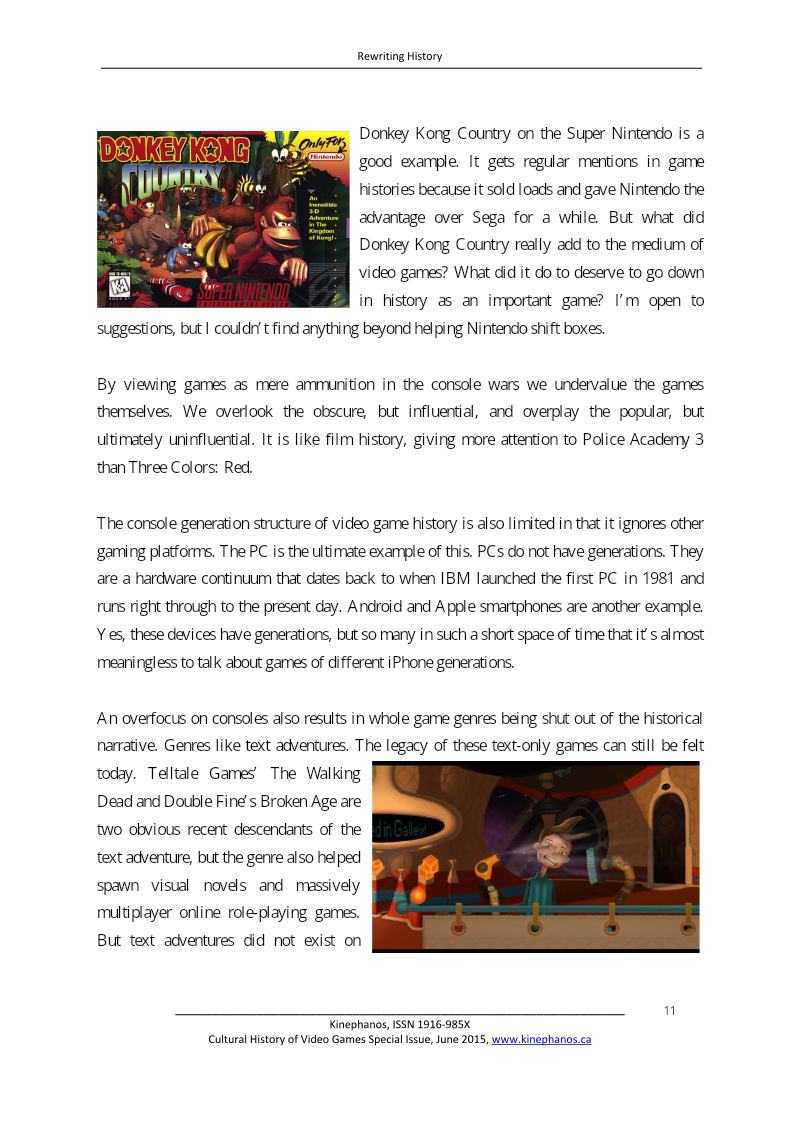
Video game historiography requires a fundamental shift away from the traditional, linear focus on American console hardware and marketing-driven milestones.
- Video game historiography must shift from a narrow, hardware-centric focus on American consoles to a broader, multifaceted cultural narrative that accounts for global design trends and societal influences.
- The industry must prioritize the immediate collection of oral histories from pioneers to preserve firsthand accounts before these primary sources are permanently lost.
- Methodological rigor requires synthesizing thousands of individual game titles with qualitative oral histories to move beyond simple sales figures and technical specifications.

Well Played: A Journal on Video Games, Values, and Meaning (2015)
This collection of academic essays examines the multifaceted nature of video games, focusing on how mechanics, narrative design, and business models intersect to shape player experience and cultural meaning.

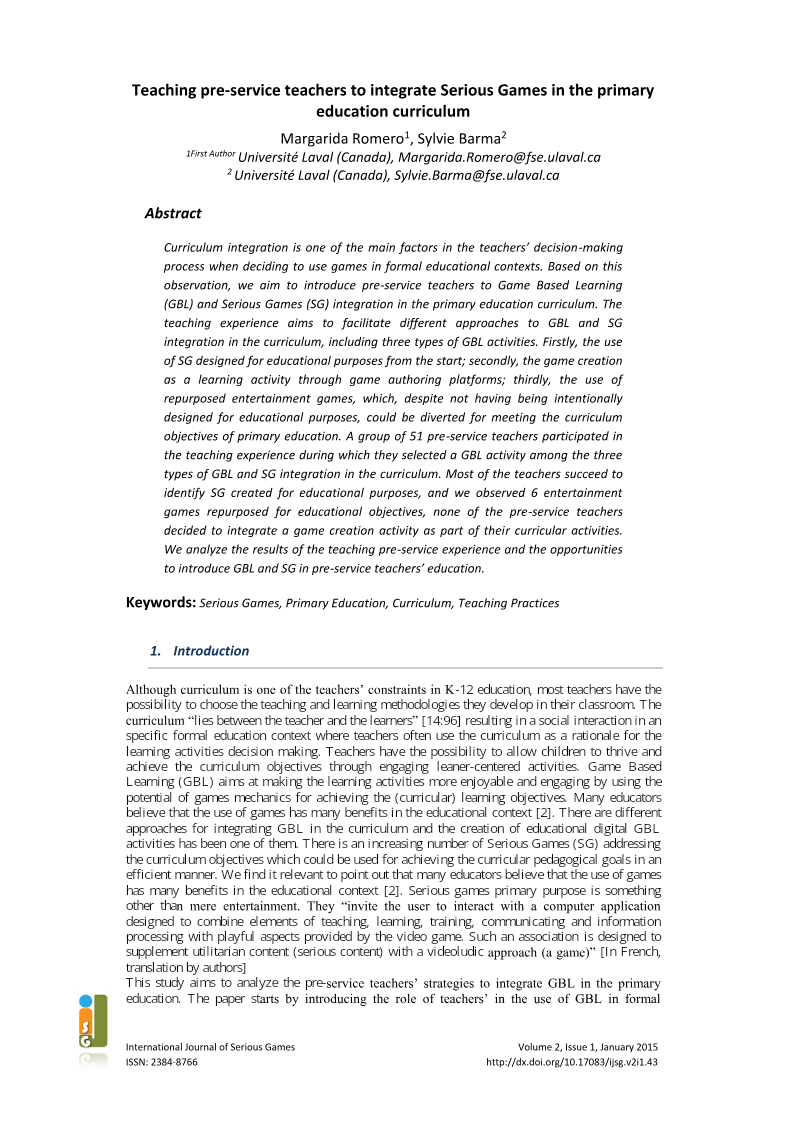
Teaching Pre-Service Teachers to Integrate Serious Games in the Primary Education Curriculum
Integrating serious games into primary education curricula serves as a vital pedagogical strategy for enhancing student engagement, particularly within mathematics, science, and history.
- Successful integration of serious games in primary education relies on teachers acting as facilitators in a community of learners rather than as developers of original content.
- A study of 51 pre-service teachers in Quebec confirms that technical proficiency and time constraints are the primary barriers to creating bespoke educational games.
- Educators prefer repurposing existing entertainment titles or utilizing established serious games over developing original software due to the high preparation time required.
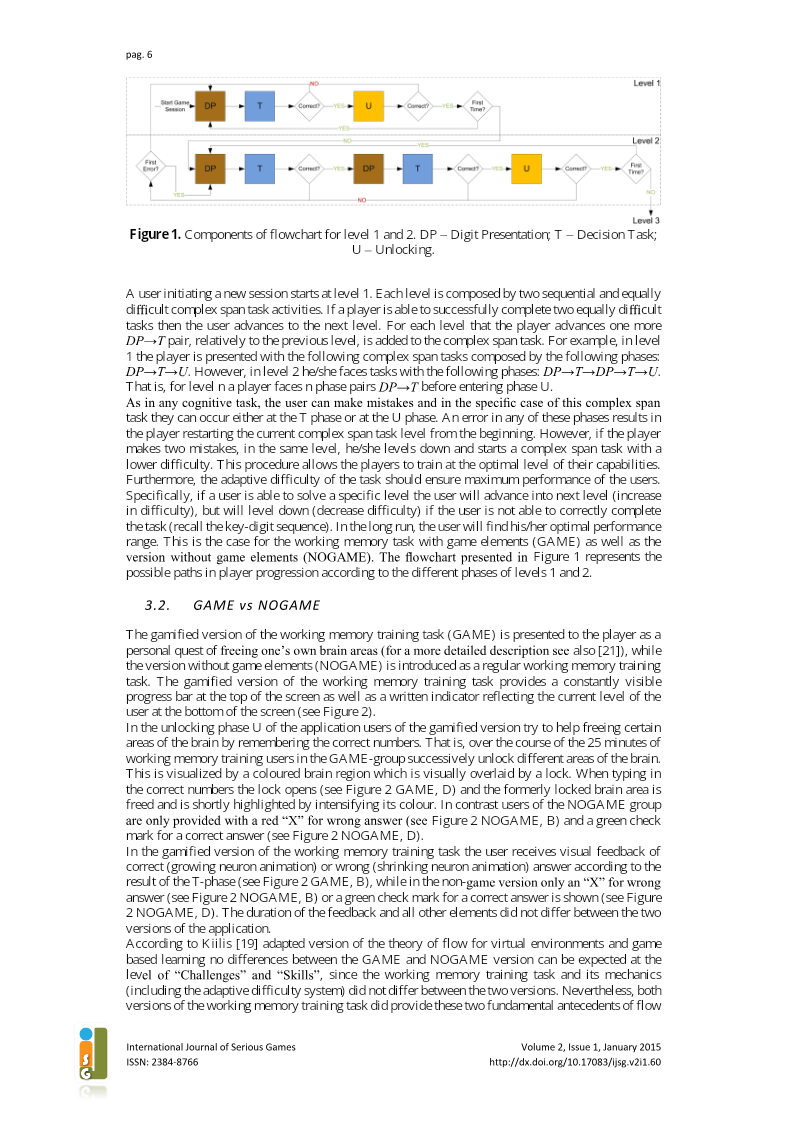

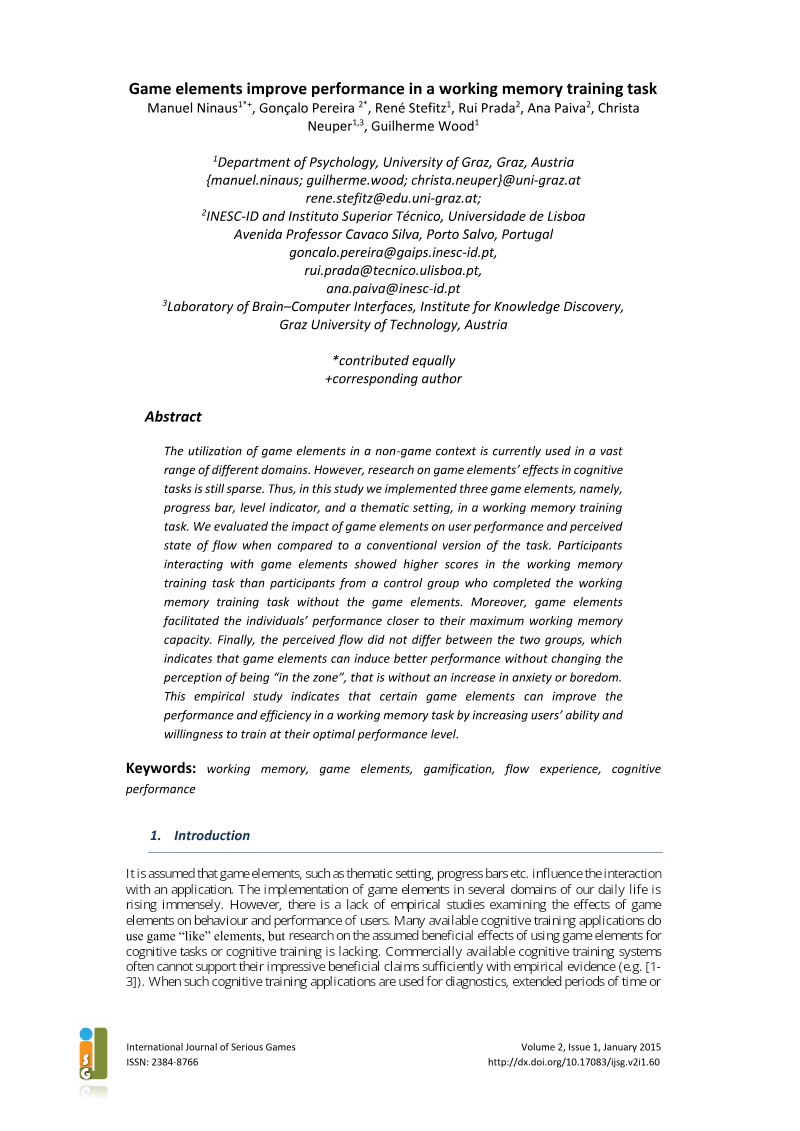
Game Elements Improve Performance in a Working Memory Training Task
Integrating game elements into cognitive training tasks significantly enhances user performance and operational efficiency.
- Gamification elements such as progress bars and level indicators significantly increase user performance and operational efficiency in working memory training tasks.
- The integration of game mechanics encourages participants to utilize their maximum working memory capacity more effectively than conventional, non-gamified training methods.
- Gamification acts as a performance catalyst for objective output without fundamentally altering a user’s maximum cognitive capacity.
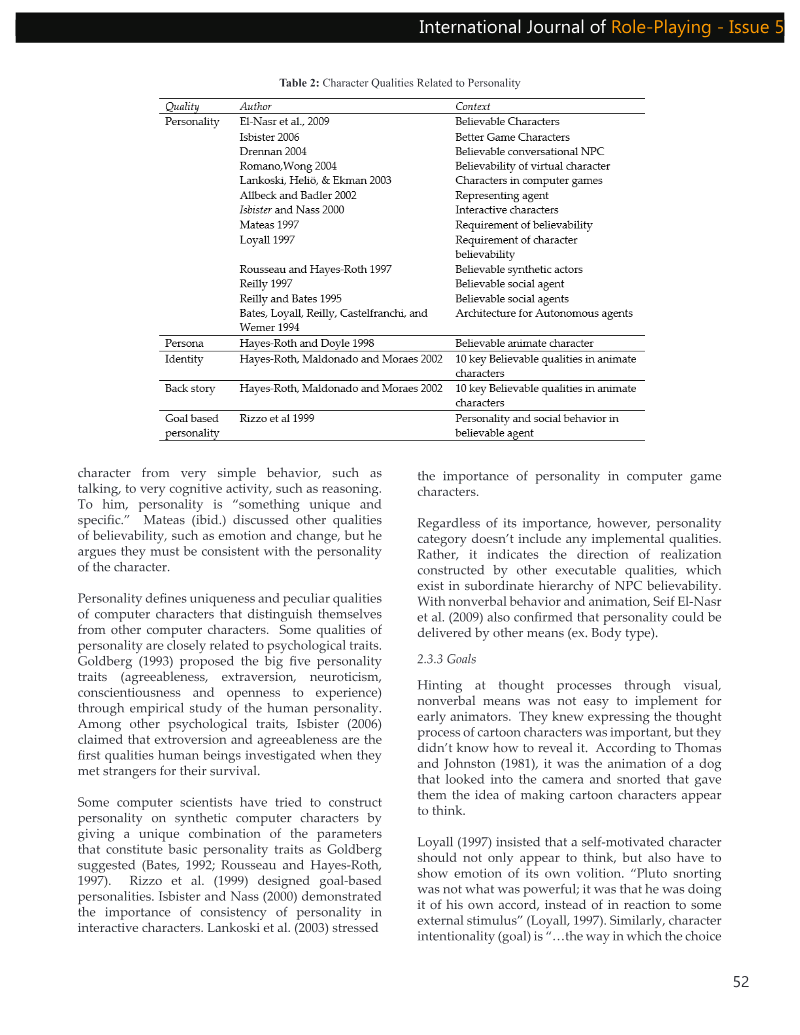
Cognitive Intervention and Reconciliation: NPC Believability in Single-Player RPGs
NPCs in single-player RPGs are often experienced as mechanical and limited, a shortfall that erodes player immersion and enjoyment.
- Believability in single-player RPG NPCs is treated as a cognitive gap between players' expectations and their actual experience, and the report synthesizes AI, communication, film theory, and game studies to build a working definition rather than adopting one discipline's framing.
- Five qualities (appearance, behavior, personality, goals, and emotion) must be displayed clearly and consistently to players rather than assumed, since they act as precursors that shape one another.
- Appearance more expressive than an NPC's internal models produces false impressions, a risk illustrated by the Eliza and Tale-Spin effects.
Ecological Approach to the Performance of Larping
Lampo's paper proposes an ecological framework for understanding the performance of live action role-playing games (larps), drawing on Gibson's ecological perception, Kershaw's theatre ecology, and Ingold's notion of knots and lines.
- Larp performance is framed as an ecology rather than a set of isolated acts: individual player actions interweave into an interdependent, improvised texture drawing on Gibson's ecological perception, Kershaw's theatre ecology, and Ingold's knots and lines.
- Because larps are unscripted and transient, they can only be partially captured through documentation, and Taylor's concept of scenarios is proposed as a way to grasp their structure.
- The core model describes player performance as four steps: information pickup, extraction of possibilities, choice-making, and embodiment.

The Effects of Using Academic Role-Playing in a Teacher Education Service-Learning Course
This study examines the effects of academic role-playing, using an adapted Shaftel model, in an undergraduate physical education and coaching service-learning course at a large urban university.
- Academic role-play using an adapted Shaftel model was tested in an undergraduate physical education and coaching service-learning course, comparing an intervention group of 52 students with a control group of 50.
- Role-play participants scored significantly higher on two of six course effectiveness items: the instructor asking students to discuss topics (p=.037) and students asking and responding to questions (p=.039).
- In focus group and questionnaire data, 22 of 24 pre-service teachers preferred role-play to lecture, two rated both equally, and none favored lecture; 21 participants reported feeling more engaged during role-play sessions.