Key insights
5 slides
Initial Reach
Spacewar! did not achieve rapid, widespread adoption in the 1960s.
The game's distribution was initially limited by the high cost of computing hardware. Access was also restricted to elite research facilities.
1 / 5
- 01Spacewar! did not achieve rapid, widespread adoption in the 1960s, as its distribution was initially limited by the high cost of computing hardware and restricted access to research facilities.See it on page 2
- 02The game's expansion only gained significant momentum after 1967, driven by the increased availability of cathode-ray tube displays and the growth of interactive computing communities.See it on page 17
- 03Spacewar! served as a foundational influence for the commercial arcade industry, directly inspiring subsequent titles such as Galaxy Game and Computer Space.See it on page 1
- 04The evolution of early computer games was characterized by localized innovations, such as the 'Minnesota Panic Button,' which developers created while porting the software between incompatible research platforms.See it on page 23
- 05The transition of Spacewar! from a niche MIT laboratory project to a cultural touchstone demonstrates that hardware accessibility and community-driven development were the primary drivers of the early digital gaming industry.See it on page 1
- 06Documenting the history of early software is challenging due to the labor-intensive nature of porting code and the incomplete historical record, requiring a synthesis of technical documentation and archival research.See it on page 19
Ask AI about this report
Summary
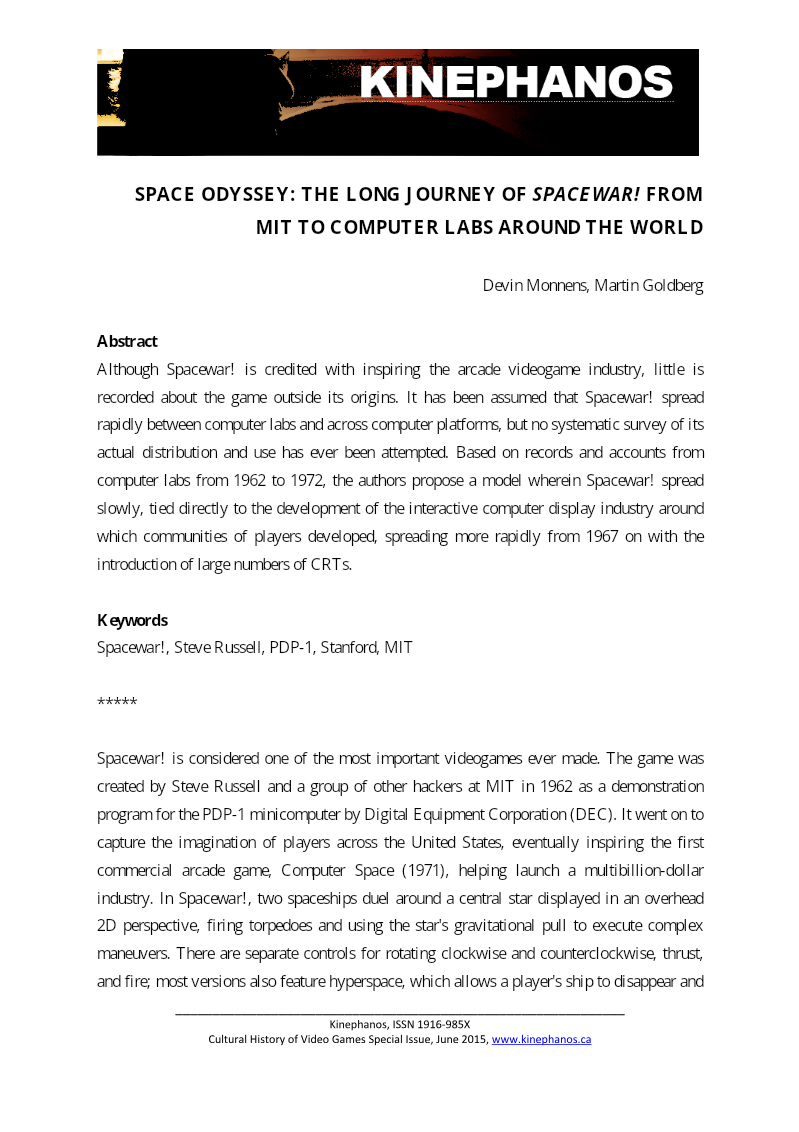
The historical narrative surrounding the proliferation of Spacewar! during the 1960s often overstates its initial ubiquity. In reality, the game’s distribution was constrained by the prohibitive costs of computing hardware and the restricted access inherent to elite research environments. Rather than a rapid, widespread adoption, the game experienced a slow, fragmented expansion that only gained momentum after 1967. This acceleration was primarily driven by the increased availability of cathode-ray tube displays and the emergence of nascent interactive computing communities that prioritized graphical capabilities.
Originating at MIT, Spacewar! functioned as both a technical demonstration and a recreational outlet for researchers across various academic institutions. As the software was ported to diverse systems, developers introduced localized innovations, such as the Minnesota Panic Button, which helped refine the user experience. These adaptations were pivotal in bridging the gap between niche laboratory experimentation and the eventual birth of the commercial arcade industry. Titles like Galaxy Game and Computer Space emerged directly from this lineage, cementing the game’s status as a foundational influence on modern public gaming culture.
The dissemination of this early software remains a complex subject due to the labor-intensive nature of porting code between incompatible research platforms. Because the historical record of this era is incomplete, understanding the evolution of early computer games requires a synthesis of technical documentation, personal interviews, and archival research. Ultimately, the transition of Spacewar! from a localized project to a cultural touchstone highlights the critical role of hardware accessibility and community-driven development in the formative years of the digital gaming industry.