1 free read left. Create a free account for unlimited reading + AI research.
Create free accountWhitepaper International Journal of Serious Games
1 free read left. Create a free account for unlimited reading + AI research.
Create free accountWhitepaperInternational Journal of Serious Games
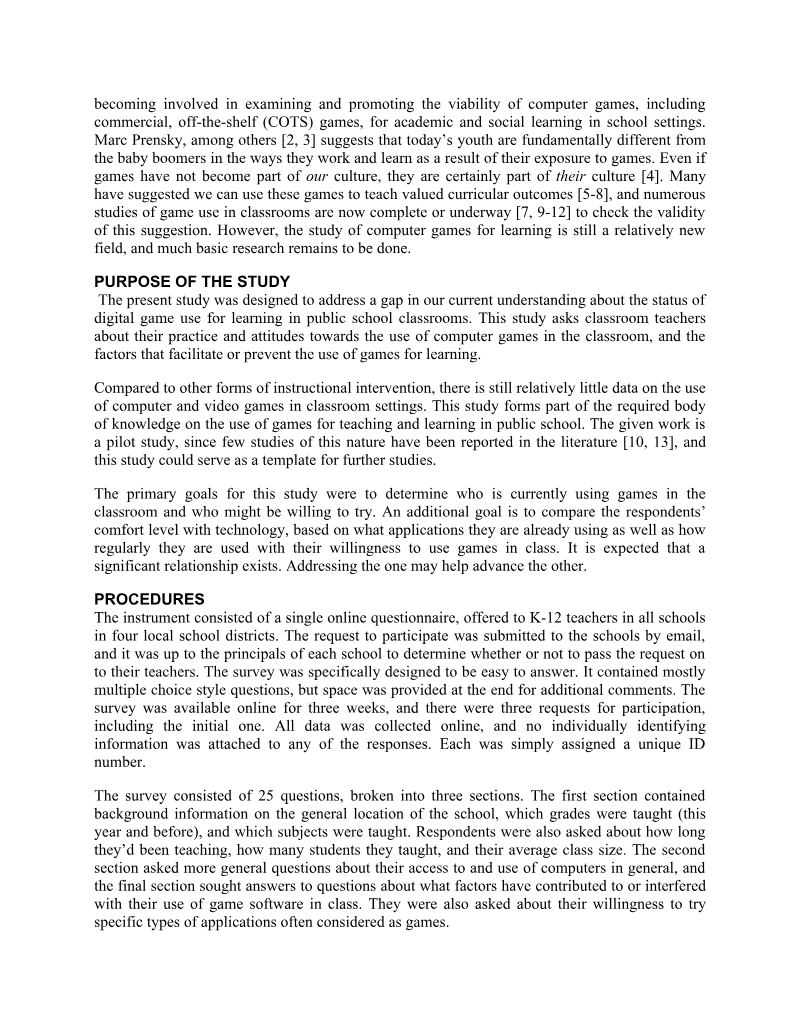
Integrating serious games into primary education curricula serves as a vital pedagogical strategy for enhancing student engagement, particularly within mathematics, science, and history. Research involving 51 pre-service teachers in Quebec demonstrates that while educators recognize the value of game-based learning, their implementation strategies are heavily influenced by technical proficiency and time constraints. Participants consistently favor utilizing existing serious games or repurposing entertainment titles over developing original content, as the latter requires specialized technical skills and significant preparation time that many teachers currently lack.
The findings indicate that successful integration does not necessitate perfect alignment with traditional curricula or advanced software development capabilities. Instead, the most effective approach involves a shift toward a community of learners model. In this framework, teachers transition from being sole content experts to facilitators who engage in collaborative problem-solving alongside their students. This flexible methodology allows educators to overcome technical limitations by leveraging existing digital resources and fostering a classroom environment where peer-to-peer learning bridges the gap between pedagogical goals and technological execution.
Ultimately, the evidence suggests that while barriers to game creation remain significant, the pedagogical potential of serious games is best realized through adaptable, resource-conscious instruction. By prioritizing the facilitation of student-centered learning over the creation of bespoke digital tools, educators can effectively navigate the complexities of modern classroom technology. This approach is supported by a robust body of academic literature that emphasizes the importance of teacher perceptions, student motivation, and the thoughtful design of game-based environments in ensuring the long-term success of digital integration in primary education.
International Journal of Serious Games · 2023
International Journal of Serious Games · 2022
International Journal of Serious Games · 2020
International Journal of Serious Games · 2020

International Journal of Serious Games · 2020
International Journal of Serious Games · 2020
International Journal of Serious Games · 2020
International Journal of Serious Games · 2020

International Journal of Serious Games · 2020



International Journal of Serious Games · 2020

International Journal of Serious Games · 2020
Air Force Institute of Technology · 2020
Institute for Educational Technology · 2019