Game Development reports and market data
Documents

Why None of Us Saw Cyberpunk Coming Apart I Michal Nowakowski. joint CEO, CD PROJEKT RED
CD Projekt Red’s evolution from a regional distributor to a global AAA powerhouse is rooted in a strategy of intellectual property ownership and creative independence.
- CD Projekt Red restructured its development operations by abandoning proprietary technology in favor of Unreal Engine 5 to mitigate technical risks and streamline production.
- The studio transitioned from a siloed, waterfall production model to a unified, multi-platform approach that utilizes rigorous gating milestones to prevent future launch failures.
- Despite a 75% decline in stock value following the technical failures of Cyberpunk 2077, the studio achieved long-term commercial recovery with 35 million base game units sold and 10 million expansion units sold.

Sony Fumbles Kojima, Zelda’s Ocarina of Load Times & Skyrim LOVES Ikea | Games For Breakfast
The gaming industry is currently navigating a period of significant strategic volatility, characterized by shifting publisher priorities and evolving consumer expectations.
- IKEA has released a playable Skyrim mod featuring actor Matt Barry as part of a marketing campaign to promote a new shelving system.
- Sony and Kojima Productions have experienced a public disconnect regarding the developer's departure from the PlayStation ecosystem, with Xbox actively courting the studio.
- Nintendo has confirmed it will not provide refunds to customers for costs associated with past illegal tariffs, instead opting to host a customer appreciation sale to discount products.

Why PlayStation Ditched Hideo Kojima's Physint
PlayStation has officially terminated its partnership with Hideo Kojima for the development of his upcoming espionage action title, Physint.
- PlayStation cancelled its partnership with Hideo Kojima on the espionage game 'Physint' (renamed 'Fizzant') due to the project consistently missing development milestones, exceeding budget expectations, and failing to meet internal revenue targets.
- Kojima Productions has moved the 'Physint' project to Xbox, which views the investment as a strategic play to expand its presence in Asian markets and secure film and television rights for both 'Physint' and 'OD'.
- PlayStation is currently undergoing a strategic shift toward maximizing revenue per user and implementing more rigorous development milestones, following a period where previous Kojima titles like 'Death Stranding' failed to meet the company's high commercial expectations.
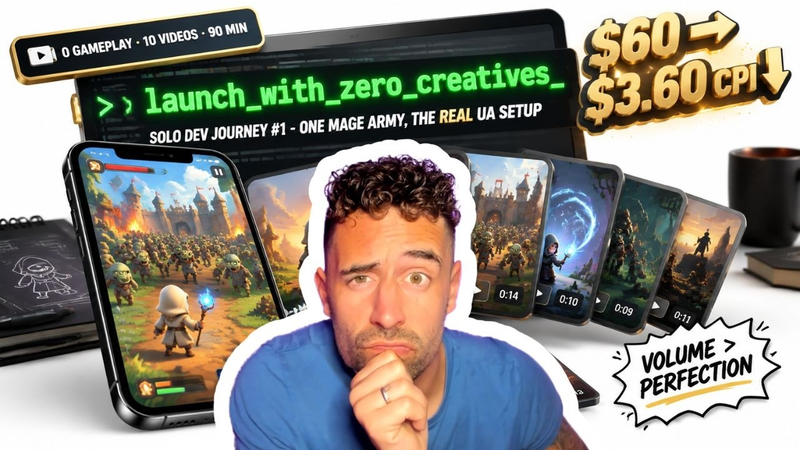
🧙 Solo Dev Journey #1: How to start with UA? From a store link to a LIVE UA Campaigns
This analysis outlines a practical, low-resource approach to launching a mobile game, specifically focusing on a solo developer’s experience with the title One Mage Army.
- In the early stages of a mobile game launch, the volume and diversity of creative assets are more critical to performance than high-polish production quality.
- AI-driven tools can be used to generate ten distinct, story-driven video ads in approximately 90 minutes by utilizing existing store page assets and brief narrative prompts.
- Campaign maturity is essential for cost stabilization, as demonstrated by AppLovin CPI dropping from an initial $60 to approximately $3.60 as the campaign progressed.

TWIG #400: Is the Game Industry Actually Crashing, OpenAI's Astra and 8 Years of Hot Takes
The global gaming industry is currently undergoing a structural market correction rather than a catastrophic collapse.
- The gaming industry is undergoing a structural market correction rather than a collapse, with employment levels remaining stable at approximately 750,000 workers since 2022.
- The sector remains fundamentally robust, supported by a global player base exceeding 4 billion and a 16% compound annual growth rate in mobile advertising.
- Indie game revenue has increased sixfold over the past decade, highlighting a significant shift in market distribution alongside AAA development budgets that now range from $250 million to $400 million.
The Legend of Zelda: Ocarina of Time and GTA 6: The video game industry’s Barbenheimer moment
The simultaneous anticipation surrounding the upcoming remake of The Legend of Zelda: Ocarina of Time and the impending launch of GTA 6 represents a pivotal cultural moment for the gaming industry.
- The simultaneous anticipation for the Ocarina of Time remake and GTA 6 serves as a primary catalyst for market engagement, mirroring major industry showcases.
- The gaming industry is experiencing cyclical volatility, marked by significant layoffs in North America contrasted with growth in the Asia-Pacific region.
- Studios are shifting development strategies by balancing cost-effective outsourcing with the need for local talent retention and cultural alignment.

Inside NYT Games: Why They Don't Play by the Same Rules
The New York Times Games division operates under a distinct philosophy that prioritizes long-term brand integrity and subscriber value over the aggressive monetization tactics common in the mobile gaming industry.
- The New York Times Games division rejects standard mobile industry monetization tactics like gacha systems and battle passes in favor of a subscription-based model that prioritizes long-term brand integrity.
- The development team utilizes a democratic, open-pitch greenlight system that allows any employee to contribute ideas, which led to the creation of successful titles like Connections.
- The division mandates a 60-day content buffer for new prototypes, using Canada as a primary testing market to analyze retention metrics before committing to a full-scale release.

Why Video Game Developers Love Remakes
The prevalence of video game remakes is driven by a combination of strategic risk mitigation, operational efficiency, and creative opportunity.
- Remakes serve as a risk mitigation strategy by providing a clear, pre-defined vision, which reduces the uncertainty and decision-making overhead associated with developing entirely new intellectual property.
- Studios utilize remakes to train staff on new tools and development pipelines, such as transitioning from Unreal Engine 4 to 5, without the added complexity of inventing a new game concept simultaneously.
- Remakes provide a productive outlet for large development teams during the 'pre-production' phase of a new project, preventing the need to assign staff to low-value busy work while core directors prototype the next title.
Steam Platform 2026: How Valve is Helping Game Developers Succeed on PC Gaming
Steam has solidified its position as the dominant PC gaming storefront by 2026, achieving a massive scale with 42 million peak concurrent users and 13.9 million in-game concurrent users.
- Developer revenue from Steam Daily Deal placements increased by 274% year-over-year following the implementation of a self-service scheduling system that allows developers to claim slots directly via Steamworks.
- Steam now categorizes user reviews by language to provide context for players and developers, addressing concerns about review bombing and regional-specific issues without removing content.
- Controller usage on Steam is significant, with nearly 5 billion gameplay sessions involving gamepads in 2025; developers are encouraged to use the Steam Input API to ensure compatibility across various hardware, including Xbox, PlayStation, and Nintendo controllers.
“Some of the offers were actually offensive” – How Forza Horizon rival Clutch found its publisher
Maverick Games is positioning its debut title, Clutch, as a cinematic, story-driven racing experience designed to carve out a distinct niche rather than directly challenging established industry titans like Forza Horizon.
- Maverick Games secured a publishing partnership with Focus Entertainment for its debut title, Clutch, after an initial deal with Amazon Games was terminated due to shifting corporate priorities.
- The studio successfully retained full intellectual property rights following the Amazon Games split, allowing them to reject unfavorable offers and maintain creative control.
- Clutch is being developed as a cinematic, story-driven racing game set in the South of France, intentionally designed to occupy a niche distinct from major competitors like Forza Horizon.
How Double Fine Survived The Xbox Bloodbath
Double Fine Productions, the San Francisco-based studio led by Tim Schafer, has returned to independence following a seven-year tenure under Microsoft’s Xbox division.
- After seven years under the Xbox umbrella, Double Fine has returned to independence following a shift in Microsoft's corporate strategy under Sarah Bond, which prioritized higher profit margins over the studio's niche, quirky output.
- The transition to independence involved a grueling negotiation process in June 2026, resulting in Double Fine securing ownership of its intellectual property and necessary runway capital, though the studio was forced to lay off 23 employees.
- Double Fine is pivoting to a 'Double Fine Action Labs' model, focusing on smaller, experimental titles and rapid prototyping to mitigate the financial risks associated with high-budget game development.
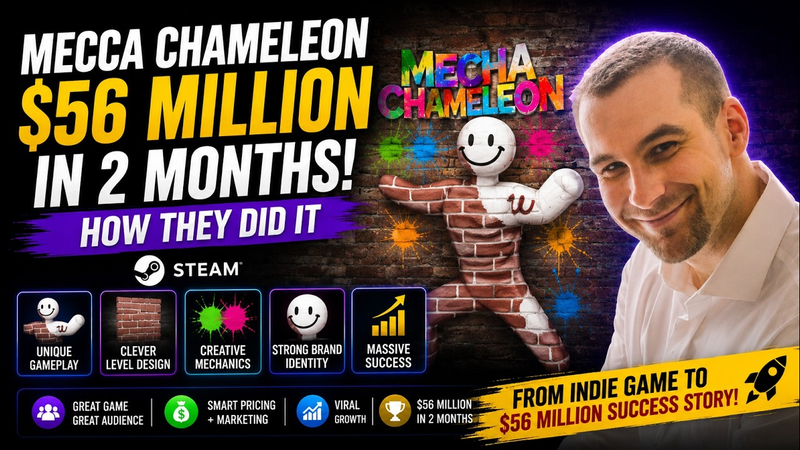
🦎Making $60 Mil in 2 months of development ? Meccha Chameleon playthrough 👀
Meccha Chameleon serves as a case study for the high-revenue potential of low-production, viral-driven games within the Steam ecosystem.
- Meccha Chameleon generated $56 million in revenue from a two-month development cycle, proving that low-production, viral-driven games can achieve massive financial returns.
- The game reached a peak of approximately 320,000 concurrent users in June, driven by a $5.99 price point and simple, highly social hide-and-seek mechanics.
- Community longevity is sustained by the Steam Workshop, which allows user-generated maps to refresh the gameplay meta and maintain engagement.