VideoDeconstructor of Fun
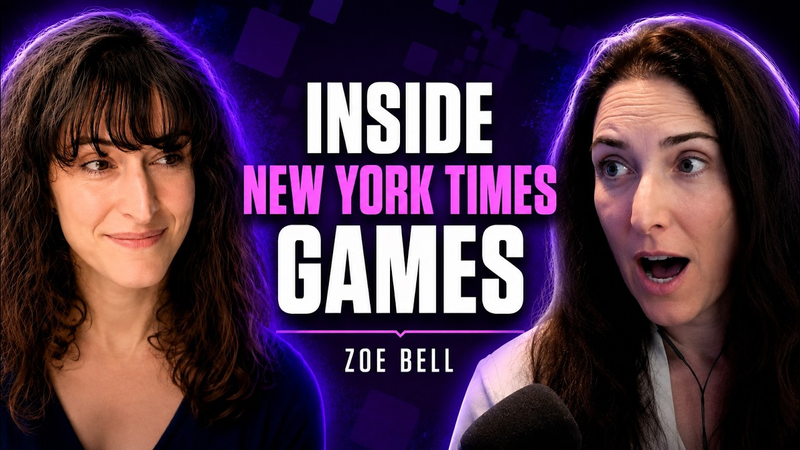
Inside NYT Games: Why They Don't Play by the Same Rules
9 Sept 202621 min video

Transcript
[music]
The other thing when we talked that was super interesting, and you said this on the panel as well, that the culture is really different from, you know, where we have been in traditional mobile gaming to now being inside the New York Times. And I think I think you even joked you can't say which means you can't curse. Um so, talk a little bit about like the cultural difference that you have going from, you know, our industry in a sense to that newspaper industry or media industry.
It's very diff- It is diff- very different. Um I mean, you can swear at the Times, but like not with the same vigor maybe as you can in those gaming startups. Everything about the mission and and this 175-year-old company contributes to the to the culture. And it's it's like we're we're doing things that are so important for like the country, the world. We're We're helping people understand more about what's happening in the world. And so,
that kind of permeates everything that we do. And so, I think everything's a little bit more polished and buttoned up certainly than a gaming startup, right? Like I was at Zynga. I was at Kongregate. Kongregate was owned by GameStop, but they were really We were like 60 people in an office in San Francisco. It was just a little different. We had dogs in the office at Zynga. You know, all that stuff. It makes It makes it feel like a different place. And at first, it was a little bit of an adjustment for me because I was used to moving so quickly. I mean, at Zynga, everything was changing all the time. I mean, I joined when it was 300 people. And by the time I left, there were 3,000 people. We had gone public. Like it was just this huge like crazy time to be at Zynga. And all the like from fundamental premises kept changing upon which like we were building our business. And so, I think a little bit less polish was allowed because there was so many things were changing at the same time. But the New York Times, you're really thinking, how can we be around for another 175
years? You know, how we can't make mistakes in the way that Zynga could make a mistake. Because not only are we reporting on those mistakes, and so we don't want to be like, you know, also doing that. You know, we want to just continue to to exist and to provide the the journalism and that kind of permeates everything.
Mhm. So, also on the cultural aspect, so what what did you take and bring in that that you have been able to keep from you know, the traditional mobile world? Is there anything that you guys came in and said, "Hey, as game folks, here's here's what we need to do around creativity or game game design?"
Totally around game So, it's great to be at The Times, I think. I you know, when I think about even a at when Kongregate cuz you're owned by GameStop, everybody's got a boss to like wants to make games too in the games industry, right? Because that's where they came from and they want they have opinions and they're going to tell you that your art style is bad because of XYZ or change this, you know, the futui like
that. How many times have I changed the first time user experience because some executive didn't like it? The Times really respects the games after taste on our team, which feels great. You know, we if we say we don't think this game is going to work or we think this game is the one we should pursue, they really respect that, which is great to have that backing. And one of the things I brought in was our games green light process. So, we really wanted to have a way to get new hit games out there to make decisions the right types of decisions about our game pipeline. And so, I've kind of borrowed a little bit from what we did at Zynga and what we did at Kongregate to think about which games are worth spending, you know, effort on. But, also to protect the create creative people that are working on the those games. We have a, you know, a a process if you're going to release something on like the Games app or on an existing existing game. But we try to keep the the people that work on new games siloed and able to be really creative.
Actually, walk me through that right now. So, tell me about the apps that are live on the App Store right now. And And by the way, we're only talking about mobile, right? There's no Well, or are there web apps?
Yeah, yeah. So, every every game is also available on the web except for Crossway. Crossway is is only in the app app. Um so, we have two apps. We have Crossway and we have the Games app. And then also you can you can play our games in the New York Times news app as well. Um so, yeah, those are those are the games that we have.
Okay, so on the web app, so you play through the New York Times when you're logged in the New York Times, you can play the games there as well. Yeah. Okay, got it. As a New York Times subscriber, which before I I honestly am before we even talked about this, uh I'm not actually a game player. I I actually use it
[laughter]
for the news. And so, I think I've seen Wordle a couple of times on the web, so I didn't actually think about that. Do you Do you talk about the split in like
where your DAU is? Or I I I don't want to ask you any unpublic information, but are is there Is mobile like the primary focus for you guys?
We don't really talk about the the split. There are a lot of web users though. Mobile web too. People will come in and play Wordle on their phone in a mobile web browser. There's some features we just don't offer on web like our leaderboards or and you know, our friend system is is mostly just in in the apps because we have the space like space there to to and visualize it well. Um but and no, you can basically play every game on web too.
So, knowing that you're across all of these platforms, can we talk a little bit about the subscription model? So, this is the prime your primary monetization model. like I said earlier. There's some ads, but no IAP, no battle passes, no some of like that free-to-play experience. So, how did you have to think about the business model driving how you think about making
games? Was that a different process for you?
So, I think with a subscription model, you want to create value, have a have value, have a reason for people to subscribe. Then you have to show people what that value is, and then you have to kind of deepen that value over time. So, SpellingBee probably a a good example. SpellingBee is our anagram game. It's seven letters, find as many words as you can um within those seven letters rearranging them. So, right now the way it works is you can play a little bit of SpellingBee, cuz then you'll hit a paywall. And so, you get a taste of what it is, and then you hit that paywall. Then if you subscribe, you'll be able to finish the game every day, and also uh you'll get your like stats, long-term stats for SpellingBee. I mean, you you can get some stats without subscribing if you're a registered user, but they're very limited, so you should you know, if you subscribe you get that sort of deepened value. But, I think the difference between that and what like a
free-to-play mechanic is that we really have to create that value kind of from the very beginning. And so, all of our, you know, friction layers on of the value um versus actually interfering with the game design. So, like for example, at my previous company, the last company I worked at, we had a a weapon system. We used to start playing with it and tuning it, and it was starting to feel good. And then the product manager came in and said, "But, this isn't But, th- this is great. This is good, really. It's a good weapon system, but it's it's too shallow. We can't sell the gotcha for the right amounts of money because it's too shallow. We should have have a deep weapon system where you have to get a lot of little chips or whatever you're saying like for each weapon in order to upgrade it versus having a you know it being a little bit less less deep. You know, you improve your weapon, you want it to feel different, right? So it did change the two meaning in the gameplay
was like having to fit in this free-to-play mechanics so that the gotcha would work. We don't have those discussions at the time. So it's more about is this game fun or not and I I I like that.
Those damn product managers. I know.
So awful. Trying to make money out of things. Got it.
So it sounds like your focus then becomes about like a good early experience that product features can be developed more for the fun. There's a little bit of like where you put the paywall, I would imagine is like how much fun can we offer before we have to throw up the subscription paywall?
Yeah, and so Spelling Bee is the only one of our games that kind of works like that where you play part of the way and then we paywall you. There I mean there's some that work somewhat differently but like basically right now mostly we have either it's completely free or it's behind a paywall and what really transformed our business with with Wordle was people would come in to play Wordle and then they would see all of our other games and be like,
oh okay, maybe I'll give that a try and and then they would would subscribe for that. And so once you're a subscriber then you can play all the games that are behind the paywall and and I think that then that's when people really get hooked.
I wonder how much how many new subscribers came in just from Wordle but when I think about you know earlier you said that your in-laws, your parents, your friends, maybe even are your kids old enough to play? Everyone Everyone plays. Apparently the Pope plays. Like I don't know. I saw you know, that was like really interesting. You know, both of us worked on Farmville and you know, I've worked on many games where you know, people got married in these games, they formed like deep connections. Um So, who is your audience? Who's actually playing New York Times games? And how does that shape how you think about designing, you know, the range of games that you're building?
We do a lot of research into our audience and who's playing our games. You know, I think fair to say it's a broader audience than any other game that I've ever worked on. Even I worked on FarmVille, it was very
large, but I think this is a pretty broad audience. You mentioned a little bit that about FarmVille, like one difference between just existing or other games that I've worked on is that people really want to talk about this one. They really want to talk about like, "Hey, I did the Wordle." Like the Pope wants to tell us that he did the Wordle. And he said like multiple different interviews he's mentioned doing the Wordle. Carol Burnett went on Jimmy Kimmel Live and talked about doing the Wordle, but before she went on, like Julia Louis-Dreyfus, Charlize Theron, a bunch of other like famous female actors who were in Carol Burnett's Wordle group went on and told Jimmy Kimmel how much Carol Burnett cheats at Wordle.
[laughter]
That tracks, I think, with the sense of humor.
Carol Burnett says she's just really, really good at it, which I, you know, I I believe her, right? She gets the Wordle in two apparently at a very high rate. I think people are really proud of playing our games, which is a different feeling maybe from some of the other games that that I've worked on in the past. We do look at demographics a little bit, but mostly we look at like player personas and maybe jobs to be
done. So, what are people hiring us to do? Um, what do they want to get out of New York Times games? I think some people play for their mind, like they're either trying to prove to themselves that they have this, you know, that they're smart, that they're intelligent. Some people play because they're trying to stay sharp, like they feel like they it's like a good mind mind exercise. We also see people playing for social reasons, like especially with Wordle players. They want to share how they did in a group chat with their friends. And the the social people are maybe a little bit younger than the some of the other groups.
Mhm.
And then we see people playing cuz they, you know, they they pick up tiles at the end of the day cuz they just want a little they just want to feel good and have like something visual to to play through. So, the different games do satisfy different types of players. We definitely see different combinations of play where they'll play play, you know, Wordle, Connections, and Spelling Bee or
only the crossword. And so, there those people are coming in for for different reasons. When we think about new games, we think about both what another word game added to our portfolio, make our existing users happy, so happy that they would pull their friends back in to play some more, and let's try to do something different that we don't already have. So, some kind of visual logic puzzle or trivia or something that's just like outside of the box from what we what we normally do. Like the key thing we're always saying is just like is the game going to be fun, which we look at like with retention. Is it going to be something that people come back to every day and just really truly enjoy? And that's the main thing that we are looking for when we're thinking about whether or not to add any game to our portfolio.
Yeah, I think with audience as a marketing nerd, I try to shift people away from demographics, which, you know, it's a nice to have and it is what it
is. More into psychographics, which includes motivations, need states, uh emotional states. And I've been dealing just digging into a lot of casual games lately and have found that especially in today's world like the motivations and the need states and the emotional states of playing, especially casual games, is very different and it's even very different across the day. You may wake up and want to be stimulated to get the day going and maybe later on you're like, "Oh my god, I need to stay awake on my train ride home." and you're playing a game just to stay stimulated. And it's the same person over the course of of the day having different different feelings. So, as you look across news genres, you know, besides it just being fun, how do you think about like appealing to those different kind of motivational states? Do your game designers like really like utilize that kind of information?
Like I said, we have research and we we kind of think about it, but we are a
little bit unique in that we don't have game designers that are specifically only working on new game ideas. We actually let anybody on the team pitch new game ideas and we kind of take what comes from that. We schedule game jams. We uh have this whole process where we invite people to give us whatever pitch they want and we we talk through those. And so, we do try to point people like in a game jam we would try to point people toward a specific direction, but you know, most of the games are just somebody's like, "Hey, this is a really cool idea." And then we funnel it down through the views of is this going to be something that that is going to either expand our existing, you know, portfolio or or add to it in a way that feels really innovative. Our um head of user research for games is in our committee that makes the decisions about whether or not games go through and she is the one who's really respond like in charge of bringing that point of view to it.
Well, that's super interesting. That is a little different than I've seen, maybe you've seen. Is that one of the things that you brought and implemented? Like thinking about, "Hey, anyone can make a game, not just that new game team over there."?
Yeah, I mean, so we have on the games team, we have a few game designers and we have the crossword editors who I you know, they are very puzzly type people who make I would say maybe more like the content, right? Versus I took like doing the game the game design of of new games. But we don't really have enough people to have them be the only people that come up with the ideas. And I I think at Congregate, we weren't making new ideas because I was on the third-party publishing side of things, so we were pulling in ideas from everywhere else, but it was much more democratic democratic, and that felt really good for the team. Um and I think at The New York Times I did want to have
it be open, and and we've had great ideas come from a variety of sources, like uh Connections was an engineer, a producer, and our head of user research. Like it was, you know, just different people from different functions on the team coming together pitching the thing, which feels really good when that happens.
No, that's awesome. I I like to say that a great idea can come from anyone, and it sounds like it came from that that trifecta, you know, coming in and saying something different. Like that's really inspiring that the best idea wins, like a little bit of a democracy in like ideation. I I think that makes a lot of sense. As you, you know, we're kind of touching on game development, and you mentioned it earlier about like bringing a green light process. Can you walk me through like how a game gets made from idea to launch at New York Times? I mean, it feels a little different than how we do it in traditional game industry land.
Yeah, I mean, I think we have the same kind of steps, but maybe the um we have
an advantage, which is we're making these relatively small puzzle games, right? That are relatively quick to make. So we're not making you know, Grand Theft Auto that's going to take years and years and years and years. And if we, you know, like there's that we need to keep working on Grand Theft Auto to make it the best possible game it can be because that's what's going to come out versus us where we can actually just kill a game like fairly frequently. That's okay and that's like built into to our greenlight pipeline. So we start with a concept pitch. We have a really short six slide template. Anybody on the game team can fill it out. Anybody at the company if they get an executive sponsor from the game team can can do a pitch, too. And so that we're trying to have like a really wide wide wide funnel of ideas at the very beginning. Then we have this concept committee which is six people in leadership on the games team who will go through and say, "Okay, is this a concept that I can see us working on? Is it going to be fun? Is it going to offend our audience? Is it going to be
something that we can actually do editorially?" Um just kind of thinking through all the questions. We vote mostly on All we're voting for is should it get the resources of the next phase which is uh game designer will pick it up, write a game design document, work with production on a prototype plan, and kind of put together a plan for a prototype. So we're just voting on that and so that's kind of what we try to keep our minds to is like should we spend even the this amount of resources on the game idea. And then we have a prototype. We build a prototype, get a game designer, a a UI UX designer, an engineer, and they'll build a prototype. And we play it. Sometimes it gets another chance. Like we'll play it, it's not fun, we'll iterate a little bit and then if it's still not fun, maybe we'll iterate a little bit more, but we do try not to over invest in in the prototype.
And if it's fun, it gets, you know, another vote. And now we're voting on
should we put this out to the public in a Canadian We've decided Canada is a great proxy for the United States. In a Canadian only test, should should we test it? And so you know we have to be able to have at least 60 days of content cuz we need to see you know day 30 retention a couple cohorts of day 30 retention. So we have to to make sure that like that's achievable. We have to have all the back end infrastructure that we need although usually it's very lightweight. We try not to again put too much investment in. So we'll do another vote, then we'll put it out. We'll let it run for 60 days, see what the retention looks like. Maybe we'll do an intervention or two with the game you know if we can think of like the obvious issues that might improve retention. The last game we pitched we were able to actually just pull it down and do some work to get it ready for a full release and then put it up again and then and add it everywhere across the whole portfolio, the web, the new
app, all the places.
Got it.
[music] [music]
Auto-generated captions from YouTube — names and numbers may be misheard.















Comments