Game Development reports and market data
Documents
The Game Industry of Estonia 2021
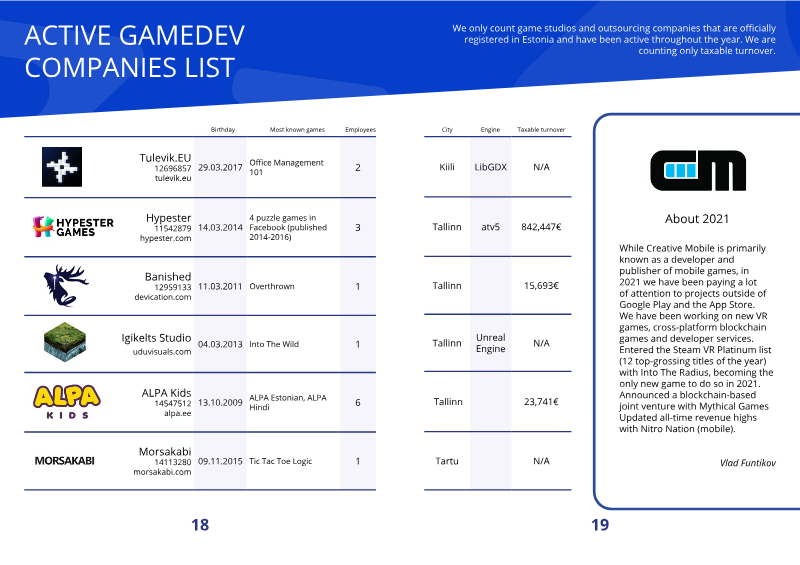
The Estonian game industry experienced significant growth in 2021, generating a total turnover of €50.44 million, a 20.69% increase from the previous year.
- Estonia's game industry grew 20.69% in 2021, with taxable turnover rising from €40.0 million in 2020 to €50.4 million, after 2020 had already surpassed 2019 levels, signalling sustained momentum despite the pandemic.
- The sector is highly concentrated: ZA/UM alone generated €20.7 million of the €50.4 million total, while other notable performers included Creative Mobile, Gamecan, Zaum Studio, and Ringtail (acquired by Magic Media in June 2021).
- The industry is dominated by very small firms, with 76% of its 41 active companies employing one to five people, and the sector overall employs roughly 300 people.

Games Croatia Brochure 2025-2026
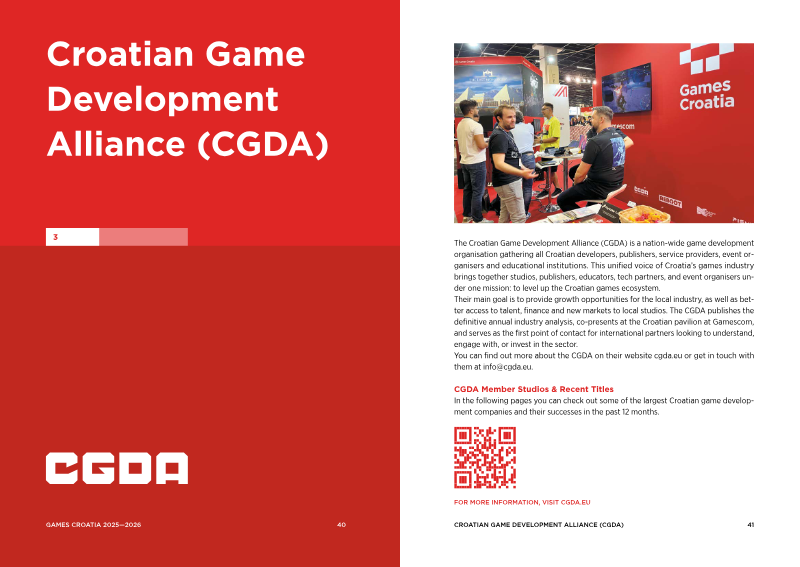
The Croatian video game industry is presented as a rapidly expanding and strategically supported sector, demonstrating significant growth and potential for international collaboration.
- Croatia's video game industry has 271 active development entities employing roughly 660 full-time staff, and reported record 2024 revenue of €72.1 million, approximately double the 2019 figure.
- Croatia is credited with delivering two to three globally recognized titles annually and is described as the largest per capita recipient of Creative Europe video game funding in the EU, with ten projects worth nearly €1.5 million since 2019.
- The brochure's core pitch combines a strong talent pipeline, labour and office costs that compare favourably with Western Europe, and layered public incentives including tax reductions under the Investment Promotion Act and HAVC grants.

Belgian Games Key Facts 2021
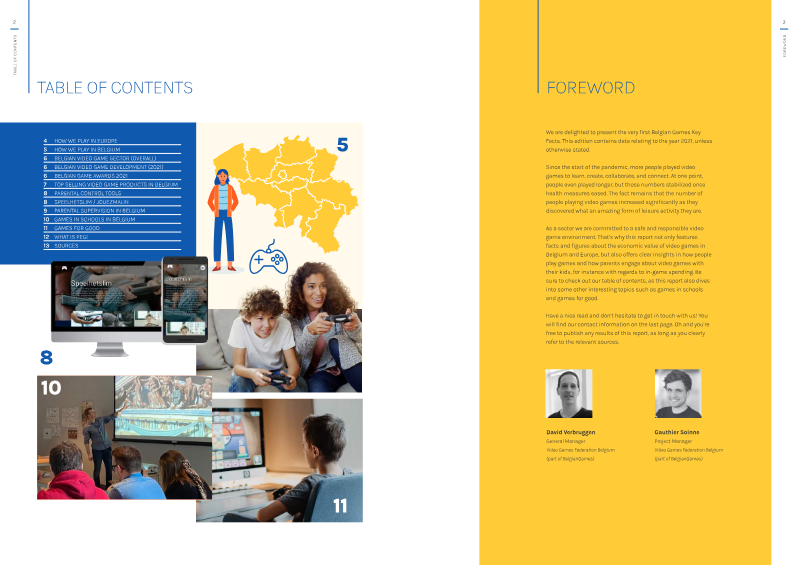
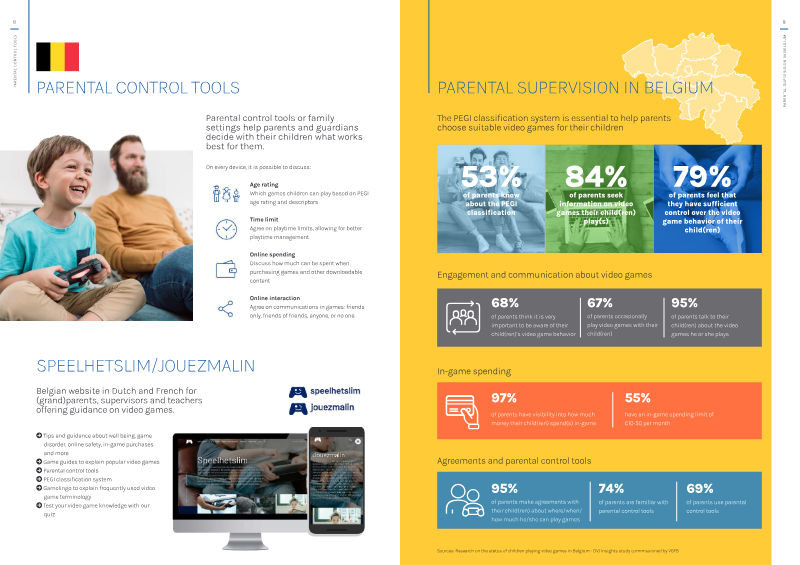
The "Belgian Games Key Facts 2021" report provides an overview of the video game sector in Belgium and Europe for the year 2021, focusing on economic value, player demographics, parental engagement, and the broader societal impact of games.
- Belgium's video game sector was valued at an estimated €600 million in 2021, growing about 4% over 2020.
- Belgian video game development generated €88 million in turnover in 2021 across 110 companies employing 935 full-time equivalents.
- About 52% of Belgians aged 6 to 64 play video games, with an average player age of 31 and women making up 48% of players.

Belgian Games Key Facts 2022
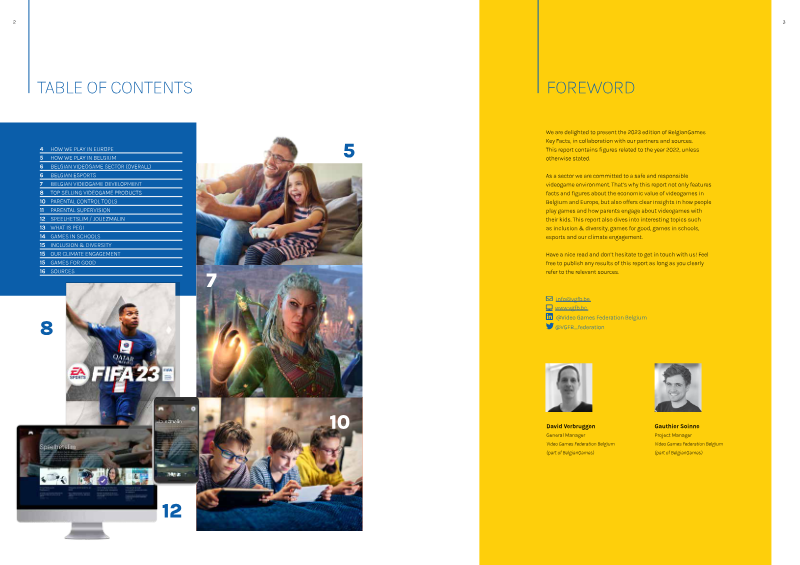
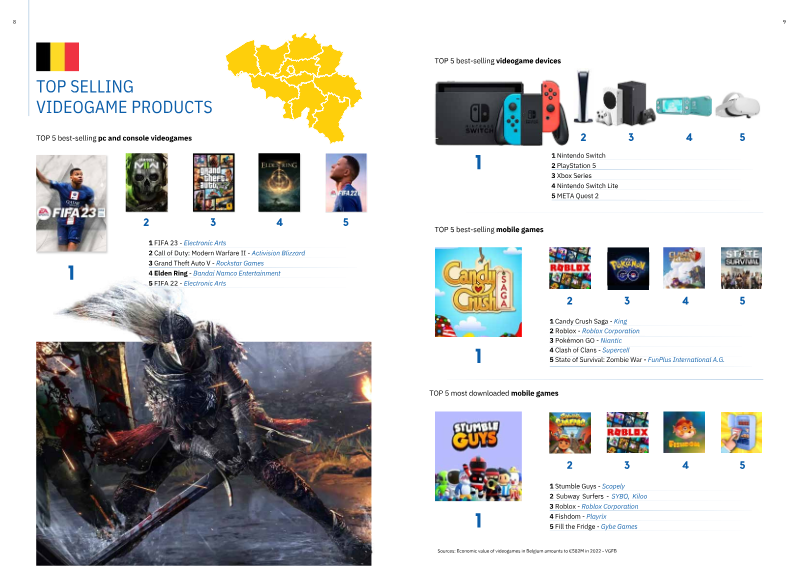
The "Belgian Games Key Facts 2022" report provides a comprehensive overview of the Belgian and European video game markets, focusing on demographic data, usage patterns, economic value, development, esports, and responsible gaming practices.
- The total value of videogames in Belgium reached €582 million in 2022, down 3 percent from 2021 but up 10 percent from the pre-pandemic year 2019.
- Belgian videogame development employed 1,085 full-time equivalents across 133 companies, and mobile game downloads reached roughly 148 million, about one million more than the previous year.
- 53 percent of Belgians aged 6 to 64 play videogames, averaging 8.8 hours per week, with female players making up 46.7 percent of the player base.
Time to Game: Facts, Figures & Inspiration of the Video Game Industry in Belgium 2024
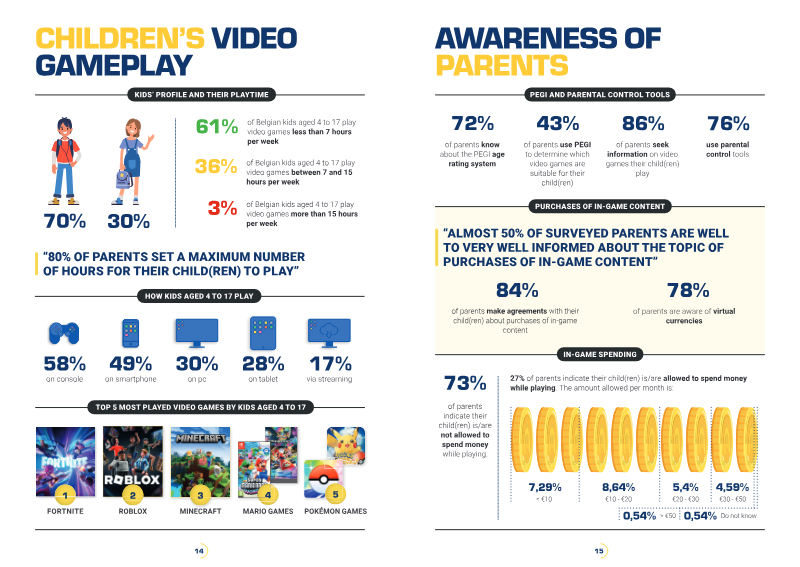
The "Time to Game" report, published in 2024 by the Video Games Federation Belgium, provides an overview of the Belgian video game industry, covering consumer spending, game development, player demographics, children's gameplay habits, and parental awareness of safety tools.
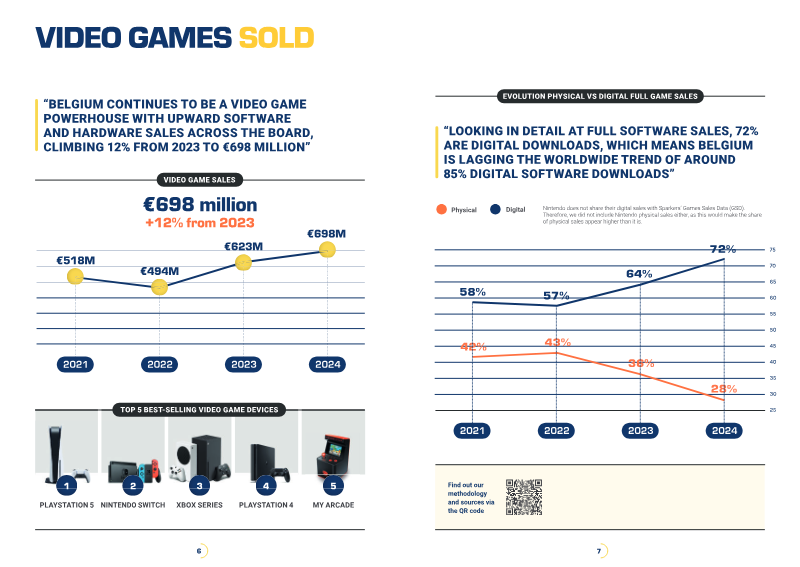
- Belgian video game software and hardware sales rose 12% from 2023 to reach €698 million in 2024.
- Belgium counted 6.2 million gamers in 2024, with more than a third aged over 35, and adventure, puzzle, and shooter games were the most popular genres.
- Digital downloads accounted for 72% of full game sales in Belgium, lagging the worldwide average of around 85% digital, while physical software made up 28%.
Sega Sammy Integrated Report 2023
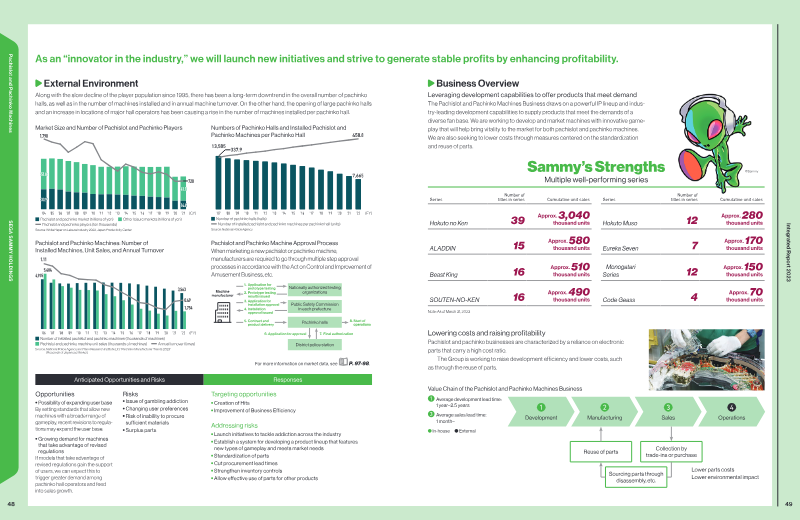
Sega Sammy's Integrated Report 2023 outlines a period of significant strategic transformation and strong financial performance, achieving its medium-term plan targets a year ahead of schedule.
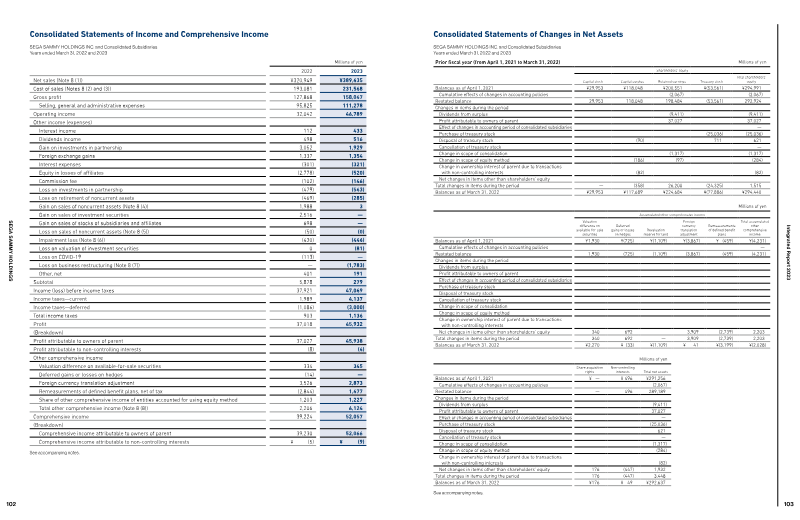
- Sega Sammy achieved its medium-term financial targets one year early, reporting net sales of ¥389.6 billion (a 21.4% increase) and operating income of ¥46.7 billion (a 45.9% increase) for the fiscal year ending March 2023.
- The company is executing a 'transmedia' strategy to leverage core intellectual properties like Sonic the Hedgehog, Like a Dragon, and Persona across gaming, film, animation, and merchandise to reach global leadership by 2030.
- Strategic growth initiatives include the development of 'Super Games,' the acquisition of Rovio Entertainment to bolster mobile gaming, and a focus on global talent acquisition.
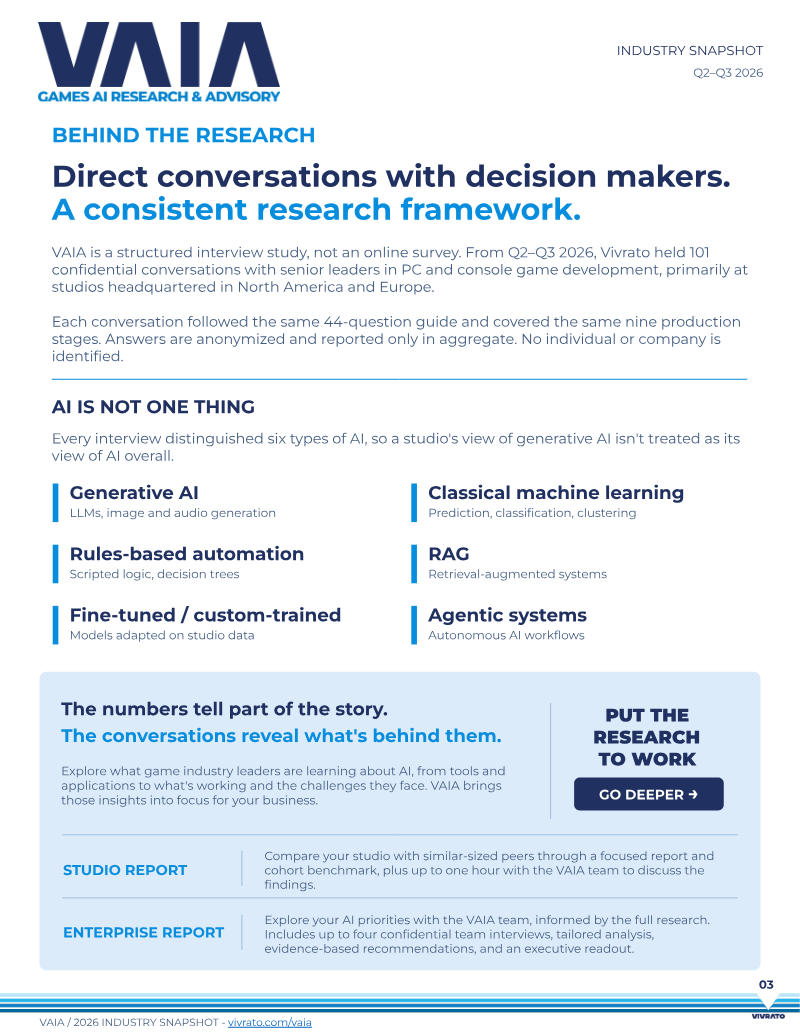
AI Adoption in Video Games: Q2-Q3 2026
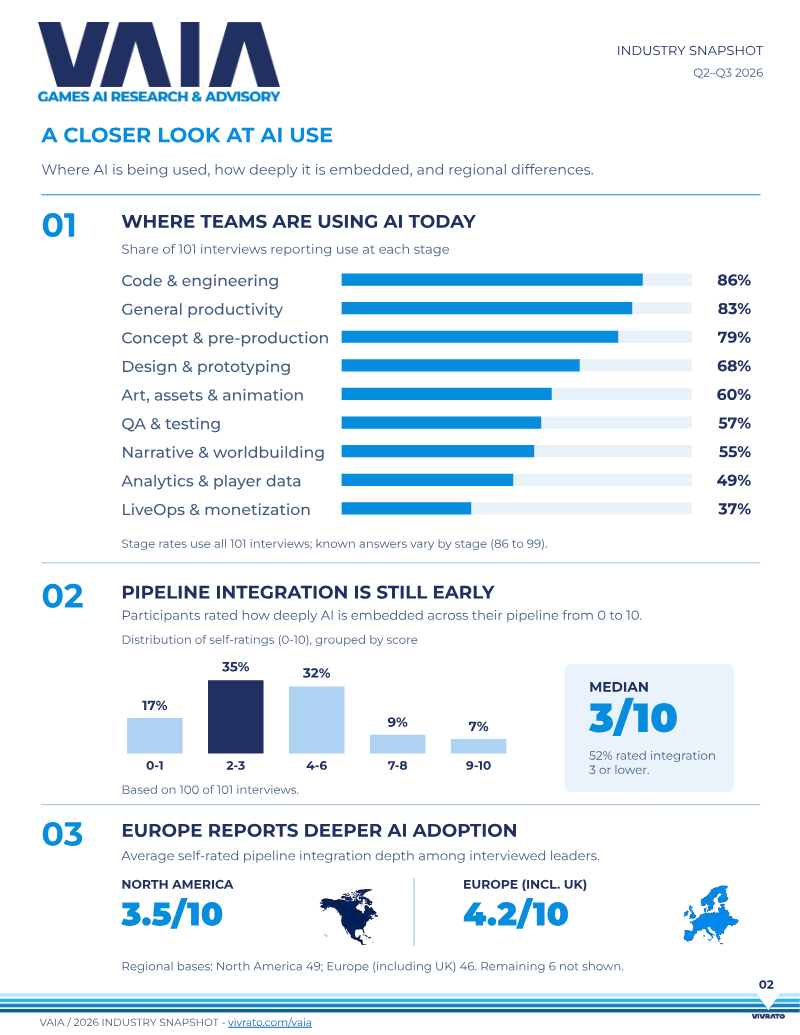
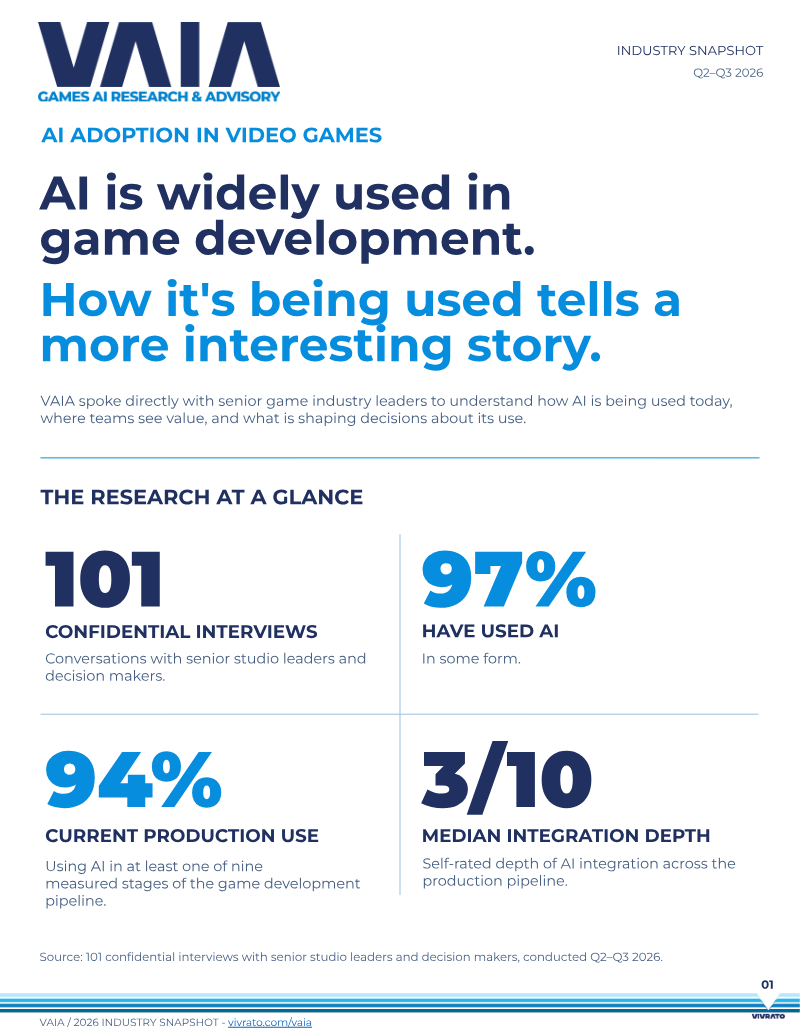
This document provides an industry snapshot of AI adoption in video game development during Q2-Q3 2026.
- AI adoption is nearly universal in the video game industry, with 97% of senior studio leaders reporting implementation as of mid-2026.
- Despite high adoption rates, AI integration remains shallow, with a median depth of only three out of ten across production pipelines.
- AI is primarily used for technical and administrative tasks, with 86% of studios using it for code and engineering, 83% for productivity, and 79% for concept and pre-production.
Square Enix Annual Report 2021
Square Enix's 2021 Annual Report details a period of unprecedented financial success, with the company achieving its highest-ever sales and earnings.
- Square Enix achieved record financial results for the fiscal year ending March 31, 2021, with net sales rising 27.6% to ¥332.5 billion and operating income increasing 44.2% to ¥47.2 billion.
- The company has set medium-term financial targets of ¥400–500 billion in net sales and ¥60–75 billion in operating income, driven by geographic expansion, cloud-based sales, and global talent acquisition.
- Growth was primarily fueled by the Digital Entertainment, Publication, and Merchandising segments, which successfully accelerated the transition toward digital distribution.

GungHo Business Report Vol. 26
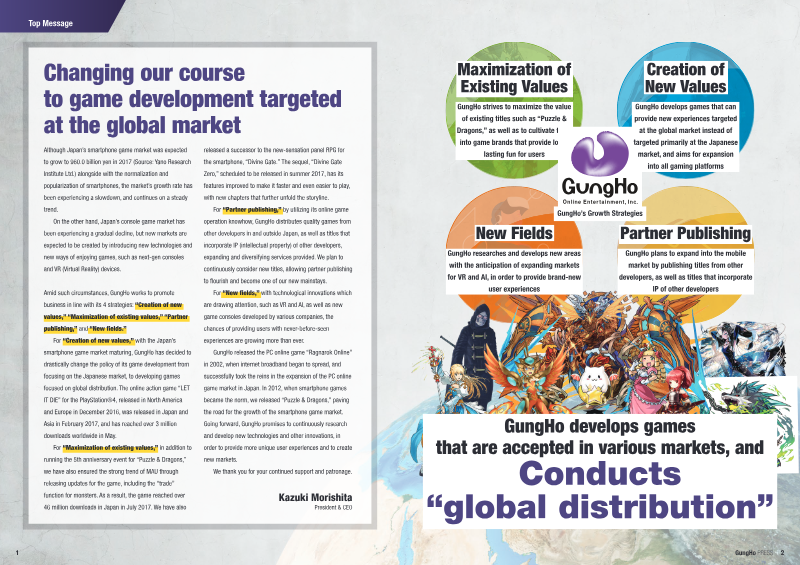
The GungHo Business Report Vol. 26 outlines the company's strategic shift towards global game development and diversification, moving beyond its traditional focus on the Japanese smartphone market.
- GungHo is shifting from a Japan-centric model to a global distribution framework to counter the maturing domestic smartphone market and declining console sector.
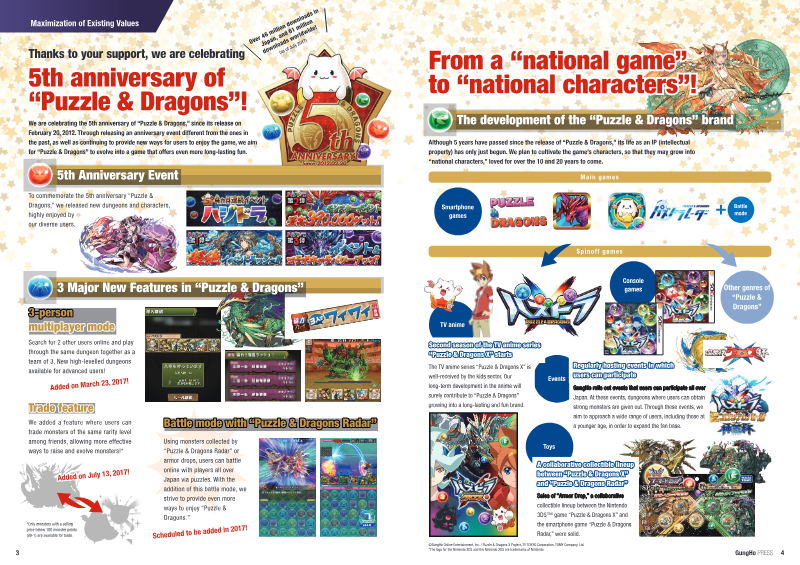
- The company is prioritizing long-term brand longevity for its intellectual property, exemplified by ongoing updates to its flagship title, Puzzle & Dragons, which reached over 46 million downloads in Japan by July 2017.
- Financial results for the first half of 2017 show net sales of 49.1 billion yen and operating income of 19.4 billion yen.

COLOPL Annual Report 2019
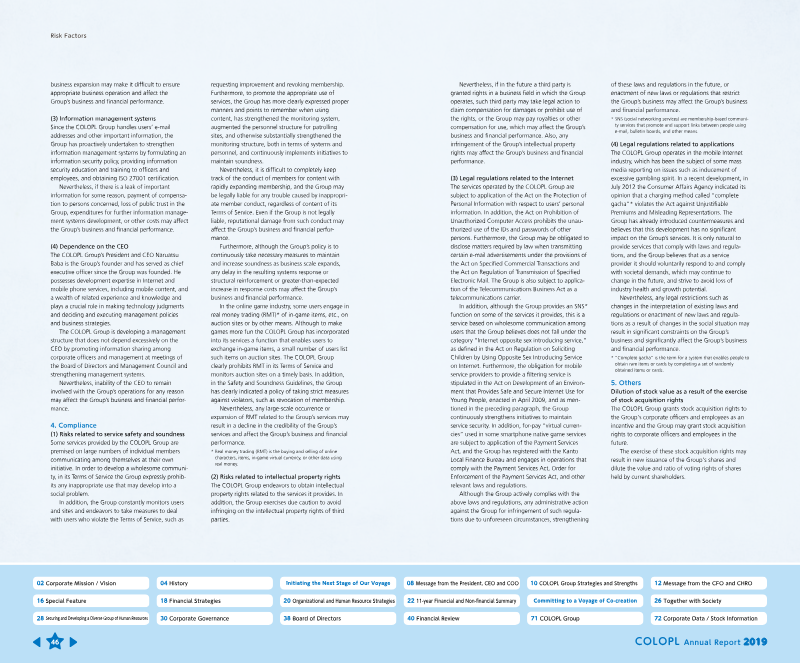
COLOPL's 2019 Annual Report outlines a company in transition, navigating a maturing mobile game market while strategically investing in diversification and new intellectual property (IP) development.
- For the fiscal year ending September 30, 2019, COLOPL experienced a 15.0% decline in net sales to ¥38,920 million and a 57.5% drop in operating profit to ¥2,952 million.
- The company is shifting its strategy from a smartphone-centric model toward a diversified entertainment portfolio, including virtual reality and location-based services, to counter volatility in the mobile gaming market.
- Financial performance was negatively impacted by a reduced volume of new title releases and diminishing returns from legacy products such as the Shironeko Project.
COLOPL Integrated Report 2022
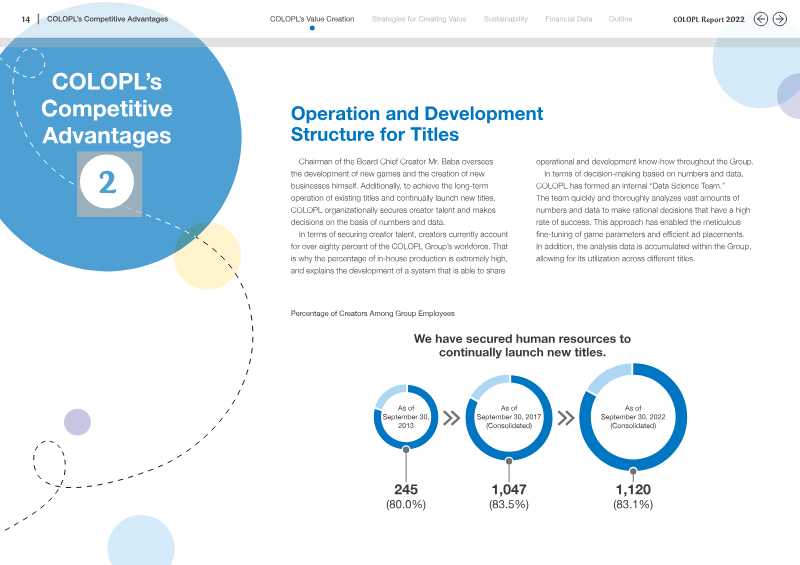
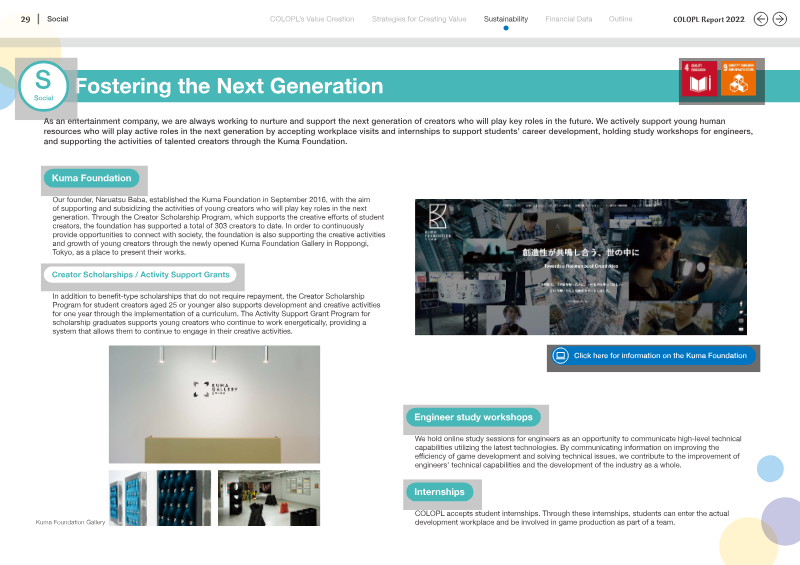
COLOPL's Integrated Report 2022 outlines the company's strategic direction, operational performance, and governance framework, emphasizing its core philosophy of delivering "New Experiences" through technological innovation and creative ideas.
- COLOPL experienced a significant financial downturn in fiscal year 2022, with net sales declining by 13.9% and operating profit falling by 27.7% in its Entertainment Business.
- The company maintains a strong balance sheet to support its turnaround strategy, reporting approximately 55 billion yen in cash and 76.6 billion yen in total net assets as of September 2022.
- Management has set a target to reverse the current downward financial trend by the fiscal year ending September 2024 through a focus on high-quality IP and emerging technology integration.

COLOPL Integrated Report 2024
COLOPL's 2024 Integrated Report outlines a strategic pivot following its first full-year net loss, driven by declining sales of existing titles and delayed new releases.
- COLOPL reported a fiscal year 2024 net loss of 1,208 million yen on 25,975 million yen in sales, driven by delayed title releases and the sunsetting of legacy games.
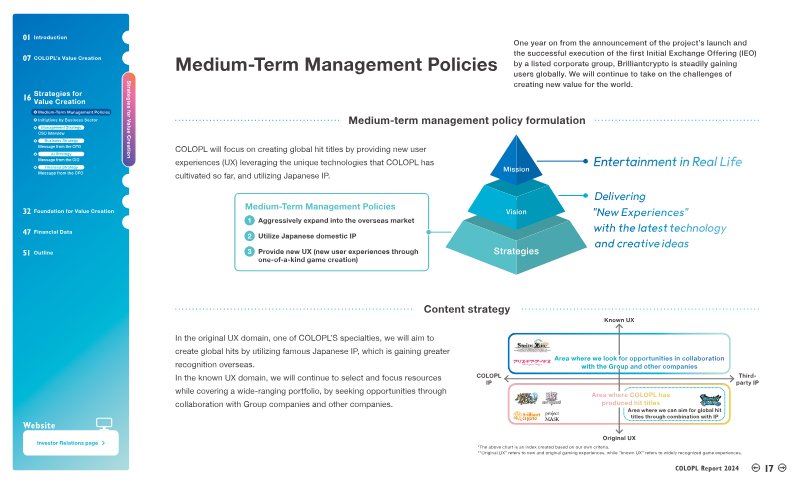
- The company is pivoting from a domestic mobile-only focus to a diversified strategy encompassing global expansion, console development, and blockchain integration.
- A central pillar of the new strategy is the Brilliantcrypto project, which established the company as the first Japanese listed corporate group to issue its own token.