Game Development reports and market data
Documents

UK Games Talent & Finance CIC's Mark Hogart on supporting new UK games IP
The UK Games Fund, operated by the UK Games Talent & Finance CIC, serves as a government-backed intervention designed to stimulate the creation of original intellectual property within the UK games industry.
- The UK Games Fund provides early-stage grant funding of up to £25,000 for prototype development, with future plans to introduce a £50,000 tier for advanced projects.
- To be eligible for funding, applicants must be UK-based, own the intellectual property being developed, and focus spending on UK labor and employment costs.
- The program operates on a reimbursement basis, requiring recipients to possess sufficient working capital to cover initial project costs before claiming grant funds.

Execution Labs' Keith Katz on the value of game accelerators
Game accelerators serve as vital catalysts for early-stage studios, providing structured environments to scale businesses rapidly through cohort-based programs.
- Game accelerators provide intensive, cohort-based mentorship and networking, distinguishing themselves from incubators through shorter timelines and a focus on rapid business scaling.
- Studios should prioritize accelerators that provide direct financial investment in exchange for equity, as this aligns the program's incentives with the studio’s success.
- Generalist tech accelerators should be avoided in favor of gaming-specific programs that offer relevant alumni networks, industry-specific mentorship, and direct access to platform holders and publishers.

Lessons Learned Making Gunpoint Quickly Without Going Mad
Game development success hinges on the principle of efficiency, defined as the ratio of player value to developer effort.
- Prioritize efficiency by maximizing the ratio of player value to developer effort, focusing on manageable features that leverage existing systems rather than high-effort, singular concepts.
- Implement a test-first methodology by using fixed, short prototyping windows to validate the technical feasibility and value of a feature before committing to full-scale development.
- Avoid feature creep by critically evaluating the necessity of every mechanic and maintaining the discipline to abandon non-essential elements that do not serve core design goals.

Why Aren't There Science Fiction Games? - The Philosophy of Fantasy vs. Sci-Fi - Extra Credits
The video industry analysis argues that while the gaming landscape is saturated with titles featuring futuristic technology, spaceships, and laser weaponry, the medium lacks true science fiction, instead offering almost exclusively science fantasy.
- The gaming industry primarily produces 'science fantasy' rather than true science fiction, as most futuristic titles rely on magic-like suspension of disbelief rather than grounded engineering logic.
- True science fiction requires developers to make the marvelous seem mundane, a design challenge that contrasts with the creative freedom found in fantasy settings where mechanics do not require technical justification.
- Developers often avoid genuine science fiction because the need to ground technology in logic limits enemy diversity and imposes strict narrative constraints on game design.

Why Are There No Good Video Game Movies? - Extra Credits
The lack of high-quality film adaptations of video games is primarily attributed to a cultural and generational gap between the film industry’s decision-makers and the gaming medium.
- The primary barrier to high-quality video game adaptations is a generational and cultural gap, as current film studio executives lack firsthand experience with the gaming medium.
- Hollywood historically prioritizes short-lived fads over established franchises because decision-making is driven by superficial sales data rather than a deep understanding of the source material.
- The trajectory of video game films mirrors early comic book adaptations, which only reached a creative and commercial peak once a generation raised on the medium ascended to leadership roles.

Why is Amazon getting into the game engine business?
Amazon Web Services has entered the game development market with the launch of Lumberyard, a free, open-source game engine.
- Amazon launched Lumberyard, a free, open-source game engine based on CryEngine, to integrate game development directly into its existing cloud and streaming infrastructure.
- The engine’s primary value proposition is its native integration with Amazon GameLift, which simplifies backend management for multiplayer session-based games.
- Lumberyard features deep Twitch integration, allowing developers to build mechanics that enable streamers to invite viewers directly into live gameplay sessions.

Free to Play Laws - Can We Stop Predatory Practices? - Extra Credits
Current regulatory efforts regarding free-to-play (F2P) games, particularly those implemented within the European Union, focus disproportionately on protecting children.
- Current regulatory efforts, particularly in the EU, disproportionately focus on protecting children, which serves as a political mechanism that avoids impacting the core business models of F2P games.
- The primary targets of predatory monetization are vulnerable adults—such as those with compulsive spending habits or social isolation—rather than children, who lack independent access to credit.
- F2P companies actively identify and cultivate high-spending 'whales' through personalized incentives, leading to severe outcomes like financial ruin and significant psychological distress for these individuals.
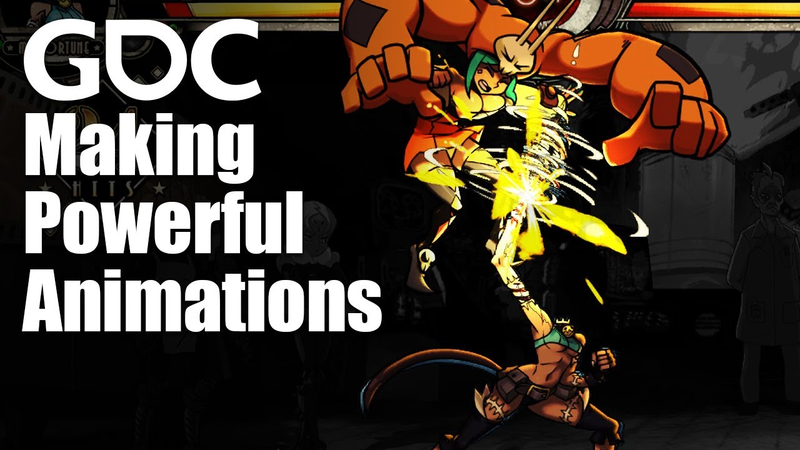
Making Fluid and Powerful Animations For 'Skullgirls'
Effective 2D animation in fighting games requires balancing artistic fluidity with the rigid constraints of responsive gameplay.
- To maintain responsiveness in fighting games, break down every attack into four distinct parts: anticipation, smear, the main attack key, and the return to idle.
- Effective animation in constrained frame counts (as low as 5–6 frames) relies on prioritizing key poses and using smears or follow-through (such as hair or clothing movement) to bridge gaps between frames.
- Prioritize clear silhouettes and snappy timing over excessive frame counts; holding key poses longer and shortening smears can significantly improve the readability of an action.

Clayburger on looking for publishers for its claymation debut Hopply
Clayburger, a two-person Czech development studio, is currently developing Hopply, a mobile game distinguished by its unique aesthetic of handmade claymation graphics.
- Clayburger, a two-person Czech studio, is developing the mobile game Hopply, which features a unique handmade claymation aesthetic.
- The game incorporates a crowdsourced character design system that allows players to submit their own clay creations for integration into the game world.
- The studio founders transitioned from long-term gaming enthusiasts to professional developers, balancing the project alongside other employment commitments.

Softlayer on the importance of cloud hosting and GPNs
Cloud infrastructure providers play a critical role in the gaming industry by offering scalable, consumable platforms that support both virtual and bare metal server environments.
- Cloud infrastructure providers support gaming workloads by offering a hybrid environment that combines the agility of virtual machines with the raw performance of dedicated bare metal servers.
- Global Private Networks (GPNs) enable seamless communication between servers across international hubs like Dallas, Amsterdam, and Singapore, allowing them to function as if connected to a single local switch.
- The implementation of a GPN facilitates high-speed data synchronization, which is critical for maintaining performance in complex, high-traffic games with globally distributed server clusters.

Volker Ritzhaupt on the challenges of developing VR puzzlers
Developing virtual reality experiences requires a strategic approach to mitigate motion sickness, a common barrier to user comfort in immersive environments.
- Maintaining a consistent frame rate of 90 frames per second per eye is mandatory to prevent motion sickness and ensure user comfort in VR.
- Low-poly graphic models are a critical optimization strategy to sustain high performance requirements and technical stability in VR environments.
- Developers can mitigate physiological distress by prioritizing slow-paced, meditative puzzle mechanics over high-intensity genres like shooters or horror.

Myriad Associates' Barrie Dowsett on UK R&D tax credits
The United Kingdom offers significant financial support for game developers through R&D tax credits and the Video Games Tax Relief (VGTR) program.
- The UK government provides a 20 percent subsidy toward game production costs through R&D tax credits and the Video Games Tax Relief (VGTR) program.
- Tax relief is claimed retrospectively, meaning developers must secure private investment to fund the initial development cycle before accessing government subsidies.
- Independent developers often struggle with the administrative complexity of navigating requirements between the British Film Institute and HM Revenue and Customs.