1 free read left. Create a free account for unlimited reading + AI research.
Create free account
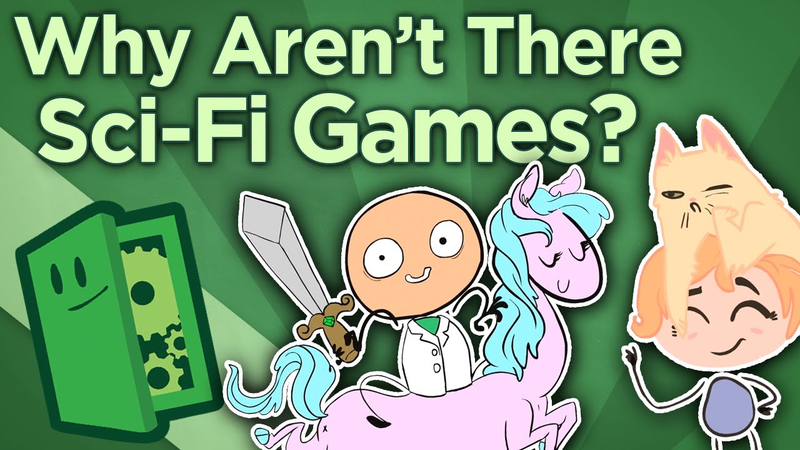
Why Aren't There Science Fiction Games? - The Philosophy of Fantasy vs. Sci-Fi - Extra Credits
Key insights
6 takeaways- 01Mechanical transference allows developers to bridge the gap between game worlds and reality by making complex mechanics feel mundane through repeated, intuitive interaction.
- 02By leveraging mechanical transference, developers can successfully shift the player's perspective, ultimately using science fiction to make mundane life feel marvelous.
- 03The gaming industry primarily produces 'science fantasy' rather than true science fiction, as most futuristic titles rely on magic-like suspension of disbelief rather than grounded engineering logic.
- 04True science fiction requires developers to make the marvelous seem mundane, a design challenge that contrasts with the creative freedom found in fantasy settings where mechanics do not require technical justification.
- 05Developers often avoid genuine science fiction because the need to ground technology in logic limits enemy diversity and imposes strict narrative constraints on game design.
- 06The industry fears that grounding high-tech elements in reality will diminish the player's sense of wonder, leading to a reliance on tropes like space-bound 'knights' instead of exploration of scientific concepts.
Ask AI about this video
Transcript
Okay, so I admit that the title is a little bit clickbait-y, and a lot of what I say here is going to be maybe nitpicky, but it points to something really interesting about the types of games we create. There are a lot of science-fantasy games out there, but we pretty much never create actual science fiction games. Also, by the way, this is Shar. She's our guest artist today, and she's great, so say hello. So, what do I mean by that question? Why aren't there science fiction video games? Well, first we'll have to define science fiction and science fantasy. I'm going to use a slightly looser definition of these things than most purists would, but in the broadest possible sense, it's the difference between Star Trek and Star Wars. Star Trek tries to make you feel like the things going on in each episode could happen in our universe. Sure, some of the events are fantastical, but in general, the goal is to make you buy in by having you believe in their technical possibility. In Star Trek, they want you to believe that a transporter could possibly be a device that might actually someday be made. They want you to
believe that faster-than-light travel was solved through an active engineering. Star Wars, on the other hand, simply wants you to embrace the force. You accept that it's just something that exists in that universe. You also just accept that sword fighting is a reasonable way to go about combat in a post-laser gun world. Sure, it may have robots and it may have spaceships, but at its heart, it's a fantasy adventure filled with magic where you believe in it because you love to believe in it. You don't actively conceptualize it as taking place in the same mundane universe that you yourself exist in, and this allows Star Wars to get away with hand-waving many, many things because they simply exist in this fantasy universe. They don't need explaining like stuff in the Star Trek universe does. In fact, you're better off not even trying to. John W. Campbell, perhaps the most important science fiction editor of all time, once said that science fiction should make the marvelous seem mundane, and then mundane life will seem marvelous. And that's the key distinction. Star Wars lets life in its universe remain marvelous, while Star Trek makes mundane
life seem marvelous by creating a universe where technology that seems marvelous to us is just mundane to the characters within the show. Now, again, these are extremely loose definitions of science fiction and science fantasy. In fact, there are a lot of people that would argue that Star Trek is also science fantasy because of story elements like the Q continuum, but whatever. For our purposes here, you get what I'm saying. Now, let's bring this all back around to video games. When you really look at it, even though it might seem at first like there's a flood of sci-fi games out there with all the spaceships, laser guns, and aliens you could ever want, almost all of those titles are actually science fantasy. They're almost all just fantasy stories in a setting that we think of as high-tech. Some of the more recent Final Fantasies are the easiest go-to examples for this, but even when you look at all the space marine games out there, those heroes aren't the alien-style corporate leathernecks of sci-fi. They're knights in space. Even games like Doom want us to just accept that there's a portal to hell on Mars rather than trying to convince us that this could possibly exist within the universe we know. And let me be clear, none of that makes
these games bad. I love so many of these games. Hey, I love science fantasy. Star Wars is great, but I also really like Star Trek. And I'd love to see some more games in the spirit of Star Trek or Dune, which goes out of its way to explain why knife fighting is important in its highly technological world in a way that Star Wars simply doesn't have to. The closest we've come in terms of narrative games have probably been things like Mass Effect, System Shock, and Fallout. And the reason for this goes back to the idea that science fiction asks that we believe in the improbable rather than simply embrace the impossible, which means that tasks like enemy design become much more difficult. If you look at the diversity of enemies in Mass Effect compared to the diversities of enemies in something like one of the modern Final Fantasies, you'll immediately notice that Final Fantasy has a ton of wildly varied enemies. Some of them are dragons, some of them are tanks, some of them are dogs. Why? No reason. It's fantasy. Doesn't need a reason. But in Mass Effect, you spend most of the game fighting humanoids or the vehicles they pilot. Why? Because you can believe in
these. If a dragon suddenly popped up in Mass Effect, it would totally blow you out of the immersion because Mass Effect requires the sci-fi form of buy-in that you believe what's going on is semi-possible. So, when they do stretch those limits, they've got to offer an explanation to build back that belief, which costs them some of the valuable limited narrative space that video games offer. Fallout on the other hand manages a little better in terms of enemy diversity because of the sheer scope of the game and because it manages to really cleverly cheat the problem by spending its time getting you to believe in one aspect of the story, nuclear war and the amazing power of nuclear radiation. And that allows them to justify basically anything else. Another reason we rarely create science fiction games is because we as an industry tend to be afraid of making things mundane. The argument goes that when watching characters on a screen or reading about them in a book, you're totally removed from them. So, seeing them treat marvelous things as mundane can make those things and the world therein all the more marvelous to us as detached viewers. But when we are the characters,
when we are the player, you can't pull that same trick. You can't make things mundane without making the world mundane. This is a view I disagree with though. Yes, it may be difficult, absolutely, but impossible? I don't think so. We just have to talk about how we use interaction to achieve it. Here, games have dangerous advantage. One of the easiest ways to make something in a game feel mundane is to have the player repeatedly interact with the same thing. I mean, anybody who has played Final Fantasy VII knows how mundane Bahamut Zero and Knights of the Round Materia become after a while. Unfortunately, this is the bad sort of mundanity, the type which doesn't make the universe seem all the more magical because people in it take such amazing wonders for granted. So, what does good mundanity look like? Well, have you ever started seeing the real world through the lens of a game you enjoyed, wishing you had some power or gizmo from the game in everyday situations? Like maybe after countless hours of Assassin's Creed, you look at a building outside and you think, that would be amazing to climb. Or maybe you wanted to get a soda from
the fridge and you thought to yourself, this would be so much easier if I had a portal gun. That's called mechanical transference and that makes an aspect of the game become mundane in a way that makes the game world seem that much more magical. If we can figure out ways to achieve the right kind of marvel through mundanity in our games, maybe we can start exploring all the possibilities that science fiction offers us. Because as much as I love science fantasy and I will happily play another thousand science fantasy games, there are so many interesting stories we haven't explored because we have such a hard time creating sci-fi. Again, I know I've been super loose with the terminology and it's actually really easy to argue that Mass Effect is actually a space opera and that System Shock has elements of horror fantasy. And fine, sure. I will happily delve into quibbling about how we subdivide and categorize our games after we figured out how to overcome that central divide between these two larger categories in our medium. I hope you've enjoyed this sci-fi talk. I am sure we will do it again sometime. James has actually had an episode on philosophical sci-fi games rattling in his brain for years and if he ever
magically finds time to replay Zen Gears, maybe that'll actually happen. But until then, thank you again Shar for the help and I will see you next week.
Summary
The video industry analysis argues that while the gaming landscape is saturated with titles featuring futuristic technology, spaceships, and laser weaponry, the medium lacks true science fiction, instead offering almost exclusively science fantasy. The core distinction lies in the philosophical approach to world-building: science fantasy, akin to Star Wars, relies on "magic" and the suspension of disbelief, whereas science fiction, exemplified by Star Trek, seeks to make the marvelous seem mundane by grounding technology in a sense of technical possibility and engineering logic.
The analysis posits that the industry struggles to produce genuine science fiction because of the narrative and design constraints it imposes. Science fiction requires players to believe in the improbable, which limits enemy diversity and requires significant narrative investment to justify the existence of game elements. In contrast, fantasy settings allow developers to bypass these explanations, granting them greater creative freedom. Furthermore, developers often fear that making high-tech elements feel mundane will diminish the player's sense of wonder.
However, the analysis contends that this challenge is not insurmountable. By utilizing "mechanical transference"—the phenomenon where players begin to view their real-world environment through the lens of a game’s mechanics—developers can successfully make the marvelous feel mundane. When a player repeatedly interacts with a game mechanic until it becomes second nature, that mechanic integrates into their perception of reality, effectively bridging the gap between the game world and the player's own. The industry is encouraged to move beyond the tropes of space-bound "knights" and explore the untapped potential of science fiction, which offers a unique capacity to make mundane life seem truly marvelous through thoughtful, grounded interaction.


















Comments