Game Development reports and market data
Documents
PlayJob Podcast #1: Jay Armstrong
The independent game development landscape demands a rigorous balance between creative ambition and operational discipline.
- Market saturation requires a highly polished initial product launch, as post-launch updates are no longer sufficient to guarantee visibility or consumer trust.
- Commercial success in the indie sector is not guaranteed by critical acclaim or influencer coverage, necessitating a focus on sustainable development cadences and robust professional support networks.
- Strategic multi-platform execution across PC, consoles, and mobile is essential for maximizing reach and operational efficiency in the current distribution landscape.
Raid on Rise: Narrative Creation on Rise of The Tomb Raider
The narrative development of Rise of the Tomb Raider centers on a collaborative, cross-disciplinary framework that rejects isolated creative silos in favor of studio-wide world-building.
- Crystal Dynamics utilizes a 'story pillar' framework for narrative development, centered on a three-act structure where the protagonist's character arc serves as the primary backbone of the entire experience.
- The narrative team employs a holistic tracking system using digital boards and hashtags to map out all character arcs and plot threads, allowing them to proactively manage emotional pacing and identify potential narrative logjams.
- To ensure internal consistency and world-building veracity, the team conducts deep research into historical and archaeological subjects, aiming for 'plausible Google-ability' so players can verify game elements against real-world facts.
Let's Be Honest About Indie Game Development — Q&A
This analysis explores the realities of independent game development, focusing on marketing, professional discipline, and the psychological management of creative work.
- Success in a saturated market requires shifting from passive promotion to interactive community engagement, such as crowdsourcing character names or design choices to foster organic growth.
- Relying exclusively on Steam is no longer a viable distribution strategy due to the high volume of annual releases, making platforms like the Nintendo Switch more attractive for discoverability and revenue.
- Developers should decouple their personal identity from their creative output to treat public criticism as a neutral tool for professional growth rather than a personal attack.

Making Games Is Just Like Making Pizza.
The process of independent game development mirrors the complexities of culinary preparation, requiring a balance between individual creative control and the efficiency of collaborative efforts.
- Independent development requires balancing the total autonomy of solo work, which extends timelines, against the faster production cycles and diverse skill sets offered by team-based collaboration.
- Managing multiple concurrent projects, specifically 'Will You Snail', 'Ovus Nova', and an undisclosed university project, creates a high risk of burnout that necessitates a shift toward long-term viability over immediate output.
- The 'Will You Snail' project is the primary focus, utilizing a simplified core design to avoid the market appeal and design issues that hindered the secondary project, 'Ovus Nova'.
The Sound of GoNNER: Exploring the Intertwined Relationship Between Sound and Game Design
The development of the roguelike platformer GoNNER serves as a case study for the symbiotic relationship between sound design and game mechanics.
- The development of GoNNER relied on a rapid, iterative workflow where the team prioritized speed over perfection, operating under the motto: 'If you can't do it quickly enough, there's probably a better way.'
- The project utilized a 'placeholder' philosophy for both sound and design, which reduced creative friction and allowed the team to experiment freely without the pressure of finality.
- The audio-visual feedback loop involved the sound designer generating hundreds of synth-based sounds in short bursts, which were then rapidly implemented and tested by the game designer to see what felt satisfying in the moment.
Procedurally Generating History in Caves of Qud
The procedural history system in Caves of Qud prioritizes the creation of evocative, mythic narratives over the implementation of a computationally expensive, bottom-up historical simulation.
- Caves of Qud prioritizes evocative, mythic narrative generation over computationally expensive, bottom-up historical simulations.
- The system focuses on the lives of five ancient Sultans, using their biographies as the foundation for world-building artifacts like shrines and paintings.
- Historical complexity is managed through a constrained set of exactly twelve specific triggers that govern life events and faction relationships.
Libro Blanco del Desarrollo de Videojuegos en la Comunidad Valenciana 2018
The "Libro Blanco del Desarrollo de Videojuegos en la Comunidad Valenciana 2018" provides a comprehensive analysis of the video game development sector within the Valencian Community, Spain, focusing on its status in 2017 and projecting future trends.
- As of 2017, the Valencian video game industry comprised 90 studios—60 established and 30 emerging—generating 10.1 million euros in revenue and employing 466 professionals.
- The sector is in a transition phase, aiming to double its annual revenue to 20 million euros by 2020 by scaling from experimental micro-enterprises into a globally competitive market.
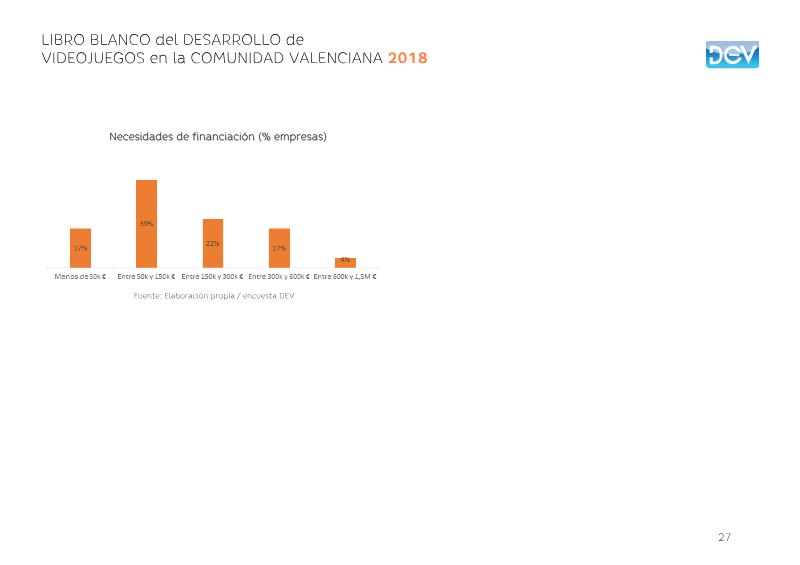
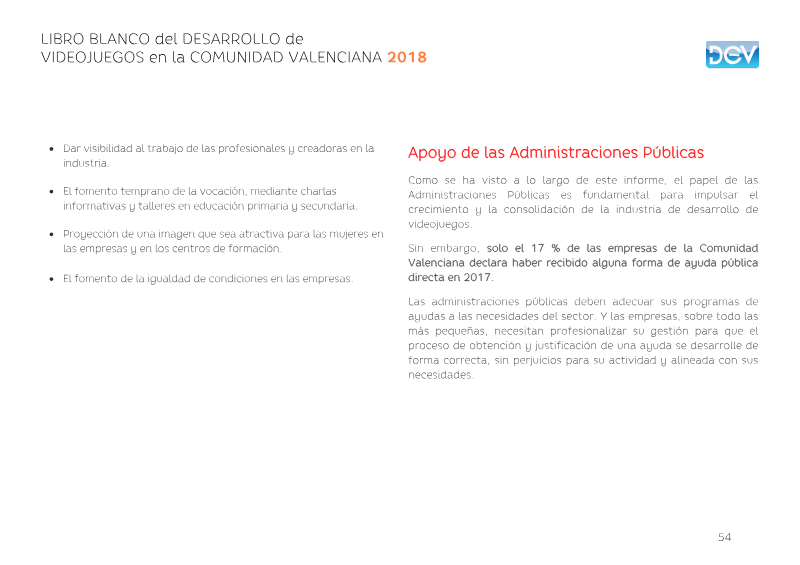
- Structural growth is hindered by a reliance on self-financing and founder capital, necessitating a shift toward professional business management and increased access to private investment.
Move or Die: Why It's Worth It to Chase Your Tail
The success of the multiplayer title Move or Die demonstrates that long-term viability in the independent games market relies on a symbiotic relationship between developers and their community.
- Success for 'Move or Die' was not driven by a single event, but by a continuous stream of updates, community engagement, and strategic marketing over a two-year period that resulted in over 500,000 players.
- Early Access was used as a financial necessity rather than a design choice, with the developer maintaining transparency by explicitly instructing players not to buy the game until it was polished.
- Strategic collaborations, such as integrating Rick and Morty characters, were timed to coincide with external events like the Steam Summer Sale to maximize visibility and press coverage.
Architecting a Multiverse - Cooperative Design in Dead Space 3
The integration of cooperative play into the Dead Space franchise required a sophisticated architectural approach to preserve the series' signature horror atmosphere while accommodating two simultaneous players.
- Developers implemented a multiverse narrative structure to enable seamless transitions between solo and cooperative campaigns without requiring a complete overhaul of existing game systems.
- The team utilized desynchronized assets to trigger character-specific hallucinations, allowing players to experience fractured realities independently to maintain the series' signature sense of isolation and horror.
- Memory management was optimized through modified door-streaming logic, which allowed for stable technical performance while supporting the addition of cooperative-specific content.
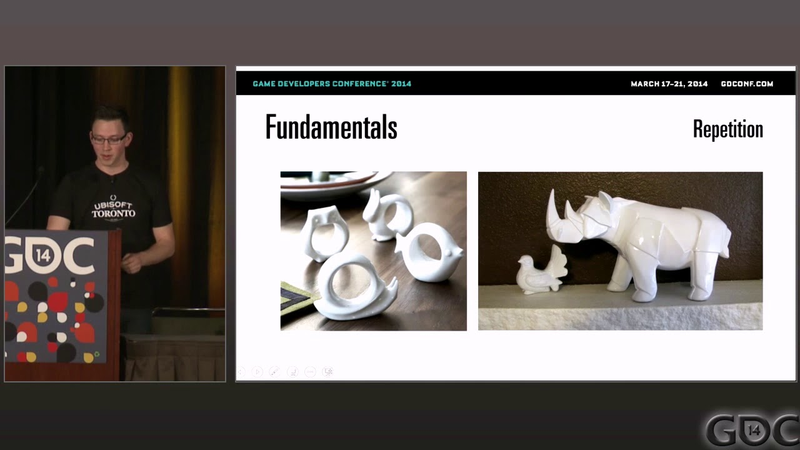
What Modern Interior Design Teaches Us About Environment Art
Modern interior design offers a robust framework for environment artists to improve the clarity, flow, and narrative quality of game spaces.
- Environment artists should shift from 2D-focused film and game references to 3D interior design principles to better balance aesthetic form with functional player navigation.
- Design principles such as lighting, contrast, and emphasis can be used to intuitively guide player behavior and highlight interactive elements without relying on heavy-handed visual cues.
- Applying the 60-30-10 color rule helps maintain visual balance and prevents environments from becoming cluttered or overwhelming.
How To Raise $100,000 On Kickstarter
Achieving a six-figure crowdfunding goal for video game development requires a strategic blend of technical preparation, rigorous research, and emotional transparency.
- Successful crowdfunding relies on emotional transparency, where creators build trust by sharing personal struggles and vulnerabilities to foster a community-supported endeavor rather than a simple transaction.
- Campaigns require a two-to-three-month preparation period dedicated to rigorous research and outreach to creators of previously successful projects.
- Developers must produce a highly polished, small-scale prototype before launching to demonstrate technical competency and establish professional credibility.
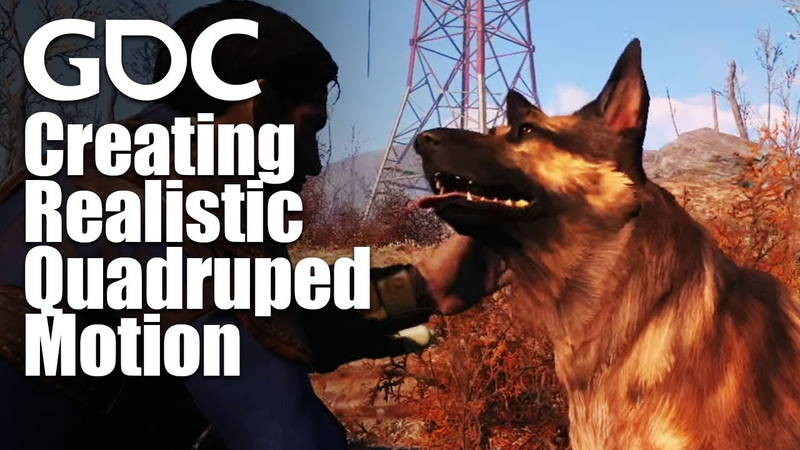
On All Fours: Creating Realistic Quadruped Motion
This presentation outlines a practical, performance-oriented approach to animating quadruped locomotion within real-time environments, specifically developed for the Microsoft HoloLens.
- Realistic quadruped locomotion in resource-constrained environments like the Microsoft HoloLens is best achieved through procedural spine manipulation rather than computationally expensive full-body inverse kinematics.
- Path generation for quadrupeds requires a two-stage process: an initial A search followed by refinement using the Chambolle-Pock primal-dual optimization algorithm to ensure waypoints remain within valid navigation nodes.
- Spine flexing, a technique that uniformly rotates spine bones to align the character's body with path curvature, provides more fluid movement than blending canned animations, which often suffer from transition and positioning errors.