Game Development reports and market data
Documents
The Missing Link - Bungie's Technical Designers in Animation
The role of the Technical Designer in Animation (TDIA) serves as a critical cross-disciplinary bridge within Bungie’s development structure, specifically designed to facilitate communication and workflow between animation, design, and engineering teams.
- Bungie established the Technical Designer in Animation (TDIA) role to act as a cross-disciplinary bridge, eliminating production silos between animation, design, and engineering teams.
- The TDIA role focuses on liberating creative talent by managing complex technical tasks such as vehicle interaction, AI state machine setup, and runtime debugging.
- By providing real-time debugging tools and simplifying the transition from Maya to the game engine, TDIA professionals reduce production costs and prevent technical bottlenecks.
A Long Dark Road: Blending Player and Authored Story in a Sandbox Survival Game
The development of The Long Dark illustrates the complex tension between authored narrative and emergent, player-driven gameplay within the sandbox survival genre.
- Hinterland Games separated 'The Long Dark' into distinct sandbox and story modes to allow for an Early Access launch without spoiling narrative content, a strategy that resulted in 250,000 players in the first three months and 500,000 within the first year.
- The long-term separation of sandbox and story modes created a dissonance in player expectations, as the sandbox community became accustomed to a non-narrative experience and resisted the shift toward a more linear, authored story.
- Development of a narrative mode in a sandbox game should ideally integrate with existing systems rather than creating a split experience, as seen in titles like 'Subnautica' and 'The Forest' which successfully blended both approaches.

Tools Tutorial Day: Tools to Reduce Open Bug Count at Media Molecule
Media Molecule maintains a highly stable development environment for user-generated content titles by prioritizing engine determinism and integrating bespoke automation tools.
- Media Molecule achieves high stability by enforcing engine-level determinism, which allows for the serialization of game states and inputs to ensure reliable bug reproduction.
- The 'Autobot' automation system utilizes a large-scale farm of development kits to continuously monitor for crashes and hangs across the build environment.
- A custom web dashboard and Chrome extension integrate Jira and Perforce to automatically populate bug reports with critical diagnostic data, including call stacks, performance metrics, and video replays.

How To Market Your Indie Game — Exclusive SCAD Panel Discussion
The modern indie game landscape has shifted from a purely creative endeavor into a highly competitive business environment where technical quality no longer guarantees commercial viability.
- Success in the current indie market requires treating marketing as a core business skill rather than an afterthought, as technical quality alone no longer guarantees commercial viability.
- Developers should avoid broad audience targeting in favor of identifying a specific niche and cultivating a dedicated community of evangelists through authentic, personal storytelling early in development.
- Building genuine, long-term relationships with influencers and streamers is more effective for organic reach than relying on standard promotional posts.
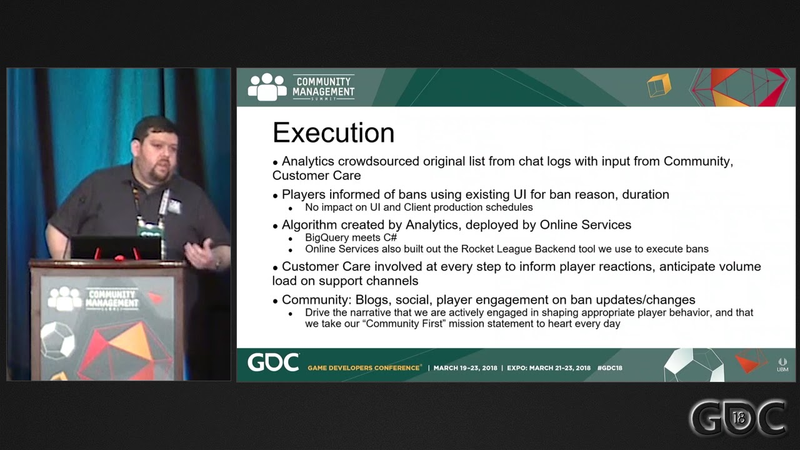
Rocket League: Language Ban System Postmortem
To combat rising toxicity within Rocket League, Psyonix implemented an automated, data-driven moderation framework designed to enforce community standards through tiered, escalating penalties.
- Psyonix implemented an automated language ban system for Rocket League that uses a data-driven 'gram' threshold, where players are escalated through a penalty ladder starting at 24 hours up to two weeks for repeated offenses.
- The system relies on active player reports rather than proactive chat scanning, allowing for context-dependent moderation that avoids penalizing friends who use informal language within private parties.
- To encourage behavior modification, the system includes a de-escalation mechanic where players who maintain good conduct for 30 days see their strike count reduced, preventing long-term accumulation of penalties for one-off incidents.
Tools-Based Rigging in Bungie's Destiny
Bungie’s approach to character rigging for the Destiny franchise centers on a modular, Python-based architecture designed to overcome the limitations of traditional, static animation pipelines.
- Bungie developed a modular rigging system for Destiny using Python and Pymel in Autodesk Maya, utilizing object-oriented programming to manage thousands of animation files efficiently.
- The rigging architecture relies on 'rig components'—independent, reusable Python classes that can be added or removed from a character's rig dynamically without breaking existing animation data.
- To maintain agility during engine development, the team implemented a 'rig template' system that assembles these modular components into complete control rigs for characters, vehicles, and props.
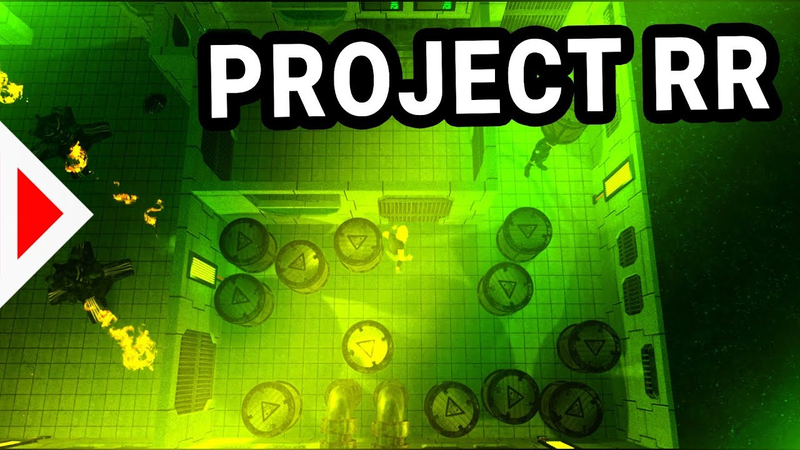
Get Feedback For Your Indie Games!... #010
The primary objective of this analysis is to evaluate the design philosophy of the indie stealth game Project RR, emphasizing the importance of establishing a clear game identity to guide development decisions.
- Developers should prioritize a cohesive game identity over conventional design rules, even if that requires incorporating elements traditionally viewed as frustrating or unfair.
- In Project RR, retaining map progress across restarts transforms the gameplay from a single-run challenge into a puzzle-solving experience based on repeated exploration.
- The developer must balance trial-and-error loops with predictable execution, ensuring that once a player masters a level, success is determined by skill rather than inconsistent AI behavior.

Global Illumination in Tom Clancy's The Division
The Snowdrop engine utilizes a sophisticated, probe-based global illumination system to facilitate dynamic lighting within the expansive, open-world environment of Tom Clancy's The Division.
- Ubisoft Massive utilized a Precomputed Radiance Transfer (PRT) system within the Snowdrop engine to achieve dynamic global illumination, allowing for a full day/night cycle without the need for static light maps or UV unwrapping.
- The system organizes light probes into 2D grid sectors of 64x64 meters, typically containing 300 to 400 probes, with a maximum capacity of 1,000 probes per sector.
- To manage memory and performance, the engine stores sky visibility per probe and uses irradiance bricks to define light influence, resulting in a total lighting data footprint of approximately 1 gigabyte.
History Shaping Design: Inequality and Player Behavior
Game design functions as a powerful laboratory for behavioral economics, where psychological heuristics like loss aversion and hindsight bias dictate how players perceive value, risk, and agency.
- Designers leverage loss aversion, where players feel the pain of loss twice as intensely as equivalent gains, to drive engagement through inventory hoarding and reward structures.
- Systemic inequality in virtual environments causes players in dominant positions to develop an empathy gap, which reduces cooperative behavior and social cohesion.
- When game systems mirror real-world socioeconomic disparities, they trigger feelings of helplessness and disengagement, often turning intrinsic play into perceived digital labor.

Crackpot AI Devs: Unproven Game AI Techniques that Might Possibly Work
Game development is currently undergoing a paradigm shift toward unconventional, data-driven artificial intelligence techniques that prioritize emergent behavior and procedural narrative control.
- Developers are shifting from scripted logic to data-driven AI that uses recorded human gameplay snippets and crossover points to emulate authentic player behavior.
- Cross-genre data harvesting allows player actions from one game title to serve as foundational training input for AI systems in entirely different gaming experiences.
- AI managers are being designed to function as automated game masters, dynamically adjusting difficulty and encounter pacing to maintain a curated emotional arc for the player.

Extrasolar Postmortem: Game Design at 0.0003 FPS
Extrasolar is an unconventional, web-based narrative experience that simulates the exploration of an alien planet through a series of delayed, non-real-time interactions.
- Lazy 8 Studios developed Extrasolar, a web-based narrative experience, over a three-and-a-half-year cycle with a budget of approximately $600,000.
- The game intentionally rejects real-time performance metrics, rendering images in the cloud at a rate of one frame per hour to prioritize narrative immersion.
- Designers successfully utilized non-game experts, such as biologists, to ground the alien planet simulation in scientific realism, which contributed to high player retention rates.

Tomb Raider Rebooted: Audio Reimagined
The 2013 Tomb Raider reboot represents a fundamental shift in game audio design, moving away from generic, weapon-centric soundscapes toward a character-driven model rooted in Lara Croft’s emotional evolution.
- The 2013 Tomb Raider reboot shifted audio design from generic weapon-centric soundscapes to a character-driven model that mirrors Lara Croft’s psychological transition from vulnerable survivor to confident hero.
- Development teams abandoned standard asset libraries in favor of bespoke, context-specific recordings to ensure every sonic element served as a narrative pillar.
- The audio system utilized a modular, reactive architecture, including complex weapon layering—such as using rubber tubing for bow sounds—and real-time ambient ducking to maintain sonic clarity.