Game Development reports and market data
Documents

The First AI Game Creator's Brutal Truth About Game Dev
Modern game development is undergoing a fundamental shift where the focus is moving away from technological novelty toward the mastery of player-centric design.
- In the gaming industry, the difference between an 80% finished game and a 100% polished, high-quality product is not linear; the 100% version can generate $100 million in revenue while the 80% version may only earn $10,000.
- AI is highly effective for non-creative technical tasks like writing SQL queries and managing data dashboards, providing a 20–30x speed increase in those specific workflows.
- Using AI for core game architecture is a high-skill endeavor because the probabilistic nature of AI can introduce technical debt and broken code if the developer lacks deep knowledge of the underlying interfaces and system constraints.
Interview with Dispatch developer: We were told comedy games don't sell
The interactive narrative game Dispatch serves as a compelling case study in challenging industry orthodoxy regarding the commercial viability of comedy and narrative-driven titles.
- Dispatch achieved commercial and critical success with over four million sales and nine BAFTA nominations, despite industry skepticism regarding the viability of comedy-focused narrative games.
- The studio successfully utilized an episodic release model to maintain high player engagement and completion rates throughout the product's lifecycle.
- After losing an initial publishing partner, the studio pivoted to self-publishing, using a high-impact trailer at The Game Awards to secure investor confidence and retain creative control.

Let's Review Your Games — Ep. 044
The indie game development landscape requires a rigorous focus on technical polish, atmospheric cohesion, and precise marketing to succeed in a crowded marketplace.
- Marketing materials must feature a 'trinity hook' that integrates mechanical, visual, and narrative elements within the first few seconds of a trailer to capture player interest.
- Technical friction, such as unresponsive movement, inconsistent lighting, and poor navigation, must be eliminated to prevent player frustration and maintain engagement.
- Steam presence requires high-quality, legible screenshots and immediate communication of narrative stakes rather than relying on ambiguous capsule art or slow-paced exposition.

We Need To Talk About My Game "Twisted Tower" (5 Years Later)
After five years of development, the indie game Twisted Tower has reached a feature-complete state and is currently undergoing beta testing.
- After five years of development, Thomas Brush’s narrative-driven indie title Twisted Tower is currently feature-complete and undergoing beta testing.
- The project transitioned from initial publisher support by 3D Realms to self-funding through community contributions and educational course sales due to extended development timelines reaching into 2026.
- The developer employs a tiered beta testing strategy that scales from a small initial group to approximately 1,000 users to validate narrative resonance and game mechanics.

TWIG #376: Epic's Failed Bet, Roblox's Brand Fee & Google’s Level Up
Google’s Level Up program represents a strategic effort to increase platform engagement by offering developers a 5% fee reduction in exchange for integrating features like cloud saves and the Sidekick overlay.
- Epic Games has laid off 20–25% of its workforce following a strategic pivot that diverted excessive resources toward legal battles against mobile gatekeepers at the expense of Fortnite's engagement.
- Epic is attempting to stabilize its business by transitioning Fortnite into a creator-led entertainment ecosystem, though the financial viability of this model remains unproven.
- Google’s 'Level Up' program offers developers a 5% fee reduction for integrating cloud saves and the Sidekick overlay, though these margin gains are expected to be offset by rising user acquisition costs.

He Knew Nothing About Making Games... Then Sold 67,000 Copies (w/ Sebastian Drews) — Ep 64
The successful launch of the Metroidvania title Constance, which achieved over 67,000 copies sold and an 86% positive rating on Steam, serves as a case study for balancing creative ambition with the practical constraints of independent game development.
- Sebastian Drews successfully launched the Metroidvania game 'Constance' and sold 67,000 copies despite having no prior professional game development experience.
- Marketing a new title by comparing it to established hits like 'Hollow Knight' can drive initial interest, but developers must clearly differentiate their unique mechanics to avoid negative reviews from players expecting a direct clone.
- Development teams should prioritize formal Quality Assurance (QA) early in the production cycle rather than delaying it until the final stages, as late-stage testing often leaves insufficient time to address critical issues.
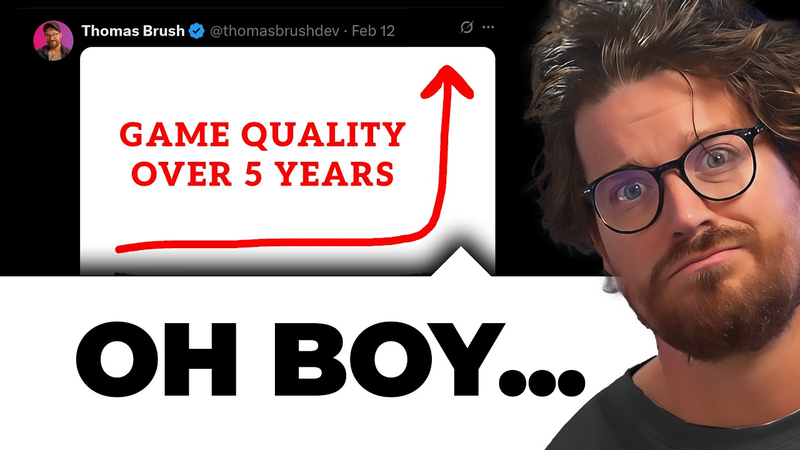
Want To Make Games? You MUST See This Graph First...
The development of a video game often follows a non-linear trajectory characterized by a prolonged period of stagnation followed by a sudden, exponential increase in quality and cohesion, a phenomenon described as the Frankenstein moment.
- Game development often follows a 'Frankenstein moment' trajectory, where a project feels stagnant and low-quality for an extended period before suddenly reaching a threshold of viability and life.
- The development process is akin to an archaeological dig, characterized by cycles of finding small, exciting features followed by periods of doubt and declining confidence.
- To accelerate development and improve quality, developers must seek feedback from two specific sources: real players who identify usability issues and seasoned industry veterans who provide high-impact, 'explosive' solutions.

Let's Review Your Games — Ep. 043
Independent horror game development relies heavily on the synergy between atmospheric immersion and intuitive mechanical feedback.
- Game design does not require perfection to achieve commercial success, as evidenced by the developer's ability to generate full-time income and build wealth from titles with mediocre design.
- Player feedback during playtesting is subjective, and a developer should not necessarily change game mechanics based on a single user's confusion if the majority of players understand the system.
- Horror games benefit from clear, visceral feedback mechanisms; for example, using physical consequences like simulated injury or screen effects helps players confirm when they have made a mistake.
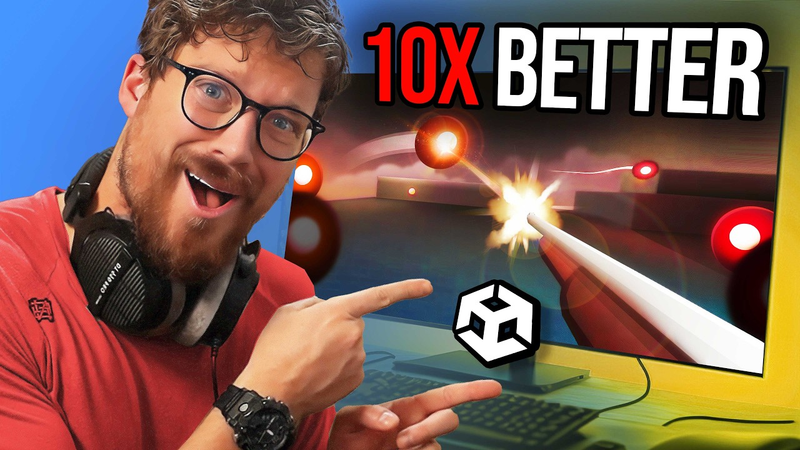
The Secret Trick To Instantly Make Your Game FUN
The primary objective is to demonstrate how to enhance the "fun factor" of a game through iterative, low-level adjustments to game feel and presentation, rather than altering core mechanics.
- Prioritize player movement feel early in development, as adjusting variables like bounce and speed can significantly enhance the 'fun factor' without altering core mechanics.
- Maintain consistent scale by ensuring the character controller height is exactly twice the size of a primitive cube to ensure platforming feels intuitive.
- Use animator trees to centralize control over movement states, jump animations, and sound triggers, allowing for iterative fine-tuning of game feel.
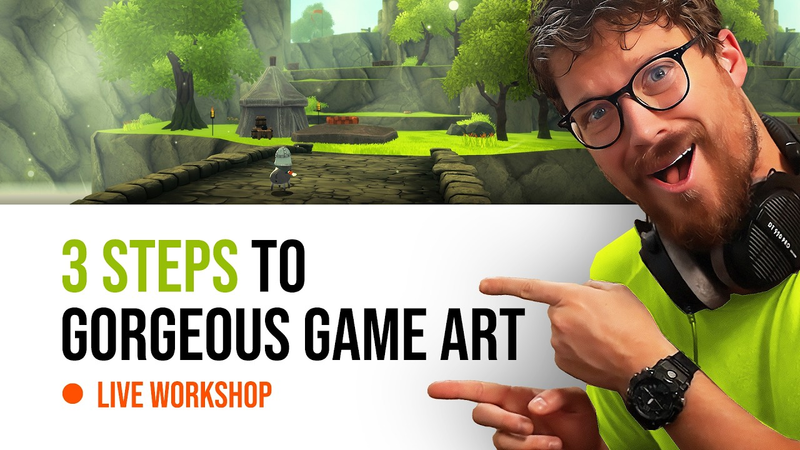
3 Steps To Gorgeous Game Art (With NO Modeling Skills) - Live Workshop
High-quality game environments are achievable without advanced 3D modeling skills by prioritizing foundational design principles over technical complexity.
- Effective game art relies on five core principles: scale, asset distribution, color, lighting, and sound, all of which can be applied to simple primitive shapes like cubes and spheres to create a polished aesthetic.
- Proper scale is essential for defining the player's relationship to the environment; using consistent reference objects, such as a humanoid character or standardized furniture, prevents visual confusion regarding world size.
- Avoid uniform spacing by arranging assets in natural clusters or groups, as this mimics organic environments and prevents the unnatural appearance of isolated, 'socially distanced' objects.

Want To Make Indie Games? Fix These 10 Things In Your Game NOW
Retention is the most critical metric for the success of indie games, as it directly influences platform algorithms and overall sales.
- The median playtime for Steam game demos is only 14 minutes, making early player retention the most critical metric for driving algorithm visibility and sales.
- Onboarding must be intuitive and avoid walls of text; players should learn mechanics through gameplay without feeling overwhelmed or unintelligent.
- Developers should front-load their games with 'triggered sequences'—frequent, reactive environmental events—to keep players engaged during the critical first 14 minutes.
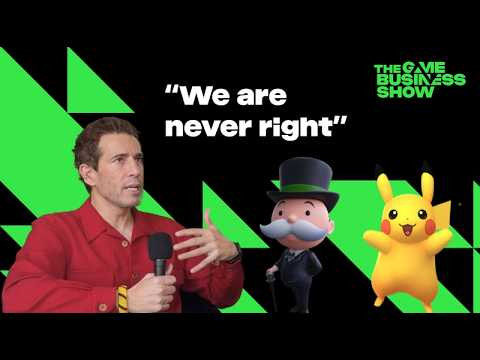
Pokemon Go owner: There’s less of a need for new games
Scopely co-CEO Javier Ferreira provides an analytical overview of the current mobile gaming landscape, emphasizing that while the market has reached unprecedented scale, the requirements for success have shifted significantly.
- The mobile gaming market has shifted from rapid user acquisition to a focus on longevity, with 80% of Scopely’s revenue now generated by players who have engaged with their titles for over a year.
- Scopely has reached $15 billion in lifetime revenue and 2 billion downloads, anchored by six distinct billion-dollar franchises including the recent hit Monopoly Go.
- Market maturity has reduced the demand for new, transient game titles, placing a higher premium on the development of exceptional, long-term player experiences.