Game Design reports and market data
Documents
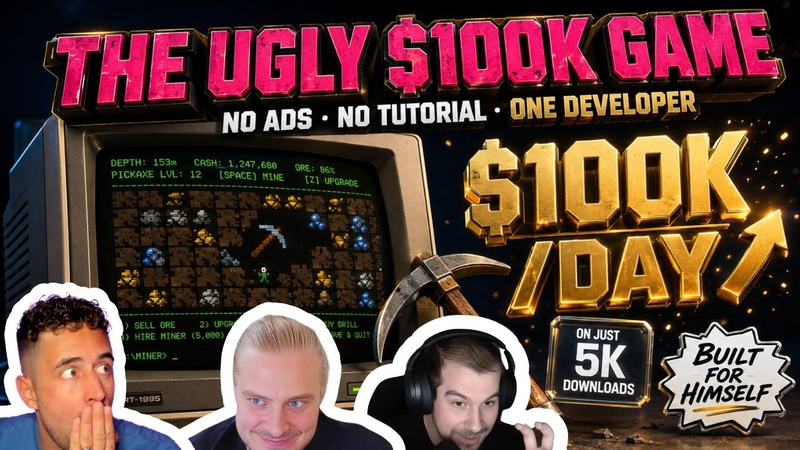
⛏️ One Guy, No Ads, No Tutorial, $100K/Day: The Idle Obelisk Miner Story
Idle Obelisk Miner represents a significant departure from contemporary mobile gaming standards, demonstrating that a solo-developed title can achieve exceptional financial performance by rejecting industry-standard monetization and design tropes.
- Idle Obelisk Miner generates approximately $100,000 in daily revenue from only 4,000 to 5,000 daily downloads, resulting in a high revenue-per-download figure of roughly $13.
- The game achieves financial success by rejecting industry-standard monetization, specifically eschewing intrusive advertisements and predatory pop-ups in favor of a player-friendly economic model.
- The title sustains a base of 50,000 daily active users and a Discord community of over 57,000 members by prioritizing deep, complex progression mechanics over mass-market accessibility.

The Miraculous Story Behind Baldur’s Gate 3
The development and release of Baldur’s Gate 3 represents a significant anomaly in the modern video game industry, characterized by a complex history of licensing, financial instability, and creative perseverance.
- Larian Studios' success with Baldur's Gate 3 is attributed to its status as a rare, large-scale, privately owned developer, which allows it to avoid the short-term pressures of quarterly earnings and investor demands faced by publicly traded companies.
- The development of Baldur's Gate 3 required a massive scaling effort, with the studio growing its workforce from 140 to 450 employees to manage the complex production pipeline required for full cinematic integration.
- Baldur's Gate 3 has achieved significant commercial success, selling over 20 million copies and winning multiple Game of the Year awards despite facing major external challenges, including the COVID-19 pandemic and the forced relocation of staff due to the 2022 Russian invasion of Ukraine.

Universes Beyond comes to Dungeons & Dragons | Design Club
Wizards of the Coast is aggressively pivoting the Dungeons & Dragons brand to meet the high-growth revenue expectations set by parent company Hasbro.
- Wizards of the Coast is shifting Dungeons & Dragons toward a high-volume product model to meet Hasbro’s aggressive revenue growth expectations.
- The strategy mirrors Magic: The Gathering by integrating external franchises into the fifth edition ruleset through the Universes Beyond initiative.
- The World of Warcraft expansion serves as the flagship for this model, providing modular toolkits of species, classes, and dungeons designed to overlay onto existing campaigns.
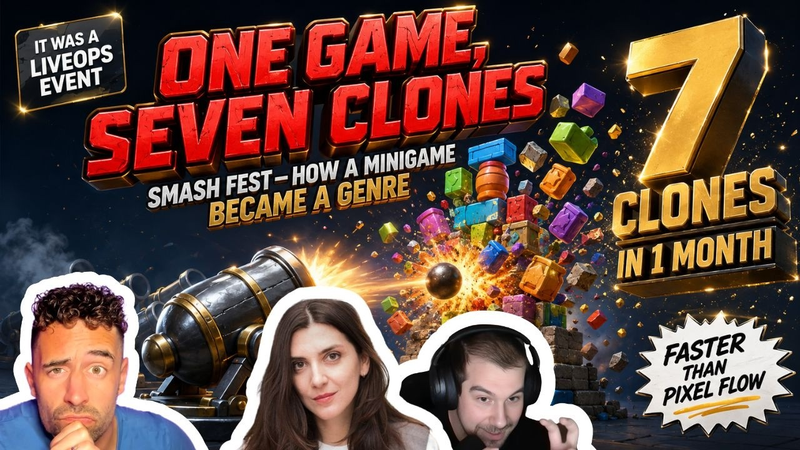
💣 How Smash Fest created a NEW Puzzle category overnight
The mobile gaming industry is currently witnessing the rapid emergence of a new physics-based puzzle sub-genre, catalyzed by the success of minigame mechanics originally featured in established titles like Toon Blast.
- The physics-based puzzle sub-genre emerged by isolating and scaling successful minigame mechanics—specifically projectile-based structure toppling—previously used as temporary LiveOps events in games like Toon Blast.
- Market leader Smash Fest achieved significant scale with approximately 300,000 daily downloads and nearly $1 million in daily revenue generated through a hybrid model of in-app purchases and advertising.
- The category is characterized by high volatility and rapid competition, as seen when successors like Royal Smash moved to capture market share following the removal of early frontrunners from major app stores.
Our New Game "Didn't Meet Expectations"
The development of a new indie title, codenamed Dodo Derby, serves as a case study in the challenges of game design and the importance of adhering to established development philosophies.
- Prioritizing a strong, clear 'fantasy' or core concept at the start of development is essential for the studio's success, as projects lacking this foundation often lead to aimless prototyping and eventual cancellation.
- The studio cancelled 'Dodo Derby' after six months of development because the gameplay-first approach resulted in unintuitive rules and a high skill gap that could not be resolved without over-complicating the design.
- Development teams often fall into the trap of 'echo chamber' testing, where playing exclusively with the same small group masks usability issues and lack of accessibility for broader audiences.
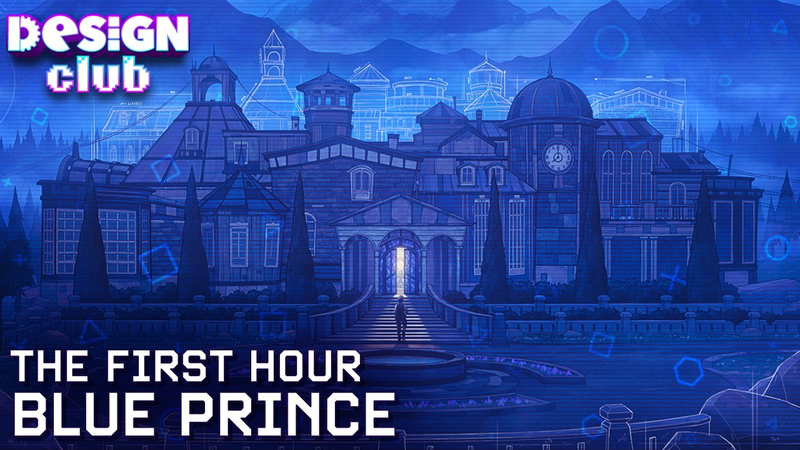
The First Hour: Blue Prince | Design Club
Blue Prince functions as a sophisticated puzzle-roguelike that challenges players to navigate a procedurally generated manor through a rigorous system of resource management and spatial logic.
- Blue Prince is a strategy-heavy puzzle game where players navigate a 46-room manor, managing a limited resource pool of 50 footsteps per run to uncover specific objectives.
- The game features a drafting mechanic where players click on doors to generate three potential floor plan options, though certain items allow for rerolls if the initial choices are unfavorable.
- Resource management is central to gameplay, requiring players to balance the acquisition of items like keys, gems, and coins against the cost of room transitions and specific environmental interactions.
Too many 'compulsion loops' in PC games?
Vertical video has emerged as a critical driver for game discovery, fundamentally altering how developers approach marketing and audience acquisition.
- Influencers are currently the primary source of traffic for Steam games, particularly for strategy, tactics, and roguelike titles, making them essential partners for developers.
- Vertical video has surpassed horizontal video in internet consumption, necessitating that developers consider how their game visuals appear when cropped for platforms like TikTok and Instagram.
- Technical performance on mid-level PC hardware is critical for launch success, as evidenced by the negative reception of the Marvel Tokon: Fighting Souls open beta due to poor optimization.
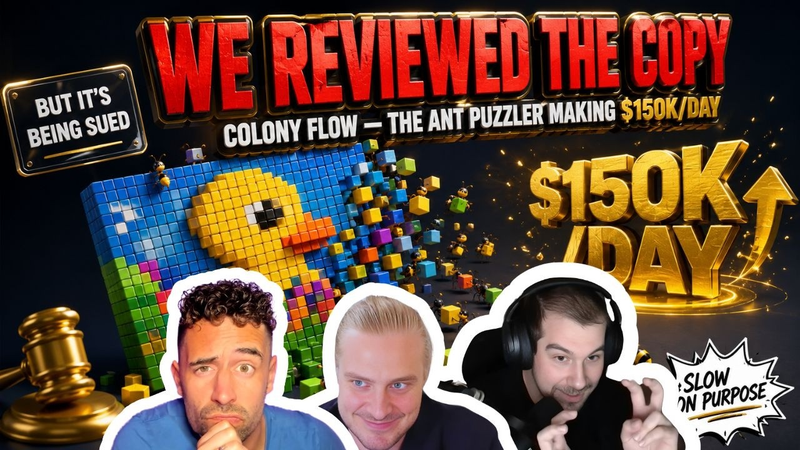
🐜 Colony Flow Breakdown: The Ant Puzzler getting sued & already taken DOWN from Android!
Colony Flow, a mobile puzzle game developed by ABI Games, represents a significant case study in the high-stakes, high-volume landscape of the casual gaming market.
- ABI Games' title Colony Flow was removed from the Android marketplace following a lawsuit from Famfinity, which alleges the game is a direct clone of its title, Food Hunt Pixel Puzzle.
- Colony Flow achieved rapid scale after its June launch, reaching 150,000 daily installs within two months.
- The game generated approximately $150,000 in daily in-app purchase revenue, supplemented by additional income from advertisements.
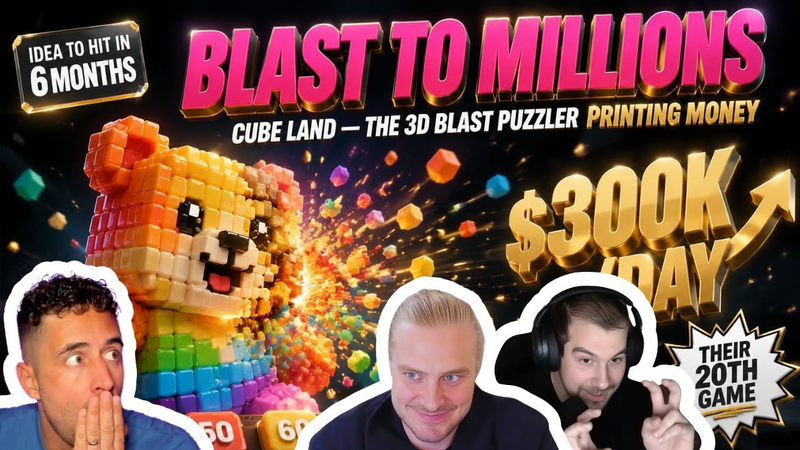
🧊 Cube Land: How RotateLab went from idea to $300K/Day in Just 6 Months
RotateLab has achieved significant commercial success with the 3D voxel blast puzzler Cube Land, scaling the title to approximately $300,000 in daily revenue within six months of its early 2026 launch.
- RotateLab scaled Cube Land to $300,000 in daily revenue within six months of its early 2026 launch.
- The studio achieved this success by testing approximately 20 prototypes before identifying the viable hit, validating a high-volume, iterative development philosophy.
- RotateLab allocates 90% to 95% of its advertising budget to AppLovin, citing a lack of necessary attribution infrastructure on alternative platforms like Meta for their hybrid monetization model.
The Evolution of Sort Puzzle: From Color Loops to Hybrid Formats
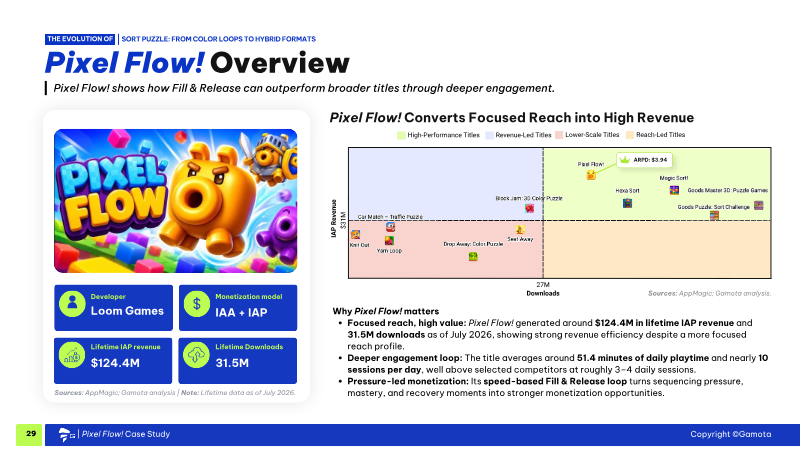
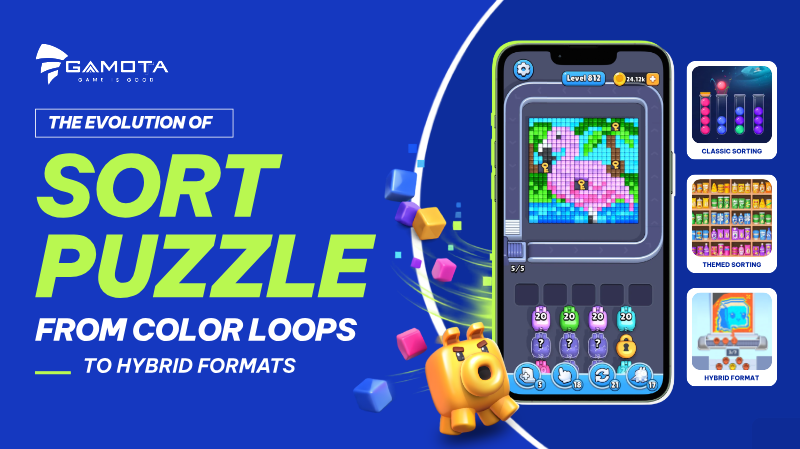
The sort puzzle genre has transitioned from rudimentary color-matching loops into a sophisticated, high-growth category that generated $279 million in in-app purchase revenue and 992 million downloads by 2025.
- The sort puzzle genre reached a scale of $279 million in in-app purchase revenue and 992 million downloads by 2025.
- Despite high download volume, the genre currently underperforms in monetization efficiency compared to mature puzzle category leaders.
- Developers are shifting from simple color-matching loops to hybrid-casual mechanics and complex progression systems to improve long-term retention.
Puzzle Monthly #5: The Secret Behind Toon Blast's Success
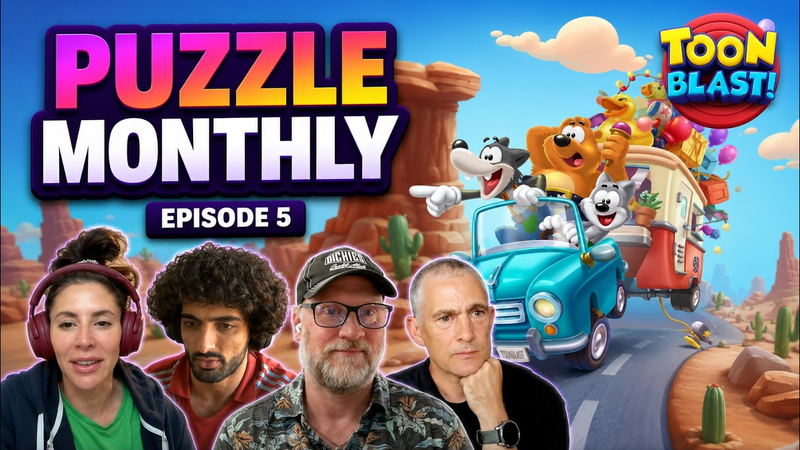
Toon Blast maintains its market dominance by fundamentally evolving the clicker sub-genre, moving away from the deterministic, high-friction gameplay that characterized earlier titles like Pet Rescue Saga.
- Toon Blast achieved market dominance by replacing deterministic, high-friction gameplay models found in titles like Pet Rescue Saga with a more accessible, luck-based experience.
- The integration of the 'Super Light Ball' mechanic served as a critical driver for increasing both player retention and revenue by enhancing the core board-clearing loop.
- The game successfully transitioned from short, isolated events to overlapping, long-term engagement structures, effectively revitalizing performance among a mature user base.

Let's Review Your Games — Ep. 060
The provided content features a game development critique session focused on evaluating indie titles to provide constructive feedback before their official releases.
- To prevent players from bypassing level content in first-person shooters, developers should implement trigger-based 'lockdown' systems that force players to defeat all enemies in a zone before progressing.
- Game feel is prioritized by ensuring combat is highly reactive, with instantaneous feedback and clear telegraphing of actions, even if graphics and audio quality are suboptimal.
- Destructible environmental objects should provide clear visual and audio cues, such as flashing white or breaking animations, to communicate to the player that an object is interactive.