Game Culture reports and market data
Documents

Skillful Play Is Dependent on Rules: Notes on a Phenomenology of Skills in Games and Digital Games
This extended abstract, presented at DiGRA 2023, argues that skillful play depends on rules and that skills provide the epistemic access necessary for aesthetic and phenomenological study of games.
- Skillful play depends on rules, and acquired skill is what gives a player or scholar epistemic access to a game's form and potentialities, making it central to the aesthetic and phenomenological study of games.
- The paper identifies a gap in game studies: rules have been widely theorized, but practical skill has received comparatively little attention.
- Drawing on Hubert Dreyfus's account of expertise, the author argues that novices move from detached rule-following toward flexible, situation-specific play, with game-constitutive and tactical rules receding into the background of expert activity.
Accidental Archivists: YouTube Gameplay Content and Game Preservation
This paper examines whether YouTube and Twitch gameplay content, particularly walkthroughs and "let's play" videos, can support game preservation efforts.
- Existing game preservation work has concentrated on published console games and emulation, overlooking the wider player experience, including strategizing, social play, and fan culture that unfolds outside the game itself.
- Because cultural heritage institutions lack resources to preserve every game and gameplay session, the authors argue that player-generated content already hosted on YouTube and Twitch can help fill these gaps.
- The study's preliminary taxonomy, built from 310 videos (10 randomly sampled from each of 31 English-language YouTube channels across five game categories), yields 20 categories of gameplay content.

Digital Games and the Category of Auteur: A Re-Evaluation and Perspectives
This extended abstract, presented at DiGRA 2023 by Filip Jankowski of Jagiellonian University, re-examines the application of auteur theory to digital games.
- The paper argues that the auteur concept, borrowed from film studies, carries problematic associations, including conservative origins, legitimization of exploitative labor conditions, and canonization of a narrow demographic of designers such as Peter Molyneux, Sid Meier, and Will Wright regardless of their actual production roles.
- Rather than abandoning auteur theory for games, the author proposes a contextual redefinition built on three principles: an auteur may be an individual or a small persistently collaborating group, developers with varied roles can qualify if their output is coherent, and an authorial signature such as placing one's likeness in a work can signal attachment to co-created material.
- Tale of Tales, run by Auriea Harvey and Michaël Samyn, is cited as an example of a small, persistently collaborating group that can be considered an auteur under the redefined framework.
Materially Random Stories: Randomness and Narrative as Material Structures in Digital Games
Janik's paper, presented at DiGRA 2023, argues that randomness in digital games should be understood as a material-discursive practice rather than merely a design mechanic for generating uncertainty.
- Janik's DiGRA 2023 paper reframes randomness in digital games as a material-discursive practice, not merely a mechanic for generating uncertainty, drawing on Karen Barad's agential realism and her concept of the apparatus.
- The central claim is that randomness acts as an apparatus: a mechanism selects one outcome from many possibilities, and embedded discursive practices give that outcome its meaning.
- The paper argues that narrative uncertainty is not just anticipation of events but a material process through which fiction emerges, and that unrealized alternatives heighten players' sense that their story is singular.

Social Acceptability of Location-Based Games in Cemeteries
A survey of 1,053 Australian adults, stratified by age, gender, and state or territory, examined how socially acceptable digital technologies are in cemeteries, with particular attention to two location-based game concepts: a historical mystery game and a ghost-hunting game played on-site among graves and monuments.
- Respondents were broadly negative toward location-based games in cemeteries, with the two game concepts drawing the highest negative responses among the thirteen cemtech concepts tested: 60% for the historical mystery game and 74% for the ghost-hunting game.
- The main concerns were that play in a place of mourning is disrespectful and disrupts its peaceful atmosphere, and respondents anticipated hostile disapproval from bystanders, with one comment raising the possibility of aggression toward players.
- Positive views existed but were a minority, expressed by 22% of respondents for the historical game and 12% for the ghost game.
Spatiality and the Power of Simulation in Covideo Games
This paper examines how video games engaged with the COVID-19 pandemic, arguing that the medium helped people make sense of a nascent cultural trauma and map possible courses of action.
- The paper argues that pandemic-era video games helped people make sense of an emerging cultural trauma by modelling systems and conveying meaning procedurally, going beyond mere distraction or social connection.
- The analysis draws on a corpus of 49 entries from IndieCade's 2020 "Jamming the Curve" design competition, where teams had two weeks to build serious games grounded in real epidemiological data.
- Using procedural rhetoric analysis, the author selected games that treated spatiality as a gameplay feature, used real-world data meaningfully, and generated procedural knowledge otherwise unavailable; spatiality and agency emerge as the central dimensions of how these games model the crisis.

Fursan Al-Aqsa: An Analysis of Moral Disengagement in the Discursive Strategies of a Pro-Palestine Video Game
This paper examines Fursan Al-Aqsa, a 2022 action game depicting the Israeli-Palestinian conflict from a Palestinian perspective, and assesses whether its narrative employs discursive strategies that facilitate moral disengagement, the psychological process by which individuals suspend ordinary moral restraint toward violence.
- The paper analyzes Fursan Al-Aqsa, a 2022 action game depicting the Israeli-Palestinian conflict from a Palestinian perspective, to assess whether its narrative facilitates moral disengagement from violence, drawing on Bandura's theory.
- The study's central question is whether the game's ideological intensity could amount to terrorist propaganda or promote online radicalization, a concern raised by security and counter-propaganda bodies about extremist use of gaming platforms.
- Methodologically, the authors pair a qualitative model built on Bandura's mechanisms and a procedure of direct gameplay engagement called "utilitarian play" with a reception analysis of 132 Steam player reviews and comments plus Twitch and YouTube gameplay content.
Beyond the Analysis from Neoliberal Subjectification? The Accelerationist Short-circuiting of Gaming Pleasure in Total War: Warhammer II & III
This paper examines whether the optimizing play style that emerges from acquiring gaming literacy in Total War: Warhammer II and III (Creative Assembly, 2017 and 2022) reproduces the neoliberal subjectivity described by Foucauldian governmentality theory, or whether its intensification produces a failure condition that exposes…
- The paper asks whether mastering the optimizing play style of Total War: Warhammer II and III (Creative Assembly, 2017 and 2022) reproduces neoliberal subjectivity as described by Foucauldian governmentality theory, or whether its intensification exposes the limits of neoliberal rationality.
- The author argues that mastering a game's mechanics treats the fantasy world as a decipherable mathematical system, which can undermine the narrative immersion that originally attracted players.
- Two trajectories are proposed: players may find their expertise tedious and be unable to return to a less analytical mode of play (linked to the 'short-circuiting of power gamer subjectivity' described by Silverman and Simon), or accelerationist intensification may reinforce capitalist relations through pleasure in maximization and community sharing of discoveries.
Lad Mags and Anti-feminist Irony in the Formation of Gaming Cultures
This exploratory paper examines how British "Lad Culture" of the 1990s shaped masculinity within gaming culture, focusing on the promotional relationship between the game publisher Eidos Interactive and the wave of men's lifestyle magazines known as "Lad Mags," including Loaded, FRONT, and Maxim.
- The paper argues that Lad Mag promotional strategies, paired with ironic framing of sexualized female characters, further embedded sexism and misogyny as expressions of masculinity in gaming culture during the 1990s.
- Its case studies are three Eidos Interactive titles heavily promoted in 1997: Deathtrap Dungeon, Fighting Force, and Tomb Raider II, whose marketing centered on the glamorized, sexualized presentation of their female protagonists.
- Eidos Interactive used glamour models from Lad Mags such as Loaded, FRONT, and Maxim at promotional events in Europe and North America.

Finding the GaaP: Data, Dashboards, and Independent Games
This paper examines how platformisation and the shift from games as a product (GaaP) toward games as a service (GaaS) are reshaping independent game development, with a particular focus on a "middle" group of developers who navigate between these two models.
- The paper argues that platformisation is pushing independent developers from a games-as-a-product model toward games-as-a-service, and that a 'middle' group of developers must navigate between these two models.
- Smaller studios often lack dedicated analysts and data expertise, and many treat data analysis as a secondary responsibility, which creates real barriers to using analytics on platforms such as Steam.
- The authors built the InGAME Market Intelligence Tools (IMAT) from Steam API data on more than 54,000 games, covering pricing, genre, tags, release dates, reviews, and DLC.
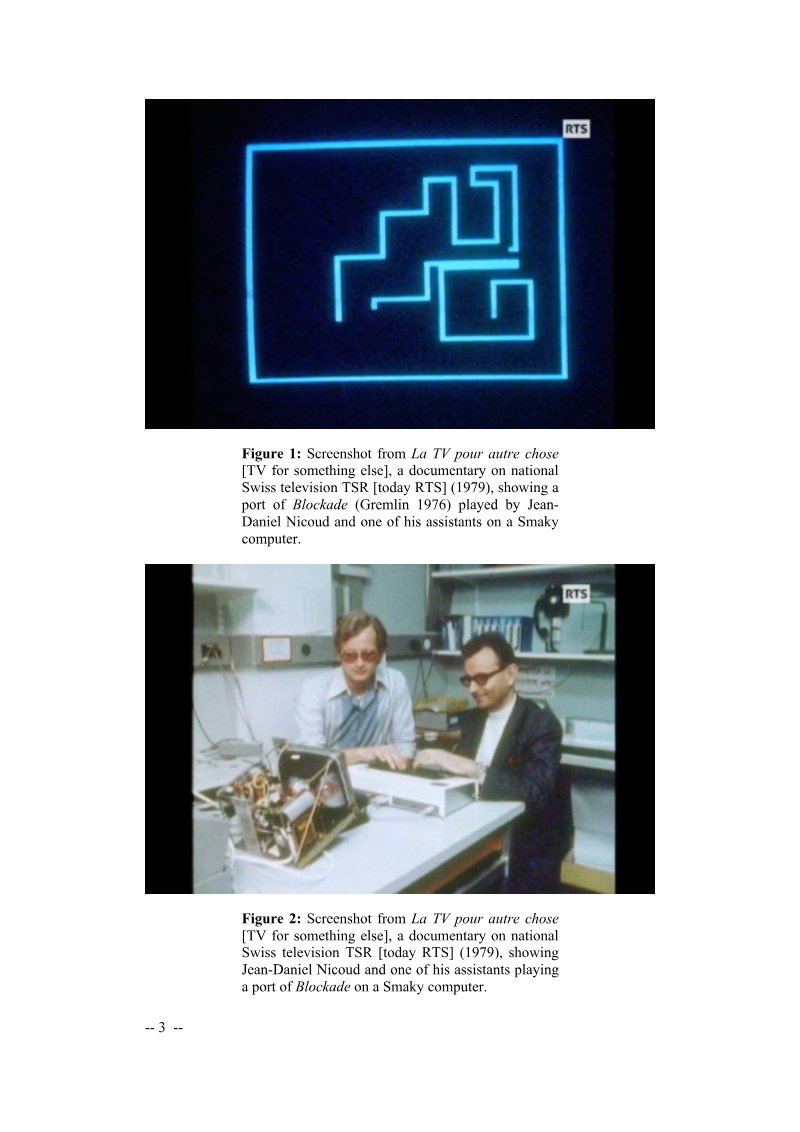
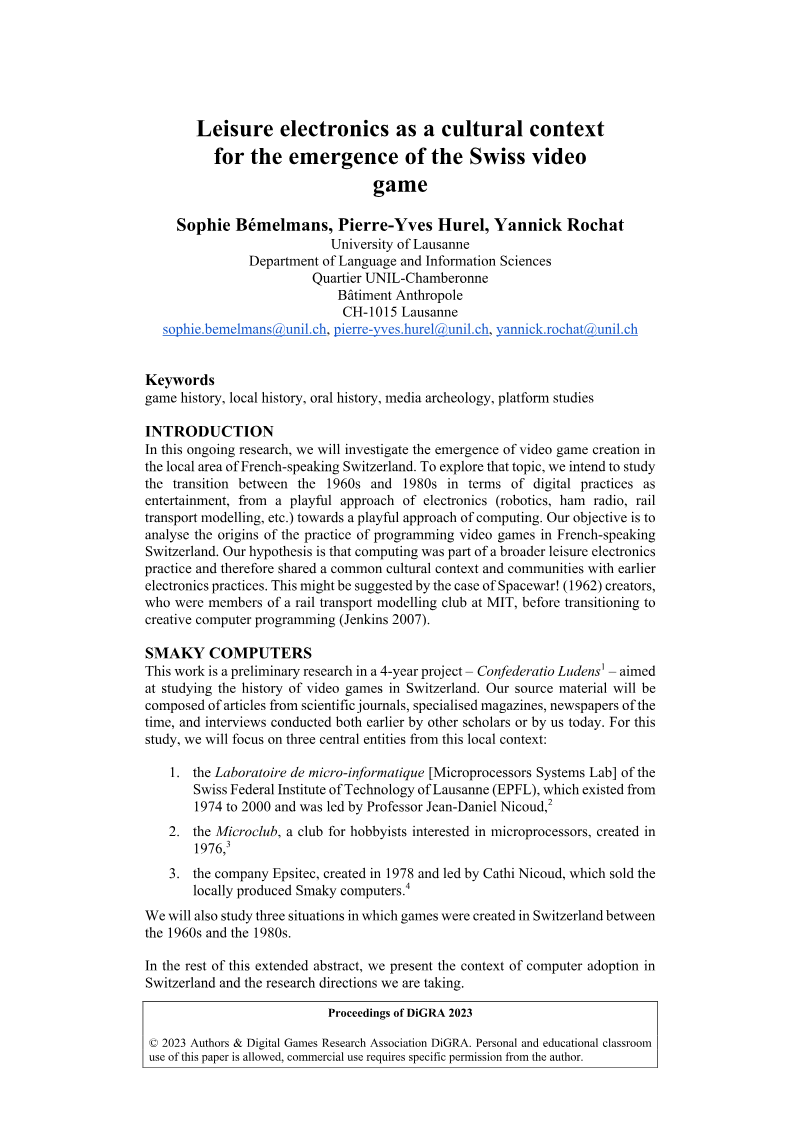
Leisure Electronics as a Cultural Context for the Emergence of the Swiss Video Game
This extended abstract, presented at DiGRA 2023, outlines an early-stage research project examining how video game creation emerged in French-speaking Switzerland between the 1960s and 1980s.
- The paper argues that Swiss video game creation grew out of a broader leisure electronics culture, including robotics, ham radio, and model railways, and shared communities and practices with those hobbies.
- It draws a parallel with Spacewar! at MIT, whose creators came from a railway modelling club, to support the hypothesis that hobby communities seeded early game programming.
- The study focuses on three local entities: the Microprocessors Systems Lab at EPFL led by Jean-Daniel Nicoud, the Microclub hobbyist association founded in 1976, and the company Epsitec, which sold locally produced Smaky computers under Cathi Nicoud's leadership.

Charting the Forgotten Realms of Digital Vernacularity: 25 Years of D&D Infinity Engine Games
This paper maps fan-made modifications of the Infinity Engine games set in the Dungeons & Dragons Forgotten Realms, focusing on the Baldur's Gate and Icewind Dale series, which together span roughly 25 years of modding activity.
- The paper maps fan modifications of the Infinity Engine Forgotten Realms games, chiefly Baldur's Gate and Icewind Dale, spanning roughly 25 years of modding activity on community hosts such as Spellhold Studios, The Gibberlings Three, and Sorcerer's Place.
- The study restricts its scope to party-based, real-time-with-pause single-player titles, framing them as digital stand-ins for the communal experience of tabletop D&D play.
- Methodology is constructivist grounded theory, triangulating mod gameplay content, official paratexts (FAQs, promotional materials), and third-party paratexts (walkthroughs, reviews), supplemented by the author's own Infinity Engine modding experience and access to active community members.