1 free read left. Create a free account for unlimited reading + AI research.
Create free accountWhitepaper DiGRA
1 free read left. Create a free account for unlimited reading + AI research.
Create free accountWhitepaperDiGRA
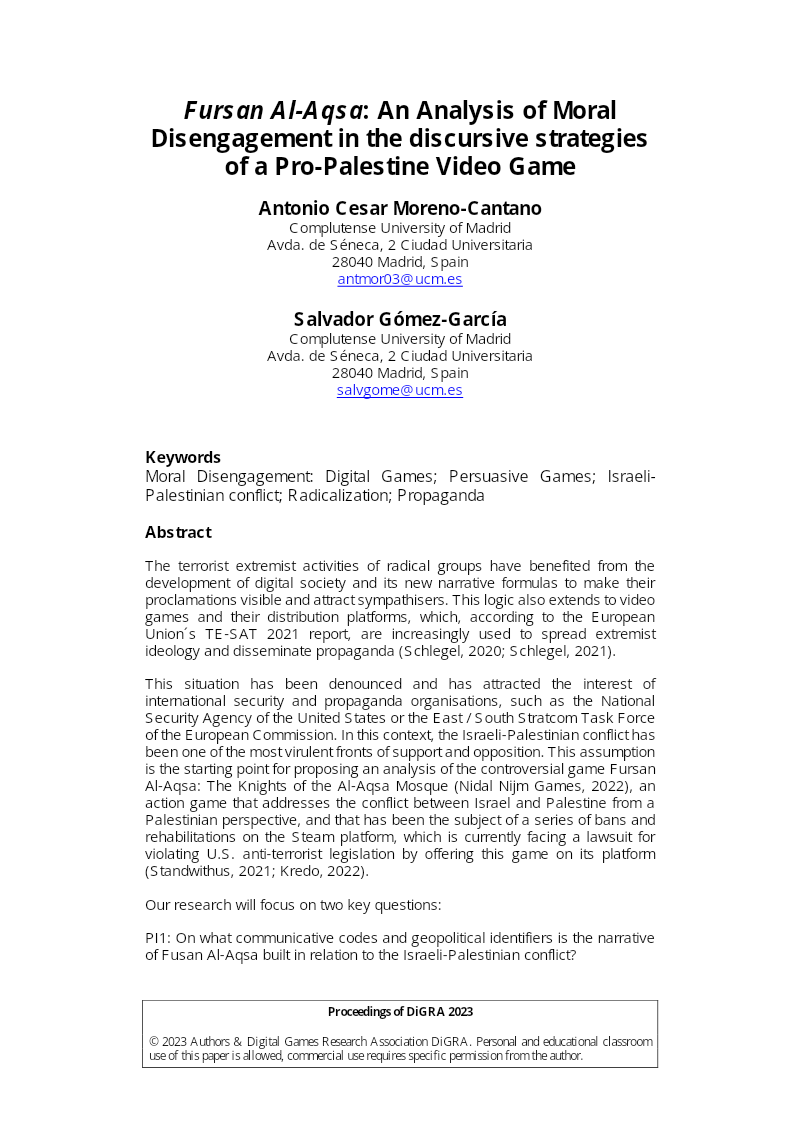
The paper analyzes Fursan Al-Aqsa, an action game about the Israeli-Palestinian conflict told from a Palestinian perspective.
This paper examines Fursan Al-Aqsa, a 2022 action game depicting the Israeli-Palestinian conflict from a Palestinian perspective, and assesses whether its narrative employs discursive strategies that facilitate moral disengagement, the psychological process by which individuals suspend ordinary moral restraint toward violence. Drawing on Bandura's theory of moral disengagement and its application to violent video games, the authors seek to determine the communicative codes and geopolitical identifiers underpinning the game's narrative, and whether its ideological intensity could amount to terrorist propaganda or promote online radicalization. The work is situated within broader concerns raised by security and counter-propaganda bodies about extremist use of gaming platforms, and it notes that the game has been subject to bans, reinstatements, and legal challenges on Steam.
The methodology combines a qualitative analytical model built on Bandura's mechanisms with "utilitarian play," a critical procedure of direct engagement with the game and its production context. A second strand addresses reception: the authors analyze 132 player reviews and comments from Steam, alongside gameplay content on Twitch and YouTube, using content analysis and sentiment analysis to identify prominent opinions and emotions. The scope is thus a single title, examined through textual, ideological, and audience-level data, rather than a broad market survey.
The study's contribution lies in combining a formal theoretical framework for moral disengagement with empirical reception data, an approach intended to move beyond contested claims about whether such games radicalize players. The analysis is positioned as a case study in how contemporary conflict narratives are constructed and received within interactive media, with implications for both game studies and the monitoring of extremist content online.
Each row is a game or company this document names, each column a document, oldest first. A mark means that document names it. Select a row to see those documents.

DiGRA · 2026

DiGRA · 2026



DiGRA · 2026



DiGRA · 2026



DiGRA · 2026



DiGRA · 2026



DiGRA · 2026



DiGRA · 2026



DiGRA · 2026

DiGRA · 2026



DiGRA · 2026



DiGRA · 2026
International Journal of Role-Playing · 2026