AI reports and market data
Documents



Interview with Lee, Su-Hyun: South Korea
The interview with Professor Lee Su-Hyun of Seoul National University articulates digital transformation (DX) as a comprehensive restructuring of the Korean fashion value chain, extending beyond e-commerce to encompass AI-driven design, smart-factory automation, and data-centric marketing.
- South Korea’s fashion industry is undergoing a comprehensive digital transformation (DX) that integrates generative AI for 3-D virtual prototyping, smart-factory automation, and data-centric marketing to reduce sample costs and lead times.
- The adoption of on-demand production and digital traceability is being prioritized to meet carbon-neutral objectives and support circular-economy initiatives within the fashion value chain.
- Smart apparel development is currently limited to functional niches in sports, healthcare, and disaster safety, with technical progress hindered by the durability of conductive fibers and the need for miniaturized, flexible battery solutions.
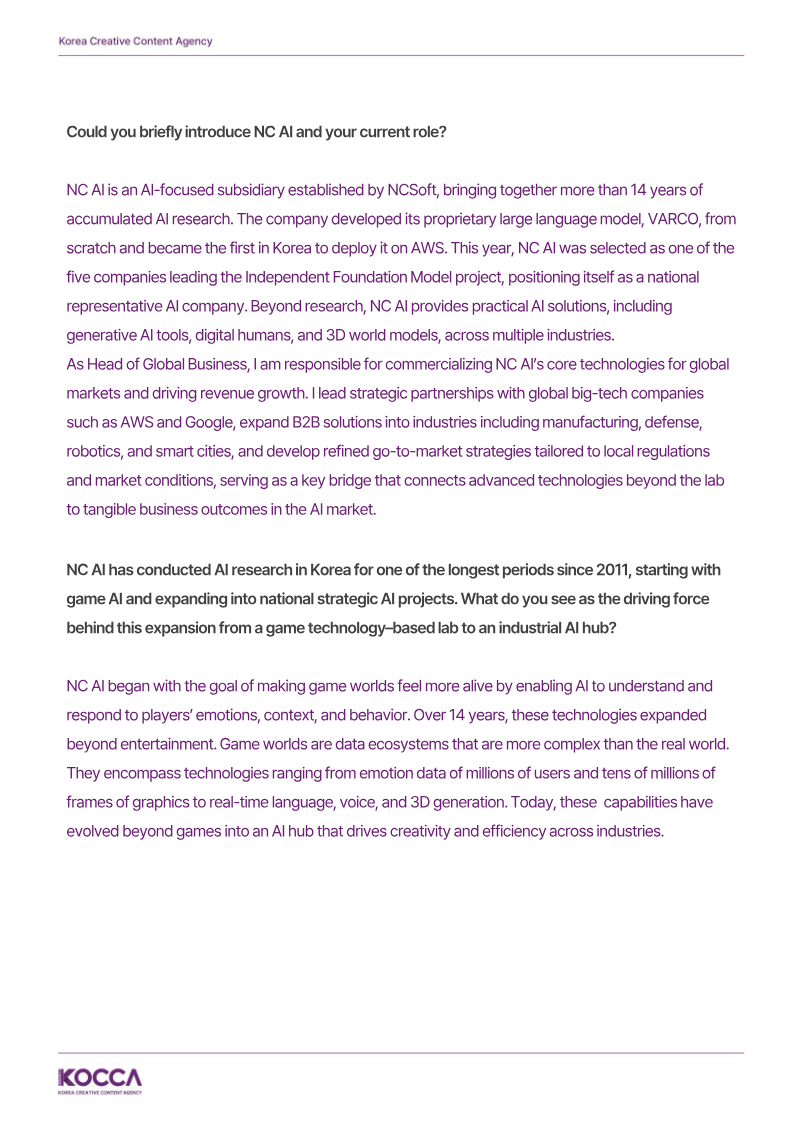

Interview with Keunkyo Kim, Head of Global Business at NC AI
The interview articulates NC AI’s transformation from a game-focused research lab into a national industrial-AI hub, positioning Korea as a global center for “K-AI.”
- NC AI is leveraging 14 years of MMORPG-based reinforcement learning and real-time processing expertise to expand from gaming into industrial sectors, including manufacturing, robotics, smart cities, and defense.
- The company is developing a dual-track AI strategy that balances a 200-billion-parameter large language model with lightweight, edge-optimized multimodal diffusion models for field efficiency.
- NC AI’s proprietary VARCO 3D engine enables the generation of physics-based 3D environments from text or images, while the open-source VARCO Vision 2.0 achieved over 10,000 downloads within ten days of release.
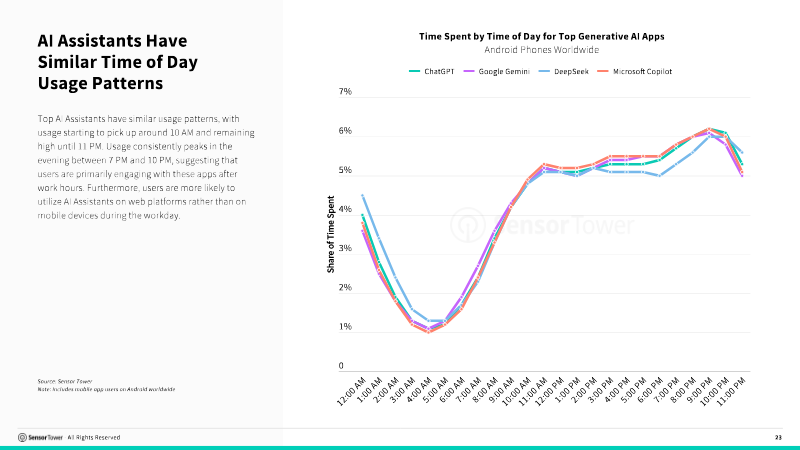
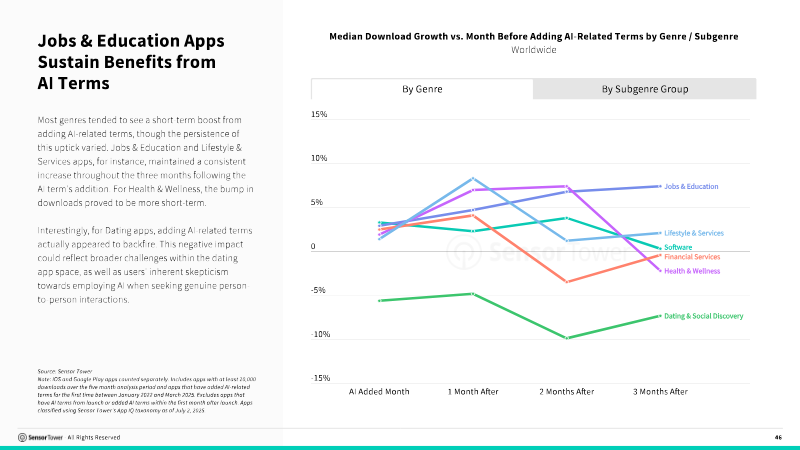
State of AI Apps Report 2025
The analysis quantifies the rapid expansion of generative-AI applications in the first half of 2025, documenting 1.6 billion downloads and $1.2 billion in in-app-purchase revenue.
- Generative AI applications experienced explosive growth in H1 2025, reaching 1.6 billion downloads and $1.2 billion in in-app purchase revenue.
- Revenue growth significantly outpaced adoption, with a 200 percent increase in in-app purchase revenue and a 67 percent rise in downloads compared to H2 2024.
- The user base is heavily skewed toward younger males, with approximately 60 percent of users being male and nearly 70 percent under the age of 35.
Yearly Live Streaming Trends Report 2024
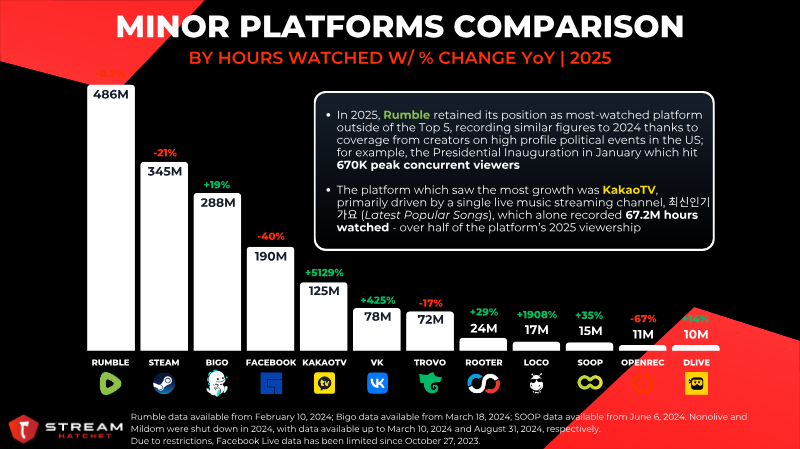
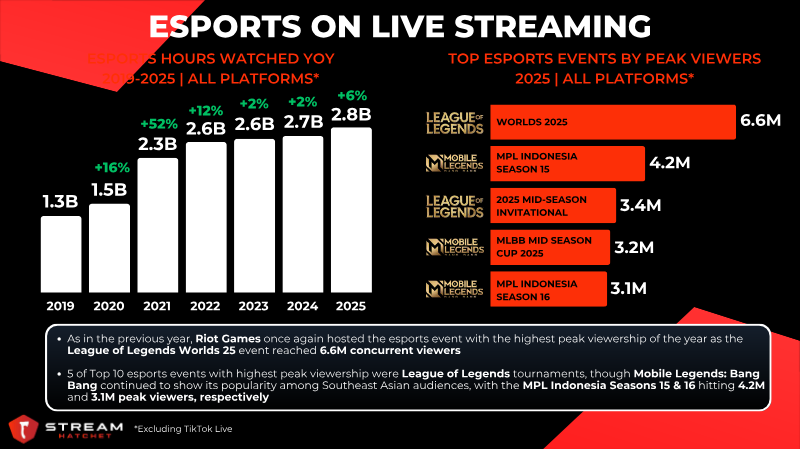
Global live streaming viewership reached 36.4 billion hours in 2025, marking a 6% year-over-year increase that brings the industry nearly back to its 2021 pandemic-era peak.
- The live streaming industry reached 35 billion hours watched in 2024, reflecting a stable 3% year-over-year growth rate as the market shifts toward long-term sustainability.
- Kick grew its viewership by 45% in 2024 by leveraging aggressive revenue-sharing models and non-exclusive contracts to challenge Twitch’s market leadership.
- The 'Just Chatting' category remains the dominant content type, accounting for nearly 15% of all platform activity across the industry.


The State of Games QA
This analysis explores the current state and future trajectory of quality assurance (QA) within the video game industry, specifically focusing on the integration of artificial intelligence and automation.
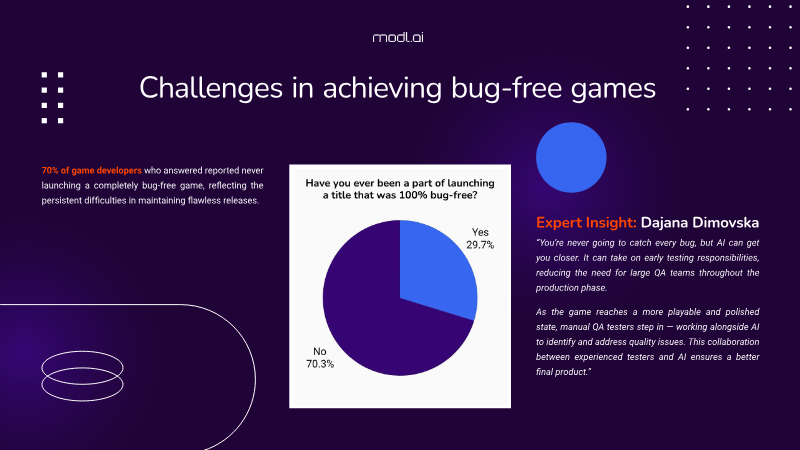
- 77% of game developers report conducting insufficient QA for their recent releases, highlighting a critical gap between traditional manual testing and the demands of modern, complex game development.
- While 94% of studios currently utilize non-AI automation, there is a near-unanimous consensus (94%) that AI integration is essential for the future of quality assurance.
- 88% of industry professionals believe AI-driven testing is equal to or superior to traditional methods, specifically citing faster bug detection, automated reporting, and 24/7 testing as key advantages.



How Developers Are Using Generative AI to Create a New Generation of Games
This research, conducted by Google Cloud and The Harris Poll in mid-2025, examines the transformative role of generative AI within the global games industry.
- 97% of game developers believe generative AI is actively reshaping the industry, with 90% already integrating the technology into their workflows to automate tasks like coding, localization, and playtesting.
- 94% of developers anticipate that the adoption of generative AI will lead to long-term reductions in game development costs over the next three years.
- AI agents are increasingly used for advanced game mechanics, with 44% of developers utilizing them for content optimization and 34% for creating more responsive NPC behaviors.

Climbing to the C-Suite: Insights from Mission One's Gerard Miles
Executive headhunting functions as a sophisticated, relationship-driven mechanism akin to mergers and acquisitions, where the primary objective is aligning top-tier leadership talent with the critical strategic needs of an organization.
- Executive advancement requires a shift from tactical craft-based contributions to a focus on organizational health, with a proven track record of three-to-five-year tenures serving as the primary currency for C-suite eligibility.
- To remain competitive in the current market, executives must move beyond superficial AI trends and acquire formal technical literacy to demonstrate how these technologies drive measurable business value.
- Candidates frequently undermine their prospects by failing to demonstrate genuine curiosity about a firm's specific products and challenges, necessitating a transition from transactional negotiation to meaningful, prepared engagement.

Week in Mobile Games E40 - Games industry trends 2024 review
The mobile gaming industry experienced a notable return to growth in 2024, with Google Play net revenue rising 5.3 percent to $54.6 billion during the first eleven months of the year.
- The top 10 list of new mobile game releases in 2024 was dominated by Asian developers, with no Western companies releasing a new game in the top 15 except for Supercell's Squad Busters at rank 14.
- New game entries into the top 10 mobile charts decreased in 2024 compared to 2023, which saw four major new titles, whereas 2024 saw only one major new entry, Dungeon and Fighter Mobile.
- Cross-platform play is shifting from a niche feature to a necessity, with titles like Infinity Nikki allowing users to transition seamlessly between mobile and console experiences.
Navigating the Botting Industry: Fraud, Cheating, and Multi-Accounting
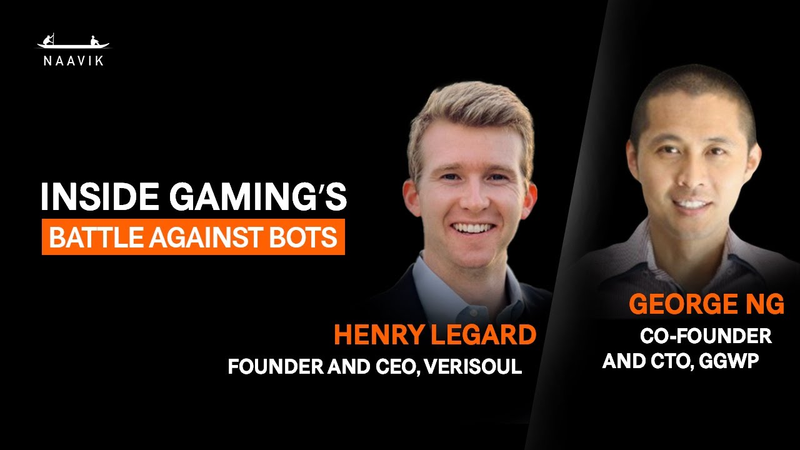
The gaming industry faces an escalating crisis driven by an unbounded economic structure that allows bad actors to extract value through botting, multi-accounting, and manual fraud.
- The gaming industry is currently the primary vertical for fraudulent traffic, driven by negligible account creation costs that enable large-scale botting and multi-accounting.
- Gaming security infrastructure lags behind financial services due to a historical industry-wide prioritization of user experience over robust defensive measures.
- Effective mitigation requires distinguishing between benign automation—such as quality-of-life tools—and malicious activity through behavioral analysis, hardware-level tracking, and digital fingerprinting.

Transforming UA Creatives Through AI (with Reforged Labs)
The mobile gaming industry is undergoing a fundamental shift in user acquisition strategy, moving away from manual, labor-intensive creative production toward automated, AI-driven experimentation.
- AI-driven creative engines are replacing manual production by deconstructing high-performing ads to generate large volumes of personalized video assets at scale.
- The integration of AI platforms has reduced the production cost of individual ad units to approximately $50, significantly lowering the barrier to entry for smaller studios.
- Reforged Labs and similar platforms are shifting the marketing professional's role from repetitive asset creation to high-level strategic optimization and data-backed validation.

TWIG #311 Musk Enters the Game, Archero 2 Aims for the Bullseye, PlayStation Goes Portable
The gaming industry is undergoing a fundamental shift in consumer behavior, as engagement with gaming-related content now surpasses active playtime, with users averaging 8.5 hours of viewing versus 7.4 hours of playing per week.
- Consumer engagement with gaming content has overtaken active playtime, with users averaging 8.5 hours of viewing per week compared to 7.4 hours of playing.
- The live-service model is facing significant instability, evidenced by the closure of titles like XDefiant and the financial struggles of major consolidators such as Embracer Group.
- Success in the current market requires rigorous data-driven strategies, specifically focusing on hybrid-casual monetization and validating retention metrics before full-scale product launches.

From Casual to Complex: Trends that Shaped Gaming in 2024
The gaming industry is undergoing a fundamental transformation, moving away from traditional user acquisition strategies toward a product-centric model defined by hybrid monetization and lean, data-driven execution.
- Competitive advantage has shifted from manual marketing optimization to product-centric design, where engagement loops and monetization mechanics are integrated at the project's inception.
- Studios must transition to a hybrid gaming model that combines the accessibility of hyper-casual titles with the complex retention loops characteristic of high-production RPGs.
- Sustainable growth now requires deep organizational integration between marketing, product, and data teams to replace siloed workflows and combat rising acquisition costs.