Report
Mobile Game Market Review: October 2025
The global mobile gaming market experienced a period of stabilization throughout October 2025, characterized by a shift toward high-fidelity mid-core titles and the continued integration of generative artificial intelligence in live-ops management. While overall consumer spending remained relatively flat compared to the previous quarter, engagement metrics saw a notable uptick in the Asia-Pacific region, which continues to account for over forty percent of total global revenue. This growth was primarily driven by the successful launch of several high-budget tactical shooters and open-world role-playing games that leverage advanced mobile hardware capabilities. Data indicates that the casual gaming segment is undergoing a structural transformation as developers pivot away from hyper-casual models toward hybrid-monetization strategies. In-app purchases now constitute a larger share of revenue for puzzle and simulation titles than in previous years, reflecting a broader industry trend of prioritizing long-term player retention over rapid user acquisition. Furthermore, the implementation of stricter privacy regulations across major app stores has led to a ten percent increase in average user acquisition costs, forcing publishers to rely more heavily on organic community building and cross-platform brand partnerships. The competitive landscape remains dominated by established franchises, yet emerging studios in Southeast Asia and Latin America are capturing significant market share through localized content and aggressive pricing models. Analysis of download trends suggests that while the North American and European markets have reached a point of saturation, emerging economies represent the primary frontier for new user growth. Moving into the final quarter of the year, the industry is expected to focus on seasonal events and cross-media collaborations to sustain momentum, with a particular emphasis on cloud-gaming compatibility to bridge the gap between mobile and console experiences.
GameRefineryOct 2025
Presentation
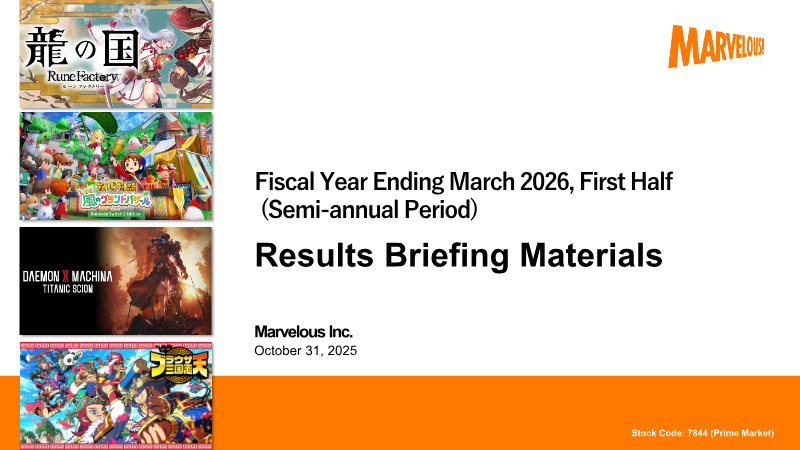
Results Briefing Materials: Fiscal Year Ending March 2026, First Half (Semi-annual Period)
Marvelous Inc. reported a significant revenue increase for the first half of the fiscal year ending March 2026, covering the period from April to September 2025. Net sales rose 157.5% year-on-year to 20,281 million yen, primarily driven by the launch of three core video games and robust performance in the amusement sector. Despite the revenue surge, operating profit fell 61.8% to 226 million yen due to high development costs for new titles. However, ordinary profit and net income saw modest gains, aided by a shift from foreign exchange losses to gains. The Digital Contents business experienced nearly doubled sales, reaching 12,414 million yen. Key performers included Rune Factory: Guardians of Azuma and Story of Seasons: Grand Bazaar, both of which surpassed half a million units sold and contributed to profits ahead of schedule. Conversely, the segment recorded a loss of 1,070 million yen, and sales for Daemon X Machina: Titanic Scion were characterized as sluggish. The Amusement business remained a strong profit driver, growing 36.3% in revenue and 41.2% in segment profit, fueled by the domestic and international success of Pokémon-themed kids' amusement machines like Pokémon Frienda and Pokémon Mezastar. The Audio & Visual business saw a revenue decline of 16% following the liquidation of unprofitable units, yet segment profit nearly tripled to 483 million yen due to high-performing stage productions and secondary usage of past anime titles. Looking ahead, the company maintained its full-year forecast of 35,000 million yen in net sales and 2,000 million yen in operating profit. Management plans to focus on the continued expansion of its core first-half releases and upcoming titles like The Thousand Musketeers: Rhodoknight for the Nintendo Switch.
MarvelousOct 2025