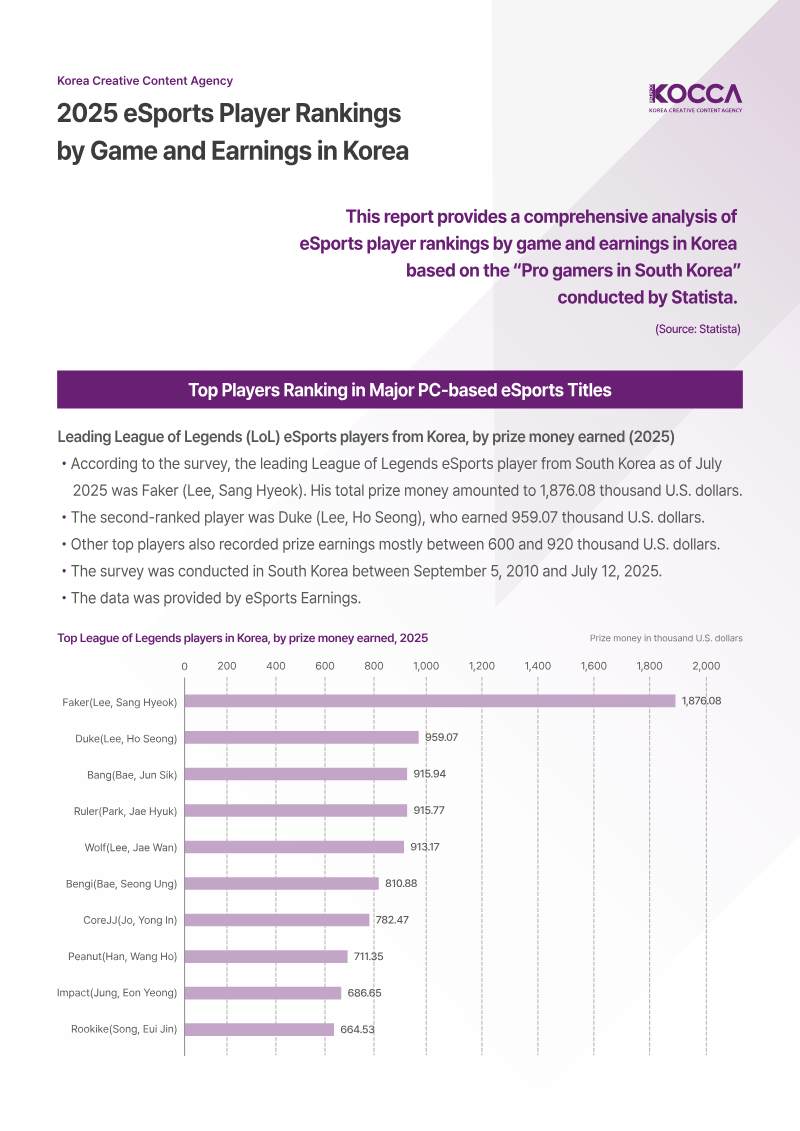
2025 eSports Player Rankings: By Game and Earnings in Korea
20256 pages~5 min full read
South Korea’s professional gaming landscape is characterized by a title-centered evaluation system where prize earnings are highly concentrated among elite players. Analysis of the country’s top eSports competitors across five major PC-based titles—League of Legends, StarCraft II, Valorant, Overwatch 2, and PlayerUnknown’s Battlegrounds (PUBG)—reveals significant disparities in cumulative wealth based on the longevity and global scale of each game’s competitive scene.
League of Legends remains a dominant sector, with Lee Sang-hyeok (Faker) leading all players with approximately $1.88 million in prize money as of July 2025. This exceeds the top earners in other disciplines, such as Cho Sung-choo (Maru) in StarCraft II, who earned $1.39 million, and Park Jung-young (Loki) in PUBG, who secured $1.25 million. In contrast, newer or more recently transitioned titles like Overwatch 2 and Valorant show lower cumulative earnings, with top players Choi Tae-min (MER1T) and Kim Jong-min (Lakia) earning $375,450 and $164,980 respectively.
The data, sourced from eSports Earnings and compiled by the Korea Creative Content Agency, utilizes a longitudinal methodology tracking performance from as early as 2010 through mid-2025. While the rankings for League of Legends, StarCraft II, and Valorant reflect 2025 figures, the data for Overwatch 2 and PUBG is current through late 2024. This segmentation highlights a fragmented domestic performance structure where success is measured by game-specific milestones rather than a unified national ranking. The findings underscore a mature market where established titles continue to provide the highest financial returns for top-tier professional talent.
KOCCA – Korea Creative Content Agency · 2025
KOCCA – Korea Creative Content Agency · 2025
KOCCA – Korea Creative Content Agency · 2025
KOCCA – Korea Creative Content Agency · 2025
KOCCA – Korea Creative Content Agency · 2025
KOCCA – Korea Creative Content Agency · 2025
KOCCA – Korea Creative Content Agency · 2025

KOCCA – Korea Creative Content Agency · 2025
KOCCA – Korea Creative Content Agency · 2025
KOCCA – Korea Creative Content Agency · 2025
KOCCA – Korea Creative Content Agency · 2024
KOCCA – Korea Creative Content Agency · 2024
Pearl Abyss · 2026
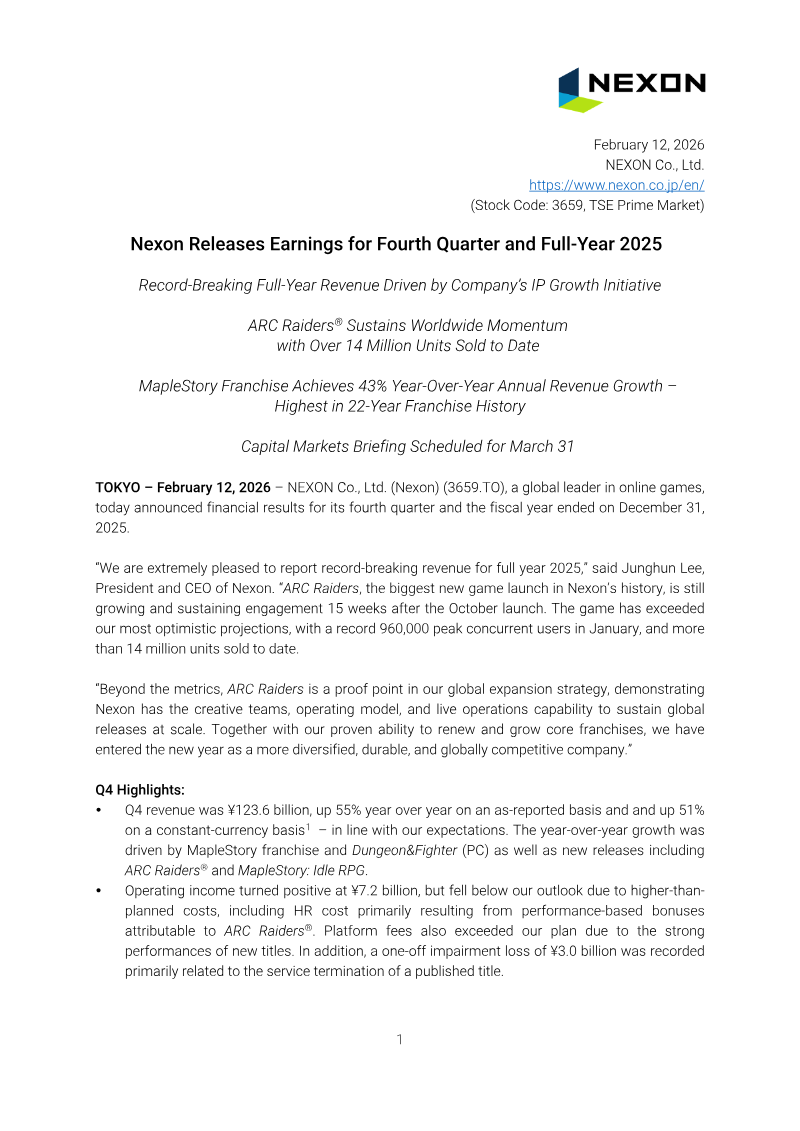
NEXON Co. · 2026
Kakao Games · 2026
Kakao Games · 2025
Kakao Games · 2025
Krafton · 2025
Neowiz · 2024
KOCCA – Korea Creative Content Agency · 2024
SuperData · 2020
game – Verband der deutschen Games-Branche e. V. · 2018
GamesBeat

Shift Up