Report54 pages
Quarterly Report of 11 bit studios S.A.: Q1 2022
BIT STUDIOS S.A.<sub>FOR</sub> QUARTERLY REPORT OF 11 BIT STUDIOS S.A. FOR THE FIRST QUARTER OF 2022 Dear Shareholders and Investors, It is our pleasure to present to you this report of 11 bit studios S.A. for the first quarter of 2022. During the first three months of the year, 11 bit studios S.A. generated more than PLN 17.75m in revenue. Our EBITDA came in at PLN 5.32m, operating profit was PLN 3.75m, and net profit exceeded PLN 3.77m.
- 11 bit studios S.A. reported a net profit of PLN 3,773,730 for Q1 2022, an increase from PLN 3,558,934 in Q1 2021. Revenue also increased to PLN 17,745,553 in Q1 2022 from PLN 14,836,980 in Q1 2021.
- The company's cash and cash equivalents significantly increased to PLN 50,404,801 as of March 31, 2022, up from PLN 26,748,530 as of December 31, 2021.
- 11 bit studios S.A. raised USD 850,000 (PLN 3,670,405) in Q1 2022 from the sale of "This War of Mine" and its DLCs, which was donated to the Ukrainian Red Cross in April 2022 and recognized as revenue and other expenses.
- The company's financial performance in Q1 2022 was strongly influenced by sales of "Frostpunk" and its DLCs, indicating a long monetization potential similar to "This War of Mine."
- 11 bit studios S.A. is actively expanding its publishing portfolio, with new contracts expected by year-end, and aims to manage 9 to 12 third-party projects simultaneously in the medium term. They also increased their workforce to 222 employees and contractors as of March 31, 2022.
11 bit studios
Report51 pages
Quarterly Report for 11 bit studios S.A.: Nine Months Ended September 30th 2021
QUARTERLY REPORT OF 11 BIT STUDIOS S.A. FOR NINE MONTHS ENDED Dear Shareholders and Investors, It is our pleasure to present to you the report of 11 bit studios S.A. for the nine months ended September 30th 2021. The results for that period, which proved much better than we assumed in our budget both in terms of revenue and profits, clearly demonstrate that the consistent implementation of the Company's growth strategy is bringing tangible financial results.
- 11 bit studios S.A.'s revenue for the nine months ended September 30th, 2021, was PLN 49,196,100, a 27.82% decrease year-on-year, primarily due to a high comparative base from the successful 2020 release of Frostpunk: The Last Autumn DLC.
- The company's total equity increased to PLN 185,464,601 as of September 30th, 2021, up from PLN 164,648,124 at December 31st, 2020.
- Salaries, wages, and employee benefits significantly increased by 74.63% to PLN 8,938,472 for the nine months ended September 30th, 2021, largely due to workforce growth and PLN 2,916,714 in non-cash provisions from the 2021–2025 Incentive Scheme.
- Basic earnings per share decreased to PLN 7.36 for the nine months ended September 30th, 2021, from PLN 13.90 in the corresponding period of 2020.
- The company is developing new games, including a new IP and a Frostpunk universe project, and has three third-party developed games in its publishing pipeline, all utilizing Unreal Engine instead of their previous Liquid Engine.
+2
11 bit studios
Report5 pages
Akt Notarialny: 11 Bit Studios
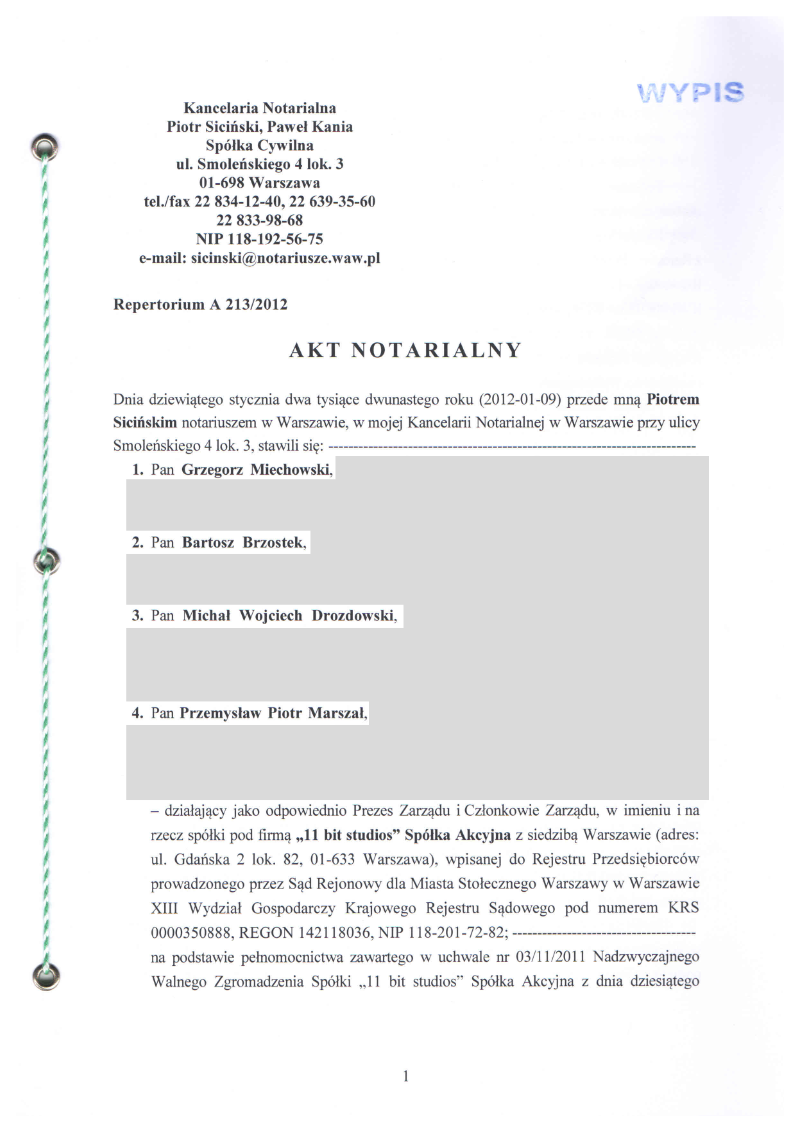
The notarized act dated January 9, 2012 records the formal approval by 11 Bit Studios’ board—Grzegorz Miechowski, Bartosz Brzostek, Przemysław Marszal, and Michał Drozdowski—of a capital increase for the Warsaw‑based public limited company. The board, empowered by Extraordinary General Meeting resolutions of November 10, 2011 (notary file A 7671/2011), authorized the issuance of up to 500,000 new ordinary shares (Series D) at a nominal value of PLN 0.10 each, raising the share capital from PLN 187,076.10 to a maximum of PLN 237,076.10. The resolution also amended the company’s statute to reflect a new share structure: 1,000,000 Series A shares, 494,200 Series B shares, 376,561 Series C shares, and up to 500,000 Series D shares.
By December 31, 2011 the board confirmed that 10 subscription agreements had been executed for a total of 40,938 Series D shares, amounting to PLN 4,093.80 in subscription proceeds. The act further specifies that the capital increase was fully paid in cash, with shares deposited into the company’s account before registration. It outlines provisions for voluntary share cancellation and issuance of utility certificates, as well as the allocation of costs: notarial fees, VAT at 23 %, and a civil‑law transaction tax.
The document is limited to Warsaw, Poland, covering the period from the November 2011 resolutions through the January 2012 notarization. It relies on statutory provisions under Polish commercial law (articles 431 §7, 310 §2, and related tax statutes) to validate the corporate actions. The act concludes with notarized signatures and fee details, confirming compliance with legal formalities for the capital increase.
- On January 9, 2012, 11 Bit Studios formally notarized a capital increase authorized by the board to issue up to 500,000 new Series D ordinary shares at a nominal value of PLN 0.10 each.
- The capital increase expanded the company's share capital from PLN 187,076.10 to a potential maximum of PLN 237,076.10.
- As of December 31, 2011, the company successfully executed 10 subscription agreements for 40,938 Series D shares, generating PLN 4,093.80 in cash proceeds.
- The company’s updated share structure now comprises 1,000,000 Series A shares, 494,200 Series B shares, 376,561 Series C shares, and the newly authorized pool of up to 500,000 Series D shares.
- The board of directors, including Grzegorz Miechowski, Bartosz Brzostek, Przemysław Marszal, and Michał Drozdowski, ratified these changes following resolutions passed at an Extraordinary General Meeting on November 10, 2011.
11 bit studios
Report76 pages
Half-Year Report: 11 bit studios (H1 2022)
HALF-YEAR REPORT OF 11 BIT STUDIOS S.A. FOR THE SIX MONTHSENDED Dear Shareholders and Investors, Please be invited to read 11 bit studios’ report for the six months ended June 30th 2022. It was a time of hard work for us. Despite the unfavourable macroeconomic headwinds, the Company’s financial performance in that period was much stronger than in the previous year and far better than we assumed in our budget.
- 11 bit studios S.A. reported a profit of PLN 15,083,775 for the period ended June 30, 2022, an increase from PLN 13,308,096 in the same period of 2021.
- The company's total assets increased by 10.48% to PLN 242,514,237 as of June 30, 2022, up from PLN 219,512,964 at December 31, 2021.
- Cash provided by operating activities rose to PLN 28,377,470 in H1 2022 from PLN 22,490,664 in H1 2021, with net cash from operating activities at PLN 24,080,772.
- Depreciation and amortisation expenses decreased by 41.63% year-on-year to PLN 3,072,760 in H1 2022, mainly due to lower amortisation of intangible assets as certain products completed amortisation.
- 11 bit studios acquired a 40% interest in Fool’s Theory Sp. z o.o. for an initial payment of PLN 2,619,215.50 in March 2022, with a second payment contingent on the sales and user ratings of their game, Vitriol.
+2
11 bit studios
Report77 pages
Half-Year Report of 11 bit studios S.A.: First Six Months of 2023
HALF-YEAR REPORT OF 11 BIT STUDIOS S.A. FOR THE SIX MONTHS ENDED JUNE 30TH DEAR SHAREHOLDERS AND INVESTORS, We are pleased to share with you our half-year Gamescom, the largest European trade fair held in report for the first six months of 2023. We invite you Cologne, Germany, where they are garnering highly to read it, and we believe it will provide you with a favourable feedback. wealth of compelling and valuable insights .
- 11 bit studios S.A.'s net profit for the first half of 2023 was PLN 4,013,206, a significant 73.39% decrease from PLN 15,083,777 in the same period of 2022, with the net profit margin falling to 16.20% from 32.96%.
- Total revenue for the first six months of 2023 was PLN 24,775,454, down 45.87% from PLN 45,769,806 in the corresponding period of the previous year, primarily due to the natural aging of proprietary and publishing portfolios and a high comparative base from H1 2022.
- The US market was the largest revenue contributor in H1 2023, generating PLN 18,144,825, though this was a decrease from PLN 35,936,180 in H1 2022.
- Cash and cash equivalents increased to PLN 38,951,881 as of June 30th, 2023, up from PLN 30,585,991 at the end of 2022, with 66.47% deposited with Powszechna Kasa Oszczędności Bank Polski S.A.
- The company's publishing division is actively developing five titles, including 'The Thaumaturge' and 'The Invincible,' with a total investment budget of approximately PLN 50 million, and is also working on a mobile, free-to-play version of 'Frostpunk'.
+2
11 bit studios
Report2 pages
Games from 11 bit studios’ Publishing Portfolio Approaching Release: Q1 2023
11 bit studios’ first‑quarter 2023 financials show a revenue of PLN 14.8 million, EBITDA of PLN 3.0 million and net profit exceeding PLN 2.46 million, slightly below the same period in 2022 but still above internal forecasts. The decline is partly attributed to a high‑base effect from the previous year’s exceptional sales of This War of Mine during February–March 2022, when the company donated weekly proceeds to the Ukrainian Red Cross. The current quarter’s profit was also influenced by revenue from the board‑game version of Frostpunk and a revaluation gain on an equity stake in Starward Industries, which owns The Invincible.
Investment in development rose 28.2 % year‑on‑year to PLN 12.14 million, reflecting a strategy of increasing spend on both proprietary and third‑party titles as release dates approach. The publishing pipeline for 2023 includes The Invincible and The Thaumaturge, developed by Fool’s Theory, with promotional campaigns boosting their Steam wishlist rankings. The company anticipates that these releases will significantly lift 2023 financial results, supported by ongoing monetisation of established titles such as Frostpunk and This War of Mine.
Long‑term growth is expected to hinge on upcoming proprietary projects—Frostpunk 2, The Alters, and an unnamed “Project 8”—all slated for launch by the end of 2025. The company’s cash cushion and solid Q1 performance underpin its focus on expanding both its own development slate and publishing portfolio across the global video‑game market.
- 11 bit studios reported Q1 2023 revenue of PLN 14.8 million, EBITDA of PLN 3.0 million, and a net profit exceeding PLN 2.46 million, figures that outperformed internal forecasts despite a year-over-year decline.
- Development expenditure increased by 28.2% year-on-year to PLN 12.14 million as the company scales investment in both proprietary and third-party titles ahead of upcoming releases.
- The 2023 publishing pipeline features The Invincible (Starward Industries) and The Thaumaturge (Fool’s Theory), with both titles seeing increased Steam wishlist traction ahead of their scheduled launches.
- The company plans to launch three major proprietary titles—Frostpunk 2, The Alters, and 'Project 8'—by the end of 2025 to drive long-term growth.
- The Q1 2023 profit was bolstered by revenue from the Frostpunk board game and a revaluation gain on the company's equity stake in Starward Industries.
+1
11 bit studios
Report51 pages
Quarterly Report of 11 bit studios S.A.: Nine Months Ended September 30th 2023
DEAR SHAREHOLDERS AND INVESTORS, We present to you the report of 11 bit studios S.A. for the nine months ended September 30th 2023. During the period, we earned PLN 34.28m in revenue, with EBITDA at PLN 1.66m and net profit at PLN 1.35 million. In the three months ended September 30th 2023, revenue came in at PLN 9.5m, while EBITDA was negative, at PLN -1.28m.
- 11 bit studios S.A.'s net profit for the nine months ended September 30th, 2023, significantly decreased by 93.38% year-on-year, from PLN 20,394,550 to PLN 1,350,738, with the net profit margin falling from 34.23% to 3.94%.
- Cash provided by operating activities decreased from PLN 37,640,147 in 2022 to PLN 21,745,702 in 2023 for the nine-month period.
- The company substantially increased spending on game development, reaching PLN 41,993,820 in the reporting period compared to PLN 34,107,931 in the comparative period, driven by development of Frostpunk 2, The Alters, and Project 8.
- Basic earnings per share dropped from 8.40 in September 2022 to 0.37 in September 2023.
- 11 bit studios S.A. provided a surety of up to PLN 5,250,000 for a PLN 3,500,000 credit facility for its associate Fool's Theory Sp. z o.o. on June 5th, 2023.
11 bit studios
Report50 pages
Quarterly Report of 11 bit studios: Three Months Ended 31 March 2024
QUARTERLY REPORT OF 11 BIT STUDIOS FOR THE THREE MONTHS ENDED 31 MARCH 2024 (all amounts in PLN unless stated otherwise) DEAR SHAREHOLDERS AND INVESTORS, It is our pleasure to present to you the quarterly report of 11 bit studios S.A. for the three months ended 31 March 2024.
- 11 bit studios' revenue for Q1 2024 was PLN 15,326,271, a 3.81% increase from PLN 14,763,386 in Q1 2023, primarily driven by sales of proprietary and third-party published games, with the publishing division accounting for 48% of revenue.
- The company's performance in 2024 will largely depend on the upcoming releases of two proprietary games: Frostpunk 2 (PC/Mac, July 25, 2024) and The Alters (PC, Xbox Series X/S, PS5, Q3 2024), both highly anticipated with Frostpunk 2 ranked 3rd and The Alters 70th on Steam wishlists.
- The US market generated the highest revenue for 11 bit studios in Q1 2024 at PLN 11,292,378, an increase from PLN 10,758,651 in Q1 2023, while Poland, Japan, and China saw revenue decreases.
- Net cash from investing activities was negative PLN 1,096,643 in Q1 2024, an improvement from negative PLN 5,240,459 in Q1 2023, with significant payments for property, plant, and intangible assets totaling PLN 14,016,607.
- Cash and cash equivalents increased by PLN 3,973,583 in Q1 2024, reaching PLN 40,557,349 at the end of the period, compared to a decrease of PLN 3,840,062 and a balance of PLN 26,745,930 in Q1 2023.
+2
11 bit studios
Report75 pages
Half-Year Report: 11 bit studios H1 2024
HALF-YEAR REPORT OF 11 BIT STUDIOS S.A. FOR THE SIX MONTHS ENDED 30 JUNE 2024 (all amounts in PLN unless stated otherwise) DEAR SHAREHOLDERS AND INVESTORS, It is our pleasure to present to you the half-year report of 11 bit studios S.A. for the six months ended 30 June 2024. During the period, we earned PLN 30.76 million in revenue.
- 11 bit studios reported a net loss of PLN 477,805 for the first half of 2024, a significant decline from a net profit of PLN 4,013,206 in H1 2023.
- Revenue increased to PLN 30,760,568 in H1 2024 from PLN 24,775,454 in H1 2023, while total operating expenses surged to PLN 36,117,307 from PLN 24,178,057 in the same periods.
- The company experienced an operating loss of PLN 5,352,141 in H1 2024, contrasting with an operating profit of PLN 628,869 in H1 2023.
- Development expenditure on games increased to PLN 29,611,891 in H1 2024, up from PLN 26,412,763 in H1 2023, with estimated total development costs for three games potentially exceeding PLN 160 million.
- Frostpunk 2's PC release was postponed from July 25, 2024, to September 20, 2024, following positive feedback from influencer and media previews in May 2024.
+1
11 bit studios
Report55 pages
Quarterly Report: 11 bit studios Q1-Q3 2024
QUARTERLY REPORT OF 11 BIT STUDIOS FOR NINE MONTHS ENDED 30 SEPTEMBER 2024 DEAR SHAREHOLDERS AND INVESTORS, It is with great pleasure that we present the quarterly report of 11 bit studios S.A. for the nine months ended 30 September 2024.
- 11 bit studios' net profit for the nine months ended September 30, 2024, was PLN 47,547,111, a significant increase from PLN 1,350,738 in the same period of 2023.
- Total comprehensive income for the nine months ended September 30, 2024, reached PLN 274,612,144, up from PLN 231,721,429 in the prior year.
- The company's cost of services increased to PLN 28,565,995 in Q1-Q3 2024, from PLN 20,038,142 in Q1-Q3 2023, driven by higher royalties (PLN 11,766,222) and marketing expenses (PLN 5,194,744).
- Salaries and wages rose to PLN 15,451,599 in Q1-Q3 2024 (from PLN 9,588,136 in 2023), including a non-cash provision of PLN 2,882,089 for the 2021–2025 Incentive Scheme.
- Finance costs significantly increased to PLN 2,781,184 in Q1-Q3 2024 from PLN 932,271 in Q1-Q3 2023, largely due to exchange differences (PLN 1,889,374) and measurement of financial instruments (Starward Industries S.A.) (PLN 440,287).
+4
11 bit studios
Report52 pages
Quarterly Report: 11 bit studios S.A. 2025
QUARTERLY REPORT OF 11 BIT STUDIOS S.A. FOR THE NINE MONTHS ENDED 30 Death Howl i This document is a translation from the original Polish version. In case of any discrepancies between the Polish and English versions, the Polish version shall prevail.2 PLN EUR 1 Jan– 1 Jan– 1 Jan– 1 Jan– 30 Sep 2025 30 Sep 2024 30 Sep 2025 30 Sep 2024 Revenue 101,310,402 106,658,014 23,913,703 ...
- 11 bit studios S.A.'s total assets increased to PLN 282,018,457 as of September 30, 2025, up from PLN 262,302,617 at December 31, 2024.
- Net cash from operating activities was PLN 27,345,047 for the nine months ended September 30, 2025.
- The company plans to launch two new titles in Q4 2025: Moonlighter 2: The Endless Vault (Early Access on November 19, 2025) and Death Howl (exact Q4 date to be announced).
- Intangible assets, primarily development work for games, increased to PLN 132,733,629 as of September 30, 2025, from PLN 128,778,863 at December 31, 2024, with PLN 27,779,769 in additions during the period.
- A PLN 212,021 impairment loss was recognized for the game Creatures of Ava due to a risk of impairment of completed development work.
11 bit studios
Report51 pages
Quarterly Report: 11 bit studios Q1 2025
QUARTERLY REPORT OF 11 BIT STUDIOS FOR THE THREE MONTHS ENDED 31 MARCH DEAR SHAREHOLDERS AND INVESTORS, It is our pleasure to present to you the quarterly technical quality, balanced gameplay, and, of report of 11 bit studios S.A. for the three months course, a lot of excitement and entertainment. In ended 31 March 2025.
- 11 bit studios reported a profit loss of PLN 6,373,618 for Q1 2025, a significant increase from the PLN 1,605,666 loss in Q1 2024.
- Operating expenses increased to PLN 20,638,820 in Q1 2025 from PLN 15,614,303 in Q1 2024, primarily due to a more than fivefold increase in depreciation and amortization expense.
- The substantial rise in depreciation and amortization (from PLN 912,412 in Q1 2024 to PLN 4,581,735 in Q1 2025) is attributed to the amortization of recently released games like Frostpunk 2, The Thaumaturge, INDIKA, and Creatures of Ava.
- Net cash from operating activities decreased slightly to PLN 5,256,567 in Q1 2025 from PLN 5,438,889 in Q1 2024.
- The company's future performance will be largely influenced by upcoming releases of both proprietary and third-party titles, including Frostpunk 2 and The Alters.
+3
11 bit studios
Report77 pages
Half-Year Report of 11 bit studios S.A.: H1 2025
HALF-YEAR REPORT OF 11 BIT STUDIOS S.A. FOR THE SIX MONTHS ENDED 30 JUNE DEAR SHAREHOLDERS AND INVESTORS, It is our pleasure to present to you the half-year report of 11 bit studios S.A. for the six months ended 30 June 2025. During the period, we earned PLN 57.24 million in revenue, a year-on-year increase of 86.09%.
- 11 bit studios S.A. reported a net profit of PLN 8,482,905 for H1 2025, a significant turnaround from a net loss of PLN 477,805 in H1 2024.
- Revenue for H1 2025 increased by 86.09% year-over-year to PLN 57,241,575, driven primarily by new titles 'The Alters' (PLN 20,415,393) and 'Frostpunk 2' (PLN 13,173,906).
- Operating profit saw a substantial improvement, reaching PLN 18,068,721 in H1 2025 compared to an operating loss of PLN 5,352,141 in H1 2024.
- Salaries, wages, and employee benefits decreased by 42.09% to PLN 7,711,456 in H1 2025, while depreciation and amortization increased by 275.18% to PLN 10,946,880.
- The company's liabilities decreased by 14.64% to PLN 27,644,524 as of June 30, 2025, mainly due to lower royalties payable to third-party developers.
+3
11 bit studios
Report14 pages
Protokół Zwyczajnego Walnego Zgromadzenia: 11 bit studios S.A.
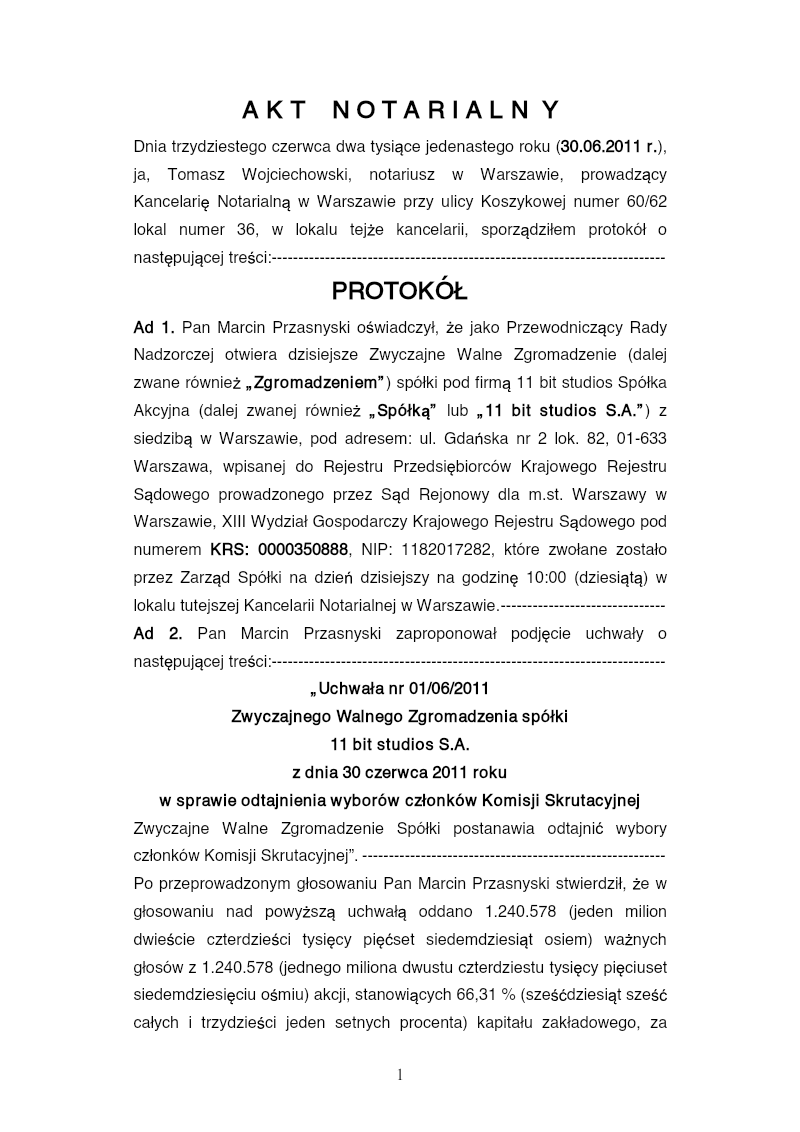
The document records the proceedings of a regular shareholders’ meeting held on 30 June 2011 by 11 bit studios S.A., a Warsaw‑based joint‑stock company. The meeting, convened by the board and chaired by Chairman Marcin Przasnyski, approved a series of resolutions concerning corporate governance and financial matters. Key actions included the disclosure of the audit committee election, the appointment of three members to the audit committee—Grzegorz Miechowski, Bartosz Brzostek and Bohdan Drozdowski—and the election of Przasnyski as meeting chair. The shareholders unanimously approved the company’s 2010 activity report and financial statements, which showed a net loss of PLN 231,199.53 and total assets of PLN 1,352,359.17. A resolution to cover the loss from future profits was adopted. Subsequent resolutions granted absolute approval (absolutory) to all board members and supervisory board members for the 2009‑2010 period, with voting results ranging from 48.74 % to 66.31 % of the capital represented by votes, reflecting full quorum and majority requirements under Polish company law. The meeting concluded with the adoption of the agenda, confirmation of proper convening and quorum, and closure. The protocol includes a signed attendance list and is notarised by Tomasz Wojciechowski. The proceedings cover corporate governance, financial reporting, and loss coverage for the 2010 fiscal year within Poland.
- 11 bit studios S.A. reported a net loss of PLN 231,199.53 for the 2010 fiscal year.
- Shareholders formally resolved to cover the 2010 net loss using the company's future profits.
- The company’s total assets were valued at PLN 1,352,359.17 as of the 2010 reporting period.
- Shareholders unanimously approved the 2010 activity report and financial statements during the June 30, 2011, regular meeting.
- The board and supervisory board members were granted formal discharge (absolutory) for their performance during the 2009–2010 period.
11 bit studios
Report1 pages
Prognozy dla 11 bit studios S.A. Wybranych Danych Finansowych na lata 2011-2013
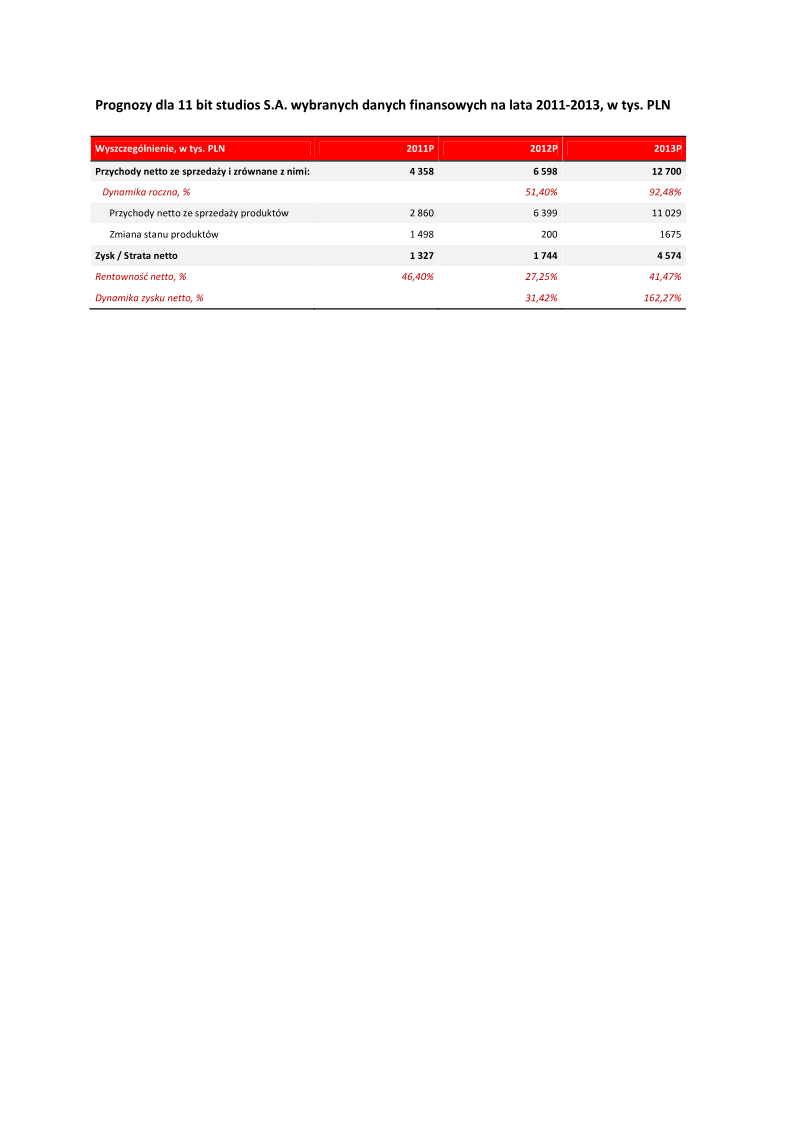
The forecast presents projected financial performance for 11 bit Studios S.A. over the years 2011‑2013, expressed in thousands of Polish zloty. Net sales revenue is expected to rise from 4 358 in 2011 to 12 700 by 2013, reflecting annual growth rates of 51.40 % and 92.48 %. Net sales from product sales alone are projected to increase from 2 860 to 11 029, while changes in product inventory contribute an additional 1 498, 200, and 1 675 respectively. Net profit is projected to grow from 1 327 in 2011 to 4 574 in 2013, with profitability margins moving from 46.40 % to 41.47 %. The net profit growth rate accelerates sharply, from 31.42 % in the first year to an impressive 162.27 % in the second.
The scope covers a single company within the video‑game development sector, focusing on selected financial metrics over a three‑year horizon. The methodology is implicit: the figures represent forecasted values rather than historical data, likely derived from internal projections or market analysis. No explicit sample size or external data sources are cited; the report appears to be an internal financial planning document. The analysis underscores a strong projected expansion in both revenue and profitability, driven largely by product sales growth and inventory management.
- 11 bit studios S.A. projects net sales revenue to grow from 4,358 thousand PLN in 2011 to 12,700 thousand PLN by 2013.
- Net profit is forecasted to increase from 1,327 thousand PLN in 2011 to 4,574 thousand PLN in 2013, representing a significant acceleration in growth.
- The company expects a sharp rise in the net profit growth rate, climbing from 31.42% in the first year to 162.27% by the second year of the forecast period.
- Annual revenue growth rates are projected at 51.40% and 92.48% respectively across the 2011–2013 timeframe.
- Product sales are the primary driver of revenue expansion, with projections rising from 2,860 thousand PLN in 2011 to 11,029 thousand PLN in 2013.
11 bit studios
Report3 pages
Zakończenie Subskrypcji Akcji Zwykłych na Okaziciela Serii D
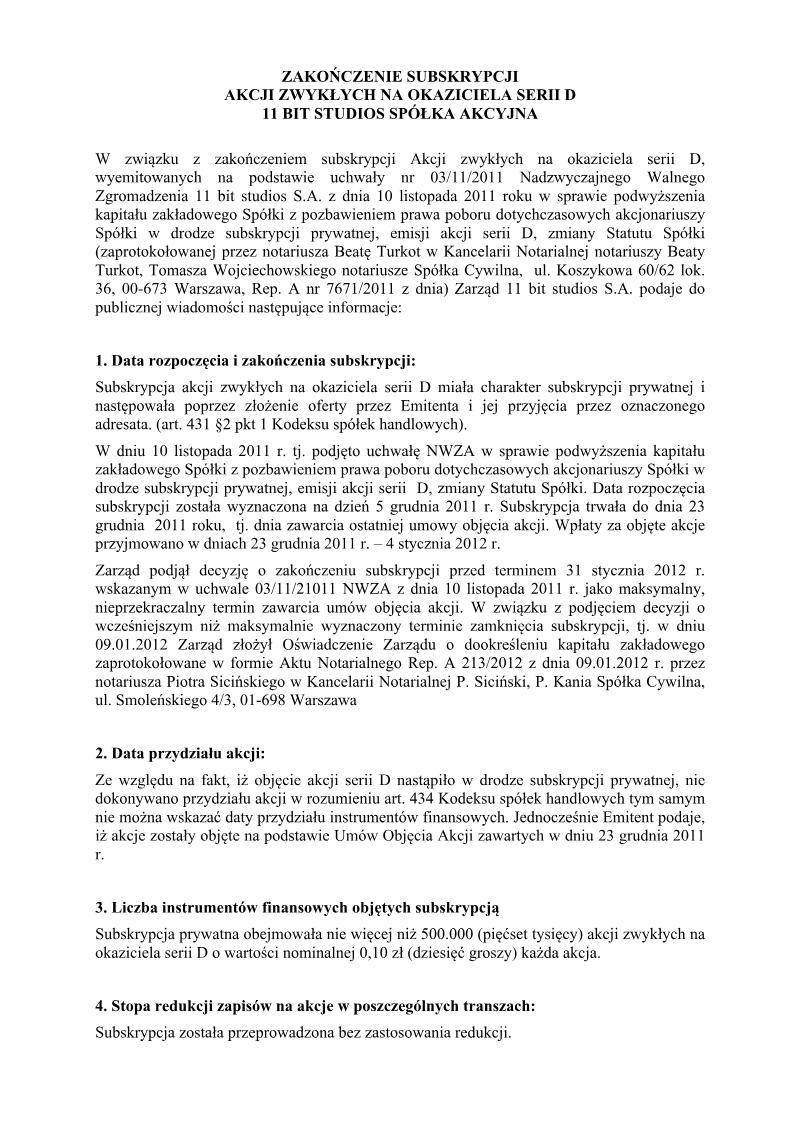
The announcement details the conclusion of a private subscription for ordinary bearer shares Series D issued by 11 Bit Studios S.A. The subscription, authorized on 10 November 2011 by a special general meeting to increase capital without existing shareholders’ subscription rights, commenced on 5 December 2011 and closed early on 9 January 2012, ahead of the originally stipulated 31 January deadline. The subscription capped at 500 000 shares, each with a nominal value of 0.10 zł.
A total of 40 938 shares were actually subscribed and issued on 23 December 2011, at an emission price of 9.00 zł per share. The offering attracted 64 investors, but only ten entered into subscription agreements on the closing date; no sub‑emission arrangements were made. The transaction incurred total costs of 46 722 zł, comprising 41 722 zł for preparation and execution (including notarial fees), 5 000 zł for advisory and informational documentation, with no remuneration paid to sub‑emitters or promotion expenses. These costs are recorded as interim expenses and will be expensed upon registration of the capital increase in accordance with Polish accounting regulations.
The report is confined to Poland, covering a single fiscal period (late 2011–early 2012) and the ordinary share segment of 11 Bit Studios. It follows statutory disclosure requirements under Polish corporate law and the Alternative Trading System regulations, providing a concise overview of subscription dates, share numbers, pricing, investor participation, and cost allocation.
- 11 Bit Studios S.A. concluded a private subscription for Series D ordinary bearer shares, issuing 40,938 shares out of a maximum authorized 500,000.
- The shares were issued on December 23, 2011, at an emission price of 9.00 zł per share, with a nominal value of 0.10 zł per share.
- The subscription period ran from December 5, 2011, to January 9, 2012, closing ahead of the original January 31, 2012 deadline.
- The offering attracted 64 total investors, though only ten finalized subscription agreements by the closing date.
- Total transaction costs amounted to 46,722 zł, consisting of 41,722 zł for preparation and notarial fees and 5,000 zł for advisory and documentation services.
+1
11 bit studios
Report6 pages
Dookreślenie kapitału — seria E
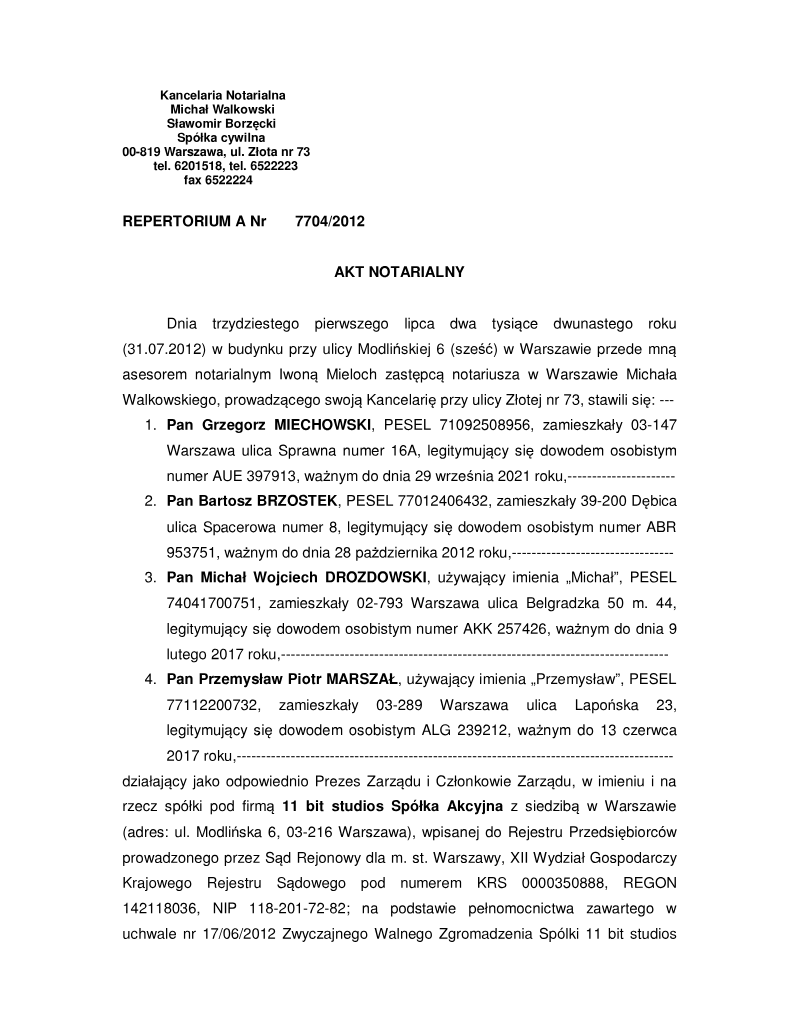
The document records a notarial act concerning the capital increase of 11 bit studios Spółka Akcyjna, a Warsaw‑based video game developer. The act confirms that the extraordinary general meeting held on 22 June 2012 approved a capital increase from PLN 191,169.90 to a maximum of PLN 231,169.90 by issuing up to 400,000 new ordinary shares (Series E) with a nominal value of PLN 0.10 each, and amended the company’s articles to reflect the new share structure. The updated capital is set at PLN 221,719.90 and divided into five series: 1,000,000 Series A shares (PLN 0.10), 494,200 Series B shares, 376,561 Series C shares, 40,938 Series D shares, and 305,500 newly issued Series E shares. Six subscription agreements were executed by 27 July 2012, covering 305,500 Series E shares for a total subscription value of PLN 30,550.00.
The act lists the board members—Grzegorz Miechowski, Bartosz Brzostek, Przemysław Marszał, and Michał Drozdowski—who represent the company in signing. It details procedural aspects such as notarization, registration requirements, and cost allocation (notarial fee PLN 200.00 plus VAT PLN 46.00). The document is limited to the company’s Warsaw jurisdiction and pertains exclusively to its capital structure changes in 2012, with no broader industry or geographic scope. The methodology is purely legal documentation, relying on corporate minutes and statutory provisions to validate the capital increase and share issuance.
- 11 bit studios S.A. increased its share capital in 2012 from PLN 191,169.90 to PLN 221,719.90.
- The capital increase was achieved through the issuance of 305,500 new Series E ordinary shares with a nominal value of PLN 0.10 each.
- Subscription agreements for the 305,500 Series E shares were finalized by 27 July 2012, resulting in a total subscription value of PLN 30,550.00.
- Following the issuance, the company's total share structure consists of 2,217,199 shares divided across five series: Series A (1,000,000), Series B (494,200), Series C (376,561), Series D (40,938), and Series E (305,500).
- The capital increase was authorized by an extraordinary general meeting held on 22 June 2012, which also mandated amendments to the company's articles of association.
11 bit studios
Report2 pages
Report on the Completion of Series E Share Subscription
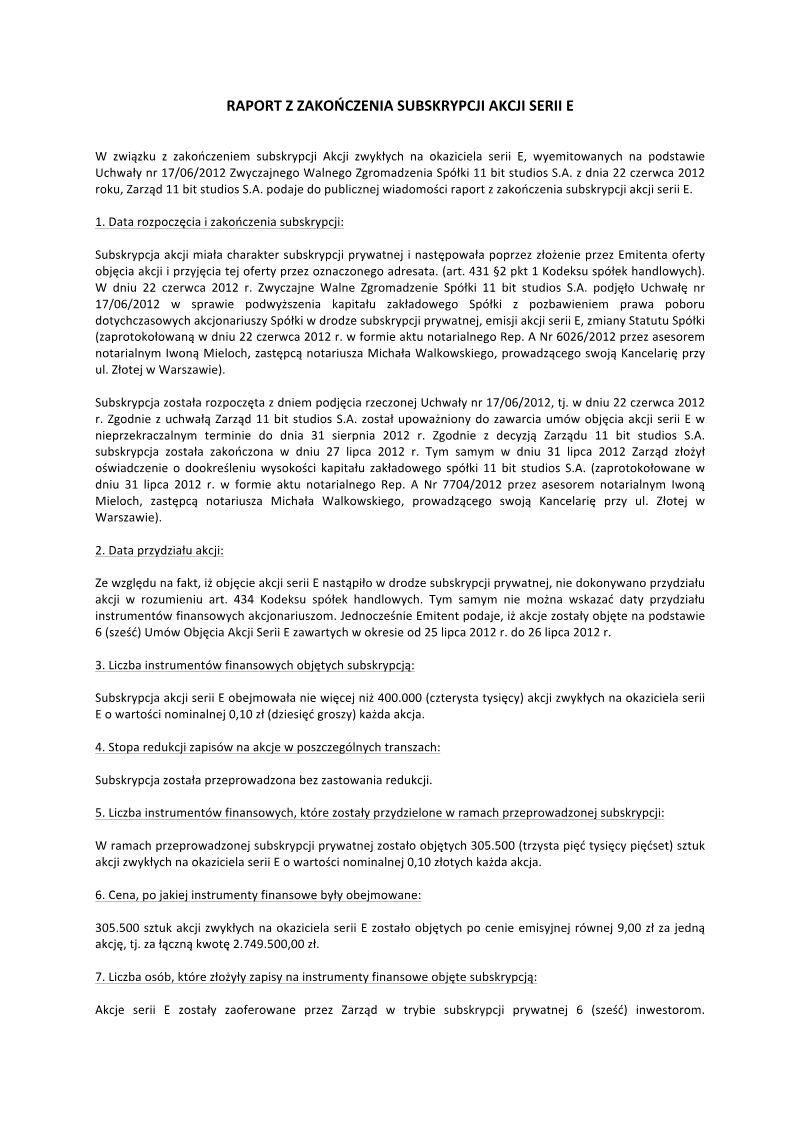
The report details the completion of a private subscription for Series E ordinary shares issued by 11 bit studios S.A. following the board’s resolution on 22 June 2012 to increase share capital without existing shareholders’ subscription rights. The subscription commenced on the resolution date and concluded on 27 July 2012, with the board filing a capital declaration on 31 July 2012. Six private investors entered into purchase agreements between 25 and 26 July 2012, acquiring a total of 305,500 shares at an issue price of PLN 9.00 per share, generating proceeds of PLN 2,749,500.
The subscription involved no reduction in nominal value and did not include any sub‑subscription agreements. The total number of shares offered was 400,000, but only 305,500 were ultimately subscribed. Costs associated with the issuance amounted to PLN 42,386, broken down into preparation and execution of the offer (PLN 20,000), informational document drafting and advisory fees (PLN 20,500), notarial and treasury charges (PLN 1,886), with no sub‑subscription or promotion expenses. These costs were recorded as interim expenses and will be capitalised in accordance with Polish accounting regulations.
The report confirms that the Series E shares were issued privately, without a public allocation date, and outlines the legal basis for reporting under the Alternative Trading System regulations. The capital increase was fully executed within the stipulated period, and all financial and procedural details comply with applicable corporate law provisions.
- 11 bit studios S.A. raised PLN 2,749,500 through a private subscription of 305,500 Series E ordinary shares.
- The shares were issued at a price of PLN 9.00 per share to six private investors between 25 and 26 July 2012.
- The capital increase fell short of the 400,000 shares originally offered, with 305,500 shares ultimately subscribed.
- Issuance costs totaled PLN 42,386, covering advisory, legal, and administrative fees, which will be capitalized under Polish accounting regulations.
- The subscription process was initiated by a board resolution on 22 June 2012 and concluded with a formal capital declaration on 31 July 2012.
11 bit studios
Report2 pages
Professional Curriculum Vitae: Piotr Sulima
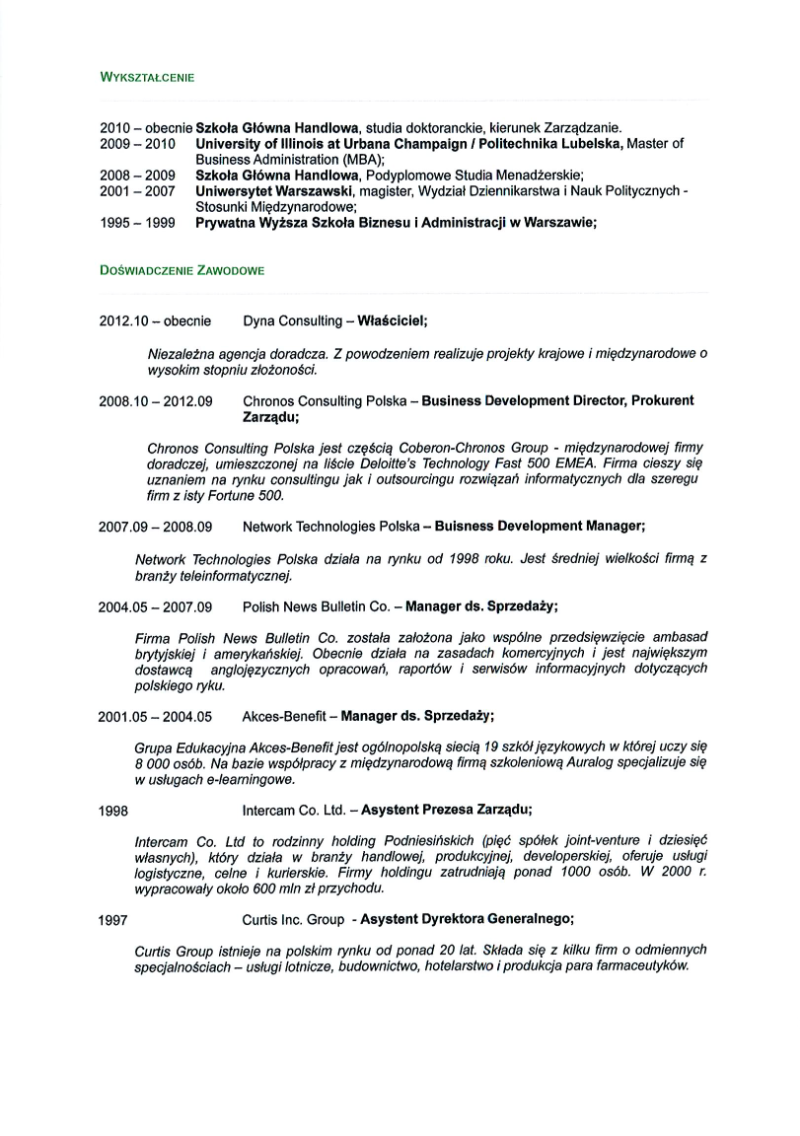
Piotr Sulima’s professional trajectory spans academia, consulting, and business development across Poland and internationally. He holds a PhD in Management from the Warsaw School of Economics (2010‑present) and an MBA, complemented by a master’s degree from the University of Illinois at Urbana‑Champaign (2009‑2010). Earlier academic credentials include a master’s in International Relations from the University of Warsaw (1995‑1999) and postgraduate managerial studies at the Warsaw School of Economics (2001‑2007).
Professionally, Sulima has led growth initiatives for several firms. From 2012 onward he owns Dyna Consulting, a boutique advisory agency executing national and mid‑regional projects. Between 2008 and 2012 he served as Business Development Director at Chronos Consulting Polska, part of the Deloitte Technology Fast 500 EMEA‑listed Coberon‑Chronos Group, where he managed Fortune 500 client engagements. Earlier roles include Business Development Manager at Network Technologies Polska (2007‑2008), Sales Manager positions at Polish News Bulletin Co. and Akces‑Benefit (2004‑2008), and assistant roles at Intercam Co. Ltd. and Curtis Inc. Group (1997‑2001).
His language proficiency is fluent English with FCE, CAE, CPE certifications; basic German and Russian. Technical skills cover Windows, Office, Lotus Notes/Domino, Linux Ubuntu, and macOS.
Sulima’s extracurricular involvement includes volunteering with a Maltese medical service (2013‑present), vice‑chairmanship of SMT SA’s supervisory board (since 2011), and long‑standing participation in youth, student, and sports organizations. His interests feature motorcycling (Harley Owners Group) and skydiving (Polish Association of Air Sports).
- Piotr Sulima has operated his own boutique advisory firm, Dyna Consulting, since 2012, focusing on national and mid-regional business projects.
- From 2008 to 2012, he served as Business Development Director at Chronos Consulting Polska, a subsidiary of the Deloitte Technology Fast 500-listed Coberon-Chronos Group, managing Fortune 500 client accounts.
- Sulima holds a PhD in Management from the Warsaw School of Economics (in progress since 2010) and an MBA from the University of Illinois at Urbana-Champaign (2009–2010).
- His early career includes business development and sales management roles at Network Technologies Polska, Polish News Bulletin Co., and Akces-Benefit between 2004 and 2008.
- He has served as the vice-chair of the supervisory board for SMT SA since 2011 and has been a volunteer with a Maltese medical service since 2013.
11 Bit Studios
Report1 pages
Oświadczenie o nieubieganiu się o wybór na kolejną kadencję: 11 bit studios
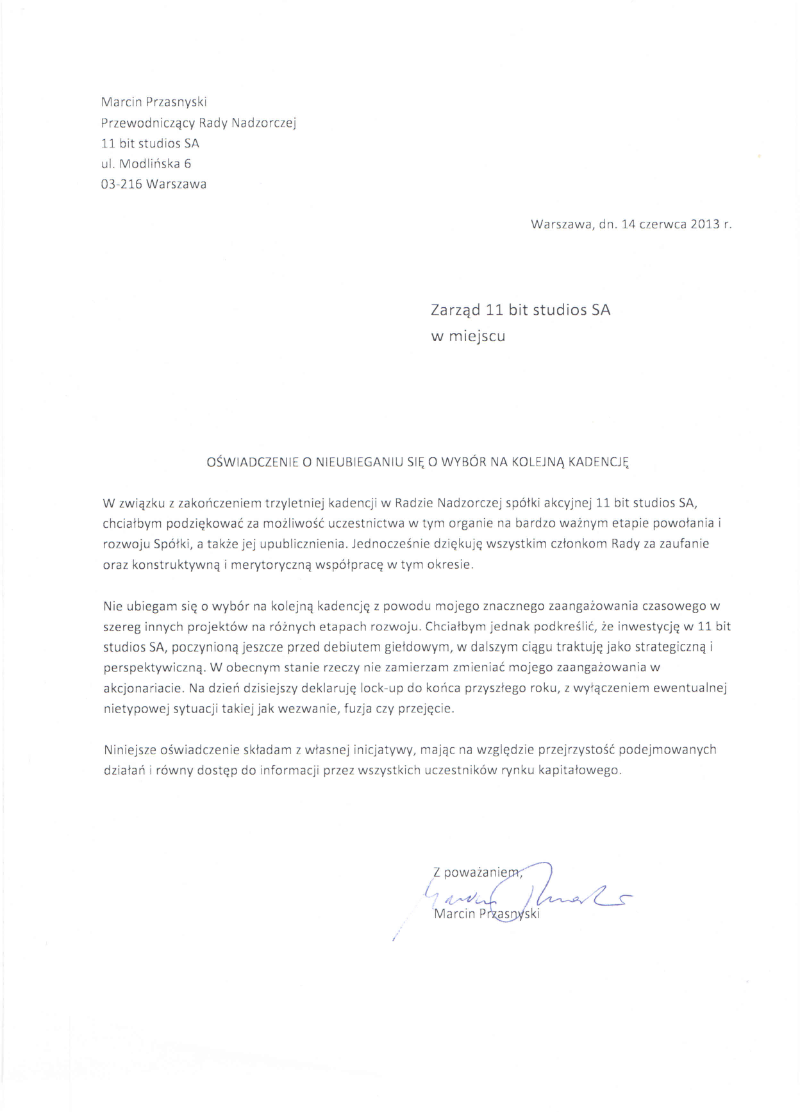
The statement, issued by Marcin Przasnyski, Chairman of the Supervisory Board of 11 bit Studios SA on 14 June 2013, announces his decision not to seek re‑election for the next three‑year term. Przasnyski expresses gratitude to shareholders and board members for their trust and collaborative work during a critical phase of the company’s development and public listing. He cites extensive time commitments to other projects at various stages as the primary reason for stepping down, while affirming continued strategic investment in 11 bit Studios. The declaration includes a lock‑up commitment until the end of the following year, except in extraordinary circumstances such as a call, merger or acquisition. The statement underscores transparency and equal access to information for all market participants, reflecting the company’s commitment to governance standards. The document is a formal communication from the board chair to shareholders, covering the period up to mid‑2013 and focusing on corporate governance within the Polish capital market. No additional data, statistics or methodological details are provided beyond the personal commitment and governance context.
- Marcin Przasnyski, Chairman of the Supervisory Board of 11 bit studios, announced on 14 June 2013 that he will not seek re-election for the upcoming three-year term.
- Przasnyski cited excessive time commitments to other professional projects as the primary reason for his departure from the board.
- Despite stepping down, Przasnyski committed to maintaining his strategic investment in 11 bit studios.
- The outgoing chairman entered into a lock-up agreement for his shares effective until the end of 2014, with exceptions only for extraordinary events such as mergers, acquisitions, or calls.
- The announcement was framed as a commitment to corporate governance standards, emphasizing transparency and equal information access for all market participants.
11 bit studios