Updated Jun 1, 2026 by Playing for the Planet Alliance
Report
Published by Playing for the Planet Alliance, Carbon Trust, Unity Charitable Fund, Ukie
A practical guide to climate action and carbon emissions in the video gaming industry alongside guidance for video game businesses on scope 3 guidance greenhouse onscope 3 The Carbon Trust was commissioned to author this report by the Decarbonisation Working Group of the Playing for the Planet Alliance. Funding was provided by the Unity Charitable Fund while Ukie supported with stakeholder management.
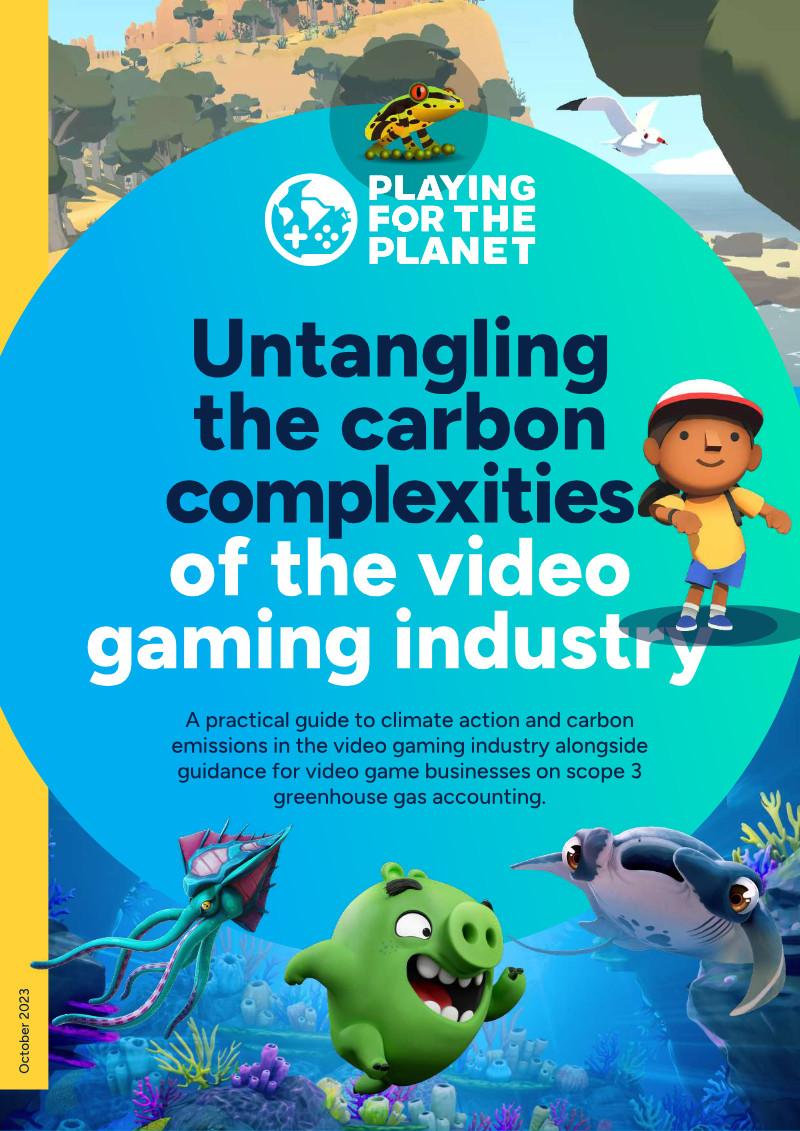
PLAYING FORTHE PLANET Untangling the carbon complexities of the video gaming industry A practical guide to climate action and carbon emissions in the video gaming industry alongside guidance for video game businesses on scope 3 guidance greenhouse onscope 3 greenhouse gas accounting. gasaccounting. October 2023
Acknowledgements The Carbon Trust was commissioned to author this report by the Decarbonisation Working Group of the Playing for the Planet Alliance. Funding was provided by the Unity Charitable Fund while Ukie supported with stakeholder management. We would like to thank the Playing for the Planet members who form part of the Playing for the Planet Decarbonisation Working Group for providing their valuable time, expertise and feedback during development of the report. Thanks to the Carbon Trust team and Playing for the Planet members. The Carbon Trust Matt Anderson, Senior Consultant Luisa Diaz Flores, Corporate Sustainability Manager Mari Karla Medina, Analyst Participating Playing for the Planet members Microsoft Xbox Neogames Pixel Federation Rovio Sony Interactive Entertainment Sumo Group Ubisoft Ukie* Ustwo Games Unity Video Games Europe* Special thanks to non-Playing for the Planet members who contributed to the report Team17 * Associate Members participation is limited to their respective secretariat and cannot be read as an implicit endorsement of the paper by their individual members UNTANGLING THE CARBON COMPLEXITIES OF THE VIDEO GAMING INDUSTRY 2
CARBON TRUST About Playing for the Planet About the Carbon Trust The Playing For The Planet Alliance was launched in 2019 during the Climate Summit at UN Headquarters in New York. In total, the members of the Alliance have the ability to reach more than 1 billion video game players. In joining the Alliance, members have made commitments ranging from integrating green activations in games, reducing their emissions and supporting the global environmental agenda through initiatives ranging from planting millions of trees to reducing plastic in their products. The Carbon Trust is a global climate consultancy driven by the mission to accelerate the move to a decarbonised future. Climate pioneers for over 20 years, it partners with businesses, governments and financial institutions to drive positive climate action. From strategic planning and target setting to implementation and communication, the Carbon Trust turns ambition into impact. To date, its 400 experts have helped set over 200 science-based targets and guided more The initiative is facilitated by the UN than 3,000 organisations and cities across Environment Programme. five continents on their route to Net Zero. Report disclaimer
Carbon Trust turns ambition into impact. To date, its 400 experts have helped set over 200 science-based targets and guided more The initiative is facilitated by the UN than 3,000 organisations and cities across Environment Programme. five continents on their route to Net Zero. Report disclaimer This is a Playing for the Planet Alliance report whose aim is to address the uncertainty in the application of the Greenhouse Gas Protocol (GHG Protocol) accounting and reporting standards to organisations in the video gaming sector. There is currently a lack of clarity on how the video gaming sector applies aspects of the accounting frameworks. This is creating significant barriers for businesses wanting to increase the ambition of their climate action, as measurement and tracking of carbon emissions is a fundamental pillar of carbon reduction strategies. This report seeks to gather approaches currently used by Playing for the Planet Alliance members to measure scope 3 emissions. The report consolidates learnings and experiences of industry organisations and provides valuable guidance for video game businesses that seek clarity on applying GHG accounting standards. The aspiration of the report is to generate consensus within the Alliance around accounting approaches in relation to the GHG Protocol. Please note that at this stage the intention is not to define or require an industry standard GHG accounting approach. UNTANGLING THE CARBON COMPLEXITIES OF THE VIDEO GAMING INDUSTRY 3
About this report Why do we need this report? As part As part of its mission and in line with its core focus areas for 2023¹, the Playing for the Planet Alliance (P4P) seeks to accelerate climate action and decarbonisation in the video gaming industry. In recent years, video game businesses across the industry have worked to measure, report, and understand their carbon footprints, set carbon reduction targets, and develop carbon reduction strategies. Through P4P’s work in this area and engagement with video game businesses across the industry, foundational challenges to accelerating climate action have become clear. This report seeks to address these challenges, namely: a lack of clarity on how video game businesses should interpret and apply existing carbon accounting frameworks and engagement with the broader video gaming community on climate action. Frameworks – such as the Greenhouse Gas (GHG) Protocol and, the related, Science Based Targets initiative (SBTi) – already exist. Businesses can follow these frameworks to measure, report and therefore reducetheir carbon emissions. Currently there is ambiguity on how the video gaming sector applies and interprets these frameworks, particularly around scope 3 emissions. Members of the video gaming industry that
already exist. Businesses can follow these frameworks to measure, report and therefore reducetheir carbon emissions. Currently there is ambiguity on how the video gaming sector applies and interprets these frameworks, particularly around scope 3 emissions. Members of the video gaming industry that measure their emissions are having to evaluate and interpret how they apply these frameworks individually, resulting in reports that are not always comparable and can vary significantly between companies. This causes uncertainty as to whether the frameworks are being correctly interpreted and inconsistency in how the sector measures and reports its carbon emissions. In turn, businesses face a significant barrier when they start to measure and reduce their emissions, consequently slowing down the speed of climate action. Establishing new understanding on this agenda was seen as the priority project for P4P to take forward together in 2023. Discussions were held to confirm this approach in a series of meetings through a period of six months in 2022 and this approach has also been informed by other initiatives such as Carbon Call which was founded with the support of Microsoft, with UNEP’s support in 2022. Building a connection between video game players, the video gaming community and video game businesses also forms an important part in accelerating climate action. Players should have access to clear and useful information on this topic, which this report seeks to provide. 1 ~~https://www.playing4theplanet.org/project/annual-impact-reporting~~
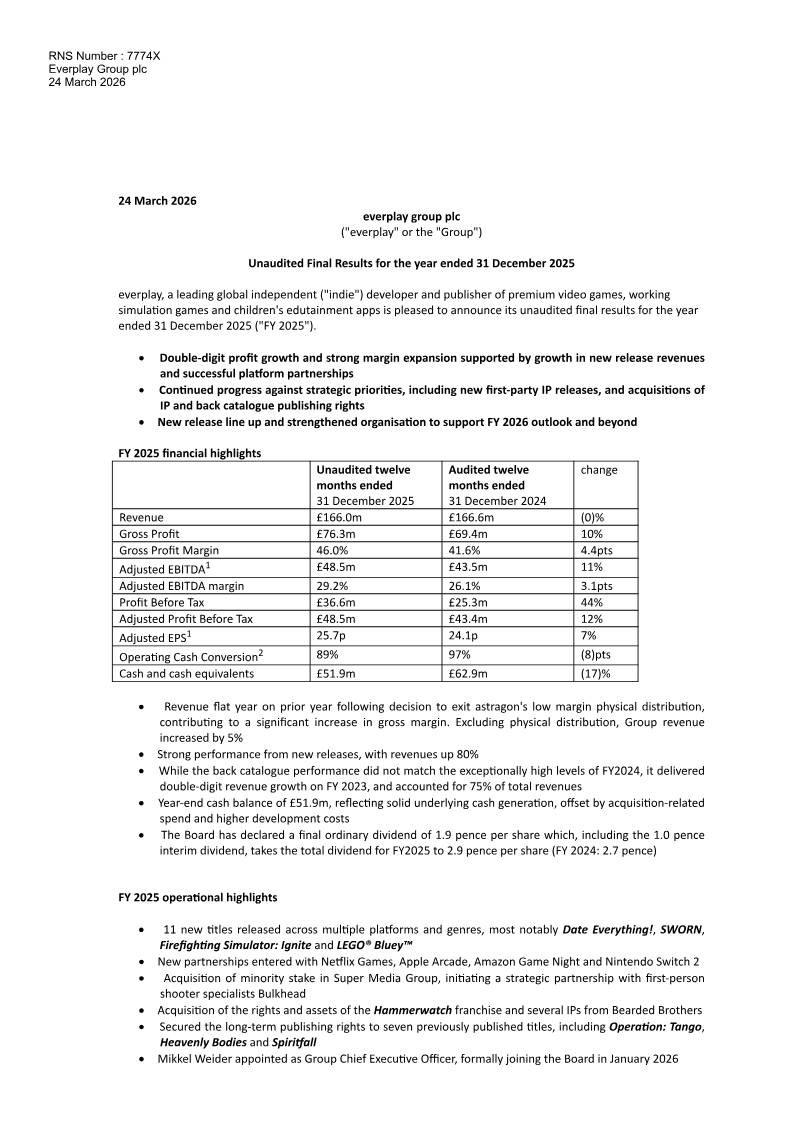
24 March 2026 ("ev everplay group plc Unaudited Final Results for the year ended 31 December 2025 everplay, a leading global independent ("indie") developer and publisher of premium video games, working simulation games and children's edutainment apps is pleased to announce its unaudited final results for the year ended 31 December 2025 ("FY 2025").
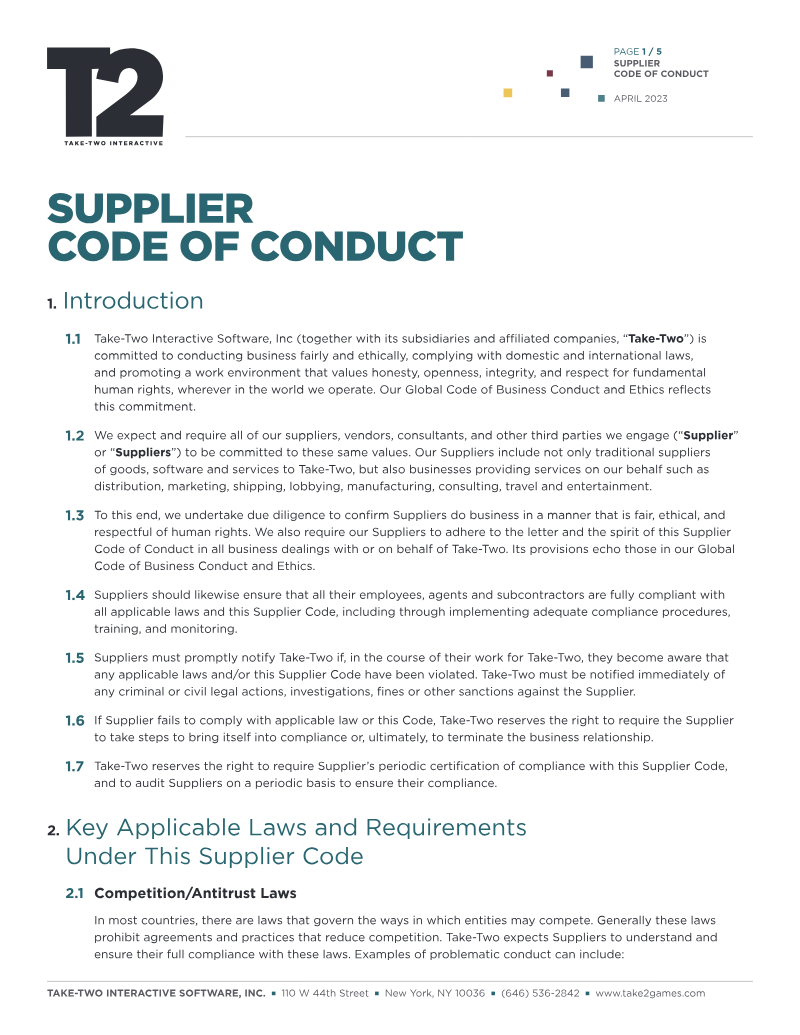
The Supplier Code of Conduct for Take-Two Interactive Software, Inc., updated in April 2023, establishes the ethical, legal, and professional standards required of all third-party partners. The primary thesis is that all suppliers, consultants, and vendors must mirror the company’s internal commitment to honesty, integrity, and human rights. This mandate extends globally to any entity providing goods or services, including distribution, marketing, and manufacturing, and requires these partners to ensure compliance among their own subcontractors and employees. The document outlines specific legal requirements across several critical domains. Suppliers must strictly adhere to competition and antitrust laws, anti-bribery and corruption statutes such as the US Foreign Corrupt Practices Act and the UK Bribery Act, and anti-money laundering regulations. Furthermore, the scope includes strict compliance with trade sanctions and export controls, specifically highlighting high-risk regions such as Iran, Cuba, Syria, North Korea, and certain areas of Ukraine. Partners are also prohibited from engaging in insider trading based on non-public information gained through their relationship with the company. Beyond legal compliance, the standards emphasize social responsibility and operational integrity. Key provisions include the prohibition of child or prison labor, the protection of fundamental human rights, and the maintenance of a work environment free from discrimination and harassment. Suppliers are required to maintain accurate financial records, protect intellectual property, and avoid conflicts of interest. To ensure adherence, the company reserves the right to conduct periodic audits and requires immediate notification of any legal investigations or violations. A global reporting infrastructure is provided, featuring a 24-hour ethics hotline available across more than twenty countries, supported by a non-retaliation policy for those reporting grievances in good faith.
SEGA SAMMY HOLDINGS INTEGRATED REPORT 2025 SEGA SAMMY HOLDINGS INTEGRATED REPORT 2025 Key Visual from Sonic the Hedgehog 3 movie Group Value Introduction Strengthening of Non-Financial Capital Creativity is Mindset and DNA SEGA SAMMY Group Core Businesses 02 Materiality 56 Creativity is Alway...
GungHo Online Entertainment’s FY 2025 financial briefing outlines a strategic pivot from Japan‑centric mobile development toward global expansion, emphasizing action titles on consoles and PCs. The company reports a 64.1 % overseas net‑sales ratio in FY 2025, up from 47.7 % in 2019 and 56.2 % in 2020, reflecting intensified sales in North America and Europe through new releases such as “Let It Die: Inferno” on PlayStation 5, Steam, and Nintendo Switch. The launch of nine global titles in 2025, including the “Ragnarok” series and “Puzzle & Dragons,” is highlighted as a key growth driver, with the latter celebrating its 5 000‑day anniversary and hosting cross‑platform events to boost user activity. Financially, consolidated net sales fell by 1.3 % YoY to ¥125.3 billion, driven mainly by declines in mobile titles and “Ragnarok”‑related revenue under subsidiary Gravity. Operating profit contracted by 9.3 % YoY to ¥276 million, as SG&A expenses rose due to increased advertising spend and personnel costs following the full acquisition of Alim in December 2024. Non‑consolidated results remained flat, but mobile sales slipped and Gravity’s “Ragnarok” titles underperformed, contributing to the consolidated loss. The briefing covers a global geographic scope—North America, Europe, Latin America, and Asia—with a 2025 focus on launching titles in over 150 countries. Methodologically, data derive from consolidated financial statements and quarterly performance metrics, with a clear emphasis on aligning product development with international market demand.