Updated Jun 1, 2026 by Mistplay
Report
Published by Mistplay
Frequency ofin-gamespend by spenders Frequently Occasionally Rarely (multipletimes (once every (a few times a month) month or two) a year) than their Western counterparts. Average pricerange of a single IAP 42% 30% 8% Less than $5 USD More than $10 USD prioritize value, whereas in the
MISTPLAY R EAST VS. WEST: MONETIZATION TRENDS How spending behavior differs between Eastern and Western mobile gamers
spend more frequently than mobile gamers in the West. Frequency ofin-gamespend by spenders EAST WEST 35% 36% 37% 41% 29% 22% Frequently Occasionally Rarely (multipletimes (once every (a few times a month) month or two) a year)
to spend moreper purchase than their Western counterparts. Average pricerange of a single IAP 76% 42% 30% 8% EAST WEST EAST WEST Less than 5 USD More than 10 USD
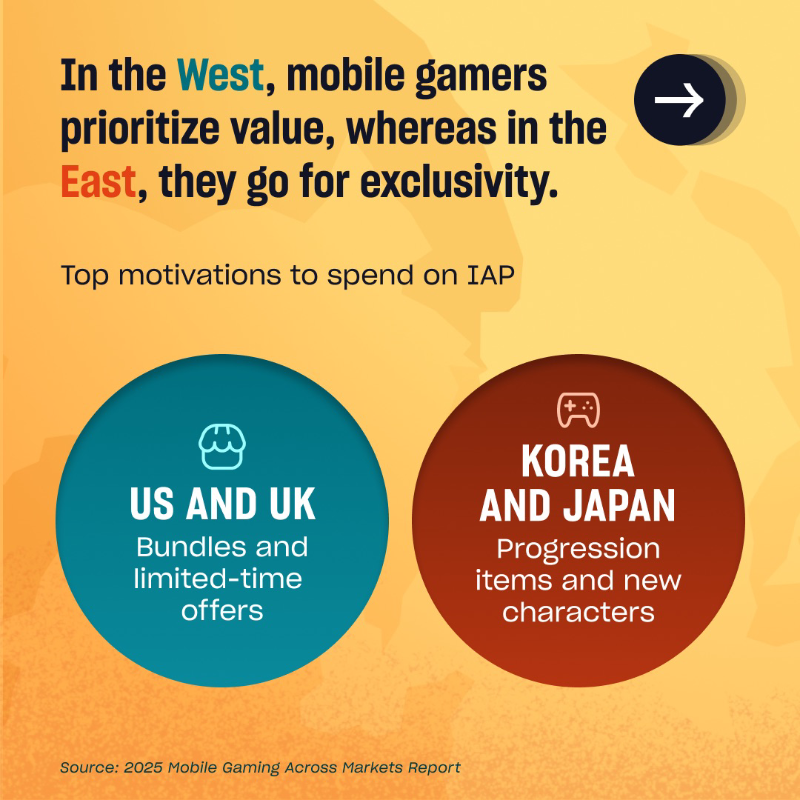
prioritize value, whereas in the East,theygofor exclusivity. Topmotivations to spendon IAP KOREA US AND UK AND JAPAN Bundles and Progression limited-time items andnew offers characters
Chinese gaming developers are aggressively expanding their global footprint by leveraging sophisticated monetization models and high-volume, AI-driven marketing strategies. The primary objective for these publishers is to balance the high revenue potential of mature markets like the United States, Japan, and South Korea against the rising costs of user acquisition. By prioritizing video advertising, which currently yields the highest Day 7 return on ad spend at 21%, developers are successfully capturing market share in competitive strategy and RPG segments. Success in these international territories is increasingly predicated on hyper-localization and technological integration. Publishers are utilizing generative AI to streamline the production of localized ad creatives, voice-overs, and performance-tested copy, allowing for rapid iteration and regional customization. Leading titles demonstrate that high-engagement gameplay loops—such as the inclusion of social hangout spaces, customizable home systems, and minigame integrations—are essential for sustaining long-term retention. These efforts are further bolstered by strategic partnerships with local influencers and the implementation of innovative, time-limited gacha mechanics. To maintain consistent growth, developers are diversifying their engagement tactics through gamified live events, including seasonal collections and interactive board-style challenges. These features, combined with trial character systems, allow publishers to cater to varied player motivations while maintaining a steady revenue stream. By synthesizing competitive intelligence with agile content updates, Chinese gaming apps are effectively navigating the complexities of global expansion, ensuring that both monetization and user interest remain high across diverse geographic regions.
The global mobile gaming market reached $57.1 billion between 2023 and 2025, representing a 3.4% increase driven primarily by the App Store and emerging regions such as LATAM and MENA. While established markets like China and Japan experienced revenue contractions of up to 15%, the Strategy genre surged by over 25%, bolstered by a massive 213% increase in Card Battlers. A pivotal shift in the industry is the rise of direct-to-consumer revenue, which grew by 46% among the top 100 US titles as developers increasingly adopt webshops and alternative payment systems to bypass traditional platform fees. Monetization trends indicate a widening performance gap between platforms, with the App Store consistently outperforming Google Play in both revenue growth and average revenue per paying user. In the United States, the share of high-value players spending over $100 rose from 22% to 32%, while the App Store’s 90-day ARPPU climbed by 71%. This growth is largely attributed to rising transaction values, including the introduction of $159.99 price caps in top-tier titles. Conversely, Google Play’s growth remains dependent on a higher frequency of smaller, low-priced purchases, particularly as the RPG sector faces a 15% decline and a significant drop in Android spending. Genre-specific performance reveals a move toward diversification and sophisticated LiveOps. The Puzzle genre grew by 15%, led by a 911% revenue explosion in Block Puzzles, while the Hybridcasual segment saw in-app purchase revenue surge by 84% through the standardization of Season Passes and failure-triggered offers. Despite a 7.5% decline in the Casino market, the Simulation genre successfully increased average purchase values by 52%. Across all segments, developers are prioritizing customizable bundles and high-value special offers to maintain engagement and offset declining purchase frequencies among long-term players.
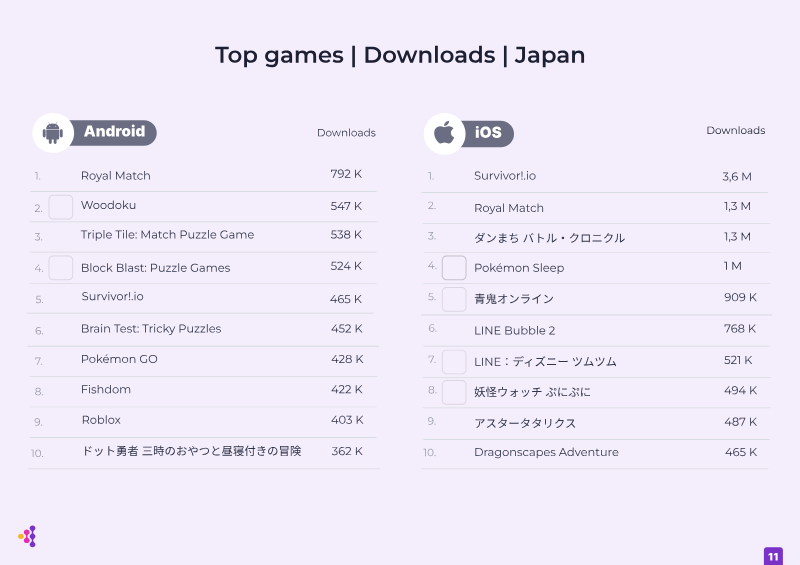
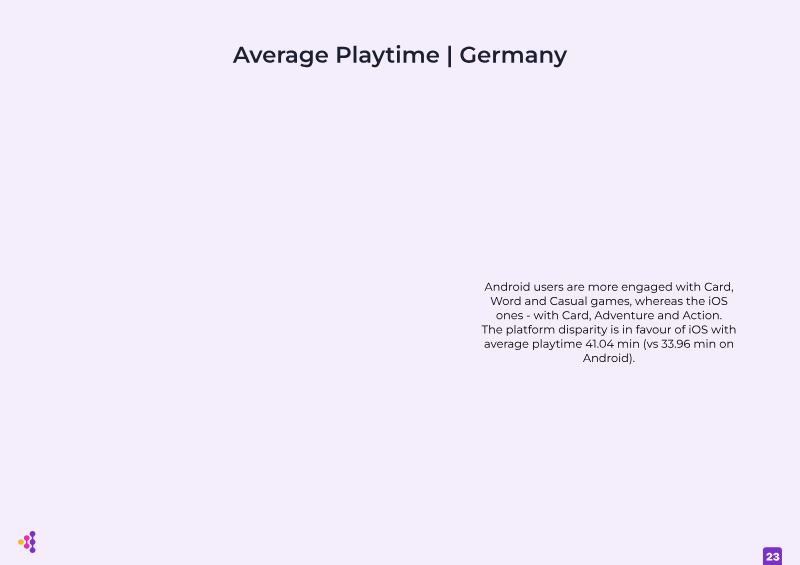
The analysis evaluates the current performance of the mobile‑games ecosystem, concentrating on download popularity, revenue generation, and user‑engagement metrics across key Western and Asian markets. By comparing platform‑specific behavior and regional preferences, it seeks to identify the titles and genres that drive the strongest financial returns and the longest play sessions, thereby informing strategic decisions for developers, publishers, and marketers. Casual‑puzzle and social titles dominate download charts in France, Germany, and the United Kingdom, with Monopoly Go!, Roblox and Subway Surfers leading the rankings. Revenue concentration is even more pronounced: Coin Master repeatedly tops earnings tables, delivering €5.3 million on Android in France and €6.7 million on Android in Germany. Across the surveyed territories, iOS users exhibit markedly longer sessions than Android users, with average iOS playtime ranging from 35 minutes in the United States to 51 minutes in Japan, compared with 29–44 minutes on Android. Japan records the longest sessions overall, while France shows the smallest platform gap of roughly 3.6 minutes. The titles that capture the most playtime vary by region but are largely anchored by the same franchises, such as Candy Crush and other established puzzle series. The study covers major European markets (France, Germany, UK), North America (US) and Japan, reflecting data from the most recent full‑year cycle. It spans the casual, puzzle, and social segments of the mobile‑games industry, highlighting a persistent dominance of a limited set of high‑engagement franchises and a clear platform‑based divergence in user behavior. These patterns suggest that future monetization strategies should prioritize iOS‑centric engagement tactics in markets with
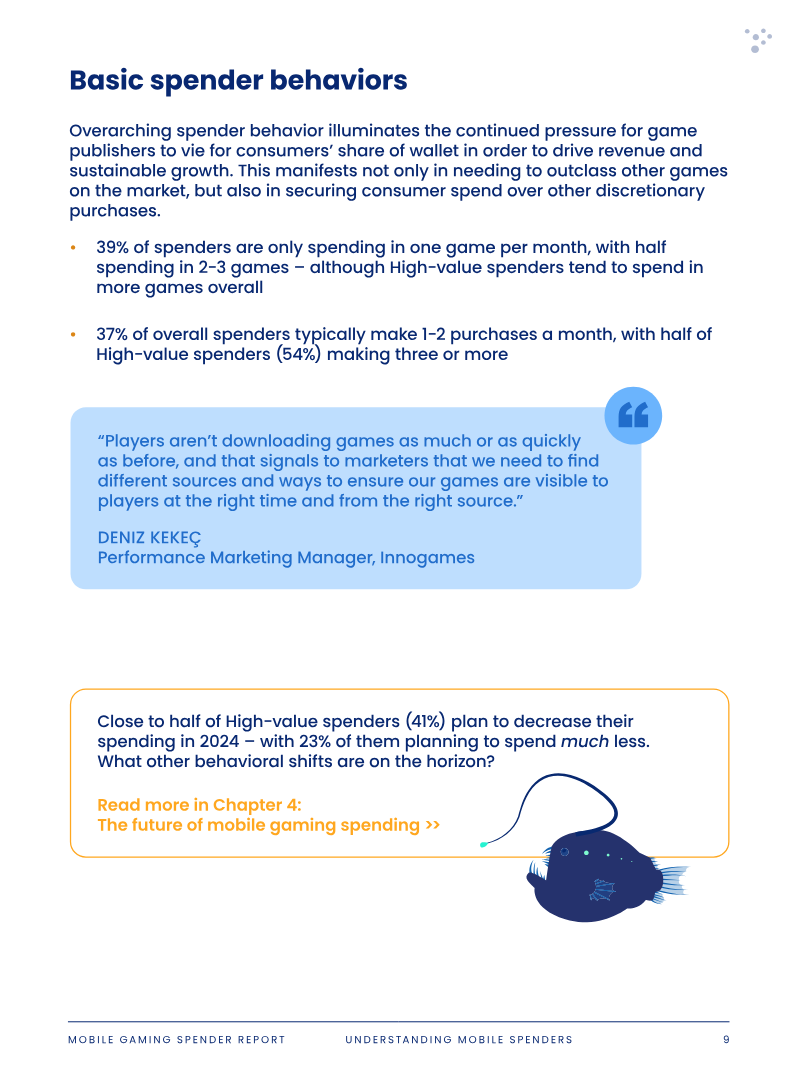
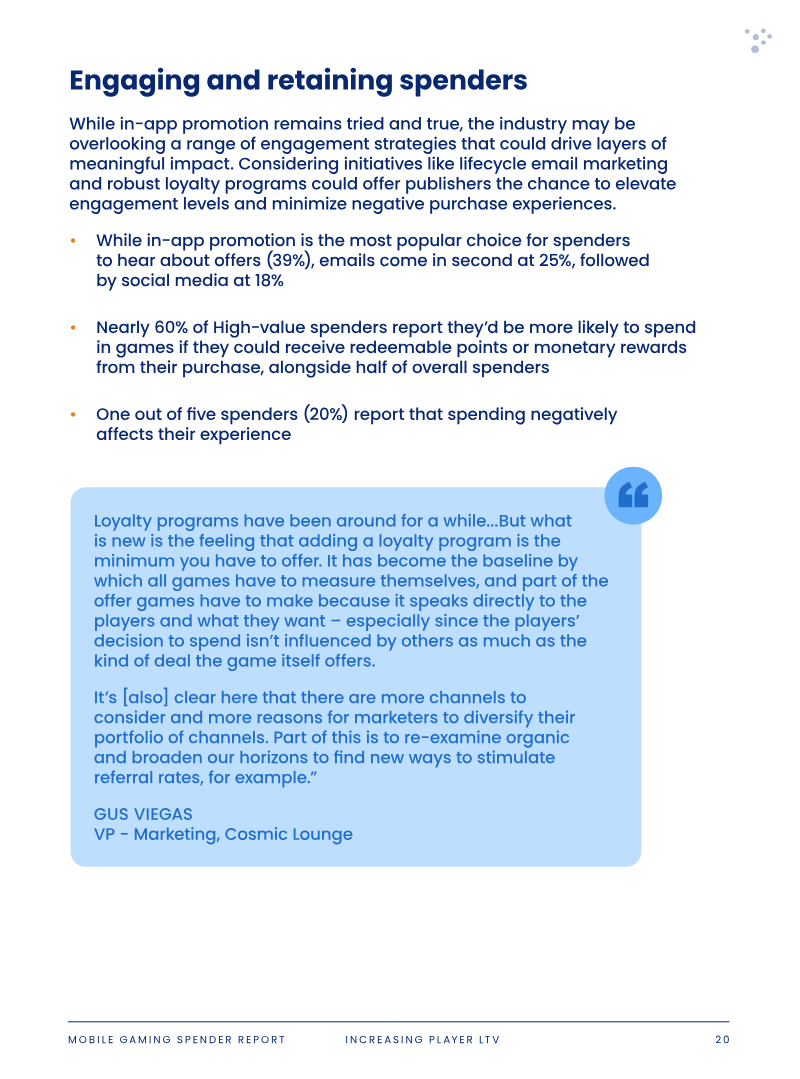
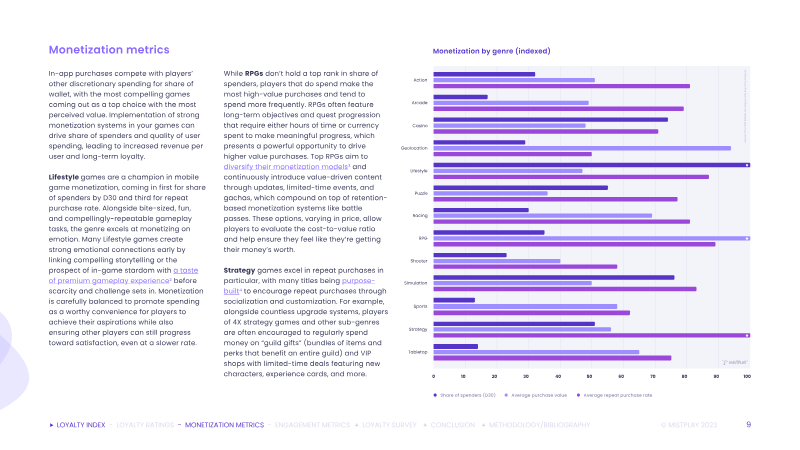
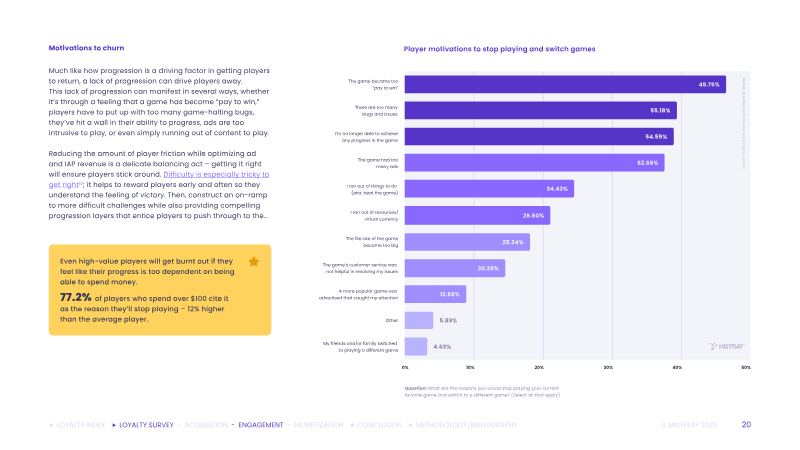
The Mobile Gaming Loyalty Report examines the drivers of player engagement, retention, and spending across the mobile landscape. By combining a longitudinal benchmark of 500 games with a survey of 3,000 mobile gamers in the US and Canada during 2023, the analysis establishes a Loyalty Index based on six key monetization and engagement KPIs. The findings emphasize that while user acquisition remains expensive, maximizing the lifetime value of existing players through loyalty-centric design is essential for sustainable growth. Role-Playing Games (RPGs) emerge as the most loyal genre, scoring 75 out of 100 on the index due to deep gameplay loops and compounding monetization systems that encourage high-value, frequent spending. Strategy games follow closely, excelling in repeat purchases and session frequency. Conversely, Lifestyle games lead in average sessions per user, utilizing bite-sized tasks and emotional storytelling to drive incremental spending. Data indicates a significant gap between average and top-quartile performers in genres like Casino and Sports, suggesting substantial room for optimization in retention and spender conversion. Consumer behavior insights reveal a disconnect between play and spend habits; while over 77% of spenders rotate between two to seven games weekly, 53% concentrate their spending on a single title. Progression is the primary motivator for both continued play and in-app purchases, whereas "pay-to-win" mechanics and poorly received updates are leading causes of churn. Notably, 39% of players will abandon a game if a bad update is not corrected within a week. High-value spenders, defined as those spending over $100, exhibit more demanding standards for app store ratings and customer service. Marketing effectiveness is heavily influenced by authenticity and social proof. Over 71% of gamers demand real gameplay footage in advertisements, and 60% consider app store ratings and reviews crucial for downloads. While digital ads remain the primary discovery tool, word-of-mouth ranks as a top-three acquisition source. Additionally, there is a strong interest in play-and-earn mechanics, with 84% of respondents open to trying games that offer tangible rewards.