Report26 pages
Q4 2025 Financial Report
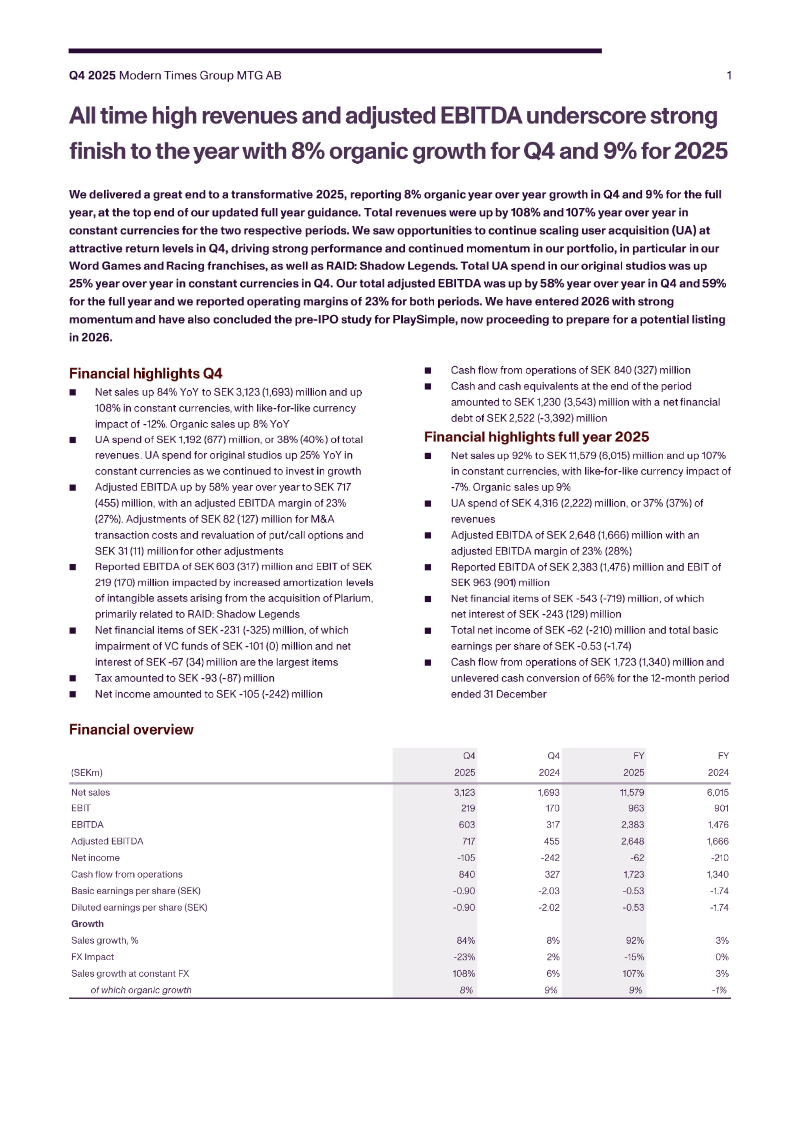
Q4 2025 Modern Times Group MTG AB 1 All time high revenues and adjusted EBITDA underscore strong finish to the year with 8% organic growth for Q4 and 9% for 2025 We delivered a great end to a transformative 2025, reporting 8% organic year over year growth in Q4 and 9 % for the full year ,at the top end of our updated full year guidance .
- MTG AB achieved all-time high revenues and adjusted EBITDA in Q4 2025, with 8% organic growth for the quarter and 9% for the full year 2025. Total revenues were up 108% in Q4 and 107% for the full year in constant currencies, while adjusted EBITDA increased by 58% in Q4 and 59% for the full year.
- Net sales for Q4 2025 reached SEK 3,123 million, an 84% increase year-over-year. Full-year net sales for 2025 were SEK 11,579 million, up 92% from 2024.
- The strong performance was driven by scaling user acquisition (UA) at attractive return levels, particularly in Word Games and Racing franchises, and RAID: Shadow Legends. Total UA spend in original studios increased by 25% year-over-year in Q4 in constant currencies.
- MTG has concluded a pre-IPO study for PlaySimple and is now preparing for a potential listing in 2026, which is seen as an opportunity to accelerate M&A ambitions in the casual gaming market.
- Plarium's consolidation from February 1, 2025, significantly impacted sales growth, contributing SEK 1,464 million to Q4 sales. The acquisition's effect on sales for the full year 2025 was SEK 5,384 million.
+1
Modern Times Group
Report110 pages
2021 Interim Report
Incorporated in the Cayman Islands with limited liability 3 Financial Performance Highlights 3 Financial Performance Highlights 9 Management Discussion and Analysis 9 Management Discussion and Analysis 23 Report on Review of Interim Financial Information Report on Review of Interim Financial Information 24 Consolidated Income Statement 25 Consolidated Statement of Comprehensive Income 26 Consolidated Statement of Financial Position 29 Consolidated Statement o...
- Tencent's FinTech and Business Services revenue significantly increased, reaching RMB 80,920 million for the six months ended June 30, 2021, up from RMB 56,337 million in the same period of 2020.
- The company experienced a shift from net cash of RMB 5.6 billion as of March 31, 2021, to net debt of RMB 21.0 billion as of June 30, 2021, primarily due to M&A activities and dividend payments, partially offset by RMB 17.3 billion in free cash flow.
- Tencent's Value Added Services (VAS) revenue grew to RMB 144,456 million for the six months ended June 30, 2021, compared to RMB 127,431 million in the prior year, with games contributing RMB 86,620 million and social networks RMB 57,836 million.
- Online Advertising revenue increased to RMB 44,653 million for the six months ended June 30, 2021, up from RMB 36,265 million in the same period of 2020, driven by social and other advertising.
- Selling and marketing expenses rose by 17% quarter-on-quarter to RMB 10.0 billion in Q2 2021, mainly due to seasonality and increased spending on digital content, games, and Business Services.
+2
Tencent
Report122 pages
2025 Interim Report
Incorporated in the Cayman Islands with limited liability smart communication inspires 2025 E Interim Report 33 Financial Performance Highlights Financial Performance Highlights 88 Management Discussion and Analysis 22 Report on Review of Interim Financial Information 23 Condensed Consolidated Income Statement 24 Condensed Consolidated Statement of Comprehensive Income 24 Condensed Consolidated Statement of Comprehensive Income 25 Condensed Consolidated S...
- Tencent's investment portfolio significantly grew to RMB948.3 billion as of June 30, 2025, up from RMB817.7 billion at the end of 2024, with listed associate investments alone increasing to RMB165.3 billion from RMB149.6 billion.
- The company completed the acquisition of a game company for USD1.2 billion (RMB8.8 billion) during the first half of 2025, resulting in RMB5.2 billion in goodwill.
- Gross profit for Marketing Services increased by 16% quarter-on-quarter to RMB20.6 billion, with gross margin improving to 58% from 56%.
- Gross profit for FinTech and Business Services rose by 5% quarter-on-quarter to RMB29.0 billion, with gross margin increasing to 52% from 50%.
- Net cash decreased to RMB74.6 billion as of June 30, 2025, from RMB90.2 billion as of March 31, 2025.
+1
Tencent
Report282 pages
2023 Annual Report: Tencent Holdings
7 MANAGEMENT DISCUSSION AND ANALYSIS 85 CORPORATE GOVERNANCE REPORT 85 CORPORATE GOVERNANCE REPORT 119 INDEPENDENT AUDITOR'S REPORT 119 INDEPENDENT AUDITOR’S REPORT 128 CONSOLIDATED INCOME STATEMENT 128 CONSOLIDATED INCOME STATEMENT 129 CONSOLIDATED STATEMENT OF COMPREHENSIVE INCOME 130 CONSOLIDATED STATEMENT OF FINANCIAL POSITION 133 CONSOLIDATED STATEMENT OF CHANGES IN EQUITY 137 CONSOLIDATED STATEMENT OF CASH FLOWS 139 NOTES TO THE CONSOLIDATED FINANCIAL STATEMENTS 1...
- Tencent's revenues for Q4 2023 remained broadly stable quarter-on-quarter at RMB155.2 billion.
- International Games revenues increased by 5% quarter-on-quarter to RMB13.9 billion, driven by PUBG Mobile and Clash of Clans.
- Domestic Games revenues decreased by 18% quarter-on-quarter to RMB27.0 billion due to seasonally lower revenue accruals in Q4.
- Online Advertising revenues increased by 16% to RMB29.8 billion, attributed to advertising platform upgrades benefiting Video Accounts, the mobile ad network, and Weixin Moments.
- Social Networks revenues decreased by 5% to RMB28.2 billion due to lower revenue accruals from app-based game virtual item sales.
+1
Tencent
Report122 pages
2024 Interim Report
Incorporated in the Cayman Islands with limited liability smart communication inspires 2024 P Interim Report 33 Financial Performance Highlights Financial Performance Highlights 88 Management Discussion and Analysis 22 Report on Review of Interim Financial Information 23 Condensed Consolidated Income Statement 23 Condensed Consolidated Income Statement 24 Condensed Consolidated Statement of Comprehensive Income 24 Condensed Consoli...
- Tencent's profit for Q2 2024 significantly increased to RMB 48,366 million, up from RMB 27,023 million in Q2 2023.
- Revenues for Q2 2024 grew to RMB 161,117 million, compared to RMB 149,208 million in Q2 2023.
- The company's net cash position decreased from RMB 92.5 billion as of March 31, 2024, to RMB 71.8 billion as of June 30, 2024, primarily due to share repurchases and dividend payments.
- Tencent's employee count slightly increased to 105,506 as of June 30, 2024, from 104,503 as of June 30, 2023.
- The weighted average fair value of employee share options granted in the first six months of 2024 was HKD 103.11 per share (RMB 93.53), a decrease from HKD 132.11 per share (RMB 115.67) in the same period of 2023.
+1
Tencent
Report83 pages
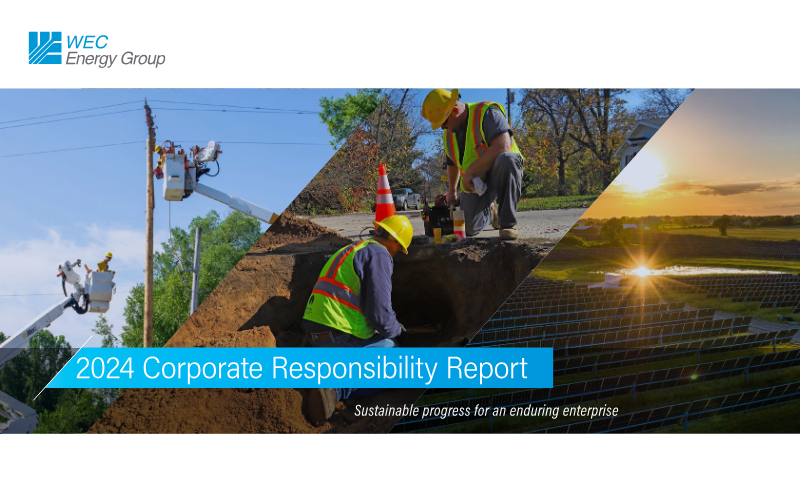
2024 Corporate Responsibility Report: Sustainable Progress for an Enduring Enterprise
Atec 2024 Corporate Responsibility Report 2024 Corporate Responsibility Report Sustainable progress for an enduring enterprise Sustain s for an enduring enterprise 2024 Corporate Responsibility Report Message from leadership 4 Social 39 Governance 69 Our company 5 Empowered employees 40 Governance framework 70 Building and sustaining Safety and health 46 Cybersecurit...
- Atec, with a $29.9 billion market cap and $47.4 billion in assets as of Dec. 31, 2024, has a long history of quality earnings with a compound annual growth rate of ~6.7% from 2015-2024, and projects long-term EPS growth of 6.5%-7%.
- The company plans a $28.0 billion capital investment from 2025-2029, primarily focused on electric generation ($13.2 billion) and electric distribution ($5.3 billion), to invest in renewable/low-carbon energy and modernize infrastructure.
- Atec actively remediated environmental sites in 2024, including completing sediment remediation at the Milwaukee Solvay Car Ferry Slip and continuing work on several former manufactured gas plant (MGP) sites.
- Combustion product production decreased from 508,200 metric tons in 2022 to 476,000 in 2024, while beneficial use remained high at 99% in both 2023 and 2024, exceeding production in 2024 by utilizing surplus from prior years.
- Atec's WEC Energy Group achieved first place in the 2024 E Source Large Business Customer Satisfaction Study, and Wisconsin Public Service was named a 'Customer Champion' and 'Most Trusted Brand' in Escalent’s 2024 study.
Atec
Report14 pages
UnitedHealth Group: First Quarter 2025 Results and Revised Guidance
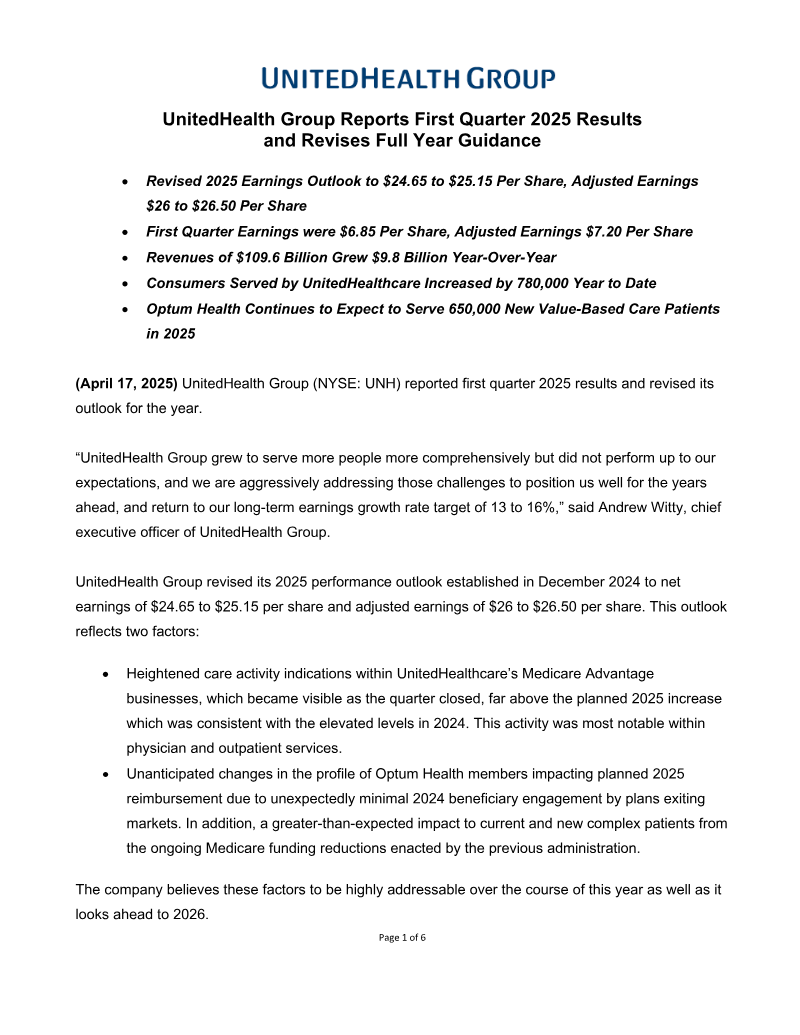
alth Group Reports First Quarter 20a UnitedHealth Group Reports First Quarter 2025 Results and Revises Full Year Guidance • Revised 2025 Earnings Outlook to $24.65 to $25.15 Per Share, Adjusted Earnings • First Quarter Earnings were $6.85 Per Share, Adjusted Earnings $7.20 Per Share • Revenues of $109.6 Billion Grew $9.8 Billion Year-Over-Year • Consumers Served by UnitedHealthcare Increased by 780,000 Year to Date • Optum Health Continues to Expect to Serve 650,000 New Value...
- UnitedHealth Group revised its 2025 earnings outlook to $24.65-$25.15 per share (net) and $26-$26.50 per share (adjusted), following first-quarter adjusted earnings of $7.20 per share.
- First-quarter 2025 revenues grew by $9.8 billion year-over-year to $109.6 billion, with earnings from operations reaching $9.1 billion.
- The company returned nearly $5 billion to shareholders in Q1 2025 through dividends and share repurchases, achieving a 26.8% return on equity.
- UnitedHealthcare increased its consumers served by 780,000 year-to-date, while Optum Health expects to serve 650,000 new value-based care patients in 2025.
- The medical care ratio increased to 84.8% in Q1 2025 from 84.3% in Q1 2024, primarily due to Medicare funding reductions and higher senior care activity, partially offset by Medicare Part D program changes.
+2
UnitedHealth Group
Report2 pages
Q1 2026 Market Themes to Watch
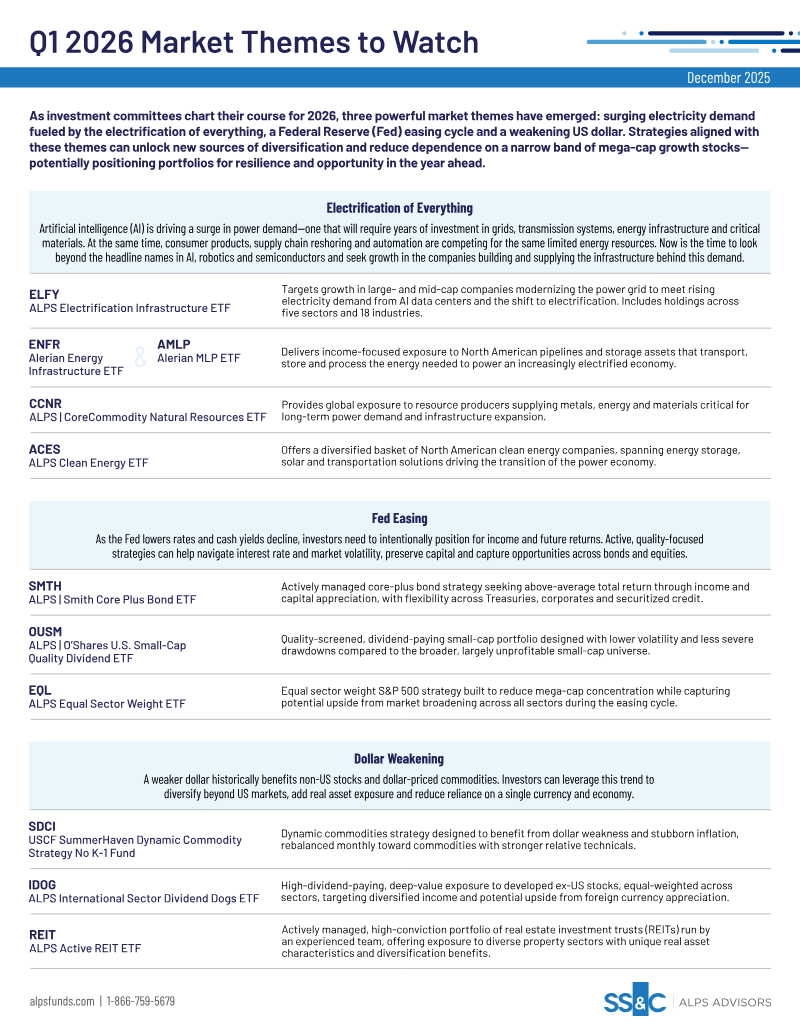
Investment committees navigating the 2026 landscape are advised to pivot toward three primary market themes: the widespread electrification of the global economy, the Federal Reserve’s interest rate easing cycle, and the depreciation of the US dollar. These trends offer a strategic framework for diversifying portfolios beyond the narrow concentration of mega-cap growth stocks, potentially enhancing resilience and capturing emerging opportunities across various asset classes.
The surge in power demand, driven by artificial intelligence, data center expansion, and industrial automation, necessitates significant capital allocation toward infrastructure. Rather than focusing solely on headline technology firms, investors are encouraged to target the underlying grid modernization, energy transmission, and critical material supply chains. This thematic shift encompasses North American energy pipelines, clean energy solutions, and global natural resource producers, all of which are essential to sustaining an increasingly electrified economy.
Simultaneously, the transition toward lower interest rates requires a shift in focus toward quality-oriented income strategies. As cash yields decline, active management in fixed income and the inclusion of quality-screened, dividend-paying small-cap equities can help mitigate volatility and reduce reliance on unprofitable market segments. Furthermore, the anticipated weakening of the US dollar provides a catalyst for diversifying into non-US developed markets and real assets, such as commodities and real estate investment trusts. By rebalancing toward these sectors, investors can hedge against currency risk and inflation while positioning for broader market participation across international and domestic landscapes.
- Investors should pivot from mega-cap growth stocks toward infrastructure assets that support the electrification of the economy, including grid modernization, energy transmission, and critical material supply chains.
- The surge in power demand driven by AI, data centers, and industrial automation necessitates capital allocation into North American energy pipelines, clean energy solutions, and global natural resource producers.
- The Federal Reserve’s interest rate easing cycle requires a shift toward quality-oriented income strategies, such as active fixed-income management and dividend-paying small-cap equities, to replace declining cash yields.
- Anticipated depreciation of the US dollar creates a strategic opportunity to diversify portfolios into non-US developed markets to hedge against currency risk.
- Real assets, including commodities and real estate investment trusts (REITs), should be utilized to hedge against inflation and capture broader market participation as the dollar weakens.
+2
GameVault System
Report162 pages
Corporate Responsibility Report 2020: Germany
This PDF document contains all information on accountability (“Management & facts”) from Deutsche Telekom’s 2020 CR Report. Version: 20.01.2022 The themed pages “Green future”, “Digital life”, “New ways of working”, and “Good stewardship” may be downloaded individually using the “Print this page” function or as one document using the “Info basket” function.
- Deutsche Telekom's 2020 Corporate Responsibility Report highlights a strong focus on compliance, with 122 reports made via the "Tell me!" portal, 38 confirmed as misconduct, and 63 investigated as compliance cases. Most tip-offs concerned financial compliance interests.
- The company's sustainable capital investment strategy for the Deutsche Telekom Pension Fund was recognized in 2019, placing second in the "ESG Implementation" category at the Institutional Assets Awards.
- In 2020, 45% of supplier violations were related to occupational health and safety, 15% to working hours, and 14% to environmental issues. One supplier's business relationship was terminated due to indications of forced labor and youth labor protection lapses, and only resumed after corrective measures were verified.
- Deutsche Telekom calculates an "Enablement Factor" for climate protection, which was x4.31 in 2020 (excluding USA), representing 38.0 million metric tons of CO2e emissions reductions by customers against 8.8 million metric tons of DT's own CO2e emissions.
- In 2020, over 235 million online bills were sent to mobile and fixed-line customers in Germany, accounting for approximately 83% of all bills and credit notes. Additionally, discounted food sales after 4 p.m. at two German locations prevented 2,400 items from being thrown away since November 2020.
+1
Deutsche Telekom
Report93 pages
Responsibility Report 2020: Partners for Greater Purpose
Leading in a Changing World R 2 ABOUT THIS REPORT 21 ENVIRONMENT 3 Letters from Ecolab’s Chief Executive Officer 22 Environmental Management and Chief Sustainability Officer 23 Energy and Emissions 5 Combatting the Covid-19 Pandemic 31 Water 6 About Ecolab 37 Materials Use and Waste 8 OUR APPROACH 40 Ch...
- Ecolab has set ambitious 2030 Impact Goals, aiming to save 300 billion gallons of water (69% progress), avoid 6 million metric tonnes of CO2e (58% progress), provide safe food to 2 billion people (65% progress), and clean 90 billion hands (73% progress).
- Ecolab's sustainability strategy is core to its business, focusing on innovative solutions to minimize environmental and social impact, particularly addressing water scarcity and climate change.
- Ecolab developed the Smart Water Navigator, a publicly available online tool in partnership with S&P Global Trucost and Microsoft, to help businesses improve water resilience through a four-step process: Identify, Target, Implement, and Track.
- Ecolab's governance structure for sustainability includes the Safety, Health and Environment (SHE) Committee of the Board, which has the highest responsibility for sustainability matters, including climate and water issues, reporting to the full Board.
- Ecolab's facilities demonstrate strong management systems, with 56% achieving ISO 14001 certification, 31% OHSAS 18001 or ISO 45001 certified, and 74% of manufacturing sites having ISO 9001 certification.
Ecolab
Report98 pages
Corporate Responsibility Report 2020
World Alzheimer's Day 2020: Ending The Stigma Aroui In support of this year's theme - 'Let's talk about dementiar - Elsevier articles and book chaptets focused on challenging the fear and stigma assoclated 2 ZERO 3 GOOD HEALTH QUALITY 5 GENDER 6 HUNGER AND WELL-BEING EDUCATION EQUALITY ABLECTES 12RESPONSIBLE 13CUMATE 14 UNITMES CONSUMPTION ACTION BELOW WATER RELX is a global provider of information-based analytics and decision tools for professional and business...
- RELX achieved significant environmental reductions in 2020: Scope 1 and 2 carbon emissions decreased by 64% against a 2010 baseline, energy and fuel consumption at key locations dropped by 52% against a 2010 baseline, and total waste generated at reporting locations fell by 78%.
- The company purchased renewable electricity equivalent to 100% of its global consumption in 2020 and attained 100% through green tariff purchases in Europe and green-e certified renewable energy certificates in the United States.
- RELX is a UN Global Compact LEAD company, actively contributing to UNGC Expert Network and SDG working groups on Decent Work in Global Supply Chains (SDG 8) and Peace, Justice and Strong Institutions (SDG 16).
- Reed Exhibitions transformed an exhibition venue in Vienna into a 3,111-bed field hospital for COVID-19 patients in March 2020, with the first 880 cubicles built in three days.
- RELX scored 94% in the Workplace Pride Benchmark in 2020, an increase from 61% in 2019, and held its first virtual Pride Festival.
RELX
Report86 pages
2020 Report on Corporate Responsibility
2020 Report on Corporate Responsibility Our frameworks: Our corporate responsibility report is prepared in accordance with the Global Reporting Initiative’s (GRI) Core Standards, and the Greenhouse Gas Protocol (GHG Protocol). We also provide reporting indices for the Task Force on Climate-related Financial Disclosures (TCFD), and the Sustainability Accounting Standards Board (SASB) Oil & Gas Services Industry Standard - Extractives & Minerals Processing Sector.
- Baker Hughes reduced its Scope 1 & 2 greenhouse gas emissions by 15% in 2020 compared to 2019, with Scope 1 emissions decreasing from 497,144 CO2e in 2019 to 432,316 CO2e in 2020, and Scope 2 market-based emissions decreasing from 303,647 CO2e to 252,069 CO2e.
- The company significantly increased its electricity from renewables and zero-carbon sources, reaching 22% of total electricity (163,075 MWH) in 2020, up from 15% (104,457 MWH) in 2019 and 3% (17,762 MW) in 2018.
- Baker Hughes increased female representation in its workforce from 17% in 2019 to 18% in 2020, with stronger hiring rates for women (27% in 2020 vs. 22% in 2019).
- Total combined contributions to communities, including financial and in-kind donations, increased substantially from $26 million in 2019 to $119 million in 2020, with company in-kind contributions rising from $24 million to $115 million.
- Water use decreased from 7,882 million liters in 2019 to 5,798 million liters in 2020, and the volume of significant spills decreased from 1,598 barrels in 2019 to 738 barrels in 2020.
Baker Hughes

Report47 pages
IBM 2020 Corporate Responsibility Report
While the events of 2020 have tested and tried the world’s resolve in entirely new ways, they also revealed humanity’s determination to adapt and emerge stronger. It was a profound reminder that, when pressed for more, individuals and organizations will rise to reinvent themselves and apply ingenuity to the most challenging of societal problems.
- IBM transitioned 95% of its employees to remote work in March 2020 and is shaping the future of work for a post-COVID era, focusing on employee well-being and flexible innovation.
- IBM aims to achieve net-zero greenhouse gas (GHG) emissions by 2030 through energy conservation, efficiency, and renewable electricity, without using financial certificates or nature-based carbon offsets.
- IBM's SkillsBuild program has enrolled 215,000 people worldwide, completing 341,000 learning hours in technical and workplace skills, with over 4,000 learners in India finding full-time employment.
- IBM spent $2.1 billion directly with first-tier diverse suppliers in 2020, with the largest portion ($1.53 billion) in the United States.
- IBM plans to eliminate nonessential, single-use plastics from cafeteria operations by 2025 and from IBM logo hardware packaging by year-end 2024, aiming for 100% reusable, recyclable, or compostable essential plastic packaging.
+1
IBM

Report64 pages
Corporate Responsibility Report: 2024 Fiscal Year
About METRO 3 Message from Our President and CEO 5 Three Questions for Our Vice President, Public Affairs and Communications 6 12 35 45 Our Approach 7 Our Business Fundamentals 8 Materiality 9 Products and Services Colleagues Our Performance E...
- METRO's total GHG emissions increased significantly from 395,589.9 t CO2e in 2022 to 10,617,773.7 t CO2e in 2024, with Scope 3 emissions seeing the largest rise from 114,172.7 t CO2e to 10,333,846.0 t CO2e in the same period.
- METRO is transitioning to low-carbon transportation, piloting electric vehicles in e-commerce, and partnering with FLO to install over 500 fast-charging ports at more than 130 grocery stores in Quebec and Ontario starting spring 2025.
- METRO has made progress in sustainable packaging, replacing 91 tonnes of plastic with aluminum in Metro Go ready-to-eat meals in Quebec and reducing the weight of paper used in flyers by 53% compared to 2023.
- METRO's suppliers' average transition rate to alternative housing for laying hens was 61% in 2024, with 30% in enriched cages and 31% in cage-free systems. For pork, 65% of Canadian suppliers are transitioning away from gestation cages by 2029.
- METRO has documented the origin of 97% of its private brand and perishable beef products, confirming none come from high-risk deforestation areas, with Canada and the United States being primary sources.
4A Games
Report79 pages
2020 Corporate Responsibility Report
OVERVIEW 3 PEOPLE & COMMUNITIES 32 A Letter from our Chairman & CEO and CSO 3 Employee Health & Safety 33 About This Report Our Company 4 Employee Engagement & Development 35 Keurig Dr Pepper (KDP) has reported on Key Highlights 5 Diversity & Inclusion ...
- All K-Cup pods produced by Keurig Dr Pepper (KDP) are now recyclable, made from #5 polypropylene plastic.
- KDP achieved 90% recyclable or compostable packaging across its total portfolio in 2020, up from 86% in 2018, and increased post-consumer recycled (PCR) content to 22% in 2020 from 20% in 2018.
- KDP aims to replenish 100% of the water used for beverages in its highest water-risk operating communities by 2025, with a 20% improvement in water use efficiency targeted by the same year.
- KDP achieved its 100% responsibly sourced coffee commitment and has engaged over 1 million people in its supply chain since 2014 to improve their lives, with over $64 million in social impact investments since 2003.
- KDP's plastic packaging that is recyclable or compostable increased from 64% in 2019 to 74% in 2020, and PCR content in plastic packaging rose from 0.4% in 2019 to 2% in 2020.
+1
Keurig Dr Pepper
Report104 pages
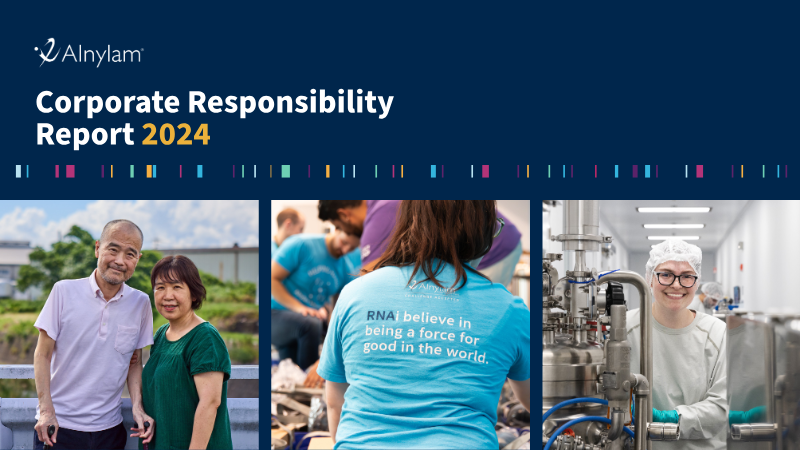
Corporate Responsibility Report 2024
Corporate Responsibility Report 2024 Introduction Patients Science Employees Communities Planet Governance Data <td>Corporate Responsibility at Alnylam</td> stol. S7 Catalina, patient (Spain) On the cover, left: Tsuyoshi, patient and his wife Rika (Japan) Corporate Responsibility Report 2024 Introduction Patients Science Employees Communities Planet Governance Data A Pivotal Year at Alnylam Transforming Lives Through Innovat...
- Alnylam's Patient Access Philosophy, established in 2017, was revisited in 2024 to expand its reach and ensure patients benefit from their medicines.
- Alnylam launched a 'Patient Perspectives series' in 2024 to help employees understand the experiences of patients, caregivers, and advocates impacted by the diseases they serve.
- In 2024, Alnylam focused on cardiovascular provider collaboration, engaging global cardiologists and other specialists to understand their needs due to two approved medicines and a robust pipeline in this area.
- Alnylam's modular drug discovery platform utilizes a three-pronged approach: delivery of RNAi therapeutics to new tissues, enhancement of existing platform designs, and investment in human genetics to identify drug targets.
- Alnylam was named to Newsweek’s 'America’s Most Responsible Companies 2025' for the third consecutive year, moving from #422 in 2023 to #153 in 2025.
+1
Alnylam Pharmaceuticals
Report10 pages
2024 Annual Corporate Responsibility Report
The 2024 Annual Corporate Responsibility Report outlines the strategic framework and operational progress of RBC BlueBay Asset Management regarding its social, ethical, and community-focused initiatives. The primary thesis centers on the integration of corporate responsibility into the firm’s core business model, asserting that a transparent, inclusive, and community-engaged culture drives superior outcomes for both clients and employees. The firm operates under a centralized Corporate Responsibility Committee that monitors key performance indicators across four pillars: people, communities, conduct, and responsible investment.
Key findings for the 2024 fiscal year highlight significant engagement in community and social efforts. Over 50% of staff participated in volunteering activities, and employees collectively donated more than £210,000 to charitable causes, exceeding the annual target of £165,000. The firm transitioned to a single primary charity partnership with St Luke’s Community Centre to deepen its local impact. Additionally, the report details the success of talent development programs, including summer internships and the Catalyst Education Programme, which aim to foster diversity within the investment management industry.
The scope of this report covers RBC BlueBay’s global operations, with a specific emphasis on its EMEA-based activities and organizational structure. The methodology relies on internal data tracking, committee oversight, and performance monitoring against established annual targets. Looking ahead to 2025, the firm has set specific objectives to increase participation in employee resource groups by 10% and boost attendance at social events by 10%. The report emphasizes that these efforts are supported by a rigorous compliance framework, ensuring that ethical market practices and client-first philosophies remain central to the firm’s governance and long-term institutional strategy.
- RBC BlueBay Asset Management exceeded its 2024 charitable donation target of £165,000 by raising over £210,000.
- Over 50% of the firm's staff participated in volunteering activities during the 2024 fiscal year.
- The firm transitioned to a single primary charity partnership with St Luke’s Community Centre to consolidate its local social impact.
- Corporate responsibility is governed by a centralized committee that monitors performance across four pillars: people, communities, conduct, and responsible investment.
- The firm manages talent development through initiatives like the Catalyst Education Programme and summer internships to improve diversity in investment management.
RBC BlueBay Asset Management
Report47 pages
2024 Corporate Responsibility Report
+ Publication Date: July 30, 2025 Publication Date: July 30, 2025 2 Introduction The Care The People The Planet 32 Governance, Policies & We Advance We Support We Share Systems Infrastructure 5 Who We Are 39 Appendix Overview 41 Sustainability Accounting 7 IDEXX Corporate ...
- IDEXX is a global leader in pet healthcare innovation, providing diagnostic and software products and services in veterinary medicine, employing approximately 11,000 people and serving customers in over 175 countries.
- In 2024, IDEXX's overall Greenhouse Gas (GHG) emissions increased by 10.5%, primarily due to increased energy consumption at the newly operational Horizon Center in Scarborough, Maine, though the company remains on track to meet its 2030 GHG emissions reduction goal of 37.8% for Scope 1 & 2.
- IDEXX donated over 21,000 SNAP™ tests in 2024 for disaster response, education, and community outreach, contributing to enabling access to care for over 79,000 animals in underserved communities.
- Employees logged over 86,000 hours of learning and development in 2024, including 23,200 hours in leadership and AI, and 50,200 hours in skill-based training.
- IDEXX reduced its freight forwarders from 18 to three in 2024 to ship products more sustainably, prioritizing ocean shipping over air when possible.
+1
IDEXX
Report10 pages
Winning on Google Discover: A Data-Driven Guide for Gaming Media
The brief explains how Google’s February 5, 2026 “Discover core update” expands the personalized content feed and shifts traffic from traditional search to Discover, especially for gaming media. Across 197 active gaming sites in the Raptive network, roughly half of Google traffic originates from Discover, with a 20 % rise in sites receiving feed impressions after the update. The report identifies three key performance drivers that correlate with both Discover visibility and overall revenue: high U.S. traffic concentration, deep session depth, and structured editorial content such as guides and reference databases. Sites that meet these criteria see stronger Discover performance, while those dominated by forum‑style or low‑differentiation content face greater volatility.
Methodologically, the analysis draws on internal Raptive data from 6,000+ sites and external sources like Chartbeat and Google Search Console. It highlights early post‑update signals: Discover traffic is growing for smaller publishers, click volatility remains high due to real‑time recommendation algorithms, and AI summaries now occupy about half of feed impressions. The brief recommends five high‑impact actions—optimizing Core Web Vitals, crafting Discover‑specific headlines, adding author voice, aligning publishing calendars with gaming events, and correcting meta tags—to boost Discover clicks.
The document concludes by outlining Raptive’s support services, including a forthcoming Discover Workbook and personalized audits that have historically yielded an 89 % RPM uplift for gaming publishers. The brief positions Discover as a critical, data‑driven channel for gaming media amid declining search traffic and AI‑generated content.
- Google Discover now accounts for roughly 50% of Google traffic for gaming sites within the Raptive network, following a February 5, 2026 core update that shifted traffic away from traditional search.
- Sites that prioritize high U.S. traffic concentration, deep session depth, and structured editorial content like guides and databases experience superior Discover performance and revenue stability.
- Following the February 2026 update, 20% more gaming sites began receiving Discover feed impressions, with smaller publishers seeing notable traffic growth.
- AI-generated summaries currently occupy approximately 50% of all Discover feed impressions, contributing to high click volatility for publishers.
- Publishers relying on forum-style or low-differentiation content face increased traffic volatility compared to those producing structured, expert-led editorial content.
+2
RaptiveMar 2026
Report17 pages
Adjust Guide to Deep Linking
This technical guide outlines the strategic importance and functional mechanics of deep linking within the mobile app ecosystem. The primary thesis is that deep links are essential tools for streamlining the user experience, reducing friction, and driving higher conversion rates compared to standard mobile web interfaces. By directing users to specific in-app content rather than generic homepages, marketers can significantly improve retention and re-engagement through targeted campaigns across email, social media, and SMS.
The scope of the analysis covers the technical distinctions between three primary types of links: default, deferred, and contextual. Default deep links function only when an app is already installed, while deferred deep links—facilitated by specialized SDK integrations—route non-users to the appropriate app store before delivering them to the intended internal page upon installation. The guide also examines platform-specific solutions like Apple’s Universal Links, noting their ability to prevent error messages while highlighting limitations regarding attribution data and support within major apps like Facebook.
Key data points emphasize the commercial impact of native app environments, noting that consumers purchase at three times the rate of the mobile web. Furthermore, with 70% of emails opened on mobile devices, the integration of deep links into owned media channels is presented as a critical driver of revenue. The conclusion suggests that as digital interactions expand into voice, television, and automotive platforms, deep linking and cross-device tracking will remain the foundational technology for maintaining a cohesive and measurable mobile marketing strategy.
- Mobile app users purchase at three times the rate of those using mobile web interfaces, making deep linking a primary driver of conversion.
- Integrating deep links into owned media channels is critical for revenue, particularly as 70% of all emails are currently opened on mobile devices.
- Deferred deep links are essential for acquisition, as they route new users through the app store installation process before landing them on the specific content they originally clicked.
- Default deep links are limited to users who already have the app installed, whereas deferred deep links utilize SDK integrations to bridge the gap for non-users.
- Apple’s Universal Links prevent common error messages but face limitations regarding attribution data and compatibility with major platforms like Facebook.
+1
Adjust