Market (Mobile)·Updated Apr 8, 2026 by GameAnalytics
Report · January 1, 2024
Published by GameAnalytics
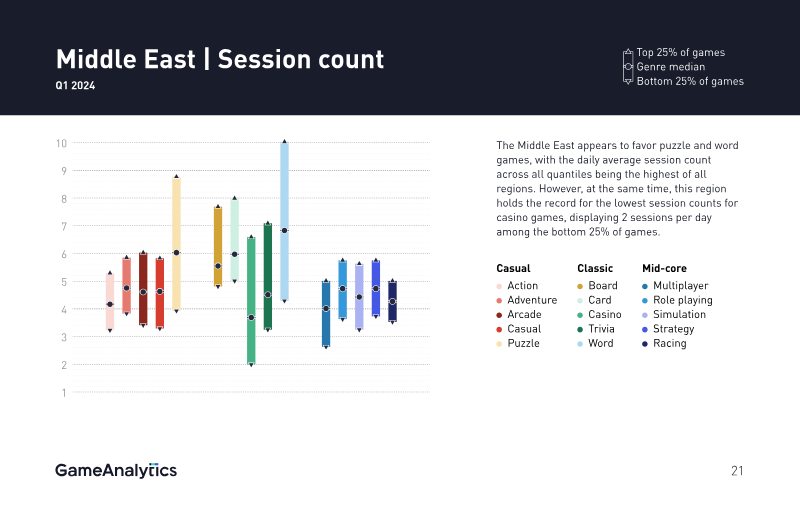
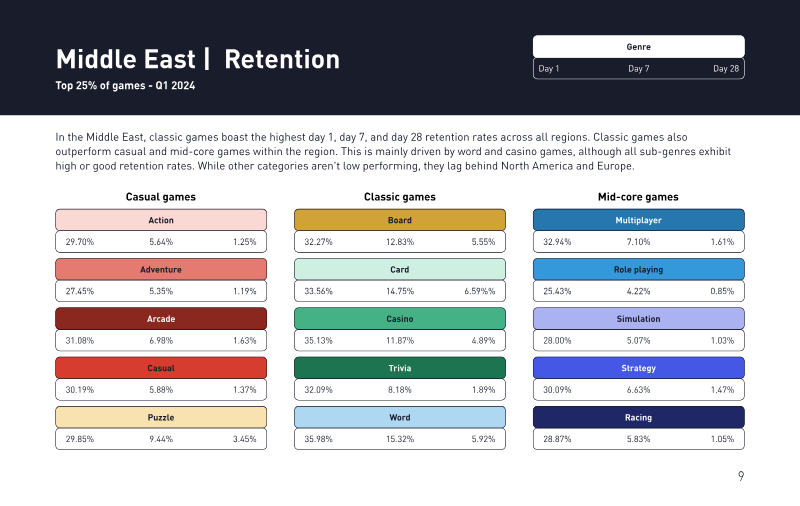
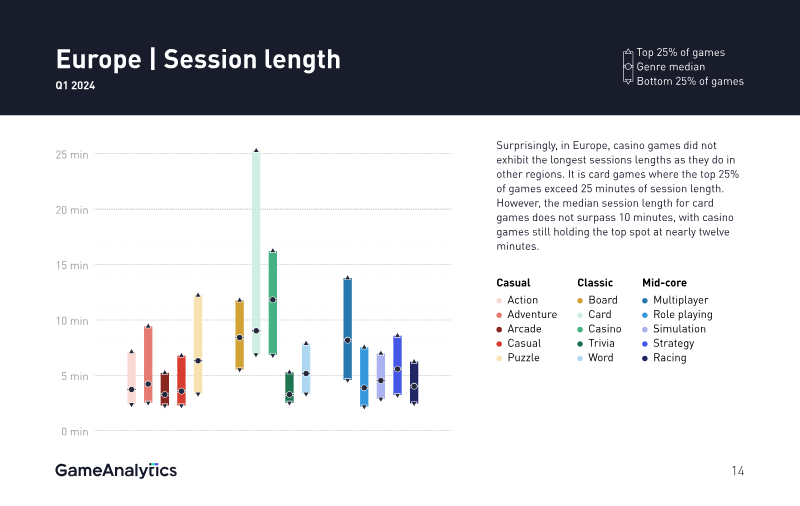
The benchmark study presents a comprehensive snapshot of mobile gaming performance during Q1 2024, focusing on key engagement metrics—retention, session length, and session count—across North America, Europe, the Middle East, and Asia. Data derive from over 10 000 games tracked by GameAnalytics, with each title typically released in at least three regions, yielding a combined monthly active user base of approximately 1.67 billion. Retention figures reveal that the global median day‑1 retention stands at 22.91 %, day‑7 at 4.20 %, and day‑28 at 0.85 %. Classic games (board, card, casino, trivia, word) dominate retention performance, especially in the Middle East where they lead all regions. Casual and mid‑core titles lag behind, with puzzle games maintaining stable but lower retention across all markets. Session length analysis shows a global median of 4.45 minutes, with casino and card games achieving the longest sessions in North America (≈20 min) and Europe (card games exceeding 25 min). In the Middle East, casino titles surpass 15 minutes, while Asia’s top casino games reach nearly 23 minutes. Session count averages range from 3–5 daily sessions per game, with puzzle and word games in the Middle East achieving the highest counts (≈10 sessions/day). Methodologically, metrics are reported in quantiles—top 25 %, median, and bottom 25 %—to illustrate performance across the spectrum of developers. The report underscores that high retention, longer session lengths, and frequent session counts correlate with stronger player engagement, offering actionable insights for studios aiming to benchmark against industry leaders.
Mobile gaming benchmarks for Q1 2024 Access the industry's performance with Q1 2024 benchmarks. Explore key metrics like retention rates and session engagement to benchmark your games against industry standards. Gameanalytics.com
GameAnalytics provides game studios and mobile app developers with a full suite of powerful analytics tools, helping them better understand their users and optimize their entire app portfolio. Our analytics solution enhances overall app performance, offering insights into crucial user metrics such as retention, session count, or length, providing advanced Live Ops features, reporting on health and design issues, and more. Security 7 kidSAFE PRIVACY APPROVED STATUS ISO SOC 2 P 0 Transparency 27001 TYPE 2 iab and Consent AICPA Eu data Framework
What’s inside? 3 GameAnalytics Benchmarks 12 Session length 4 Key takeaways 13 North America 14 Europe 5 Methodology 15 Middle East 16 Asia 6 Retention 17 How to successfully optimize session length? 7 North America 18 Session count 8 Europe 19 North America 9 Middle East 20 Europe 10 Asia 21 Middle East 11 Game analytics 100: The retention curve 22 Asia
Access industry benchmarks 5.4h and compare your game to your competitors 4.0h While paying attention to your game performance cannot be overstated, 2.7h it is equally important to deeply understand player preferences and industry standards. Conveniently packaged in GameAnalytics Pro , our industry benchmarks can help you identify areas of strength for their game, or weaknesses that need improvement. Helps game studios 1.4h D1 Retention - Monthly Stats prioritize efforts and optimizations alongside the access to next-gen D1 Retention - Monthly Stats analytics solutions for your game. Jan Feb Mar Jan Feb Action 39.16% 39.16% Os Jan 2024 Action 38.56% 38.56% We recommend making a holistic approach by comparing and Dec 2023 Jan 2024 024 Adventure 38.88% 38.88% 38.48% 38.48% Adventure contrasting several benchmarks and metrics to unveil deeper insights. Top 2% Top 3% Arcade 39.30% 39.30% 38.78% 38.78% Arcade Platform Africa Board 42.38% 42.38% 43.91% Board 43.91% Platform Africa 43.86% Platform > Africa For instance, by analyzing how changes in session length correlate with Region > Asia Card 43.25% 44.88% Region > Asia Countries Southeast Asia retention rates, you can pinpoint optimal session durations that keep Countries > 42.79% 42.66% Spenders Europe Casino players coming back for more. Similarly, understanding how playtime Spenders > Middle East Casual 39.98% 40.09% affects retention can inform decisions about game pacing, content North America Multiplayer 41.08% 40.55% Central America depth, and progression mechanics to enhance player engagement over Central Puzzle 44.29% 44.64% time. Explore more use-cases here .
e Spenders > Middle East Casual 39.98% 40.09% affects retention can inform decisions about game pacing, content North America Multiplayer 41.08% 40.55% Central America depth, and progression mechanics to enhance player engagement over Central Puzzle 44.29% 44.64% time. Explore more use-cases here . Racing 35.28% 34.99% Role Playing 38.18% 37.83% Simulation 40.40% 40.03% Sports 39.05% 38.36% Strategy 42.62% 42.32% Trivia 41.05% 41.41% Word 45.91% 45.97%
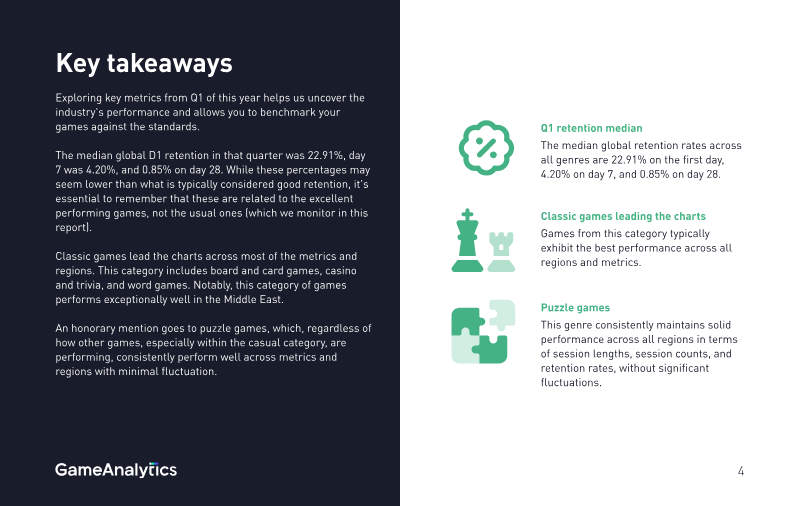
Key takeaways Exploring key metrics from Q1 of this year helps us uncover the industry's performance and allows you to benchmark your games against the standards. Q1 retention median The median global D1 retention in that quarter was 22.91%, day The median global retention rates across 7 was 4.20%, and 0.85% on day 28. While these percentages may all genres are 22.91% on the first day, seem lower than what is typically considered good retention, it's 4.20% on day 7, and 0.85% on day 28. essential to remember that these are related to the excellent performing games, not the usual ones (which we monitor in this Classic games leading the charts report). Games from this category typically Classic games lead the charts across most of the metrics and exhibit the best performance across all regions. This category includes board and card games, casino regions and metrics. and trivia, and word games. Notably, this category of games performs exceptionally well in the Middle East. Puzzle games An honorary mention goes to puzzle games, which, regardless of This genre consistently maintains solid how other games, especially within the casual category, are performance across all regions in terms performing, consistently perform well across metrics and of session lengths, session counts, and regions with minimal fluctuation. retention rates, without significant fluctuations.
The Q1 2024 mobile gaming benchmarks provide a comprehensive analysis of player engagement metrics, specifically retention rates, session lengths, and session counts across 15 game genres. The analysis is based on data from over 10,000 games utilizing the GameAnalytics platform, representing 1.67 billion monthly active users across North America, Europe, the Middle East, and Asia. The primary objective is to offer developers a standardized framework to evaluate game performance, identify areas for optimization, and refine mechanics to improve long-term player retention and engagement. Key findings indicate that global median retention rates for the first quarter of 2024 were 22.91% for Day 1, 4.20% for Day 7, and 0.85% for Day 28. Classic games—encompassing board, card, casino, and trivia titles—consistently outperformed other genres across most regions and metrics. While North America and Europe generally exhibit higher retention averages, the Middle East shows a distinct preference for classic games, which achieve their highest regional performance there. Puzzle games also demonstrate notable stability, maintaining consistent engagement metrics across all monitored territories. Regarding session behavior, the global median session length is 4.45 minutes, with most genres averaging 4 to 5 sessions per day. Europe leads in session duration, while the Middle East records the highest frequency of daily sessions, particularly within the puzzle and word genres. The analysis suggests that session length and frequency are highly correlated with game pacing and social features. To optimize these metrics, the findings recommend a data-driven approach involving A/B testing, funnel analysis, and the implementation of LiveOps to adapt to player behavior in real-time.
Hybrid monetization can increase revenue without eroding player retention by treating advertisements as an integral part of the game’s design system. Three core ad formats—interstitials, rewarded video (RV), and banners—are positioned strategically through careful gating on level progression, playtime, or cooldown periods. Optimal triggers and placement reduce player frustration while maximizing eCPM, ensuring that monetization flows naturally with gameplay. Rewarded video is most effective when offered during high‑stakes moments such as revives, boosters, or time‑limited rewards. Leveraging scarcity and urgency in these contexts drives conversions while preserving the core experience. Consistent visual cues, a clear distinction between coin rewards and RV value, and optional “No Ads” bundles further balance monetization with player comfort. Selling “No Ads” bundles requires thoughtful presentation. Bundles should appear side‑by‑side with regular items, use distinct visual cues and anchoring to convey high value, and be gated behind a minimum purchase tier to protect payer retention. Segmenting ad exposure—capping impressions, applying cooldowns, and filtering out disruptive creatives—maintains a positive user experience while sustaining revenue. Overall, the strategy blends ad formats with gameplay mechanics, employs scarcity and urgency for rewarded video, and offers high‑value “No Ads” options. This approach delivers robust monetization across diverse segments while safeguarding long‑term player engagement and retention.
I W w k o A look A T k T ATT o - l W x l M l v l l . I l l v w l ll l w l w ll w . W w ll ll v l k v v lv k l . A l w l l 2 l .
The global gaming landscape in 2026 reflects a challenging environment for player retention, as metrics across Day 1, Day 7, and Day 30 continue a downward trend established in previous years. Data indicates a widening performance gap between average titles and the top 10% of performers. While the industry has historically relied on the 40/20/10 rule for retention percentages, current benchmarks suggest a shift toward a more realistic 35/15/5 standard. Median Day 1 retention currently sits at approximately 22%, while the top tier of games maintains a 40% threshold. This decline becomes more pronounced over time, with median Day 7 retention dropping to 4% and Day 30 retention falling to a mere 0.7%. The analysis emphasizes that early engagement is the primary driver of long-term success, noting that players typically churn within the first five to fifteen minutes if the value proposition is not immediately clear. Effective onboarding must transition from functional tutorials to demonstrations of core gameplay pleasure to mitigate this early loss. Despite the seemingly low median figures, the data is influenced by a high volume of indie and early-stage projects. Established studios often utilize in-house data solutions, meaning the highest-performing titles are frequently absent from public benchmarks. Geographic and genre-specific contexts remain vital for interpreting these statistics, as hybrid-casual and midcore games exhibit vastly different long-term retention profiles. While the mobile market faces significant headwinds in maintaining a loyal player base, the situation is viewed as an evolution of player expectations rather than a fundamental failure of the platform. Success in this climate requires developers to focus on immediate engagement and recognize that the widening gap between median and top-tier performance necessitates more sophisticated retention strategies than those used in previous cycles.