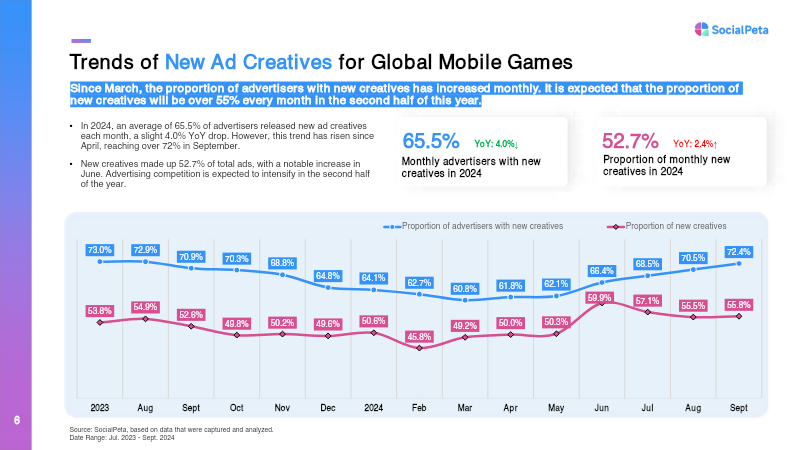
Competition is intensifying through creative iteration, with over 72% of the 63,000+ monthly active advertisers releasing fresh ad content by September 2024.
See it on page 6The proportion of new market entrants has dropped below 7%, indicating a shift toward established players focusing on retention rather than market expansion.
See it on page 6Casino games have emerged as a growth leader with a 10% increase in advertiser volume, while casual game advertising has experienced a slight decline.
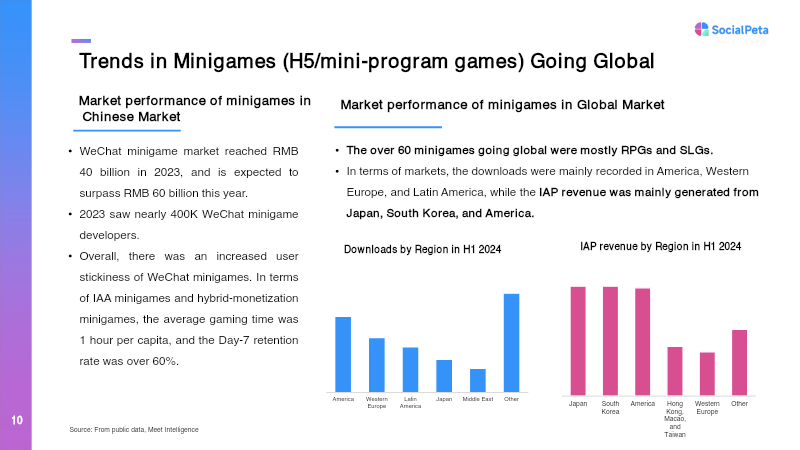
See it on page 7Minigames are increasingly adopting a global strategy, moving from Asian markets into North America, Western Europe, and Latin America.
See it on page 10Successful minigame monetization relies on hybrid models and specific sub-genres like 'backpack-like' or 'knights-like' games.
See it on page 11Marketing strategies for minigames are bifurcated: Asia-Pacific focuses on pre-registration and launch-phase intensity, while Western markets prioritize sustained, long-term advertising.
See it on page 12The global mobile gaming landscape in 2024 is characterized by a high volume of advertising activity, with monthly active advertisers averaging over 63,000. While the total number of advertisers remains robust, the proportion of new market entrants has steadily declined, falling below 7% by late 2024. Conversely, the industry has seen a consistent rise in the deployment of new ad creatives, with over 72% of advertisers releasing fresh content by September, signaling an intensification of competition and a focus on creative iteration to maintain audience engagement.
Analysis of genre-specific performance reveals a shift in marketing priorities. Casual game advertising has experienced a slight decline, whereas the casino genre has seen a notable growth of over 10% in advertiser volume. Across the board, RPG, puzzle, and simulation games remain significant contributors to the advertising ecosystem. The data suggests that successful market penetration increasingly relies on high-frequency creative updates and localized marketing strategies, particularly as developers look to expand beyond domestic borders.
The minigame sector, encompassing H5 and mini-program games, has emerged as a critical growth area. These titles are increasingly adopting a "going global" strategy, moving from initial releases in Asian markets to broader international expansion in North America, Western Europe, and Latin America. Successful minigames often utilize hybrid monetization models and leverage specific sub-genres such as "backpack-like" or "knights-like" games. Marketing for these titles is highly data-driven, with distinct strategies for the Asia-Pacific region—which favors pre-registration and launch-phase intensity—versus Western markets, which prioritize sustained, long-term advertising during a game’s stable period. The industry continues to favor creative formats that emphasize playable, low-friction experiences and culturally localized themes to maximize user retention and acquisition.