The gaming industry is shifting toward disciplined, long-term profitability as high interest rates and macroeconomic pressures reduce late-stage financing and public listing activity.
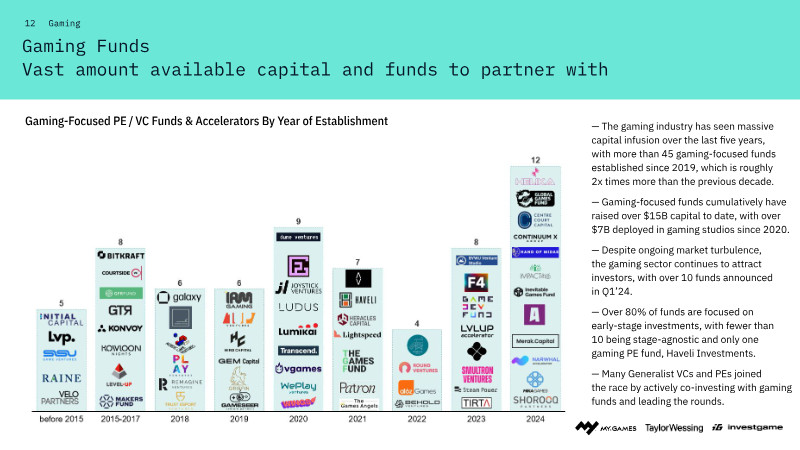
See it on page 2Over $15 billion in dry powder remains available across more than 65 gaming-focused funds, ensuring a steady pipeline for early-stage seed investments despite broader capital constraints.
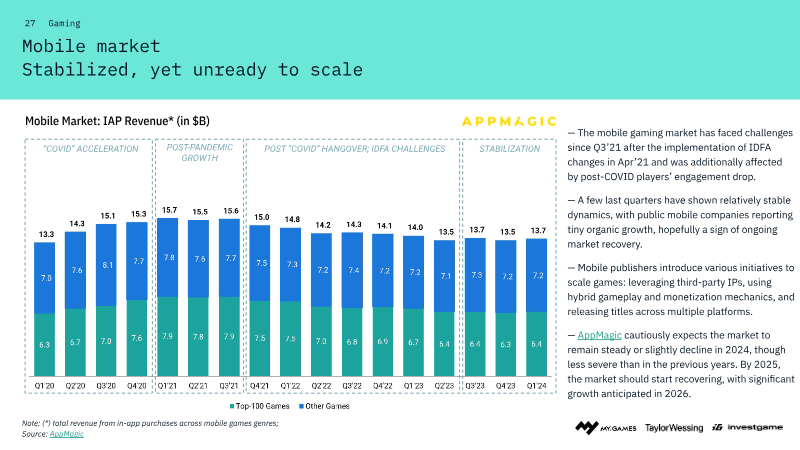
See it on page 12PC and console sectors show resilience through strong independent studio performance and consistent engagement on platforms like Steam, while mobile gaming faces a contraction due to privacy-related advertising headwinds.
See it on page 20Mobile gaming is projected to begin a gradual recovery by 2025 as business models adapt to new regulatory and acquisition environments.
See it on page 27Syndicate-based funding has become the primary mechanism for risk mitigation, reflecting a market-wide trend toward collaborative investment strategies.
See it on page 2Investors are prioritizing capital efficiency and proven development teams, with expectations for an increase in midcap merger and acquisition activity throughout the remainder of 2024.
See it on page 8The gaming industry is currently navigating a period of strategic stabilization defined by cautious capital deployment and a pivot toward long-term profitability. High interest rates and broader macroeconomic pressures have dampened late-stage financing and public listing activity, leading investors to prioritize capital efficiency over aggressive expansion. Despite these headwinds, the ecosystem remains supported by a robust foundation of over $15 billion in dry powder held across more than 65 gaming-focused funds, which continues to fuel a healthy pipeline of early-stage seed investments.
Market performance is increasingly bifurcated across platforms. The PC and console sectors demonstrate notable resilience, bolstered by the consistent success of independent studios and sustained engagement on digital storefronts like Steam. In contrast, the mobile gaming market is undergoing a necessary contraction following post-pandemic volatility and the persistent impact of privacy-related advertising headwinds. While mobile startups currently face significant barriers to entry and a decline in late-stage venture interest, the sector is expected to initiate a gradual recovery by 2025 as business models adjust to the new regulatory and acquisition landscape.
Looking ahead, the industry is transitioning away from the speculative growth patterns of previous years toward a more disciplined investment environment. Syndicate-based funding has emerged as a primary mechanism for risk mitigation, reflecting a broader trend of collaborative investment. As the market stabilizes, expectations are shifting toward an uptick in midcap merger and acquisition activity throughout the remainder of the year. This evolution underscores a fundamental industry-wide commitment to sustainable growth, with investors increasingly favoring established platforms and proven development teams over high-risk, late-stage ventures.