For Honor
GameBy Blue Byte
13 documents in the library are about For Honor, from writers such as Ubisoft, Game Developers Conference and AI and Games. Each has a summary and key insights with the page they come from.
Connections
The documents about For Honor on the inner ring, the other games and companies they name on the outer one. Select a cover to see it up close and open it in a new tab; drag to move, pinch or Ctrl + scroll to zoom.
Key figures from the reports
Total annual sales rose 4.7% to €1,459.9 million, driven by the performance of key titles including Tom Clancy’s Ghost Recon Wildlands and For Honor.
Ubisoft, 2017 · Ubisoft Full-Year 2016-17 Sales and Earnings Figures, p. 1
Julien Bares, formerly of Tencent Games Global and 2K China, has been appointed General Manager of Creative Houses 3 and 5, overseeing live service titles like The Crew and For Honor, as well as casual and mobile brands like Just Dance.
Ubisoft · Ubisoft Appoints New Leaders to Advance Its Creative Houses Operating Model, p. 1
On Steam
Steam estimates as of 9 Oct 2026. Revenue is premium revenue on Steam only: game sales, without DLC.
- Revenue to date
- $80.8M
- Units sold
- 3.5M
- Last 12 months
- $2.2M
- 148K units
- Price
- $29.99
- Positive reviews
- 69%
- of 166K reviews
- Peak players
- 226K
- at the same time
- Followers
- 295K
- Average playtime
- 48 h
| Year | Share of the best year | Revenue | Units |
|---|---|---|---|
| 2019 | $4.1M | 406K | |
| 2020 | $2.7M | 260K | |
| 2021 | $2.2M | 232K | |
| 2022 | $1.6M | 170K | |
| 2023 | $1.4M | 156K | |
| 2024 | $1.8M | 118K | |
| 2025 | $1.6M | 107K | |
| 2026 so far | $1.8M | 118K |
On Steam since Feb 14, 2017 · Developer Blue Byte, Ubisoft · Publisher UbisoftSteam store page
Documents about For Honor
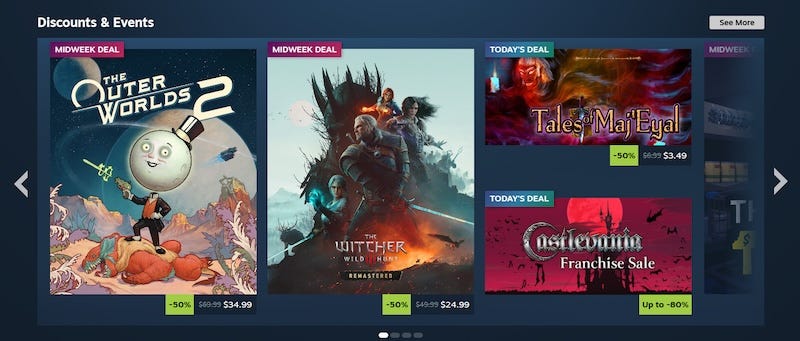
No More Universal Daily Deals on Steam: Is That Good?
Steam is transitioning its storefront promotion strategy by phasing out universal Daily, Midweek, and Weekend Deals in favor of a dynamic, algorithmic recommendation system.
- Steam is transitioning from curated, universal Daily/Weekend Deals to a dynamic, personalized algorithmic recommendation system for its front-page 'Discounts & Events' section, effective early 2027.
- Valve reported that testing the new algorithmic system allowed them to show 10 times more games to customers daily, resulting in measurable increases in store page visits, wishlists, and cart additions.
- The shift aims to reduce administrative friction by eliminating the need for developers to pitch Valve for manual feature placements, allowing them to focus on game and discount creation.
Ubisoft General Shareholders' Meeting: September 30, 2026
The 2026 Annual General Meeting of Ubisoft shareholders, held in Paris on September 30, served to solidify corporate governance and affirm the company’s ongoing strategic direction.
- Ubisoft reported net bookings of €1.53 billion for the 2025-26 fiscal year.
- Shareholders approved all resolutions at the September 30, 2026, Annual General Meeting, including the authorization of new stock options to aid in talent retention.
- The company board underwent a leadership transition with the departure of directors Katherine Hays, Olfa Zorgati, and Lionel Bouchet.
A Primer on AI in the 2026 Games Industry
Artificial intelligence in the video game industry has transitioned from rule-based, theatrical systems designed to simulate character behavior to sophisticated machine learning frameworks that underpin modern development pipelines.
- AI has been used in games since the early 1980s, initially for 'Game AI' in non-player characters (NPCs) and procedural content generation, as seen in games like Pac-Man (1980) and Rogue (1980).
- The impact of deep learning since the early 2010s has led to significant, often unnoticed, AI applications in game development, such as Xbox Live's TrueSkill matchmaking (Halo 2, 2004) and machine learning bots for bug finding and game balance in titles like Ubisoft's For Honor and Rainbow Six Siege.
- Generative AI is already part of game development, particularly in non-creative fields like business admin, finance, production, and marketing, with around 50% of studios using it in these areas.
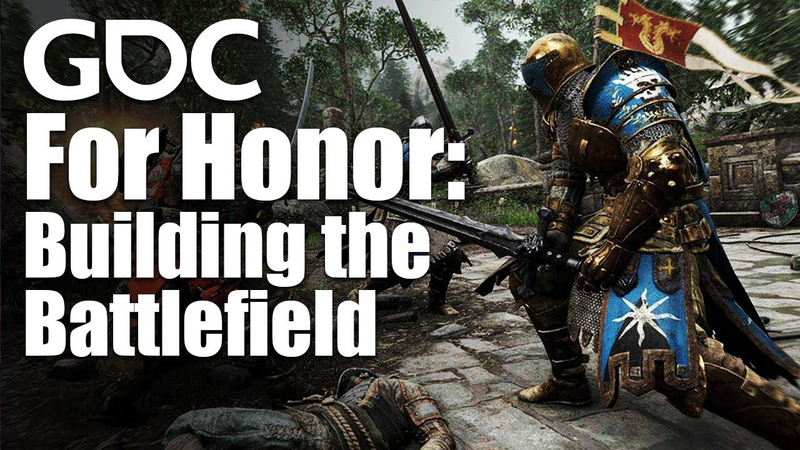
Deterministic vs. Replicated AI: Building the Battlefield of For Honor
The architecture of For Honor relies on a deterministic, input-driven simulation model designed to facilitate high-fidelity, skill-based melee combat.
- For Honor utilizes a distributed peer-to-peer deterministic simulation where only player and AI inputs are transmitted across the network, ensuring all clients reach the same game state without synchronizing complex object properties.
- The game architecture treats AI and human players identically, using a shared 'Katana' state machine tool that allows designers to define character states, movement, defenses, and branching conditions without hard-coding logic.
- To manage large-scale battles with up to 200 actors, the team replaced complex, costly platoon-merging logic with simple flocking rules to handle movement and target acquisition efficiently.
Data-Driven Dynamic Gameplay Effects on For Honor
For Honor employs a modular, data-driven modifier system designed to decouple gameplay logic from core programming, thereby granting designers the autonomy to iterate on mechanics without constant engineering support.
- Ubisoft implemented a data-driven modifier system for For Honor that allows designers to dynamically create gameplay effects—such as stat buffs, AI decision-making, and attack properties—without requiring additional programming code.
- The system utilizes a modular architecture where modifiers can be applied to various entities, including players, NPCs, capture points, and interactive objects, enabling high reusability across different game features.
- To manage performance under a load of approximately 3,000 queries per frame, the team implemented entity-specific caps, limiting soldiers to 6 active modifiers while allowing players a higher threshold.
For Honor: From a Great Launch to a Challenging Live Period
The transition from traditional game development to a games-as-a-service model requires a fundamental shift in mindset, moving from the delivery of a static product to the ongoing management of an evolving ecosystem.
- Transitioning to a games-as-a-service model requires shifting from static product delivery to managing an evolving ecosystem, necessitating a move from intuition-based design to rigorous, data-driven balancing.
- Maintaining competitive integrity in live services depends on tracking granular metrics, such as win rates and move-usage patterns, across diverse player skill levels.
- Infrastructure stability is critical to long-term viability, as evidenced by the necessity of transitioning from peer-to-peer networking to dedicated servers to resolve post-launch performance vulnerabilities.
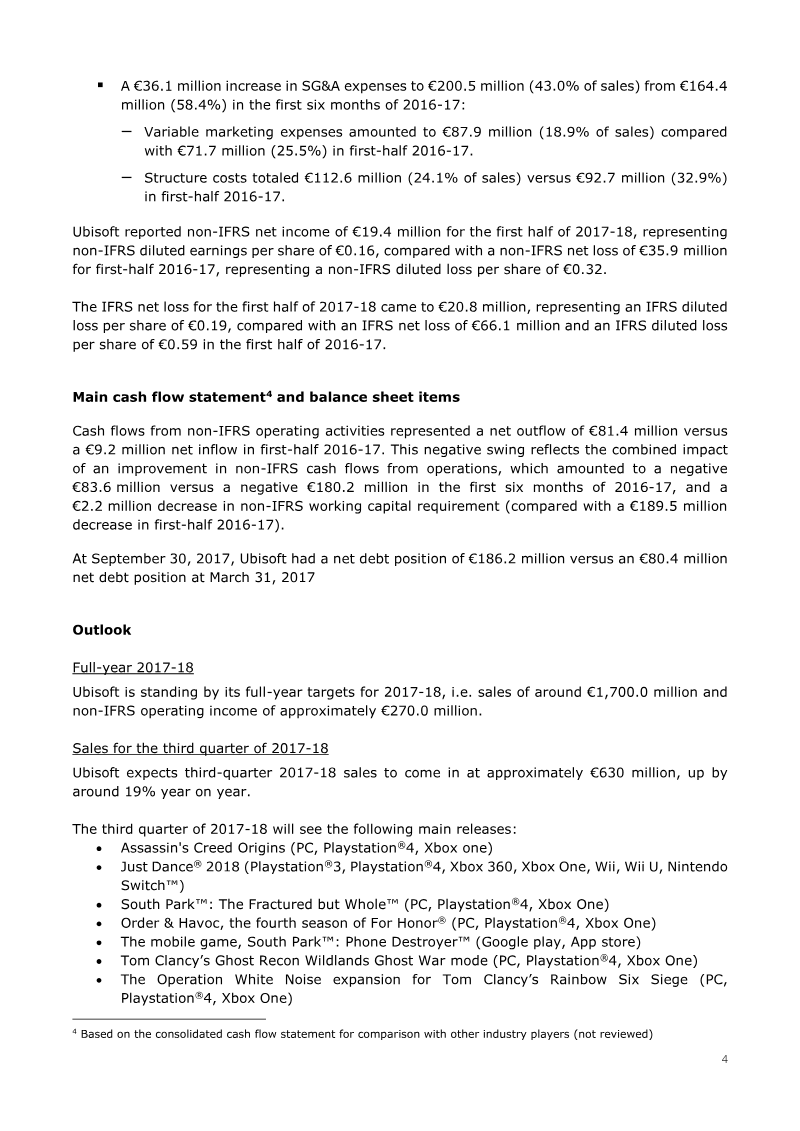
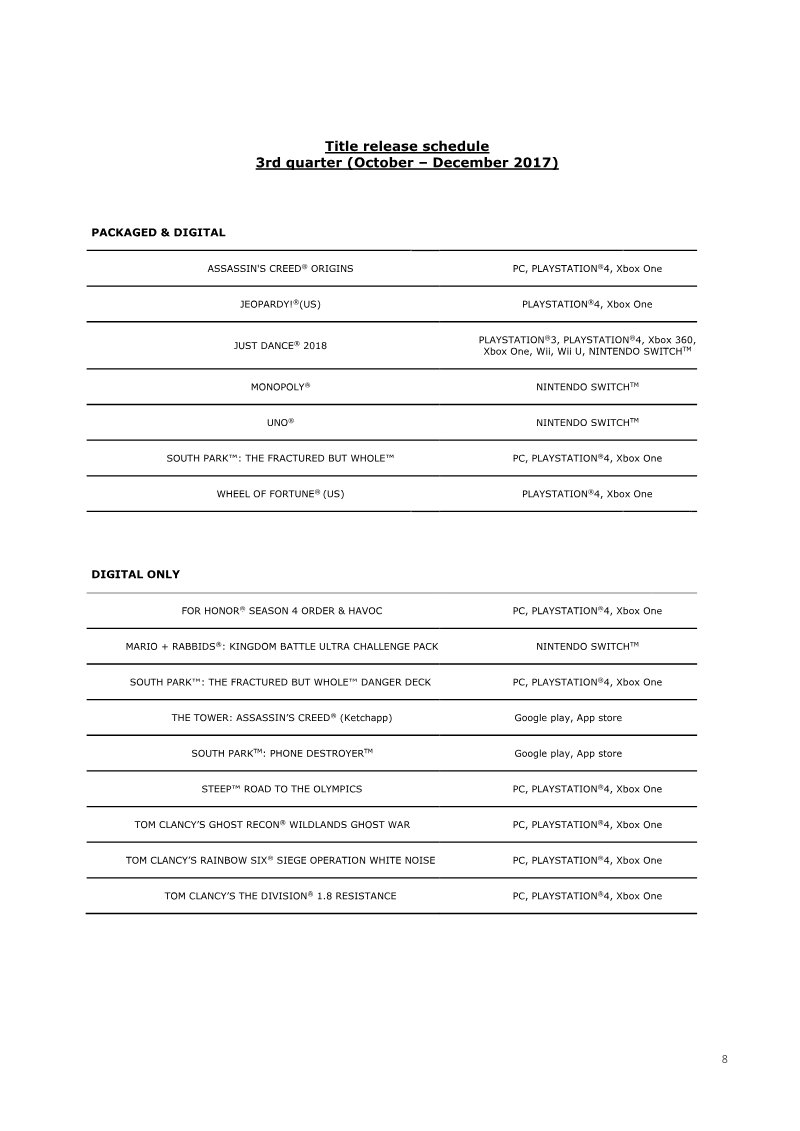
Ubisoft First-Half 2017-18 Sales and Earnings Figures
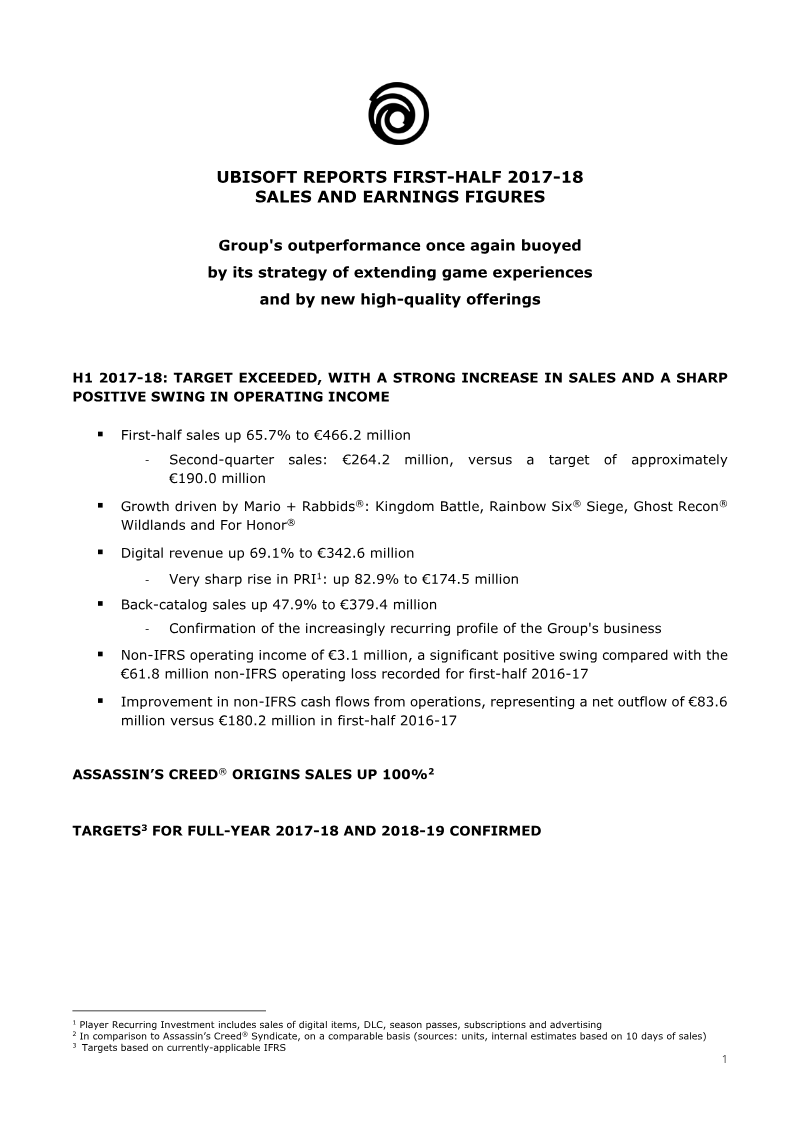
Ubisoft’s financial results for the first half of the 2017-18 fiscal year demonstrate a significant period of growth and operational improvement.
- Ubisoft achieved €466.2 million in sales for the first half of fiscal year 2017-18, representing a 65.7% increase over the previous year.
- Non-IFRS operating income reached €3.1 million, marking a significant turnaround from the €61.8 million operating loss reported in the first half of 2016-17.
- Digital revenue grew by 69.1% to €342.6 million, while Player Recurring Investment—covering DLC, season passes, and subscriptions—surged by 82.9%.
Ubisoft FY17 Earnings and Sales
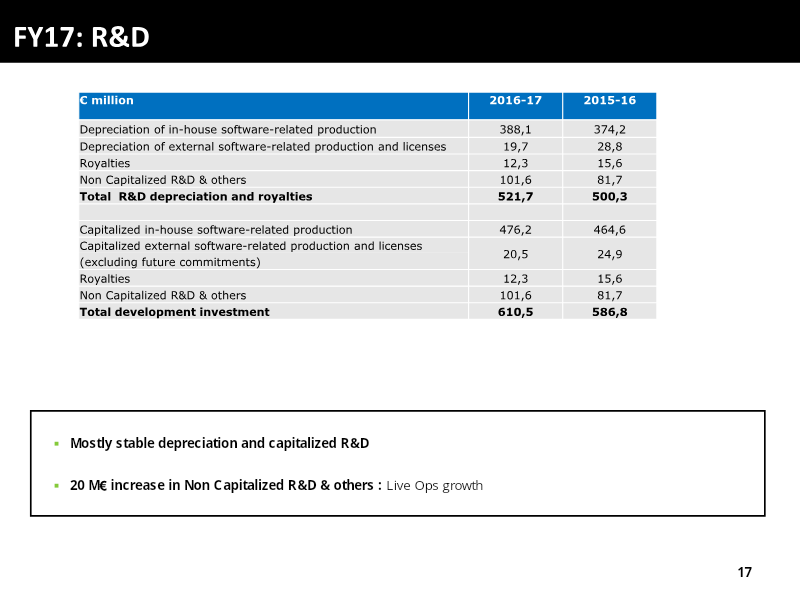
Ubisoft’s fiscal year 2017 performance highlights a successful strategic transition toward a more recurring, digital-first business model.
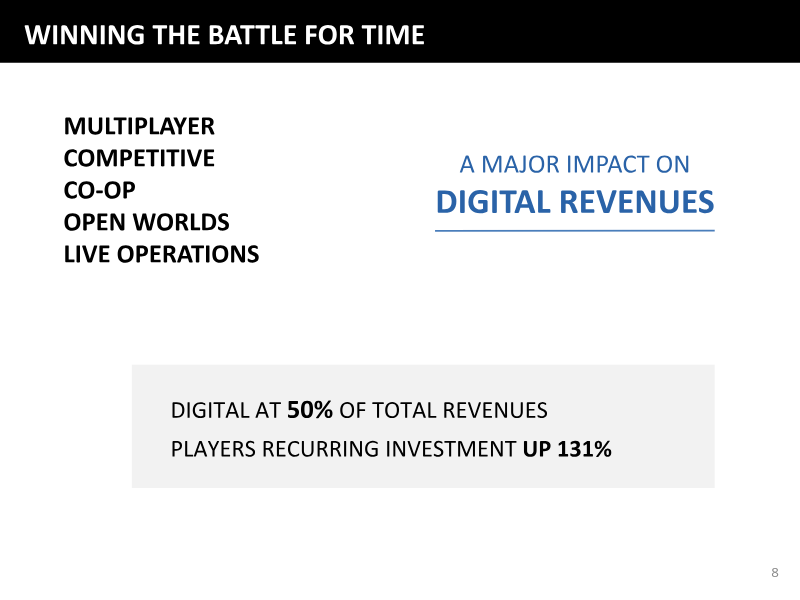
- Ubisoft achieved record-breaking digital revenue in FY17, which now accounts for 50% of total sales as part of a strategic shift toward recurring, digital-first business models.
- The company reported FY17 sales of 1,460 million euros, a 5% year-over-year increase, and reached a record non-IFRS operating margin of 16%.
- Ubisoft projects an operating income of approximately 440 million euros and an operating margin of 21% for FY19.
Ubisoft Full-Year 2016-17 Sales and Earnings Figures
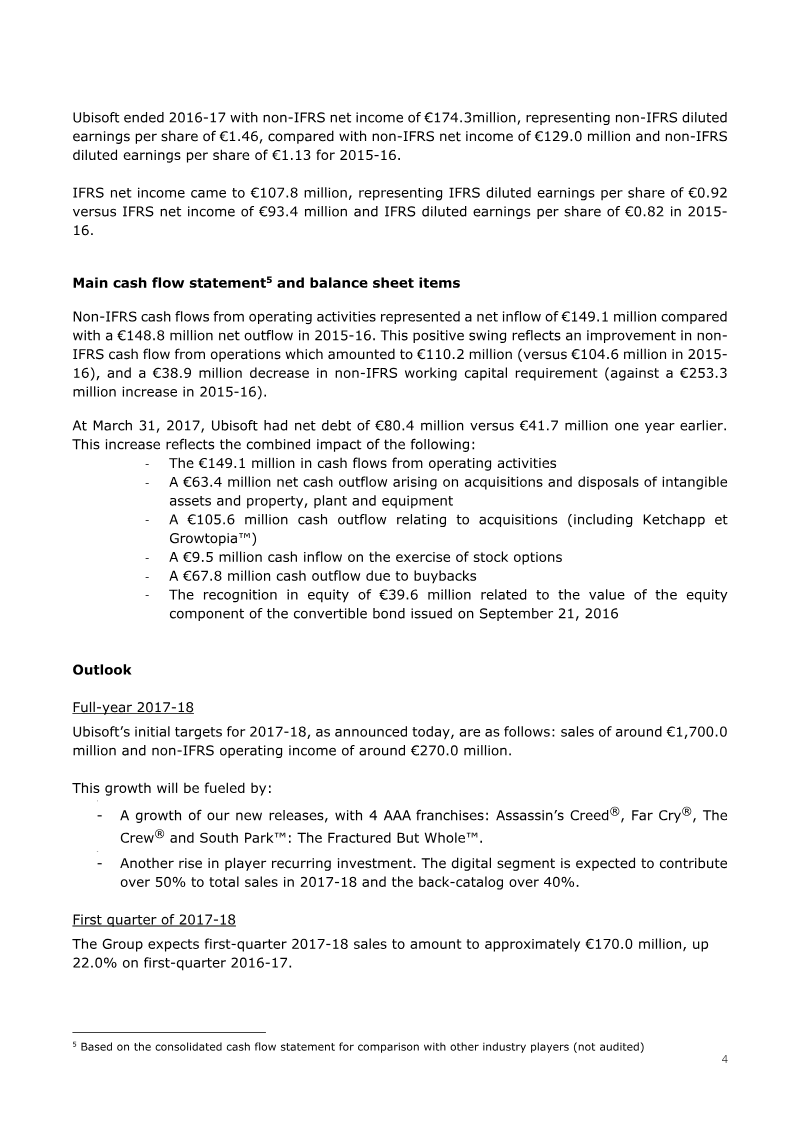
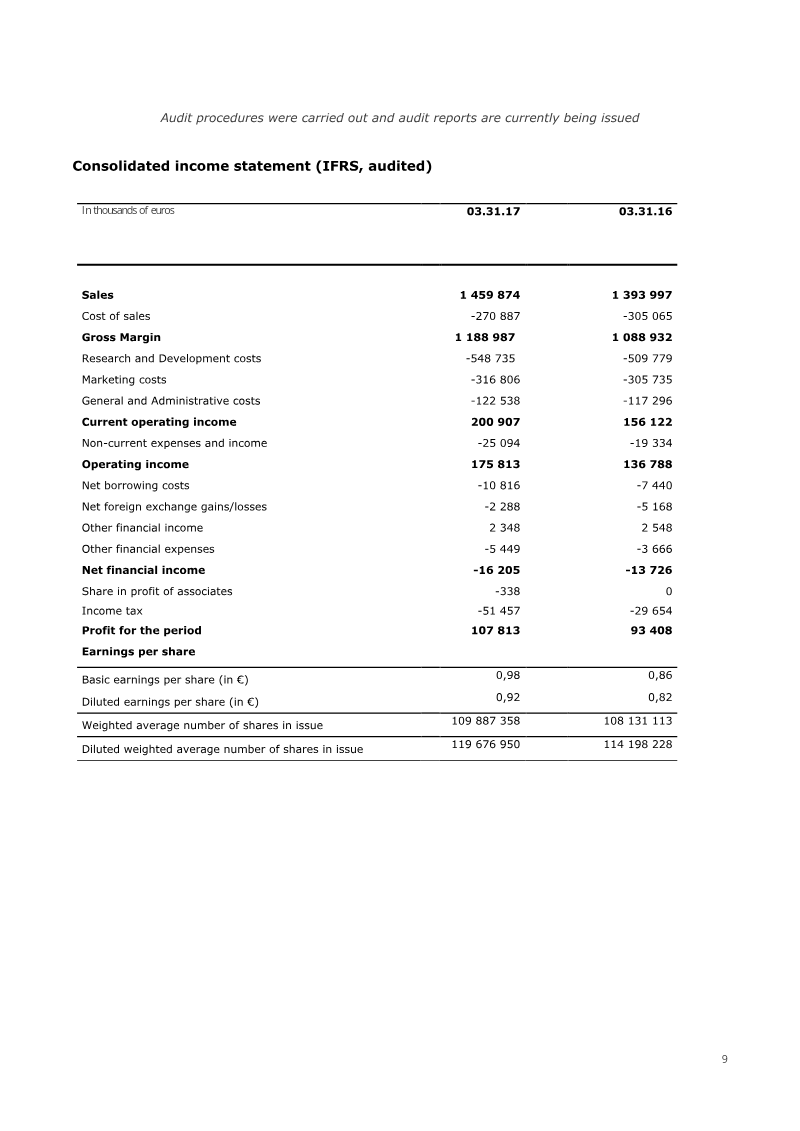
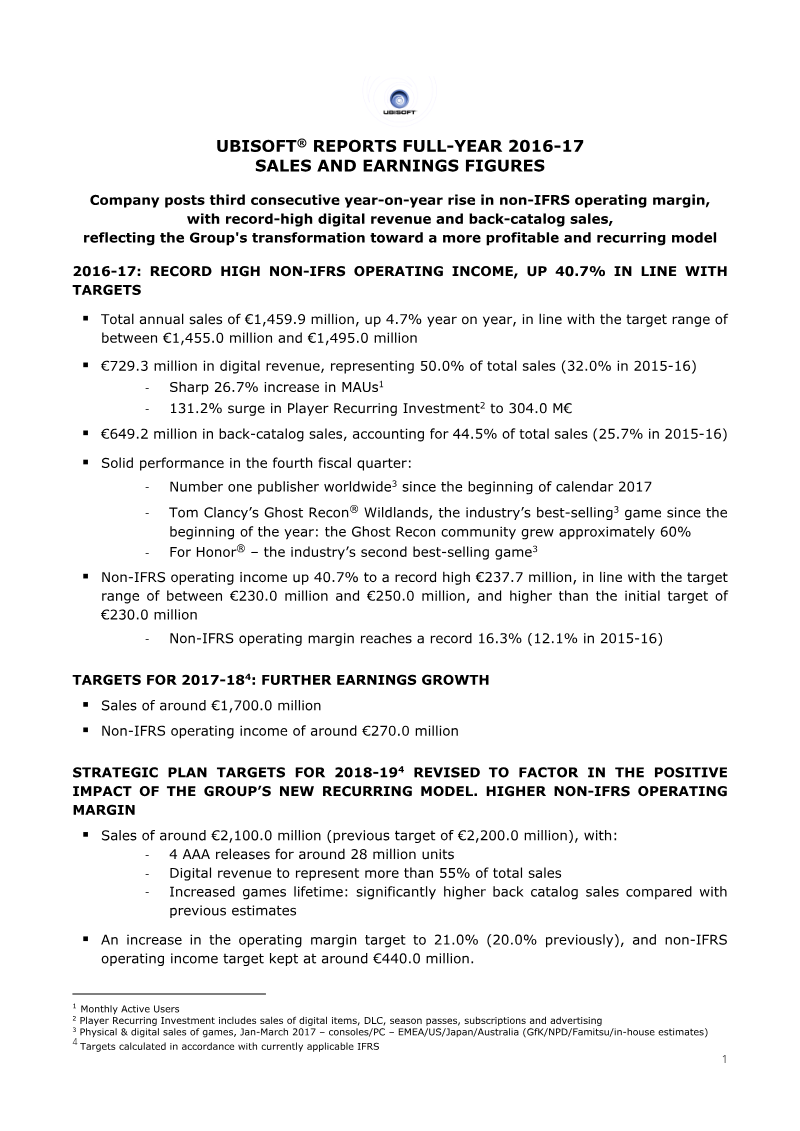
Ubisoft’s fiscal year 2016-17 financial results demonstrate the successful execution of a strategic shift toward a more profitable, recurring business model.
- Ubisoft achieved record-high non-IFRS operating income of €237.7 million, a 40.7% increase over the previous fiscal year, with a record operating margin of 16.3%.
- Digital revenue grew to €729.3 million, accounting for 50% of total sales compared to 32% in the prior year.
- Player recurring investment surged by 131.2% to €304 million, reflecting a successful shift toward a recurring business model.
Ubisoft Reports Third-Quarter 2016-17 Sales
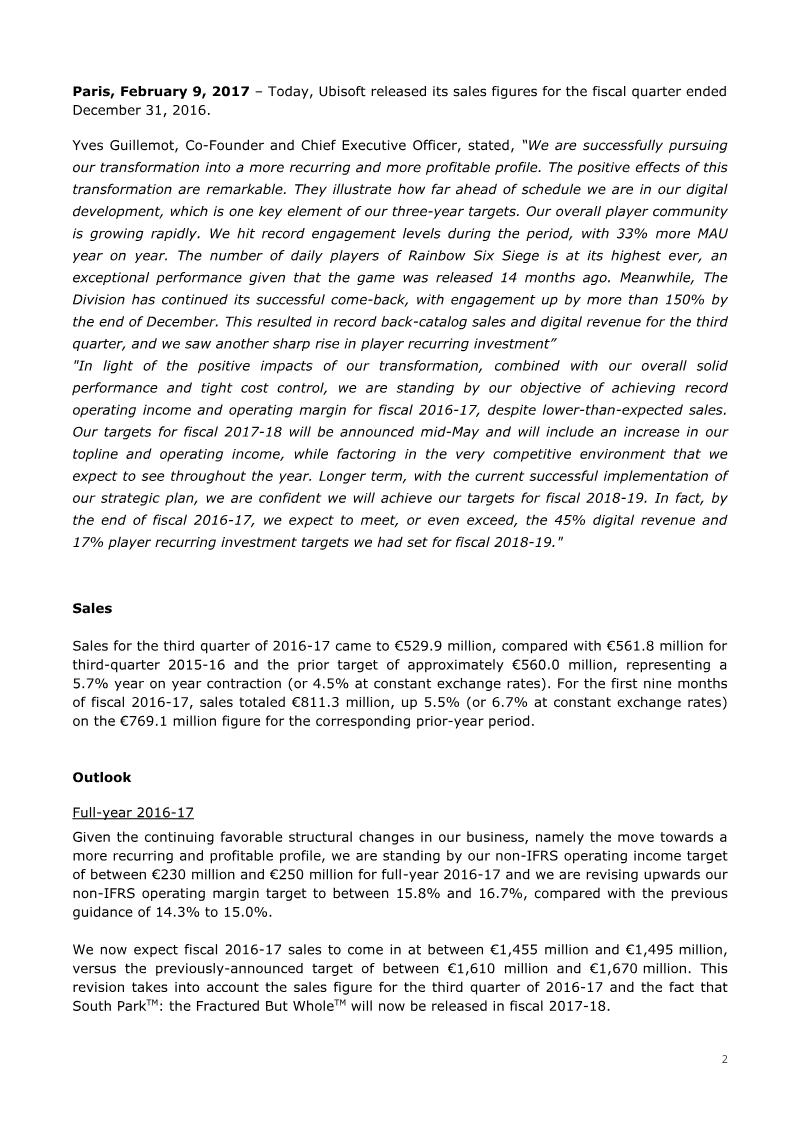
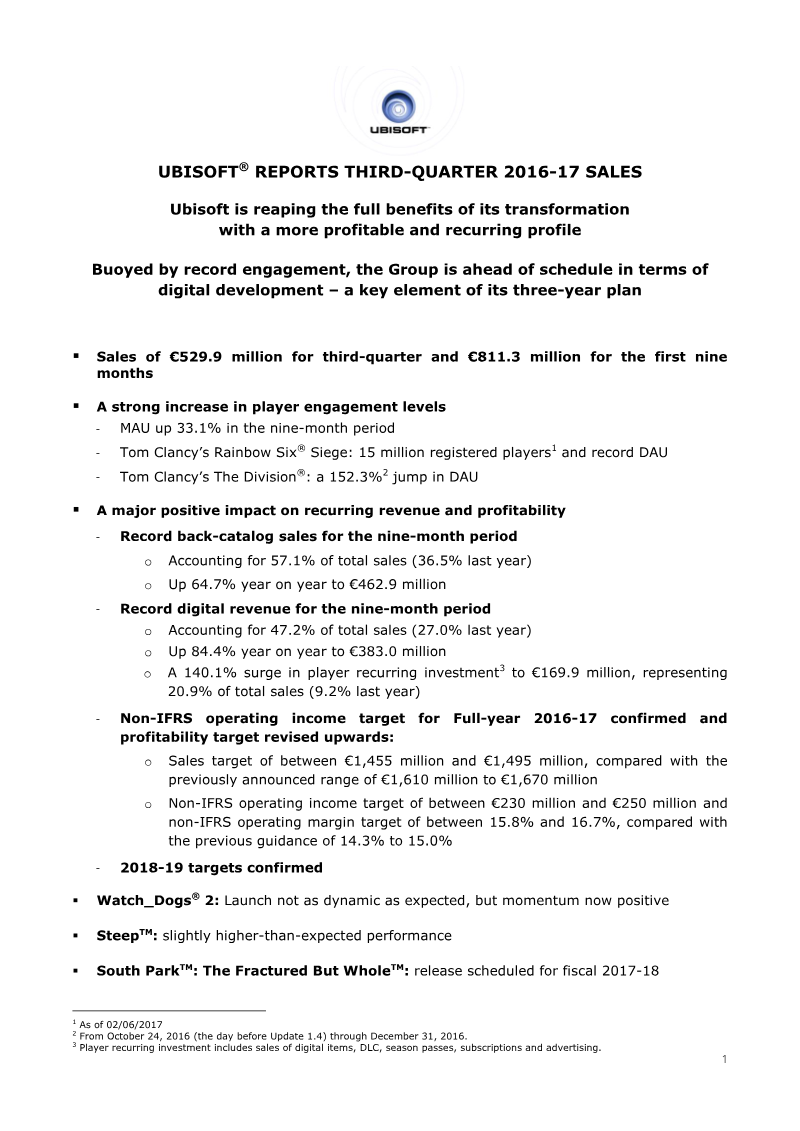
Ubisoft’s third-quarter 2016-17 financial results demonstrate a successful strategic transition toward a more recurring and profitable business model.
- Digital revenue reached €383.0 million for the first nine months of the 2016-17 fiscal year, representing 47.2% of total sales compared to 27.0% in the previous year.
- Player recurring investment—including season passes, subscriptions, and digital items—grew by 140.1% during the nine-month period.
- Monthly active users increased by 33.1% over the nine-month period, driven by the performance of Tom Clancy’s Rainbow Six Siege and Tom Clancy’s The Division.

Ubisoft Investor Day 2016
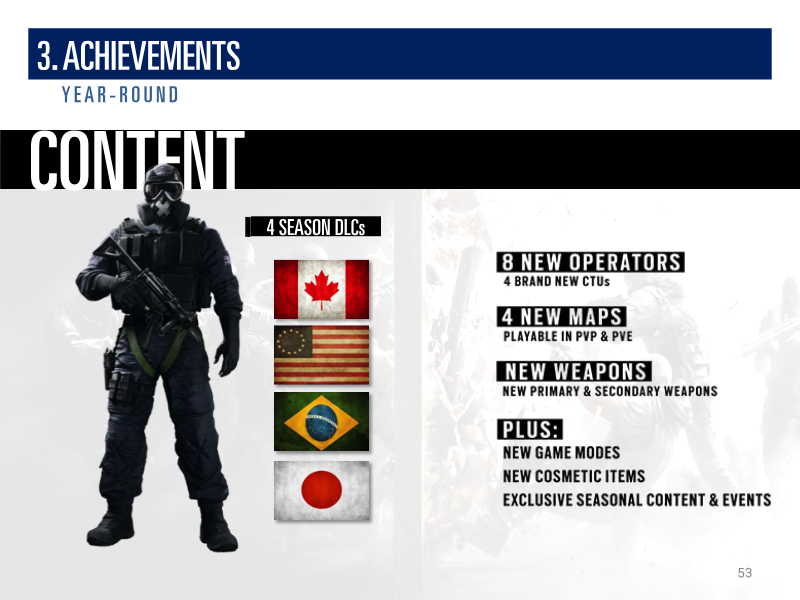
Ubisoft is executing a fundamental strategic pivot toward a recurring revenue model, aiming to transform its business from a cycle of standalone, one-off releases into a platform for long-term, high-engagement live services.
- Ubisoft is transitioning to a recurring revenue model focused on long-term live services, aiming for €2.2 billion in revenue and a 20% operating margin by fiscal year 2019.
- Digital sales are projected to reach 45% of total revenue as the company shifts from standalone releases to year-round player engagement.
- The strategy prioritizes scaling a concentrated portfolio of blockbuster franchises, including Assassin’s Creed, Rainbow Six, The Division, and For Honor.
Ubisoft Reports Third-Quarter 2015-16 Sales
Ubisoft’s third-quarter fiscal 2015-16 results highlight a strategic pivot toward long-term player engagement and digital revenue growth.
- Ubisoft is pausing the annual release cycle of the Assassin's Creed franchise to focus on creative revitalization.
- The company revised its full-year 2015-16 sales target to €1,360 million and set a fiscal 2016-17 sales target of €1,700 million.
- Digital revenue grew to represent 27% of total sales for the first nine months of fiscal 2015-16, while back-catalog sales increased by 42.6%.
Companies behind it

As the documents state it.