Simon Carless's newsletter analyzing how people find and buy video games. Game Discovery Now LLC.
This analysis examines how PC player demographics and behavioral patterns evolve based on playtime duration, utilizing proprietary Steam Fan Snapshot data. By comparing player cohorts at short-term intervals (30 minutes) against long-term engagement (50+ hours), the research identifies shifts in platform preferences, discovery methods, and external media habits. The methodology relies on over 16,000 player data points linked to authorized Steam public profiles, providing a granular view of how engagement depth correlates with specific user characteristics.
Key findings indicate that high-engagement players—those exceeding 50 hours of playtime—often exhibit a "maining" behavior, characterized by a notable reduction in monthly playtime on other platforms, such as the Nintendo Switch or PlayStation. Furthermore, discovery channels shift as playtime increases; while livestreaming becomes a more prominent discovery source for long-term players, reliance on text-based social media platforms tends to decline. These trends suggest that the most dedicated players are more focused on a single title, potentially at the expense of broader gaming variety.
The data also highlights a correlation between age and playtime. Younger demographics, who generally face fewer family-related time constraints, represent a larger share of the high-playtime cohort. Additionally, media consumption habits vary significantly by player profile; for instance, narrative-focused game players show a strong affinity for books, manga, and podcasts, though these activities often decrease as playtime in a specific game increases. Ultimately, these insights demonstrate that understanding the intersection of player age, generational media habits, and engagement depth is essential for developers to refine their marketing and targeting strategies effectively.
This analysis examines the influence of Steam player reviews on consumer purchasing behavior, utilizing data from a survey of approximately 3,800 dedicated Steam users conducted between June 25 and July 2, 2026. The primary objective is to quantify how review scores and trends impact the likelihood of a purchase, providing developers with insights into how their titles are perceived by the platform's most active audience.
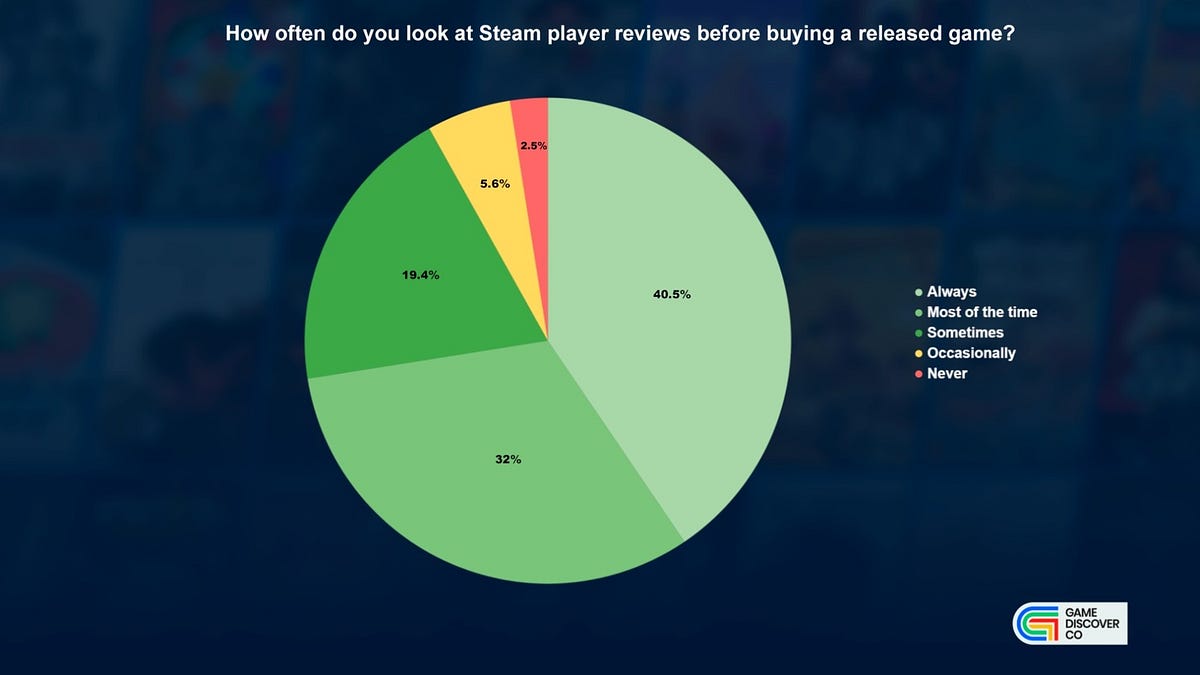
The findings confirm that player reviews are a critical component of the Steam discovery and purchasing process. A significant majority of respondents—72.5%—check reviews either always or most of the time before making a purchase. Regarding the impact of aggregate scores, 30.8% of participants indicated that a rating of Mixed or lower would make them less likely to buy a game, while 20.3% reported that anything below Very Positive would deter them. Conversely, only 9.7% of respondents stated that review ratings have no significant impact on their purchasing decisions.
Beyond static scores, recent review trends also carry substantial weight. When a game’s recent reviews are worse than its all-time rating, 32.9% of users report they will scrutinize the recent feedback closely, while 47.4% express a willingness to check but remain cognizant of potential short-term review bombing.
Qualitatively, users value reviews primarily for identifying technical issues, performance bugs, and establishing a quick consensus on game quality. Conversely, the most cited frustrations include low-effort meme reviews, coordinated review bombing, and concerns regarding fake or bot-generated feedback. Ultimately, the data suggests that while reviews are a powerful filter for consumers, they remain a net positive for the platform by providing transparency and community-driven verification.
The primary objective is to provide developers with realistic benchmarks for the long-term revenue and sales performance of PC games on Steam. By analyzing a cohort of approximately 5,000 games released between July 2023 and July 2025—specifically those with at least 1,000 units sold in their first month—the analysis establishes clear multipliers for predicting cumulative performance based on initial launch success.
The findings indicate that for a typical game, the median cumulative sales by the end of the second year reach approximately 3.32 times the volume of its first-week sales. However, the data reveals a notable decline in the "long tail" compared to 2021, with year-one sales multipliers dropping by roughly 20%—from 3.05x to 2.46x. This trend is attributed to the increasing number of new game releases on the platform, which continues to outpace overall revenue growth.
Several key variables influence these outcomes. Games priced at $10 or higher demonstrate a stronger long-term performance, achieving a 2.7x multiplier in year-one unit sales compared to 2.32x for lower-priced titles. Furthermore, initial launch success is a strong predictor of future longevity; games that sell over 100,000 copies in their first week exhibit a significantly higher median multiplier of 4.64x by the end of the first year. Additionally, the inclusion of co-op features serves as a major performance driver, with such titles achieving a 3.53x year-one sales multiplier, significantly outperforming the median. These insights emphasize that while residual revenue remains a critical component of a game's lifecycle, the market has become increasingly competitive, necessitating strategic design choices like co-op integration to sustain long-term interest.
This analysis examines the attitudes of core Steam users toward artificial intelligence in video games, while also providing updated estimates for Steam’s global monthly active users (MAU). The findings are derived from a survey of approximately 3,800 committed Steam fans conducted between June 25 and July 2, 2026, as part of a broader ongoing research initiative.
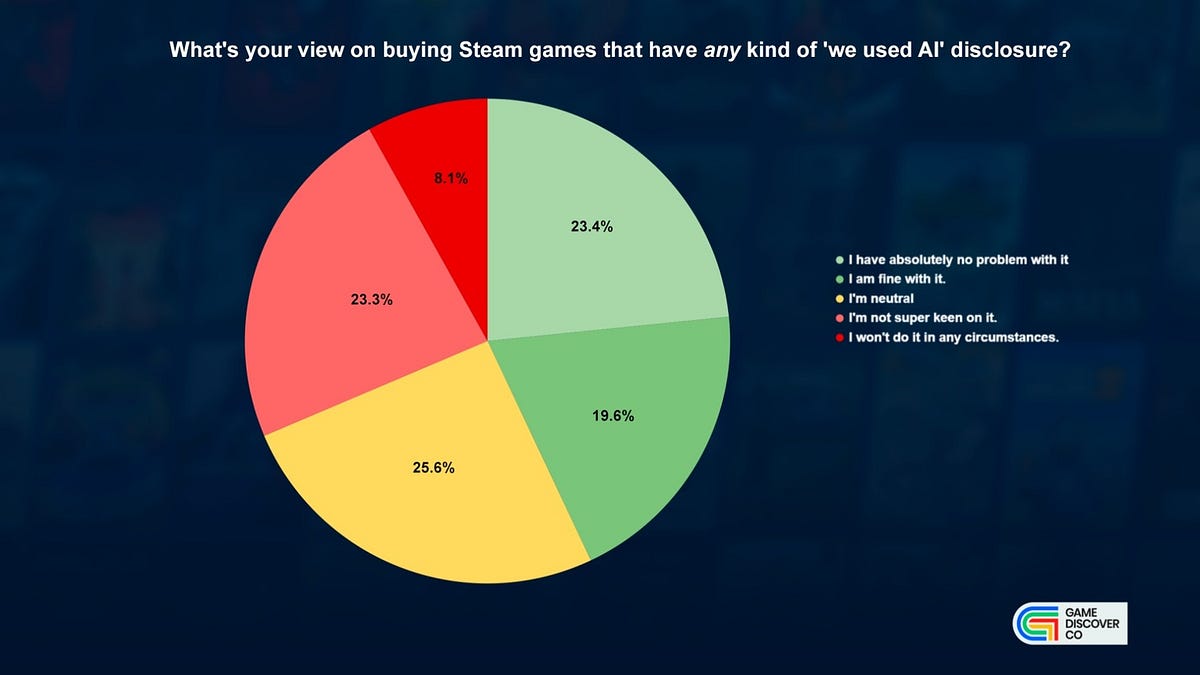
The survey reveals significant consumer skepticism regarding AI implementation. While 43% of respondents express no major issues with AI disclosure, 31% view it negatively, with a subset indicating they would refuse to purchase such titles. Trust remains a primary concern; only 17% of participants believe developers are fully transparent about their use of audiovisual AI. Furthermore, 56% of respondents argue that AI-powered coding tools should be disclosed, despite current platform policies that exempt such efficiency-focused utilities from mandatory reporting. While there is conditional acceptance for AI in technical or repetitive tasks, there is strong resistance toward using the technology to replace human creativity.
Beyond consumer sentiment, the analysis provides a data-driven estimate of Steam’s scale. By extrapolating from European Union Digital Services Act filings—which reported 31.1 million MAUs in the region—and applying regional bandwidth share data, the analysis estimates that Steam reached approximately 198 million monthly active users by the end of 2025. This figure is supported by concurrent user growth trends, which suggest a platform-wide monthly active user base exceeding 200 million. These insights highlight both the evolving relationship between players and emerging development technologies and the continued expansion of the Steam platform on a global scale.
This analysis provides a comprehensive overview of the video game market for June 2026, focusing on sales performance, platform trends, and discovery metrics across PC and console ecosystems. The data highlights a shift in industry dynamics, characterized by a move toward digital-only distribution and evolving monetization strategies. Notably, Sony has announced the cessation of physical disc production for PlayStation consoles by January 2028, signaling a significant transition that impacts both retail and secondary markets.
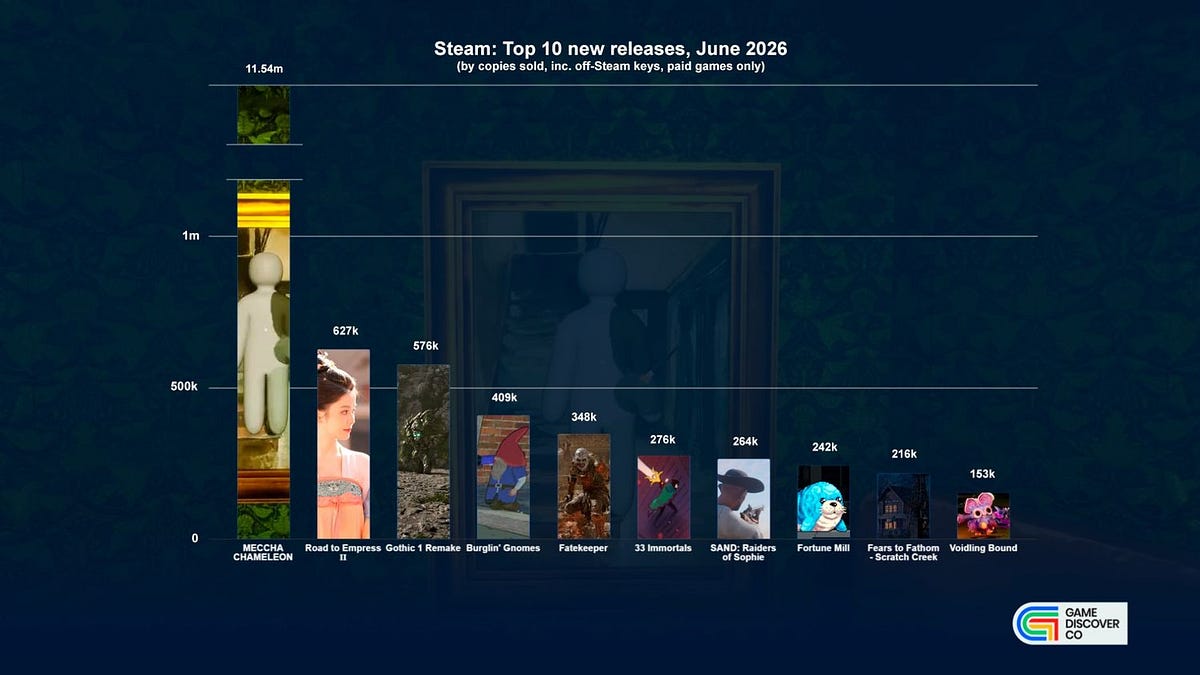
Market performance in June 2026 was marked by a notable disparity in high-grossing releases compared to the previous month. While May saw six new titles exceed $10 million in Steam gross revenue, June recorded only two. The breakout performer of the month was the multiplayer title Meccha Chameleon, which achieved 11.5 million units sold. Other significant releases included the Gothic remake, which saw strong performance in Central and Eastern Europe, and 33 Immortals, which leveraged a competitive launch price to drive volume. Overall, there is an observable downward trend in pricing for top-grossing titles, with many developers opting for aggressive launch discounts to capture market share.
Methodologically, the findings are derived from proprietary platform data, including Steam unit and revenue estimates, console eShop tracking, and Twitch viewership analytics. The scope encompasses global PC and console markets, with specific attention paid to the impact of seasonal events like the Steam Summer Sale. The analysis also incorporates broader industry shifts, such as the increasing focus on live-service models and the strategic importance of curated discount placements. These insights underscore a challenging environment where indie titles often function as high-risk, high-reward ventures, while established franchises continue to dominate revenue charts through sustained engagement and expansion content.
The integration of Twitch streaming data into game discovery analysis provides a more nuanced understanding of how titles gain visibility and sustain interest. By incorporating over a decade of historical data—covering tens of thousands of games and hundreds of thousands of streamers—the analysis moves beyond on-platform metrics to evaluate the impact of influencer and community engagement. This methodology leverages high-quality metadata, facilitated by Twitch’s acquisition of IGDB and mandatory game categorization for streamers, allowing for precise tracking even among smaller titles.
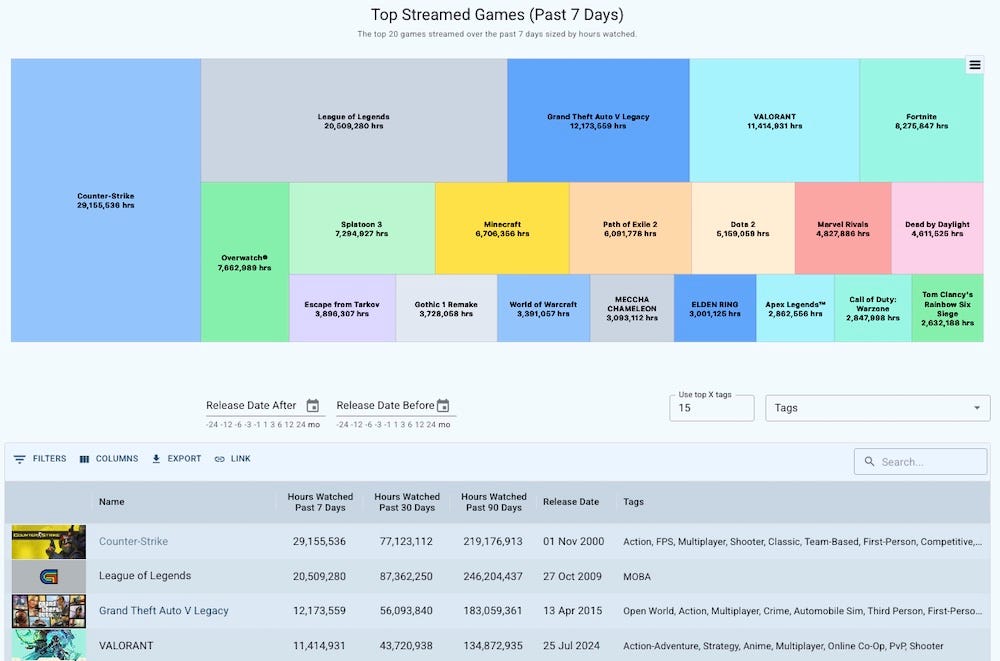
Key findings demonstrate that while major titles like Counter-Strike and League of Legends maintain consistent daily viewership across thousands of channels, most paid games follow a pattern of high initial interest followed by a gradual decline. However, this "fallowness" does not necessarily correlate with poor commercial performance, as many titles continue to sell units through wishlists and updates despite lower streaming activity. The data also highlights that viral multiplayer hits often receive significant boosts from Twitch, and that cross-referencing streaming trends with sales data helps identify specific "vibes" or genre-based fan groups that drive discovery.
The scope of this analysis encompasses global PC and console gaming, with a focus on the 2020s market landscape. By applying cross-data lenses, the research identifies which games are propelled by the "flavor" of streamer interest versus those that succeed independently of it. This approach enables developers and publishers to better target streamers, identify comparable titles, and gauge the long-term retention potential of their games. Ultimately, the inclusion of streaming metrics serves as a vital tool for contextualizing how players find, buy, and interact with games in an increasingly crowded digital marketplace.
Project Zomboid serves as a primary case study for the mechanics of long-term, evergreen success in the PC gaming market. Since its initial Steam release in 2013, the title has achieved significant commercial longevity, currently estimated at over 15 million units sold on Steam. The game maintains a consistent presence in the platform’s top 50 most-played titles, supported by a dedicated player base that often logs between 1,000 and 5,000 hours of gameplay.
The game’s sustained performance is attributed to several core factors, most notably its highly flexible sandbox design that allows players to customize their experience. A robust modding ecosystem, which has integrated former community members into the development team, has effectively transformed the title into a platform for ongoing content creation. Furthermore, the game’s high degree of "watchability" on streaming platforms and its complex, emergent narrative potential have helped it remain relevant to younger generations of players despite its older, simulation-heavy roots.
The development team emphasizes that the game’s harsh learning curve is not a barrier to entry but a core component of its appeal, providing a sense of mastery that fosters deep player engagement. By avoiding microtransactions and maintaining a consistent, low-cost pricing model, the developers have cultivated significant social capital. This analysis highlights that while early entry into the Steam ecosystem provided a foundational advantage, the game’s continued growth is driven by its ability to function as a personalized, systemic canvas for diverse play styles, ranging from casual social sessions to intense, high-stakes survival roleplay.
The May 2026 industry analysis provides a comprehensive overview of the PC and console gaming landscape, focusing on top-performing titles, platform trends, and significant interface updates. The primary objective is to evaluate market performance through proprietary sales and engagement data, offering insights into consumer behavior across Steam, PlayStation, Xbox, and Nintendo platforms.
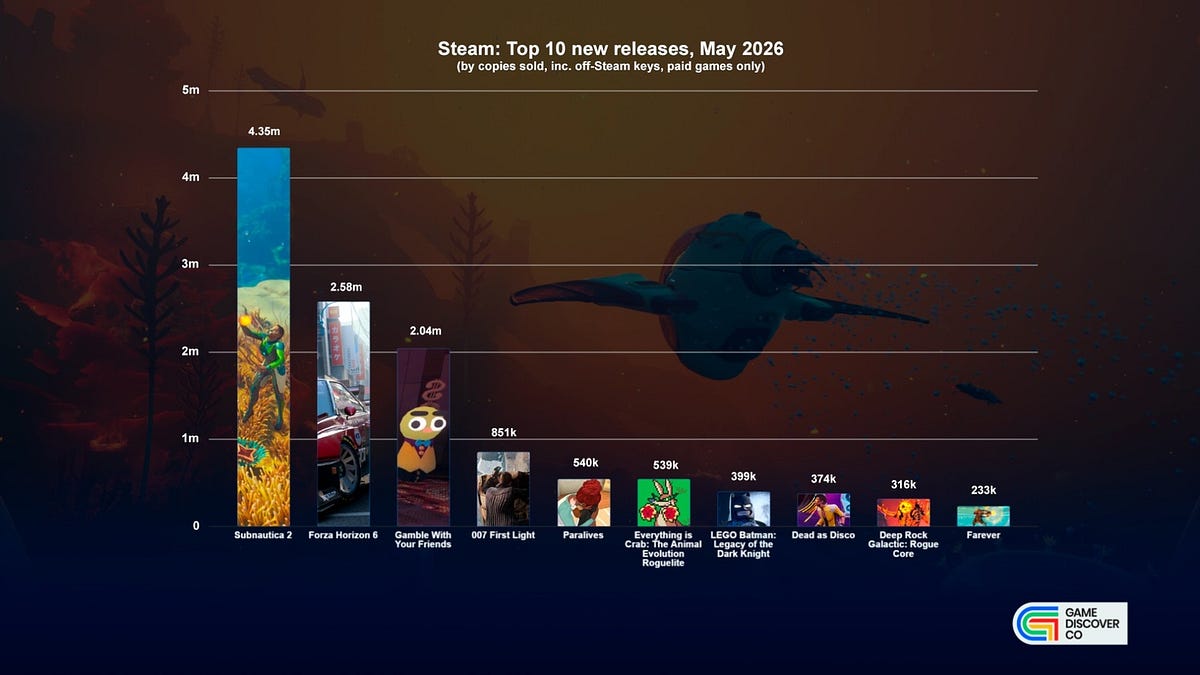
Key findings highlight the strong market impact of major releases. Subnautica 2 emerged as a top performer, achieving 462,000 concurrent users and 4.4 million sales despite a mid-month launch. Forza Horizon 6 demonstrated exceptional commercial success, exceeding 13 million total players and generating approximately $170 million in gross revenue on Steam alone. Other notable successes included the co-op title Gamble With Your Friends, which reached 2 million copies sold, and the simulation game Paralives, which surpassed 500,000 copies. Multi-platform titles such as 007 First Light and LEGO Batman: Legacy Of The Dark Knight also showed significant momentum, with the former grossing over $110 million across all platforms.
The analysis also covers broader industry shifts, including the global rollout of Steam’s redesigned homepage. This update emphasizes improved mobile usability and personalized discovery features, such as wishlist and DLC highlights. While the change to the "Popular Upcoming" section has raised developer concerns regarding visibility, the shift toward ranking by recent wishlist velocity is intended to better capture anticipated releases. Additionally, the report notes a decline in PlayStation 5 sales in the UK market and highlights the Entertainment Software Association’s findings that 67% of Americans engage with video games weekly. The data is derived from proprietary platform tracking, industry reports, and sales estimates, providing a snapshot of the global gaming market as of June 2026.
The primary thesis posits that hobbyist and semi-professional game developers represent a more significant disruptive force in the modern PC gaming market than artificial intelligence. While AI serves as a valuable tool for accelerating development, the true market shift is driven by the democratization of high-end engine technology, the accessibility of affordable asset stores, and the ability for small, skilled teams to reach global audiences directly through platforms like Steam. This trend has effectively blurred the lines between professional studios and independent creators, making it increasingly difficult to distinguish between their respective outputs.
Key evidence for this shift is found in the success of titles like the train simulator Running Train, which was developed by a solo creator using Unreal Engine 5. Within ten days of its early access launch, the game achieved an estimated 34,000 units sold and $550,000 in gross revenue. This performance highlights how niche expertise, combined with modern distribution and community-building tools like Patreon and social media, allows solo developers to compete directly with established franchises. Other notable examples of this phenomenon include successful titles such as Dinkum and Balatro, which demonstrate that high-quality, competitive games are increasingly emerging from non-traditional, solo-led development pipelines.
The analysis covers the global PC and console gaming industry as of June 2026, utilizing data from Steam, Stream Hatchet, and retail tracking services. The findings suggest that as barriers to entry continue to drop, the market will become increasingly outlier-driven. To remain competitive, developers must focus on genre-specific expertise, identify clear scale differentiators, and cultivate dedicated communities. Failure to adapt to this landscape risks irrelevance, as the sheer volume of high-quality, hobbyist-produced content continues to saturate the market.
The piece investigates the average age of Steam players for games released after January 2020 that have sold over 25,000 copies, using a 10,000‑sample survey called the Steam Fan Snapshot. The median average age across these titles is 33, suggesting that older players dominate the core Steam demographic. Top‑selling new releases show a range of 27–33 years, with notable outliers such as Slay the Spire 2 (29.7) and Crimson Desert (31.3). High‑average‑age games tend to be retro or strategy‑heavy titles—Titan Quest, MechWarrior, Songs of Conquest—that are single‑player focused and appeal to players with long PC histories. Conversely, low‑average‑age games cluster around friendslop and co‑op titles like R.E.P.O., RV There Yet?, and Sea of Thieves, which also enjoy strong YouTube presence. Tag analysis reveals that games with an average age of 28 list multiplayer as a top tag fifteen times versus three for single‑player, while those averaging 36 favor single‑player and strategy tags. These findings imply that discovery channels differ by age cohort: younger players rely more on short‑form video and word of mouth, whereas older players engage through traditional PC communities. The article also discusses the potential of agent‑based data queries to surface cross‑dataset insights, noting that such tools can streamline comparative analysis for publishers and investors. Overall, the data underscores a fragmented PC market where age‑segmented discovery strategies are essential for effective targeting.
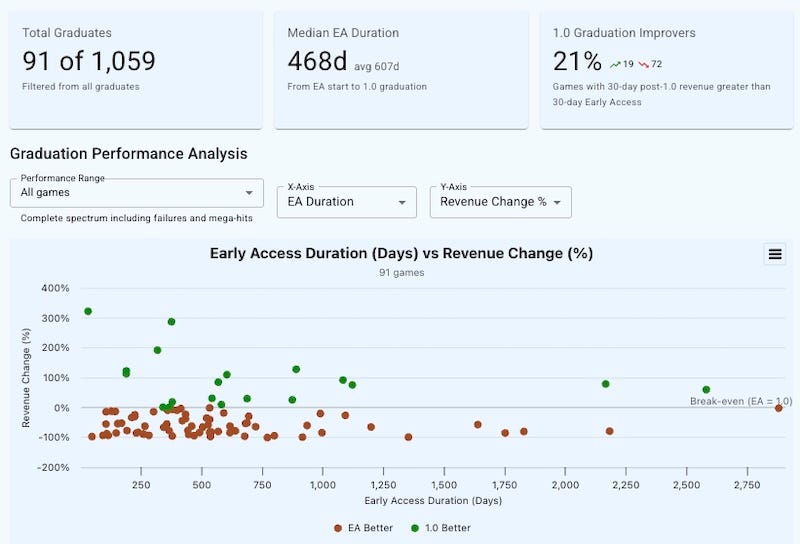
The analysis examines the performance of games graduating from Steam Early Access to full 1.0 release during the first half of 2026. The primary thesis suggests that while Early Access remains a viable development strategy, it offers no guaranteed financial windfall at launch, with performance metrics remaining largely consistent with 2025 trends. The findings indicate that only 21% of tracked titles achieved higher revenue at their 1.0 launch compared to their initial Early Access debut, highlighting a persistent challenge for developers in converting early momentum into full-release success.
The study covers 91 games that met specific criteria, including paid titles with over 5,000 copies sold or free games generating over $10,000 in revenue during their first 30 days of Early Access. Data shows that these titles spent a median of 15 months in Early Access, a slight increase from the previous year. Successful graduates often feature expandable, feature-rich gameplay loops—such as strategy or simulation titles—that allow for continuous content layering. Conversely, the analysis notes a growing industry skepticism toward the model, as many developers enter Early Access with truly unfinished products that fail to meet the higher quality expectations of 2026 consumers.
Beyond Early Access performance, the analysis touches on broader industry shifts, including the rising effectiveness of short-form video marketing and the impact of Steam’s recent tag updates, which introduced categories like Bullet Heaven to better organize the platform’s library. The findings emphasize that while Early Access can be a powerful tool for community-driven development, the "surprise" factor of a game’s initial release is a finite resource that developers must strategically time to maximize long-term viability.
The primary objective is to evaluate whether specific, measurable metrics can reliably predict the commercial success of video game launches on Steam. The analysis challenges the industry-standard reliance on raw wishlist counts, arguing that wishlist conversion rates are highly volatile and do not serve as a singular indicator of performance. Instead, the findings suggest that developers should look toward more nuanced indicators to forecast launch outcomes and manage expectations.
A key finding centers on the follower-to-wishlist multiplier, which serves as a proxy for audience intent. Data indicates that a higher multiplier—where the number of wishlists significantly outpaces the number of followers—often correlates with lower conversion rates. This suggests that high wishlist counts without corresponding follower growth may represent a more casual, less committed audience. Conversely, lower multipliers indicate a more engaged player base, with the lowest 100 performers in a sample of 600 games showing a 68% better conversion rate than their high-multiplier counterparts.
The scope of this analysis covers PC game discovery trends as of May 2026, utilizing proprietary data from approximately 5,000 titles released in 2025 and a subset of games with over 50,000 launch wishlists. The methodology involves mapping follower-to-wishlist ratios against actual sales performance and conversion metrics. While the analysis identifies clear trends, it acknowledges that significant outliers exist, influenced by factors such as pricing, marketing reach, and post-launch review scores, which can impact sales by a factor of two to five.
Ultimately, the findings conclude that while no single metric guarantees success, developers should incorporate a broader matrix of data points into their forecasting. Recommended indicators include active demo engagement, community sentiment on platforms like Discord, organic influencer activity, and consistent wishlist momentum leading up to a release. Relying solely on total wishlist volume is characterized as an insufficient strategy for predicting launch-week performance.