Battle Royale
Game
Documents about Battle Royale
Games: India Plays!
The report examines the rapidly expanding Indian mobile gaming market, highlighting a projected 91% share of online gamers playing on smartphones and an estimated revenue of US$2.2 billion in 2022, with a projected average revenue per user of US$1.5 by 2027.
- The Indian mobile gaming market generated US$2.2 billion in 2022, with smartphones accounting for 91% of the online gaming audience.
- Non-real-money gaming (non-RMG) is dominated by Adventure, Battle Royale, Puzzle, Arcade, and Racing genres, while real-money gaming (RMG) centers on card games and sports-fantasy.
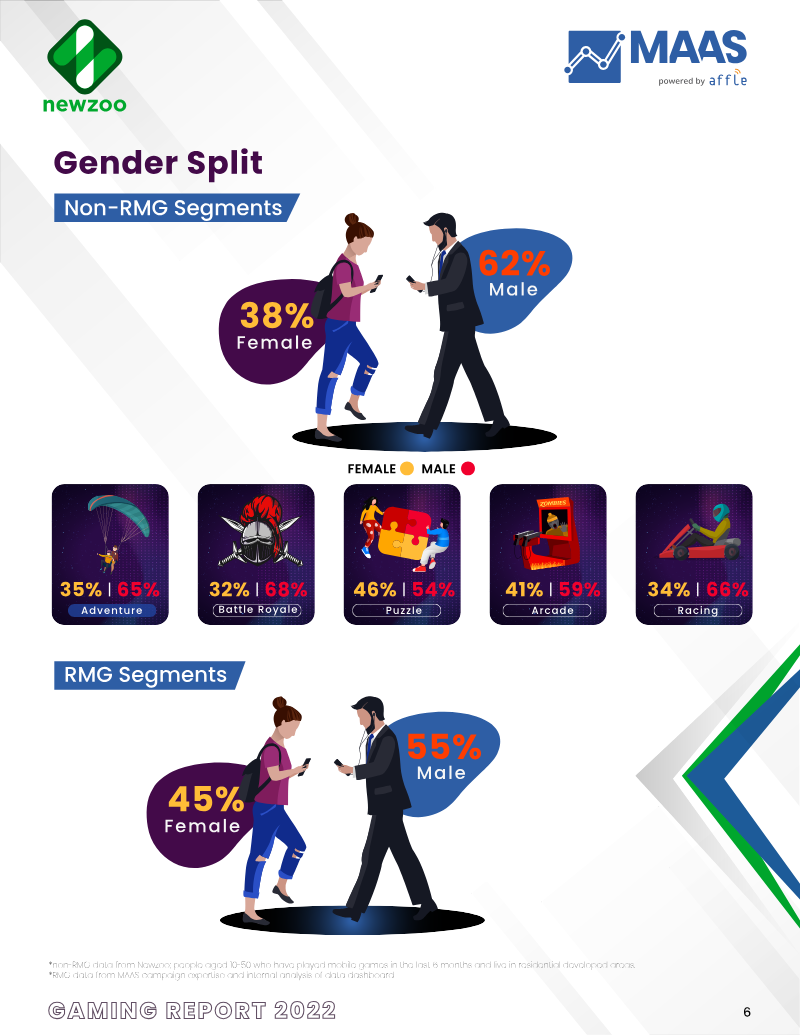
- Demographics skew young, with 55% of Adventure and Battle Royale players falling into the 13–27 age bracket, and 62% of non-RMG gamers being male.

Shooter Games
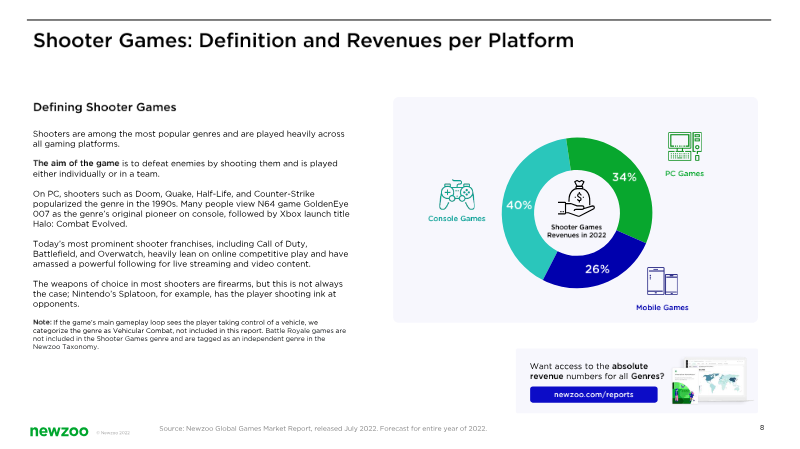
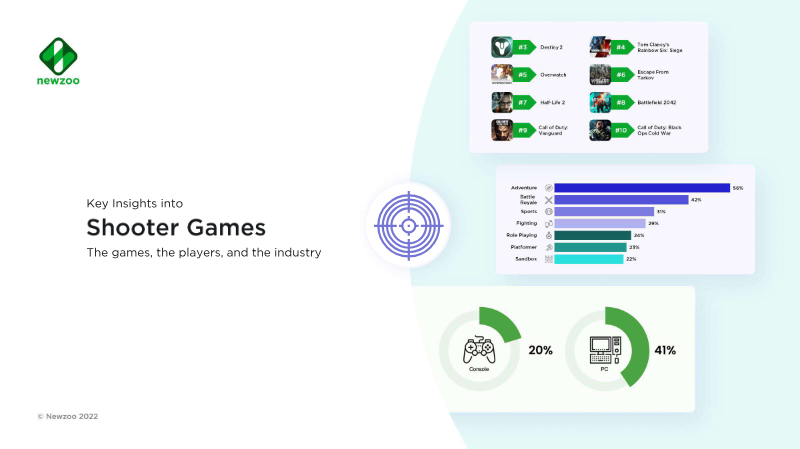
Shooter games represent the fifth highest-revenue generating genre globally as of 2022.
- Shooter games are the fifth highest-revenue generating genre globally, maintaining a massive footprint across PC, console, and mobile platforms as of 2022.
- Monetization is heavily driven by microtransactions, with 97% of players engaging in titles that feature in-app purchases.
- The player base is predominantly male (63%) and young, with 38% of players falling within the 10 to 20 age demographic.


Multiplayer Report 2022
The 2022 Multiplayer Report examines the evolving preferences, behaviors, and technical expectations of online gamers across major global markets.
- Multiplayer gaming engagement grew by 3.3% year-over-year, with 77% of the global gaming population now participating in online play.
- Unity internal data shows a 150% surge in PC multiplayer development and a 40% increase in mobile multiplayer projects since early 2021.
- Genre remains the primary driver for game selection at 49%, followed by social connectivity factors including existing friend groups (34%) and in-game chat capabilities (31%).
Consumer Insights: Games & Esports 2022
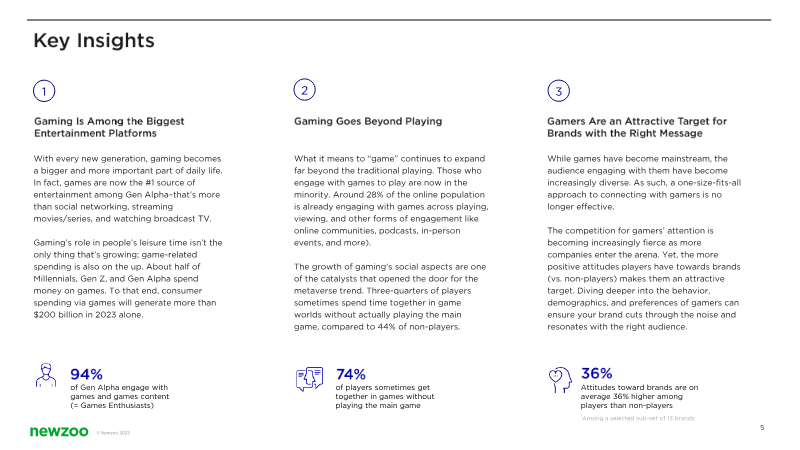
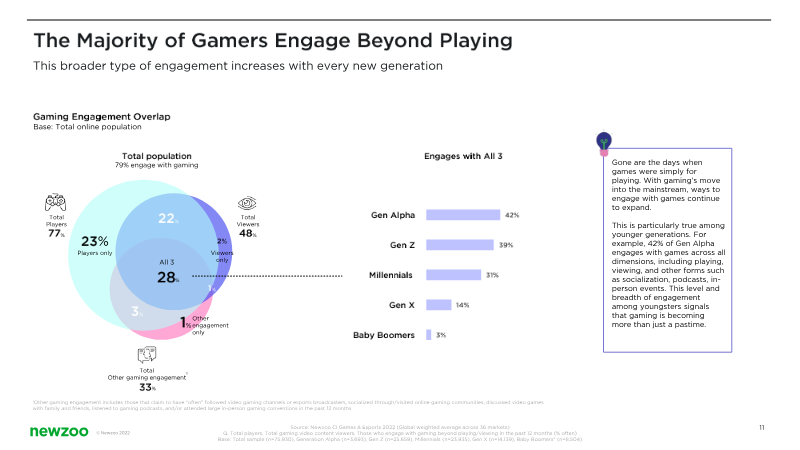
Gaming has evolved into a multi-dimensional entertainment ecosystem where traditional play is no longer the sole driver of engagement.
- Gaming has become a primary entertainment ecosystem for 79% of the global online population, with Gen Alpha prioritizing gaming over social media and streaming video.
- Consumer spending in the gaming sector is projected to exceed $200 billion in 2023, driven by a payer base that includes approximately 50% of Gen Alpha, Gen Z, and Millennial gamers.
- Game worlds are increasingly used for social interaction rather than gameplay, with 75% of players and 44% of non-players utilizing these environments for non-gaming social engagement.
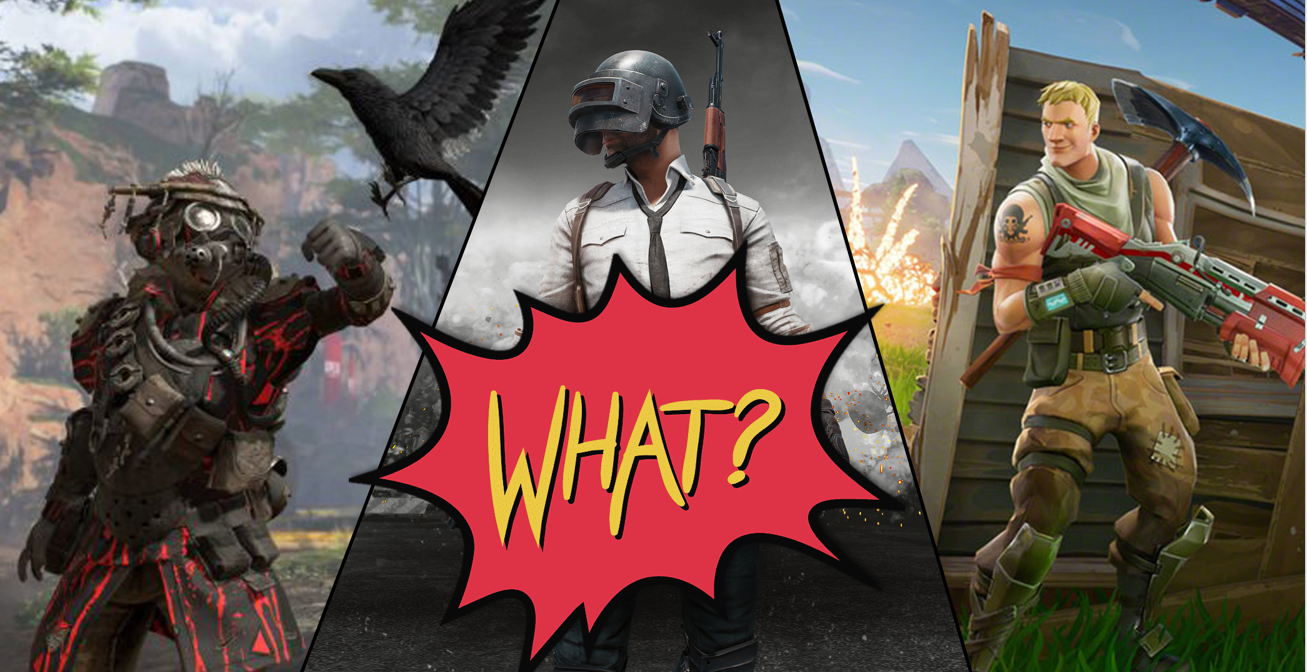
What Comes After Battle Royale and Why You Need to Know Vigor
The extraction shooter genre is positioned as the successor to the battle royale market, which has reached a saturation point.
- The extraction shooter genre is emerging as the successor to the saturated battle royale market by shifting toward more accessible, free-to-play models.
- Bohemia Interactive’s Vigor has reached 10 million registered players across Xbox, PlayStation, and Nintendo Switch since its 2018 launch.
- Vigor achieves mainstream appeal by stripping away complex survival mechanics like hunger and limb injuries in favor of a simplified, session-based loop.
Supply Chain Battle Royale: What Do You Mean It's on a Boat?
The global games industry is currently navigating a "shortage economy" characterized by severe supply chain disruptions and hardware component scarcities.
- Shipping times from China have tripled from 37 to 110 days, while container costs have increased tenfold, creating a critical bottleneck for physical hardware distribution.
- Global leisure equipment spending rose 26% year-over-year, yet hardware manufacturers cannot meet record demand for consoles like the PlayStation 5 and Xbox Series X/S due to the persistent global chip shortage.
- Market analysts have downgraded hardware-centric firms like Corsair, while companies with diversified digital revenue streams, such as Logitech, remain better insulated against supply chain volatility.
Amazon and Netflix Venture Further into Games: Battle Royale for the Streaming Giants
The convergence of streaming media and interactive entertainment is accelerating as major technology firms leverage established intellectual property to capture consumer attention.
- Amazon’s New World MMO reached over 700,000 concurrent players, marking a significant recovery after the failure of Crucible, which peaked at only 25,000 players.
- Netflix is pivoting from a video distributor to a provider of persistent online worlds by acquiring Night School Studio to focus on player-driven narratives based on its existing intellectual property.
- The gaming industry is facing increased regulatory and legal pressure, evidenced by Activision Blizzard’s $18 million workplace culture settlement and Roblox’s $200 million settlement with music publishers.
Garena Free Fire Overtakes PUBG Mobile as the Top Grossing Mobile Battle Royale Game: U.S.
Garena Free Fire emerged as the top-grossing mobile battle royale game in the United States during the first quarter of 2021, signaling a significant shift in the competitive landscape of the mobile shooter genre.
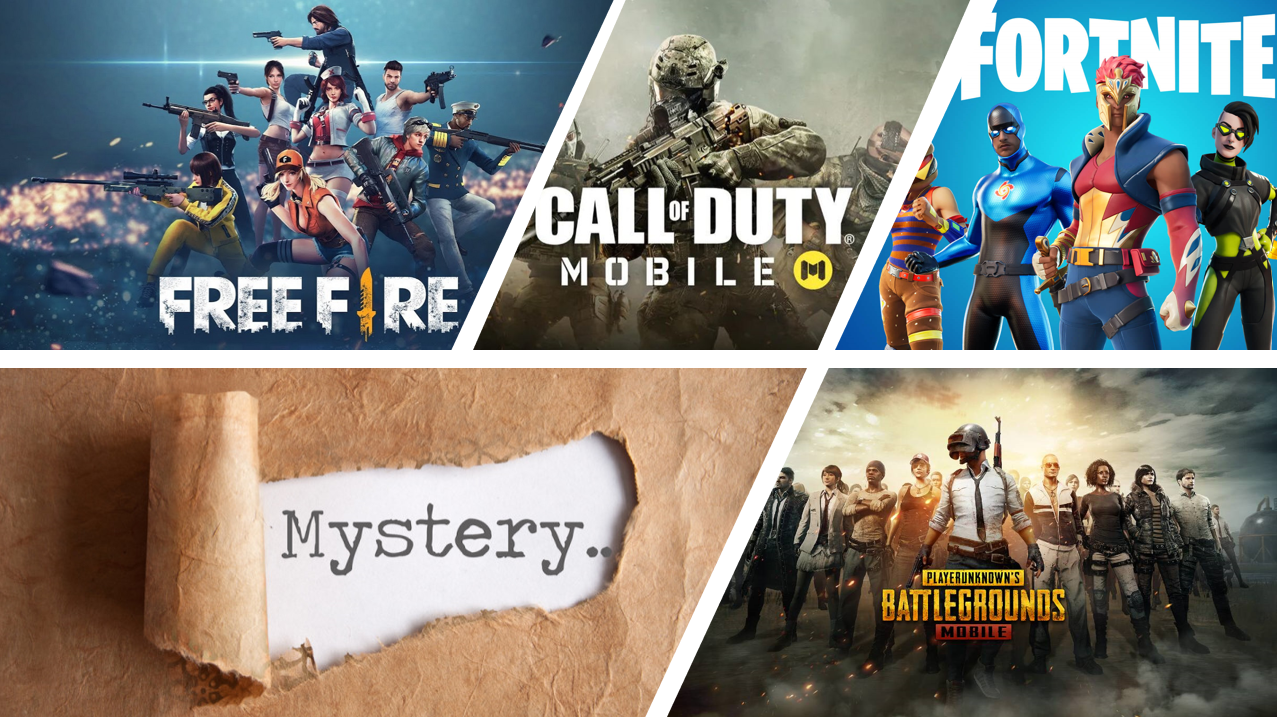
- Garena Free Fire became the top-grossing mobile Battle Royale game in the U.S. during Q1 2021, generating approximately $100 million in revenue, a 4.5x increase year-over-year.
- PUBG Mobile ranked second in U.S. player spending for Q1 2021 with $68 million, while Call of Duty: Mobile followed with $62 million, an 80% year-over-year increase.
- The U.S. mobile Battle Royale market grew 42% year-over-year to $239 million in Q1 2021, effectively absorbing the market void left by the removal of Fortnite from app stores in August 2020.
2021 Predictions: The Next Big Shooter
The mobile shooter market underwent a period of intense expansion throughout 2020, characterized by a 38 percent revenue increase and 2.7 billion total installs.
- The mobile shooter market is highly consolidated, with four dominant titles capturing 90 percent of all revenue despite a 38 percent revenue increase and 2.7 billion total installs in 2020.
- New market entrants face significant barriers to entry due to the sophisticated live operations and aggressive pricing strategies employed by established industry leaders.
- To succeed in a saturated market, developers must pivot toward niche opportunities and unique meta-game mechanics rather than competing directly with established powerhouses.
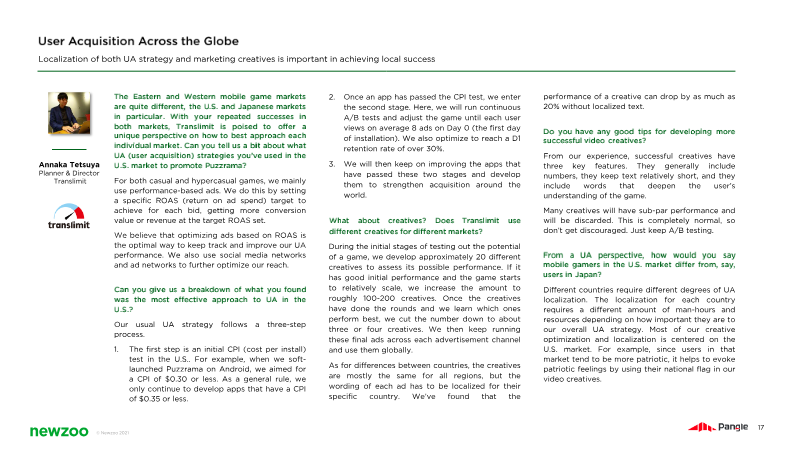
Mobile Game Genre Report: Comparing & Contrasting Eastern and Western Markets 2021
This report examines the mobile gaming landscape in 2021, focusing on the strategic differences between Eastern and Western markets regarding genre popularity, monetization, and user acquisition.
- Western markets prioritize casual genres like puzzle and arcade, while Eastern markets demonstrate a stronger preference for competitive, immersive titles such as Battle Royale and RPGs.
- Monetization strategies differ by region, with Western titles leaning toward in-game advertising (IAA) models, while Japanese players show a higher propensity for in-app purchases (IAP).
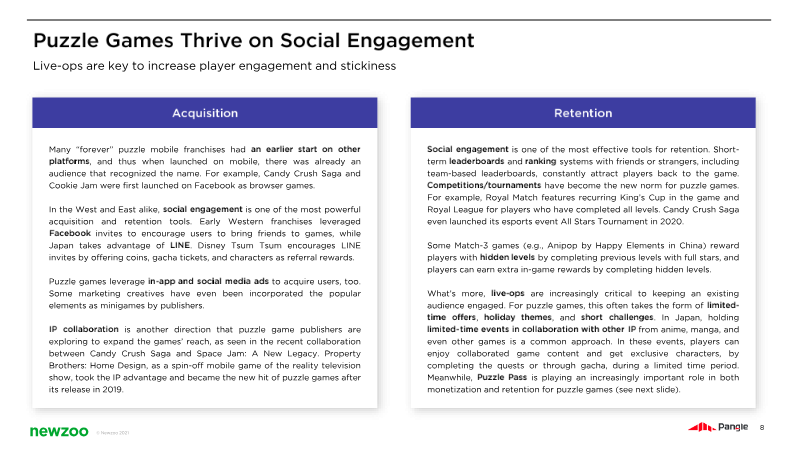
- Puzzle games are a global staple, but Western implementations focus on narrative and decoration, whereas Eastern versions prioritize character collection, deep economies, and gacha mechanics.
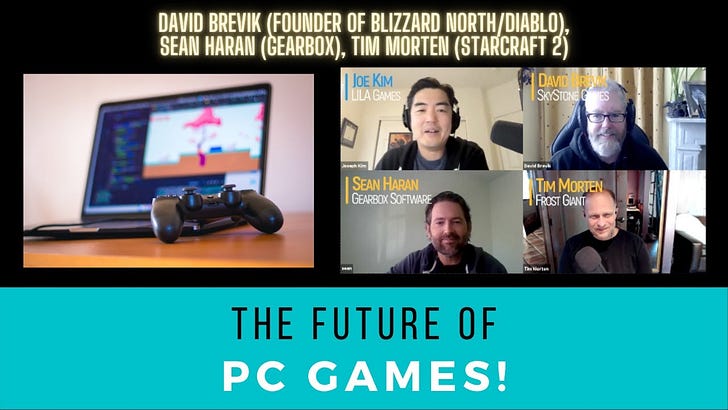
The Future of PC Gaming
The global PC gaming industry is currently undergoing a structural transformation characterized by hyper-competition and the widespread democratization of development tools.
- Cross-platform play, cross-progression, and unified experiences across devices are becoming industry table stakes to maximize player reach and engagement.
- User-generated content (UGC) is a primary driver of genre innovation, with major gaming trends like MOBAs, Battle Royales, and auto-battlers originating from modding communities.
- Mid-market publishers are increasingly essential for connecting global development teams with the resources needed to launch disruptive titles, as demonstrated by the successful multi-platform launches of games like Risk of Rain 2.
State of Mobile Battle Royale: Fortnite Leaves a $1.2 Billion Hole in the Market
The removal of Fortnite from the Apple App Store and Google Play on August 13, 2020, created a significant disruption in the mobile battle royale landscape, effectively removing a title that had generated $1.2 billion in lifetime player spending.
- Fortnite generated $1.2 billion in lifetime revenue on mobile before its removal from the App Store and Google Play on August 13, 2020.
- The vast majority of Fortnite's mobile revenue came from the App Store, which accounted for over $1.2 billion in spending compared to $9.7 million on Google Play.
- PUBG Mobile is the global leader in the mobile battle royale genre, having generated approximately $3.5 billion in player spending as of August 13, 2020.