1 free read left. Create a free account for unlimited reading + AI research.
Create free accountReport GAMEHEARTS
1 free read left. Create a free account for unlimited reading + AI research.
Create free accountReportGAMEHEARTS
The report examines how video games foster empathy through a bottom-up, qualitative approach. The wider literature remains divided on this question.
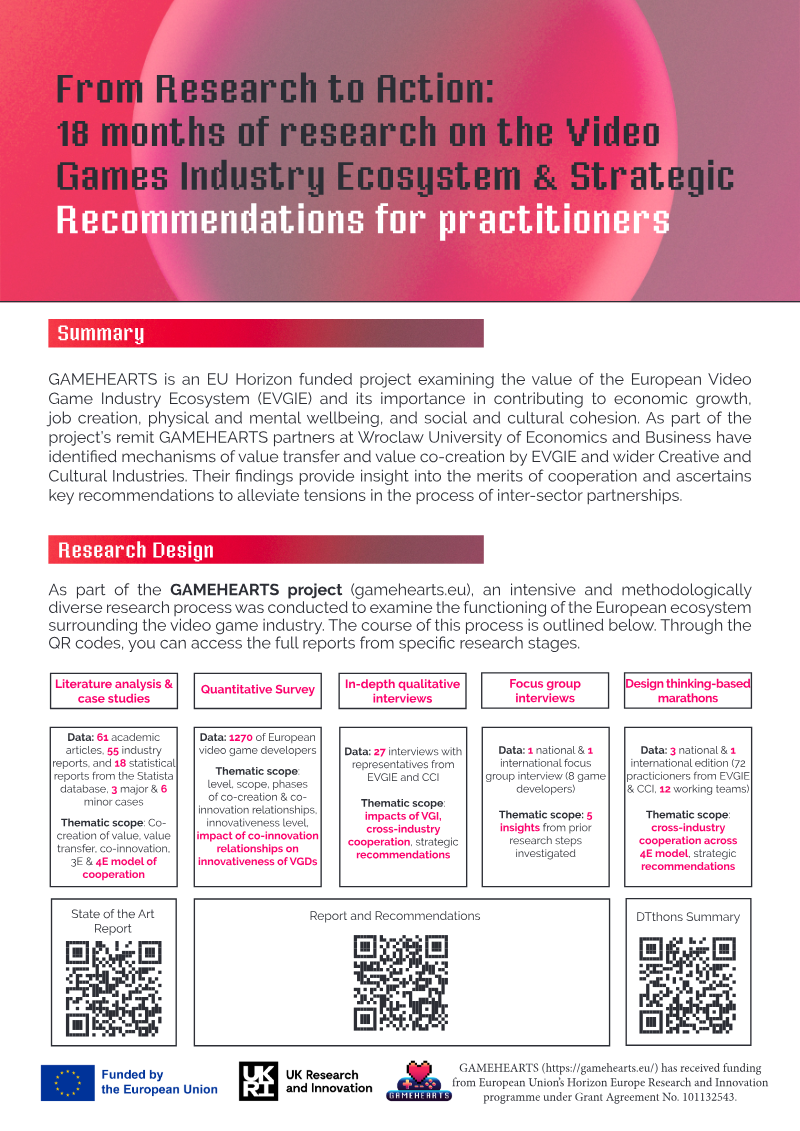
A two-year University of Salford study, part of the Horizon Europe-funded GAMEHEARTS project, examines how video games foster empathy through a bottom-up, qualitative approach combining surveys (a pilot of 20 and a main sample of 91), roughly 16 follow-up interviews, and case studies of titles including Disco Elysium, the Assassin's Creed series, and 80 Days. The central thesis is that empathy in games is a contextual, relational, and reflective process shaped by personal identification and moral engagement rather than by specific mechanics or genres. The authors also argue that games actively define what empathy means, and that the wider literature remains divided on whether games reliably cultivate it, with critics questioning whether so-called "empathy games" evoke pity or sympathy and serve marketing interests more than social change.
Empirical findings converge on several points. Players most often experience empathy through morally charged, choice-driven narratives such as The Last of Us, Life Is Strange, and Mass Effect, and frequently use these experiences for self-reflection on their own values and identity. A content analysis of 94 titles spanning 1990 to 2025 found no shared mechanical, narrative, or stylistic thread, and even games designed to foster connection, such as Gone Home, did not guarantee empathic engagement for every player. Identification was driven by life context and disposition rather than shared demographics. Case studies highlight how Disco Elysium mechanizes empathy as a skill, with 895 passive checks reported by fan data miners, and how the Assassin's Creed Animus can produce a "bleeding effect" with real-world consequences.
Overall, the report concludes that games are productive spaces for imaginative exploration of others and for moral self-examination, but that empathy has clear limits. In 80 Days, systemic issues such as colonialism cannot be resolved through individual empathic action, leading the authors to conclude that empathy can engage and invest players yet remains insufficient for confronting entrenched structural injustice. Much of the analysis is interpretive, relying on survey and interview responses rather than large-scale quantitative data.
GAMEHEARTS · 2026
DiGRA · 2026