1 free read left. Create a free account for unlimited reading + AI research.
Create free accountWhitepaper DiGRA
1 free read left. Create a free account for unlimited reading + AI research.
Create free accountWhitepaperDiGRA
The study tracked 4,922 children and young people aged 11 to 18 in Helsinki over this period.
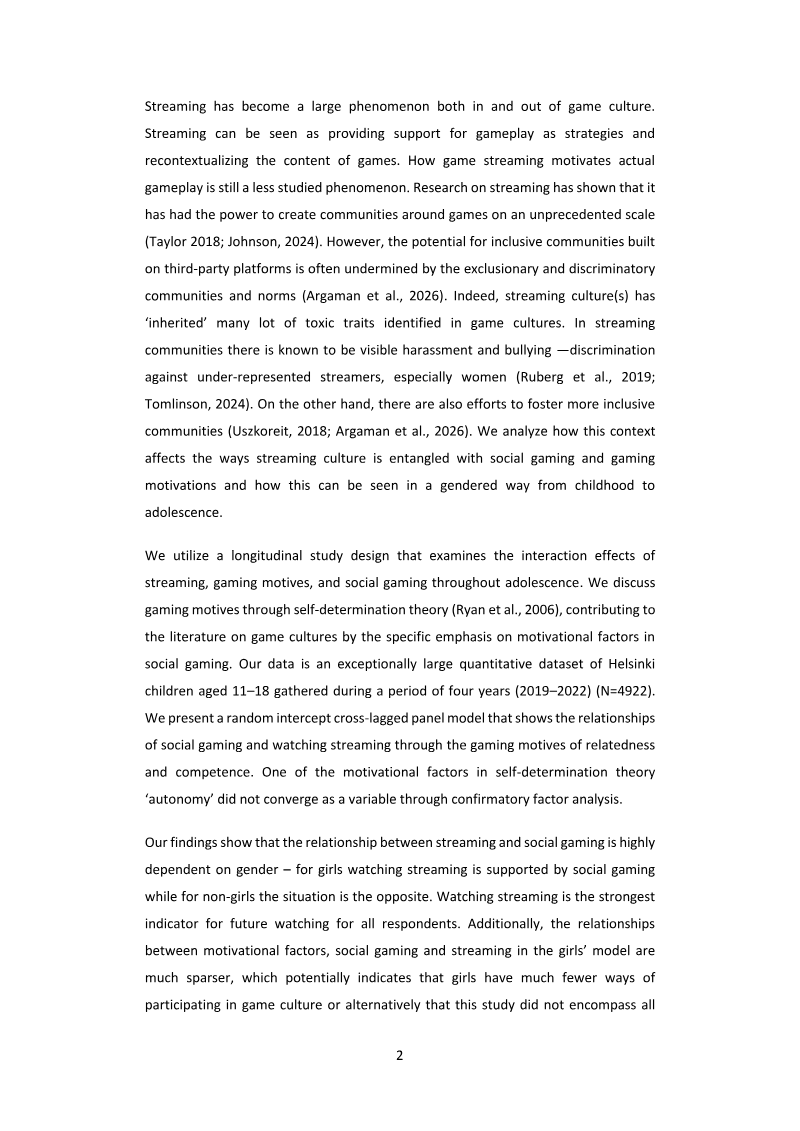
This study examines how game streaming relates to social gaming and gaming motivations among Finnish children and adolescents, with a particular focus on gendered differences across adolescence. Its central claim is that the connection between streaming and social gaming depends heavily on gender: for girls, watching streams is associated with social gaming, whereas for other respondents the relationship runs in the opposite direction. The authors situate this within a broader concern that girls begin disengaging from gaming during adolescence, particularly from social forms of play, and that game cultures, including streaming communities, have historically been marked by harassment and exclusion.
The analysis draws on a longitudinal dataset of 4,922 children and young people aged 11 to 18 in Helsinki, collected between 2019 and 2022. Using a random intercept cross-lagged panel model, the authors trace relationships among social gaming, streaming, and the motivational factors of relatedness and competence, grounded in self-determination theory. The autonomy factor failed to converge in confirmatory factor analysis and was therefore excluded. Watching streams emerged as the strongest predictor of future watching for all respondents.
The girls' model showed considerably fewer significant relationships among motivational factors, social gaming, and streaming than the model for other respondents. The authors suggest this may reflect limited avenues for girls' participation in game culture, or that the study's measures failed to capture forms of community that matter to girls. Interactions among variables also diminished toward the end of the data collection period, which the authors interpret as a sign that gaming habits become more established in later adolescence, alongside increasingly enforced gender norms.
The authors note that toxicity in gaming communities provides an important backdrop to these patterns, and that the absence of a comparable drop-off among non-binary respondents suggests that factors specific to girlhood contribute to the findings. Taken together, the study positions streaming as a potentially significant but unevenly accessible site of game-cultural participation for young people.

DiGRA · 2026

DiGRA · 2026



DiGRA · 2026



DiGRA · 2026



DiGRA · 2026



DiGRA · 2026



DiGRA · 2026



DiGRA · 2026

DiGRA · 2026



DiGRA · 2026



DiGRA · 2026

DiGRA · 2026
DiGRA · 2026