1 free read left. Create a free account for unlimited reading + AI research.
Create free accountWhitepaper DiGRA
1 free read left. Create a free account for unlimited reading + AI research.
Create free accountWhitepaperDiGRA
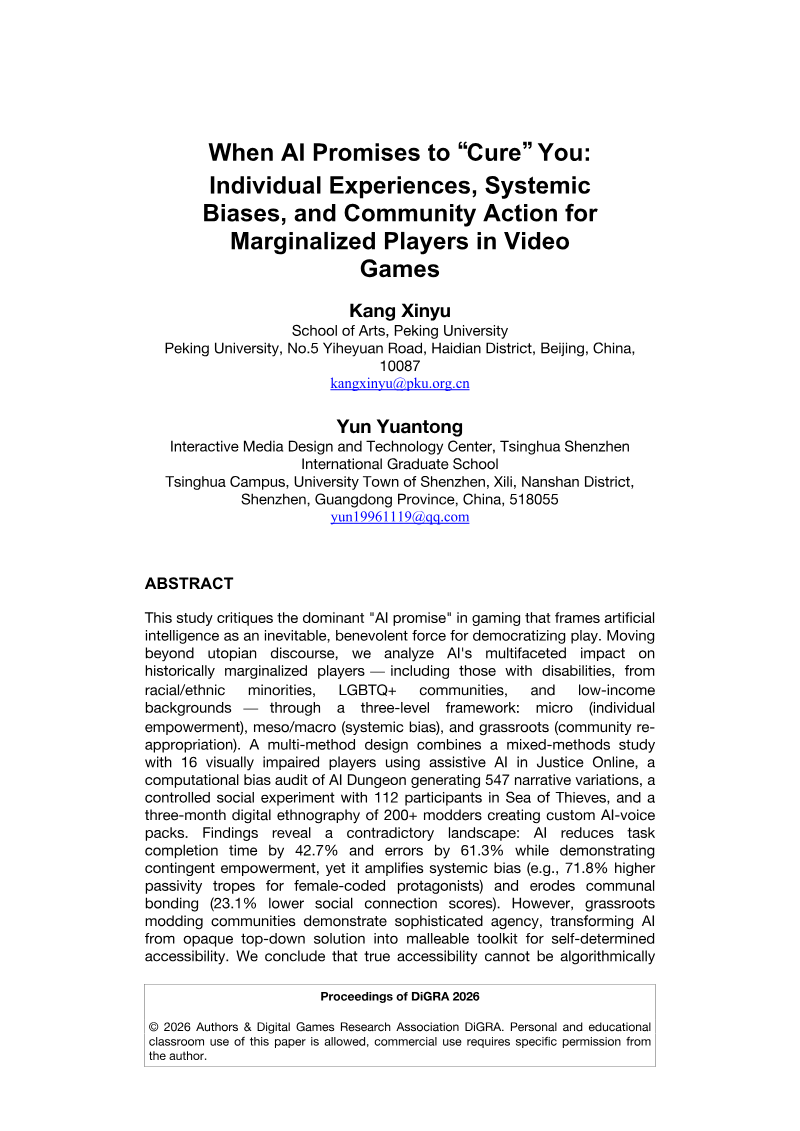
The authors argue prior work has focused on serious health-oriented games rather than casual, community-centered play among older adults.
This study examines how intergenerational play shapes gaming capital and gamer identity among older adult players, positioning these dynamics as a gap in research that has focused largely on serious health-oriented games rather than casual, community-centered play. Its authors argue that gaming spaces have historically marginalized older adults, along with women, people of color, and players of diverse sexualities, and that inclusive play may improve social connection and wellbeing. Drawing on Consalvo's concept of gaming capital and Social Identity Theory, the paper frames two research questions: how intergenerational play influences the gaming capital of older adults, and what role it plays in their gamer identity formation.
The empirical basis combines existing interview data from 16 participants (mean age 32, 62.5% male) with a planned open-ended online survey of 250 adults aged 65 and older across the United States, recruited through Prolific and with prior gaming experience treated as a potential confounder. Preliminary interview findings indicate that intergenerational play often introduces younger and older family members to gaming and establishes habits, and that when play is framed as bonding rather than distraction, participants recall it fondly. However, such play tends to become sporadic after the initial learning phase, which the authors attribute to growing skill gaps and shifting family dynamics. The interview analysis used flexible coding, and survey analysis is pending data collection.
The authors anticipate that the study will deepen understanding of the barriers older adults face in gaming and suggest practical implications for designers and scholars seeking more inclusive environments. They also note that older adults represent a large share of first-time players, so improving equitable access could yield social and commercial benefits for the gaming industry.

DiGRA · 2026

DiGRA · 2026



DiGRA · 2026



DiGRA · 2026



DiGRA · 2026



DiGRA · 2026



DiGRA · 2026



DiGRA · 2026

DiGRA · 2026



DiGRA · 2026



DiGRA · 2026

DiGRA · 2026
DiGRA · 2026