1 free read left. Create a free account for unlimited reading + AI research.
Create free accountWhitepaper DiGRA
1 free read left. Create a free account for unlimited reading + AI research.
Create free accountWhitepaperDiGRA
The authors conducted 32 semi-structured interviews of roughly two hours each in summer 2024. Participants were recruited through social media.
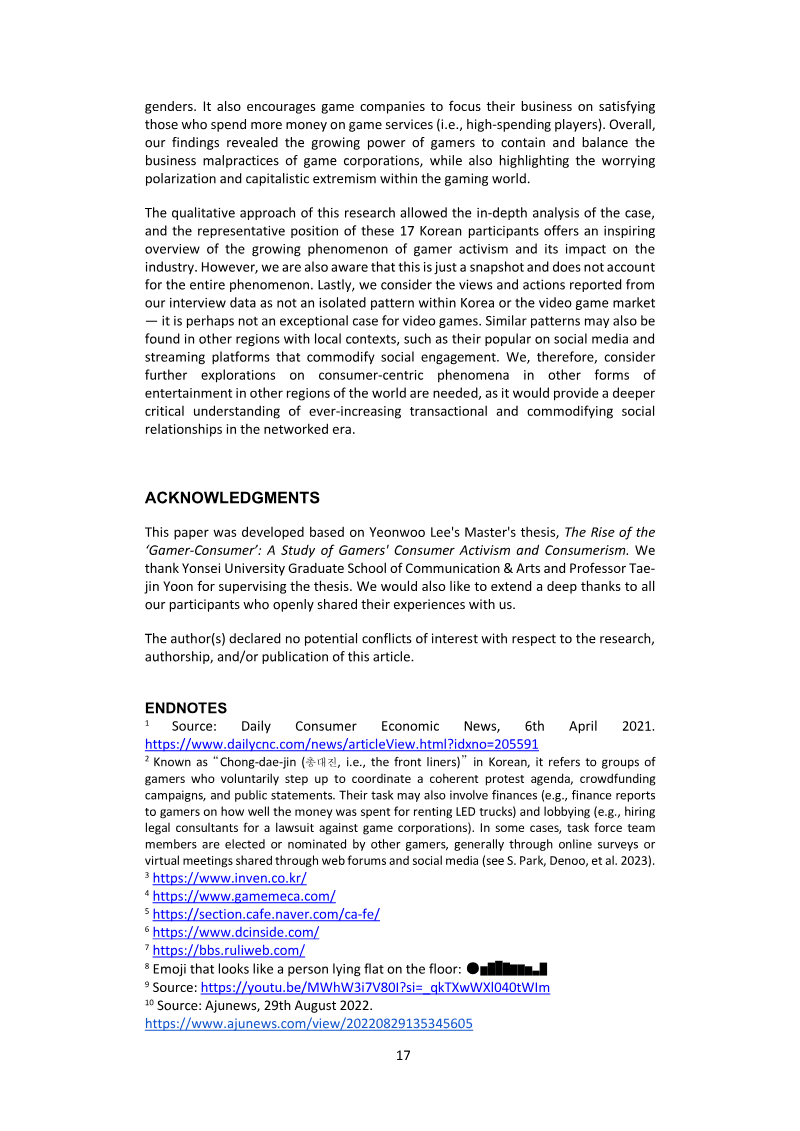
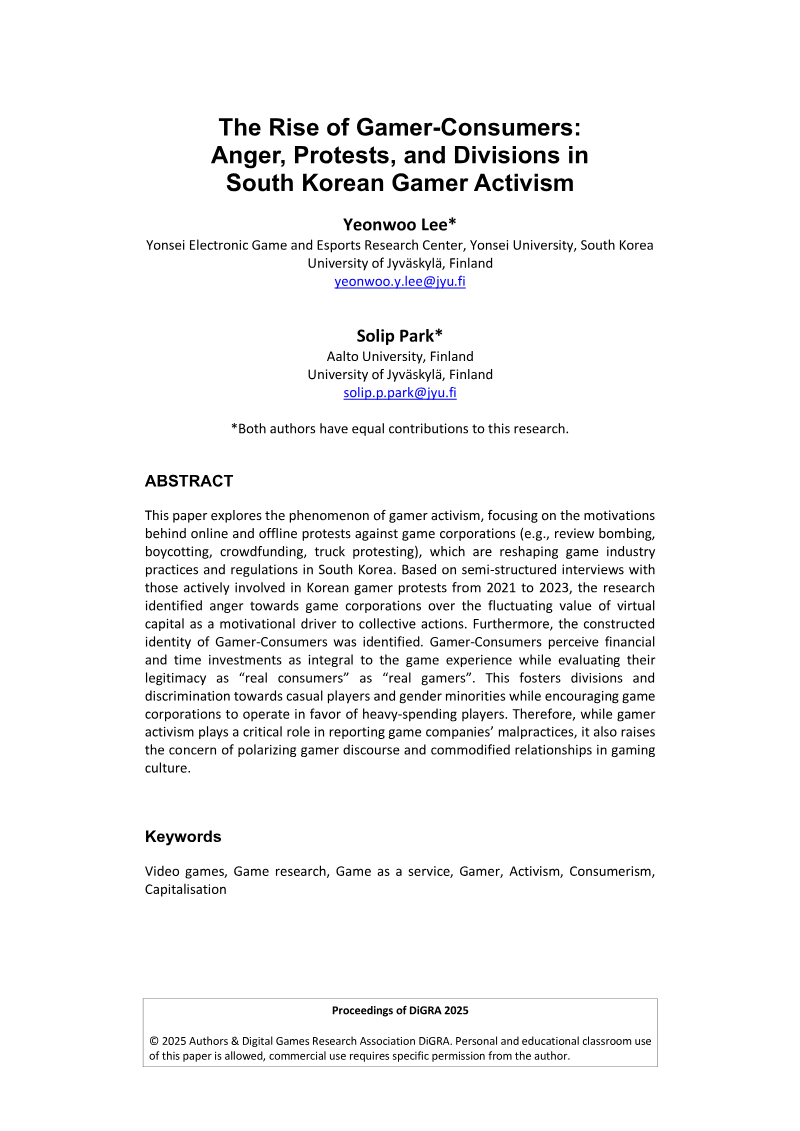
This study examines how a committed group of South Korean gamers, labeled "Real gamers," understand their identity in the post-pandemic period. Drawing on 32 semi-structured interviews of roughly two hours each, conducted in summer 2024 with participants recruited through social media, the authors argue that the older concept of the hardcore gamer has become too narrow to describe contemporary gaming culture. The "Real gamer" is offered as a heuristic category for players who strongly identify with an authentic gamer self, marked by heavy temporal, financial, and emotional investment, active community participation, and a sense of gamer authenticity. The research is situated within game studies and addresses wider questions of authenticity, cultural legitimacy, and identity in digital culture.
The findings point to a combination of defensive pride and ambivalent recognition. Participants took pride in their expertise and dedication while describing themselves as misunderstood minorities, shaped by memories of anti-game addiction discourse, the shutdown policy, and negative media portrayals. Their desire for social legitimacy coexisted with exclusionary attitudes toward newcomers such as women and older adults, whom they often regarded as insufficiently authentic. This minority consciousness is also tied to a consumer identity, as participants saw themselves as valuable customers yet recognized that high-spending "whale" consumers wield greater influence, leaving them in a contradictory position within platform capitalism.
The study further finds that online communities remain central to reproducing this identity, with vocal minorities shaping discourse while ordinary players withdrew to smaller platforms such as Discord, which paradoxically amplified the visibility of aggressive voices. Some Real gamers also acted collectively, through petitions, coordinated campaigns, and "truck protests" directed at game companies and public institutions. The authors conclude that the Real gamer identity reflects both decline and reinvention: as gaming becomes more democratized, the symbolic centrality of hardcore gamers weakens, yet this displacement intensifies struggles over inclusion, recognition, and cultural capital.

DiGRA · 2026

DiGRA · 2026



DiGRA · 2026



DiGRA · 2026



DiGRA · 2026



DiGRA · 2026



DiGRA · 2026



DiGRA · 2026

DiGRA · 2026



DiGRA · 2026



DiGRA · 2026

DiGRA · 2026
DiGRA · 2018