windows
Company
Documents about windows

Is the profit multiplier in gaming getting smaller? | Gonçalo Martins from Boombit
The mobile gaming industry is currently navigating a shift toward more conservative financial expectations, characterized by a contraction in the profit multiplier.
- The mobile gaming industry has shifted away from long-term break-even windows of two to three years, now requiring projects to demonstrate immediate cash-in potential and shorter return-on-investment cycles.
- Publishers are increasingly diversifying revenue by offering internal infrastructure as a service, providing third-party developers access to proprietary tools for business intelligence, predictive lifetime value modeling, and playable ad creation.
- Privacy-driven data restrictions have reduced ad targeting and CPMs, but this has inadvertently increased user loyalty by reducing the frequency of hyper-targeted competitor advertisements.

Breaking Silos & Boosting Growth: Metica’s AI-Driven Edge
Metica provides an AI-driven platform designed to accelerate mobile game growth by integrating user acquisition (UA) and in-game monetization into a unified, data-centric ecosystem.
- Studios implementing Metica’s integrated growth loops, which unify user acquisition and in-game monetization, have reported revenue uplifts ranging from 16% to over 40%.
- The platform utilizes contextual multi-armed bandits to test multiple game variants simultaneously, significantly accelerating production cycles compared to traditional A/B testing methods.
- By predicting individual player lifetime value (LTV) and feeding that data back into ad networks, the system improves targeting precision and assists financial teams in creating more accurate long-term forecasts.
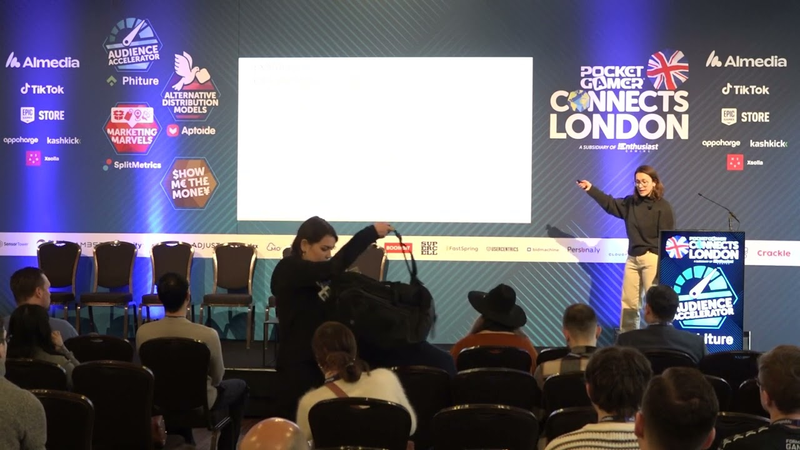
Session: Podcast Marketing – Insights & Strategies For Success - Sara Guerola, Media Bodies.
Podcast marketing has emerged as a vital, high-growth channel for user acquisition within the gaming industry, serving as a strategic bridge between traditional performance marketing and long-form engagement platforms.
- Podcast ad spend in the gaming industry is growing rapidly, with investment increasing 3.6 times quarter-over-quarter and overall market spend rising at an average annual rate of 22%.
- Gen Z listeners show high conversion potential, with 61% expressing interest in products after hearing an ad and 44% actively using promotional codes.
- Attribution for podcast campaigns is primarily probabilistic, requiring the integration of promo codes, unique URLs, and 30-day attribution windows to account for the medium's extended shelf life.
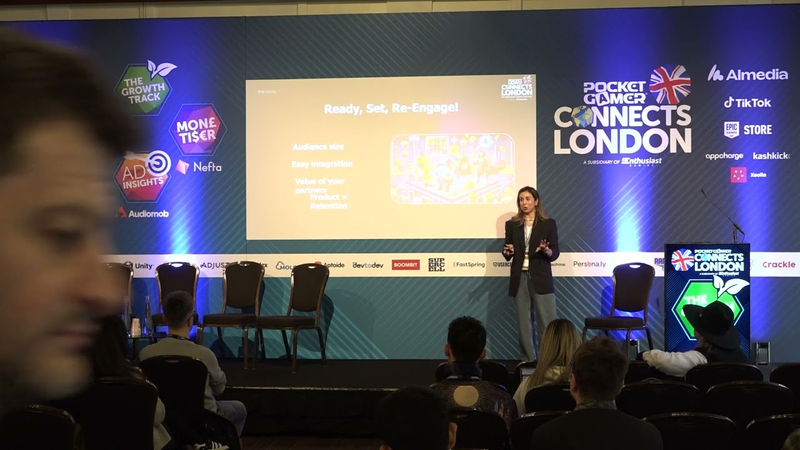
Session: Why Focusing Only On New Users Is Holding Back Your Mobile Game – Vera Manhoso, RTB
Mobile game developers often prioritize user acquisition (UA) at the expense of retargeting, a strategy that limits long-term growth and profitability.
- Only 1.83% of mobile game users typically make in-app purchases, making the retention of these high-value players through retargeting essential for long-term profitability.
- Retargeting is more cost-effective than user acquisition (UA) because it leverages existing data on player value, whereas UA requires spending to identify the value of new, unknown users.
- Retargeting campaigns can be initiated with an audience as small as 2,000 to 3,000 high-value players, and they do not need to run year-round to be effective.

The Secret Sauce of French Game Publishers with Vincent Février, CMO of TapNation
TapNation has successfully navigated the transition from a hyper-casual publisher to a hybrid-casual studio by maintaining a lean, tech-centric operational model.
- TapNation has successfully scaled to $55–$60 million in annual revenue with a lean team of approximately 80 employees by transitioning from hyper-casual to a hybrid-casual business model.
- The company has shifted its financial strategy from 30-day break-even cycles to 6-to-12-month payback windows to prioritize long-term retention and in-app purchase revenue.
- Growth is driven by a tech-centric operational model that utilizes proprietary user acquisition automation, AI-integrated management, and sophisticated lifetime value prediction models.

2.5 gamers x Live AM(F)A #7 - Ask Me Anything @ December 19 5:30pm CET
The mobile gaming industry is currently undergoing a structural shift, moving away from traditional store-dependent growth toward web-based platforms and Telegram mini-apps.
- The casual merge game market is currently dominated by Microfun and Moon Active, who have successfully scaled by maintaining high production quality and utilizing intrusive ad strategies that prioritize long-term retention over short-term revenue.
- For soft launches, the United States remains the primary testing ground; if a game fails to perform in the U.S. market, it is unlikely to succeed elsewhere.
- Consent Management Platform (CMP) implementation is critical for compliance, with paid solutions typically achieving 93–95% opt-in rates compared to 80–87% for free Google-based alternatives.

How to Launch an Online Game and Still Attend the Launch Party
Launching a cross-platform online game with a lean engineering team requires a fundamental shift away from traditional, manual server management toward managed infrastructure and high-level observability.
- Odyssey Interactive successfully launched Omega Strikers on 8 platforms with a services team of only 2–3 engineers by relying on robust observability to maintain system stability.
- The team utilized a 'single environment' strategy where all development features and upcoming content were always in production, managed through logical barriers and feature flags to simplify the deployment process.
- Observability was implemented using OpenTelemetry standards, resulting in approximately 1,200 instrumentation points that allowed engineers to proactively inspect system states in real-time.

Week in Mobile Games E39 - Mobile's hot new releases and the loot box investigation unpacked
The mobile gaming industry is currently undergoing a structural transformation defined by the rise of high-fidelity, cross-platform titles that bridge the gap between mobile and console experiences.
- Nexon’s 'Dungeon and Fighter Mobile' generated over $1 billion in iOS revenue in China within six months, highlighting the massive financial potential of successful mobile titles.
- The mobile industry is shifting toward high-fidelity, cross-platform experiences like 'Infinity Nikki' and 'Delta Force' that emphasize cross-progression to bridge the gap between mobile and console.
- Investors are increasingly prioritizing daily active user counts over traditional retention metrics, seeking shorter return on investment windows of two to three years.

Week in Mobile Games E37: Pokémon Trading Card Game Pocket's blockbuster launch & Royal Kingdom hype
The mobile gaming industry is currently navigating a period of significant volatility, characterized by a shift away from traditional performance-based user acquisition toward brand-centric development and long-term intellectual property cultivation.
- Pokémon Trading Card Game Pocket generated over $120 million in its first three weeks, demonstrating the high market potential of leveraging nostalgia and simplified mechanics.
- The mobile gaming market is experiencing high volatility, with top-tier titles often suffering revenue declines exceeding 50% from their peak launch performance.
- Warcraft Rumble has seen a 92% decline in monthly earnings, highlighting the difficulty of maintaining long-term player engagement for major franchises.

Value Optimization, Hybridcasual, and the Impact of AI
The mobile gaming industry is undergoing a fundamental transition from a volume-based user acquisition model to a sophisticated, data-driven framework centered on long-term value optimization.
- The mobile gaming industry is shifting from volume-based user acquisition to long-term value optimization due to rising acquisition costs and increased market competition.
- Developers are transitioning from hyper-casual titles to hybrid models that combine in-app purchases and advertising to capture revenue from diverse player segments.
- Success in modern mobile ecosystems requires using custom events as proxies for long-term retention to navigate auction-based environments and extend optimization windows.
How He Made $3,000,000 From His Indie Game — Full Time Game Dev Podcast Ep. 020
The indie game industry offers significant financial potential for developers who prioritize unique creative visions and sustainable production models.
- Early Access is a viable strategy for long-term development, as evidenced by Lens Island growing to ten times its initial scope during a three-year Early Access period.
- Steam treats an Early Access launch and a 1.0 full release as two distinct opportunities for store visibility, providing developers with two separate chances to gain traction and exposure.
- The conversion rate of wishlists decreases over time, meaning a large pool of wishlists accumulated over several years may be less effective than a smaller, more recent pool generated during a Steam Next Fest.
WeChat Mini-Games: Exploring the World of Mini-Games with Lemon!
The Chinese mini-game market has emerged as a high-growth sector, characterized by a 48% increase in market size during 2023 and a projected reach of 400 million monthly active users by 2024.
- The Chinese mini-game market grew by 48% in 2023 and is projected to reach 400 million monthly active users by 2024.
- Successful mini-games are now complex, fully featured experiences developed by lean teams of 5 to 30 people within accelerated two-to-three-month production cycles.
- Loot Box RPGs dominate the market, accounting for approximately one-third of total revenue through addictive progression loops and meta-systems.