VideoDeconstructor of Fun
The Secret Sauce of French Game Publishers with Vincent Février, CMO of TapNation
7 Jan 202566 min video
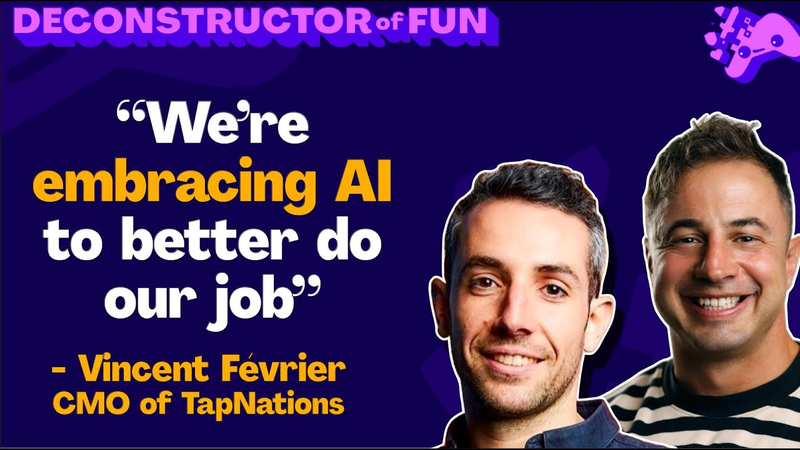
Hey folks, and welcome to the Deconstructor of Fun podcast. I'm your host, Misha Katkoff, and in this episode I'm joined by CMO of TapNation, Vincent Vervier. In this episode, we are going to talk about hyper-casual games, as always. But no, this is a different twist. Uh we're going to talk about the French hyper-casual hyper-casual publishers. There's many of them, and it's interesting to understand what their secret sauce is and what makes them all different. We're going to talk, naturally, a lot about TapNation, and what's interesting about this is not only how TapNation has evolved from a hyper-casual to a hyper-casual to a hyper pretty much a casual publisher soon, but it's also the insights in what it takes from for a studio that is growing from um a startup to a mid-size studio. We're going to talk about the the the type of a new people they've hired, uh the processes that they've instituted, the tech and tool stack, both external and internal tools that they have developed and acquired. We're going to talk about how their product focus has shifted as
they have grown and moved from hyper-casual to hybrid-casual. We talk about the development or the the establishment of their in-house studio because they're they used to be focused only on publishing. And we're going to finish up by talking about M&A and the the deal structures, the competences, and how you win with essentially personality. So, overall, an interesting conversation if you're interested in hyper-casual games, as well as interesting conversation if you are interested in what it takes to grow from a small studio or a small publisher to a mid-size publisher. It's not only the games, there's a lot of operational changes, there's a lot of elements that that will shift and and evolve as you move forward and grow. So, uh thanks so much for Vincent. Thank you for tuning in. If I may ask one thing, that would be, naturally, if you could like, share, subscribe to this podcast, and that helps the channel to grow and through
that we can bring more awesome guests like Vincent Vahe. So, without further ado, ladies and gentlemen, App Nation. Hey game makers, we got something super cool to share with y'all. Last year, hybrid casual games proved they're more than just a trend. They are a game-changing force in the industry. That's why Deconstructor of Fun teamed up with none other than Meta to crack the code on hybrid casual success. Our new and free hybrid casual playbook dives into what's driving this explosive growth, the KPIs you should aim for, cornerstones of hybrid casual design, how to structure your development process, maximizing in-app ad and in-app purchase revenues, and growing your hybrid casual game. Now, whether you're a veteran or just getting started, this playbook is your ultimate guide to understanding the market, perfecting the business model, and unlocking success.
Download it now by following the link in the description below and level up your hybrid casual game today. Attention marketers, are you ready for an event that will supercharge your strategies and leave you talking it for months to come? On January 28th in San Francisco, App Flyers' MAMA takes center stage as the must-attend event for marketers tackling the industry's toughest challenges. From privacy restrictions and signal loss issues to measuring omnichannel ROI and boosting LTV for high-value users, you'll gain actionable insights from the brightest minds in marketing. But, MAMA isn't just about learning. It's about connecting, sharing, and experiencing. It's an event people rave about for months before and after, and for good reasons. Side note, I've attended one of these events, it's god damn amazing. Anyways, spaces are filling fast, so don't miss your chances to be part of this unforgettable day in January on
28th. Register now at appslar.com /mama m a m a. That's appslar.com /m a m a. Vincent Favier, CMO of TapNation. Yeah, hello and welcome to the podcast. Thank you very much. Super excited and and pumped to be here participating with you, I mean on this very famous podcast. So, I'm I'm saying hi to everyone from the rainy and cold Paris today. Okay, let's start with the most important question. How come there are so many hyper-casual and hybrid-casual publishers in Paris in not Paris, but in France overall? Like, what's the deal with that? I think it's it's a fair question, you know, there's been few market that have been quite present, but good developer in France and some early one opened the way back then. We all remember Ketchapp.
Yes, yes. Voodoo here. Yeah. So, I think France has had a good talent in terms of developers and and support and I think Ketchapp definitely showed the way that with simple Unity games you can you can open up and and raise good studio and I think Alexia and his team from Voodoo have also like started paving the way and showing a good example. So, talent mix of talented people and and a first comer industry was a was a good way to to see good gathering. Obviously, you've got the historical like Ubisoft and Gameloft that also initiated that historically there's been a good gaming DNA from France. So, all that together create some emulation of of new studio like TapNation back in late 2019 in launched back then. I would say like yes, but it's a little bit different. Like, you know, yes, Ubisoft, Gameloft, like you have traditional game developers, but what makes hyper casual and now hybrid casual, however you want to put it,
different is that you come in with business model first, which is clearly what not not all the rivals are doing. Like you're very business focused. And so it's it's interesting that that there's the rise of these not traditional game developers, but almost like ad tech companies that are also do gaming content. Would that be a more accurate way of maybe describing it? It's true. It's true that hyper casual originally is nearly 50% or even more of pure ad tech. You know, it's good UI, good ad monetization, uh and then it's a bit of prototyping games. Uh but uh it's equally or even of as more important on the ad tech side. And we have good I would say good tech and good ad tech person as well. Good developer, good schools as well in term of uh of development and and and and tech university, so that helped as well uh a lot. And you know, if you could if you put one $1 in the machine and gives you back $1.50,
uh I think that's an easy way where we could find a lot of innovation and quickly implementing and developing such such opportunity for hyper casual. Yeah. And hyper casual. Fantastic. And do you consider like just last question, so like one thing that that came through when I was visiting Voodoo is like they're very keen on describing themselves as a tech company versus a game company. Are you also a tech company or are you a game company? What is TapNation? So, I I'm sticking with the first one. I mean, what is TapNation first of all? Uh It's a bit of a ad ad let's say ad player, outstanding player that came a bit late in the market. And our DNA, our values as basically piracy. All a small pirate team can achieve big. So, you have to be a tech company. So, basically with a small team like how do we start to to develop I mean not in-house but with external studio and publish some first prototypes, some
first games. But how do we get the tech around it to make sure that at scale we get the UA right and the monetization right, you know. So, we really started as a tech and a publisher hybrid casual publisher and now we're pivoting towards more of a studio as a global game maker. But that takes time, you know. Our DNA is really like do with what you can with very little and grow fast. So, yeah. Perhaps the right word in French would be routiers. Yes. Routiers, whatever you you want to call it. As as we could do with very little. So, that's been that's been a bit the DNA from the beginning. So, pretty close to what we do I would say in essence. So, so talk to me a little bit cuz we met up So, we met up in Abu Dhabi and you had a we were at Google Move conference and you had a really really interesting presentation about Tap Nation. Especially just showing the the amazing growth that the company has been experiencing as it has transitioned late transitioning from hyper casual to
hybrid casual and and seeing this despite being sort of a late to the market seeing pretty amazing results. So, can you a little bit talk about kind of give the context of of what has happened since you kind of you know kind of ran into the wall in hyper hyper casual and then moved to hybrid casual in terms of numbers and in the company. Sure. Sure. So, company launched in late 2019 from Erwan Montaux uh the CEO and co-founder and with Igor our CTO. Um Erwan has a background into different tech business. He had sold a small French ad network back then, but also like invest in multiple type of tech business and back in 2019 on with Igor and a couple of our team members like Anwar our former head of marketing as well to get together and and become a new hyper casual. You know, I mentioned Ketchapp actually the IDs came from the Marcos Ketchapp brother who were close with him and told him like I think
there's a good opportunity still to fit and and and find opportunity into hyper casual game. That's why we decided by raising a few hundred thousand dollars with a couple of angel investors on the French market to launch a TapNation and as soon as 2020 January they got the first game, you know, so after like three four months into the business ice cream became a worldwide hit of first hyper casual hit. And then continuing working with external studios they got on board like Giant Rush, Guess the Answer and pretty quickly the company went from like close to a million dollar in the first six months of launch 2019 to 12 million dollar in 2020 tripling to 39 million dollar in 2021 and following year we're doing close to 50 million dollar in revenue, you know, so it's been pretty times three growth over the first two three years and now we're keeping at least like 20% growth year over year, so
last year we did about 50 million dollar in revenue this we're going to be between 55 and 60 million dollar revenue and interestingly as staying lean a small team when I joined in May June 2021 we're only 20 people. Now we're still only 80 people, you know, we want to remain a very very lean and operational team, so company has been profitable since year one since 2020, so there is there is a bit of that is profitability without raising much of funding. We did raise last year in September $15 million mostly through that and the goal was here to sustain the acquisition strategy we went through, you know. I'll I'll I'll probably dive a little bit further, but yeah, the growth was there to diversify from just publishing and started doing a bit more of a asset M&A. Nice. Okay, so let me let me kind of summarize if I got this correctly. So, as with any modern French gaming
or tech company, you have a tech route. Uh tech especially Is there a lot of adtech in in France, by the way? Uh you've got a couple of ad network. I'm thinking like of AddictMobile or Voodoo. Voodoo as well there. So, uh Criteo's kind of more like web space, but uh yeah, French tech has definitely been a quite of a important flag for and support as well from from the government here. Yeah. Yeah, so French tech roots, you basically jump in and start making start publishing games or making games. Publishing or making? Did you start with publishing? Publishing. Exactly. So, straight into publishing, 1 million in revenue right away, then 12, then 39, then 50, and then continuing that 20% growth. Headcount pretty small, you know, reaching 20 people at 21 when you're already making tens of millions in revenue, then moving into currently 80 people, and and you're scaling. Um you raised to basically grow in organically. So,
starting acquisitions and asset purchases, and you've been profitable ever since. Sounds like a very good company strategy. I like that. Yeah, we try. We try. It's not always easy, especially with the last uh couple of years, you know, after COVID. Everybody's got good euphoria around COVID, but after COVID took a bit of a heat in term of eCPM, uh in term of competition, in term of finding new studio, hyper-casual studio, etc. So, the last period I would say is the most challenging year like 2024. So, that's I guess also part of the exciting time is the in the hard time we're learning a lot, you know. We're challenging ourselves. We're re-pivoting. We're re-shifting. We're reorganizing. So, um it's been a a positive journey, but the last one has been a bit more like where we really deep dive into ourselves where we find a good turn and and try to become stronger for for next year. So, there's three things that I based on what you talked about that I wanted to dive deeper. So, you choose where you
want to go. One is I'm very interested in how are you finding the LTV versus CAC um as you move from you know, the reasons why you moved from hypercasual and now in hybrid casual and that post-COVID post-IDFA world. The second thing that I wanted to talk about is something you mentioned is finding assets. You're a publisher. Asset for you is a game or a game studio, either or. I'm curious to understand how you do this. And then um third is how are you like how has your operation model changed as you moved from being a hypercasual publisher where you essentially in hypercasual you just get the game, you push it out, it's all about marketing, it's all about ad monetization. In hybrid casual, you actually have to sustain that game. So, the the ROAS is much further away, probably D30 at zero. Um so, you actually have to you know, run live ops, you have to essentially
either offer certain central resources for the companies to uh to be able to grow their games or you take the assets internally and you live ops them or somewhere in between. So, operational model, uh marketing model, and um M&A model. Like, where do you want to go? Yes, yes. Um I think we we could start with the um with your first question like on the marketing like that for sure. Um, we're very dependent on the CPM of the market. Uh, so COVID had some boost a boost of usage as well. So, a lot of advertisers were getting their attention into hypercasual. Um, but as we exit COVID, you could see some heat on the CPM, you know, like several companies I think the microenvironment of the economy is seeing a bit of a a downturn. There is the fear of recession a little bit without being so pessimistic. So, all advertisers all all together might
have decreased a bit their spending. So, you can feel that in term of the CPM, in term of LTV, and um, even though on IP side as well, like some consumers are buying or paying less, but on hypercasual, which is 95% based on ads, uh, you feel that, uh, quite quickly. And there is still some competition on the UA front. So, uh, even though a lot a lot of our games have been very sustainable in term of revenue and margin since they were published in 2020 up to this year, uh, which could be surprising cuz generally we tend to see like hypercasual portfolio might tend to decrease. We've been pretty good at diving new UA channel, new UA sources, uh, to maintain the profitability of that portfolio. Um, however, uh, it's true that LTV gets a little bit impacted. Um, there is more competition as well. CPI can be a bit more expensive and uh, and you will see, uh, with the impact of iOS ATT as well, you know, like
Facebook, which was a very strong source on iOS, Google was very strong source on iOS. So, iOS environment has been impacted a lot, uh, which which make that our 50/50 revenue between iOS and Android move probably to 70% Android versus 30% on iOS. Um, so that that that creates some some difference where we have to to reshift. And then, yeah, I think one of the reason as well as we revisited, we saw all the main player as we said that we look up to like Voodoo, Rollic, or Say Games, everybody taking a pivot from just doing hyper casual to a bit more deeper quality games with longer gameplay, longer retention. And and as the kind of gold probably for TapNation in the next 2-3 years will probably be a sort of exit or financial operation. We understand as well that having a more sustainable portfolio with longer retention games, higher IP share as well is something
that is quite appreciated and more valued for a company than just being a hyper casual portfolio, you know. In that industry, we've seen quite a few M&A and acquisition in the last year. Uh Blackout Labs with 52 and Tap TapNation in our area. Uh Even Miniclip with Easy Brain recently. We see that longer retention, they see that as a more stable and perpetual revenue opportunity. And IP as well is a direct cash with a higher, as you say, LTV, higher CAC, of course, acquisition cost of users. But that was the kind of natural turn we had to start taking. So how did we do jumping maybe on the second part of the of the M&A question? TapNation never had a full or real in-house studio. So we never really develop enough from scratch the games with a game designer, product, developer team. However, 2 years ago, 2022, we started acquiring assets. So we
acquired asset from Pakistani studio, Color Water Sort from Play Core, one of the studio Game District, for example. We acquired also like Dodge Racer or Teeth Puzzle. Teeth Puzzle being one of our flagship title today from two Vietnamese studio. Um one one called WeGoat. And and it's been Yeah, it's been an interesting journey because we could see that instead of spending a lot of time paying prototype on on prototype that we were not sure going to succeed, we were able to acquire an existing title with a stable margin, stable revenue where we can assess the different UA channel and monetization channel. And once we acquire this asset fully from the studio, just the asset, the studio remains to just hand over all the code, then we will keep improving the user acquisition, the creative, and the monetization. And we'll find ourselves successful in scaling further the game, bringing more margin to the game, and
therefore breaking even sometimes in, let's say, 10 to 12 months. And then you don't have to share revenue shares to the studio anymore. You're fully owner of the game. Um so we did successfully that on the Actually, today about 15 20 of our games were fully acquired games from our original studio. And I think with our in-house knowledge of hyper-casual publishing, it was fine to maintain this game, but without too much of a heavy road map, you know, there was not so much of a product road map, product content needed as much as is needed today on hybrid casual. Hm. And so by this doing this both was like we were like, "Okay, so what we did on hyper-casual of growing our portfolio of assets, why not start doing it for hybrid casual?" So that's what we started doing exactly this year. So in January 2024, we actually had beginning of this year three important acquisition. We acquired three games, two RPG games, Hero Making
Tycoon and Hero Adventure with a 70% share of in-app purchase. So, quite a big jump from 95% ads to 70% IP. And another puzzle game called Wordling from a Spanish studio which has a very long retention. It has a 9% between 8 to 9% by day 90 retention. So, quite a high good retention and a a longer break even and a longer LTV. So, it's still an 80% ad base. This is very similar to Wordle game like by New York Times for example. Um but the break even is more in the range of 6 months and the LTV goes up to 2 years. Oh, wow. So, so that's how we kind of jumped into the pool of learning by doing, I would say, for the for the hybrid casual and casual
aspect. And then started with all of the, I would say, troubles of this learning through troubles. I would going through. Well, well, talk to me a little bit like how do you So, I understood that like the LTV CAC makes sense, changes, Android becoming more important. You have to be just constantly evolving in your acquisition um practices, finding better and better channels like, you know, the new channels like the TikToks and and um and the Snapchat I don't know if Snapchat is that good but but but like TikTok is still there. Yeah. Yeah. Yeah. Yeah, the the audience networks and and you name it Google and Unity etc. But then what's interesting is how how you you've always acquired the assets and it's easier when you're acquiring asset aka a game from a developer when it's hyper casual, but you've now taken the same practices with hybrid casual. So, I'm interested to understand how does your operations internally have changed now that you're taking a game that you're
buying a game. And this game, you know, yes, you will optimize its customer acquisition, you will optimize the ad revenue, but how are you optimizing the actual product? Because we're talking about longer paybacks, we're talking about longer retentions, and that means that you are expecting the the players to play longer, so they have to have more content. Like, how are you doing that part? Very very interesting, and that's that's the whole challenge and the whole pivot of our team that year, because as as we discussed like that mission never had a full in-house studio capable of such things. And straight away we go with pure RPG that are very narrow, very complex, very high CAC, as you mentioned. And without having a in-house product team. So, then we start realizing that just running user acquisition as it is for those type of game is going to be very different than just hyper casual. As you say, if you don't maintain the team, if you don't have a dedicated development and product team that's
going to deliver live ops, updates, more content every month on the game, we're not going to succeed on that area. So, one of the main things was like we need a real strong profile that is able that's going to be able to deliver such product roadmap, and I'm going to look into find a a good profile. Alex Kameda who has background from uh Scopely, worked on Zombie Waves Scopely studio and and at Rovio as well. So, he's bringing like 15 to 20 years of experience really on the heavy RPG triple-A type of game, and that allowed us to kind of starting putting in place solid road maps for the 6 to 12 months ahead of the product. So, that was things that we definitely were missing, and that kind of reassured us as well on the fact that we were going to be able to deliver. So, hiring such product profile, game economy as well, designer,
mobile developer as well. So, one of the advantages Hero Making Tycoon is still have the original studio on board. So, their whole development team based in China are still there. But, I will say that Alex is doing more of the heavy road map. On Hero Adventure, however, the studio sold the game based in Cyprus, and that's it. The studio disappeared. So, we really had to take back on full on in the games. And now, I think after a year, we're really on a good pace. We start to see our first win in term of development, in term of product, in term of uplift of retention, etc. And and that's been quite of a of a reassuring. But, of course, at the beginning it was a bit worrying because well, like what do we do with those titles? When it's it's a little bit hard for us, we we don't have the whole the whole studio in house and the whole background. And the other aspects, of course, developing the road map, etc., is the UA approach, you know, as we say like hyper casual, we break even in 30 day, by day 60 we have 130 to 150% ROAS.
This is not at all the the same vision, you know, as I mentioned. Wordlings breaking even in 6 months with a 2-year LTV. So, the the UA approach we're taking as well and the kind of confidence that we can invest without seeing any revenue back or profitability before like 6, 8 months or more is the kind of senior profile we need as well to reassure us, our C our CFO, our CEO work with myself. So, Marina joined us from Miniclip this summer as a senior UA manager, and she was working there on games like 8 Ball Pools, which are 12-month break-even window. So, she brings this kind of expertise and knowledge to educate us as well, to help us make this pivot and understand that it's it's fine and we need to change our mindset from just short-term profitability and short-term margin into a more long-term growth scale of the game. How do we drive more users?
Because the more users driving into the game, the more we're going to be able to run AB test to improve the product faster, etc. Um So yeah, so that's been a very interesting changes and and the people is always behind the the secret sauce, you know, like finding the right profiles, bringing more senior into the team, helping us diversify. So um I I don't say it's the most Catholic way we're doing it, you know. We're just acquiring, jumping, and then trying to fix the things uh as we get in a little bit of a hot time with those acquisition. Uh but I think we're finding our way now, you know, and uh we're keeping on hiring strong profile. We're talking with people from other AAA or casual studios that get the excitement of uh joining a young hyper-casual uh still very lean team, but have a strong impact on helping us bring that shift to casual, you know, 80 people's team is still very small and and those people can have a big impact uh on helping us understand
faster, move faster. And we still have big ambition in term of acquisition and and M&A of assets. We're looking at big puzzle game at the moment. Um but yeah, so how do we transform from pure ad tech to a more like gaming uh center, gaming-focused and and studio uh is is kind of the journey of the past 9 months that we are we're trying to fix and and we're trying to to implement as much as possible in the best way. Yeah, that sounds really challenging, like acquiring new games, um extending your payback times, and at the same time building internal capabilities to be able to run live ops on these new games that you have acquired. So there's a lot of unknowns in the mix, and at the same time you're paying the heavy price of an acquisition and of the uh UA investments. So must be, you know, a little bit of a stressful times compared to the previous one where the payback was in 7 days. Step into the future of game monetization with Xsolla, the premier partner for game developers seeking to expand their reach and revenue. Xsolla
provides a robust suite of tools designed to enhance user acquisition, manage subscriptions, and streamline payment solutions worldwide. Unlock new markets and maximize profitability through their customized secure payment architecture and dedicated support team. Xsolla, powering game developers to achieve global success. Yes. Yes, so we we try to help ourselves with some external tools, some external advice, you know, it's always important to we keep very open discussing with other companies, other UA, other product people. Um uh IP tracking was a kind of an issue at the beginning. For like a few months, there was a lot of different discrepancies between our MMP uh and the stores, you know, there's always fraud, uh there is always like some uh verification or validation of IP that is
necessary. So, we opted out after, let's say, 3 to 6 months of trouble seeing discrepancies, which doesn't facilitate the UA uh growth if you're not sending back the right IP. We decided to opt out for, for example, RevenueCat kind of act as an intermediary and validates all the IP, send back all the accurate IP to the MMP. That's been a good uh a good way for us to fix that quickly uh uh in term of of IP tracking. And then, there is the let's say long-term prediction, you know, long-term forecasting. Uh we have our existing model. Um We acquired last year uh in May last year UA Hero, which is a UA automation tool. A central UI with all API of all different channel connected. So, all our UA manager can central manage their company in one central place. It includes prediction. So, they can in bulk edit like bids, budget, campaign setting, campaign targeting. And it has
a piece of LTV prediction and ROAS prediction model. But this was by the team always built around a day 60 or day 90. Because most of our games were having the LTV of them. So, how do we now look at Word Link, which is a game that has a very high retention as I mentioned like by day 90 up to 67% breaking even in 6 months but having LTV up to 2 years. And and we found a team of cohorts that that you may be aware of. Cohorts, yeah. They were pretty pretty helpful. They have very strong VI projection model. It's group of ex-King King.com people. So, of course having them on board help us as well. Reassure our finance team, our CEO and our CFO as well on how much we can invest today while we know we're still going to be profitable with those users. But increase the spend cuz when we acquired Word Link, I think 80% was organic volume. So, now the goal is to keep pushing the UA as much as possible. But it took some time to be sure 100% Word
Link is going the right way. So, those are kind of external tool that that can help us like gain a bit of time, gain a bit of learning a bit faster while also like hiring the right as I mentioned product UA profile internally. Also on the creative side, we know we have to keep improving with the quality of playable, with the visibility of of quality of creative we can do. So, yeah. I would say that was a bold move of acquisition. But I think maybe it takes a a hard year for everybody to learn. And and also you know, reorganizing the team. You know, in those challenges, you say like, "How do we put more process in place, more organization?" We're very much like lean, non non-hierarchical, always company. Sometimes it's very very simple process. How do we put a bit more structure in place as well for team's evolution, for HR, etc. So, it's a whole new transformation, for sure. It's hard time.
There is some pressure because of course you want to succeed. You want to keep the same growth when you invest in two games and you see your revenue is not growing as much as is expected. You need to revisit to to re-challenge all the all the methodology, all the process you have existing. So, uh But that's as I said, it's in the hard time that we're learning the most and and we're going to come back out of it stronger as after that because I think we have a brilliant next year ahead with all the improvement on the product kicking off, with the UA being more as well confident on scaling those games. So, uh It's a It's an interesting changing time, but we will embrace that, you know, remaining a pirate. We'll always find solutions to drive the ship through the storm. Okay. There's a I mean, that sounds hard, but also exciting. When you build this internal development team, does the same team develop all the products that you acquire or or is there
a sort of a product focus that you have? I mean, you talked about the word game. Um but then there's idle games, if I'm correct. So, there are different type of games with different type of economies with different type of you know, manager models. So, it's strictly the hyper-casual game unless you pivot it fully to hybrid casual, like like Voodoo had success for for a couple of their game or something Voodoo. Um The focus of our product team, like Alex, mostly our head of product, is really on the two RPG game and on Warling. So his background is triple N casual game. And we know that this is where he's going to have the most impact in term of gauge live ops, content feature, product roadmap, meta game, etc. So it's important we we focus on what's going to have the the big impact and we know if we turn around those those games can really turn into being a good a good cash cow. Hyper casual history he has a bit less
needs of strong product roadmap, you know. So it's a little bit once you have the game concept it's a little bit of features in their monetization feature, how do we kind of try to grab a little bit more rewarded video, a little bit more of subscription, but there's not like deep deep product roadmap needed. So the focus remains on very much on the on the casual and hyper casual games for him. And yeah, the goal is to keep building the team, bring some more people on board. And we considering as well like bringing um we're actually bringing product people to start developing from scratch in-house. So create the studio in-house for that mission in term of of games. So we're looking at at puzzle games, hybrid puzzle, but we're also keen to look at well at evergreen card games. So we're looking at you know, we're looking at what all people like as I mentioned Blackout, Triple Dot are doing great games. It's not an easy market because also the break even is pretty long for this type of games, but we think there is some room here to
find a way between puzzle and and card games to to develop in-house. So keeping on recruiting the right profile and the right talent to to develop such in-house studio in complementary. So we look a bit at everything, you know, we multiply our bets, multiply our investment as well to kind of diversify that portfolio from from hyper casual. And and when you are acquiring assets, so you're you're looking at this is this is what I'm I'm interested in to understand is there are so many of not only French a hybrid casual studios or publishers uh like the Omas and the uh the Voodoos and and you know the Tap Nations of the world. The Ketchup is still you know alive to some extent. Uh Yeah. Well but then there are a lot a lot a lot of internationals the Say Games the Rolex um um I'm I'm blanking the other Crazy Labs yeah exactly. So there's so many of uh of of these not not so many but there's several of prominent players in the industry the Qualities of the world.
Um how do you find the assets that others haven't found if that's possible but how do you especially compete with getting the asset? Like why would a studio from Pakistan or from Vietnam or or um from other location why would they sell their game to you versus working with another publisher? So yeah very good points and and I think that's the battle we've been fighting for for two years and it's important to to mention Crazy Lab because I think they have done they have done quite a few interesting acquisition in the last years as well. Uh Alien Invasion was also interestingly one of the game we were targeting where we're face to head face to face head to head with Crazy Lab on those so ultimately the studio will look at the at the cash you know how the money like what's what's the multiple of margin you're going to pay how much is the upfront versus the part of the earn out on success so it's all about the model like
they all want as much money as possible but sometimes they prefer smaller money but more on the upfront rather than too too big earn out. Um so that that's one of the criteria of choosing and uh and when you got people's with such a big bank account a company like Crazy Lab it's sometimes hard to compete. Uh but then they also when you've got the earn-out period uh, uh, all the the money distributed between up front and earn-out, they will look obviously at what is your team behind, what have you achieved in term of hybrid casual or casual, uh, how good is your UA team. So, that's where now we think we are better positioned since this year, since this summer having those profiles as I mentioned from uh, Marina from Miniclip, Alex coming from uh, Rovio and Square where we can prove that actually uh, the road map, the scale of the game is going to improve faster than if it was remaining with their own studio. And finally,
it's it's just a human contact, you know. We have a brilliant team of business developer, of publishing manager doing acquisition. And I think if you haven't received an email of TapNation saying they want to buy your game, it's probably you're not part of the mobile gaming industry cuz I think everybody has been flooded with the opportunity to get a uh, an assessment and and they're doing really good job in making sure that every even smaller studio out there based in Vietnam or Pakistan has received the opportunity to sell their uh, profitable game to TapNation. So, I think the reach out uh, emailing and and constant reaching out and being in person as we met in Abu Dhabi uh, last month. I was straight up straight after uh, flying to Vietnam for Games Forum uh, where I was speaking. Thank again John Speakman for organizing always brilliant event and I think he was it was really the right timing and the right event because they were like more than 250 people, Vietnamese studios. And unlike in Europe or in London where half of the people are just networking during the
speech, everybody was sitting in the room listening carefully, taking notes. And and and I think Vietnam we've seen in the last 2 years has been booming. Today they represent a huge amount of install among those top studios. And and being there in person, creating those personal ties with the with the studio, with the developer uh, uh is something that can make the difference, you know, it's just trust, it's just human relation after all. Um So, I know everybody's getting a lot of their eyes into Vietnam because it has a booming opportunity. They're doing pretty good in term of puzzle and and hybrid hybrid puzzle as well. Um So, yeah, the other part is really creating those connection, keeping open the conversation uh and and the connection with those studio and what makes this uh that they will know you more, they will trust you more than the other publisher, the other studio. So, online but also in person is going to be very important to to create those ties and potentially you are the one they've been talking the most the longest to, so they are the one they will they will
sell the game to. Um so, those I think I would say are the three pillars that uh position us in a even though being a smaller player than big industry, position us in a very good uh position to uh to close such deals and as I said, we closed about 20 apps in in the last 2 years and uh it's been uh all of them a good success. Uh as I said, couple of ones are finally picking up with the the latest casual game. Um but that's that's how we we approach the market and that's how we we try to create the this um this opportunity, yes. Yeah. Yeah, it's uh it's a quite the other competition on M&A. Like deal structure is one. Quite often it gets focused on that. Like that will be the other silver bullet, but you know, it's um it's hardly a moat. Like anybody can compete in a deal structure. If something is working, they will just switch and it's uh it's a pretty thing to do. Then the competencies is the one that is very important because that's the references that you have. Um as you said, there's often earn-outs. Is
there an earn-out in an asset sale? Uh yes. Really? Yes, there can be. How does that work? Because they're not working on the asset anymore. So, as I said, there is there is different things. Sometimes they fully handle the asset and in that case there is not really earn out. But as we go more into casual, hybrid casual, and as we continue to develop our knowledge there, as I mentioned Hero Making Tycoon, the studio in China is still on board for a year, year and a half. So, their road map is now to us, but let's say the development, since they know their game well, etc., is still there. So, uh shipping the delivering the good features, the good content, creates a part of the earn out. So, there's earn out on the margin, on the scale of the game. Definitely yes. And today we want to go more into this kind of hybrid publishing {slash} acquisition type of model. Cuz we see that acquiring assets straight away that are
not fully of our DNA, we need to to do this transition period. And I think now we definitely get the strong team on casual, on product that is able to drive solid road map and and the proof that we're seeing for our latest three games. But having the kind of one-year transition is a kind of a buffer, security period. And they still know very well their game, they still have good mindset, and I think 1 + 1 = 3. So, that's why we sell them, you know. We bring on all our knowledge, we keep them on board as well, get the whole transition of creative, of product, etc. And and it's in their interest to play the game and they can they can earn much more than a simple up front. So, that's how today we we divide the earn out generally based on either margin or either potential of spend based on a ROAS target. Yeah. Okay. Makes makes sense. So, there are certain studios that have that are still independent, they sold you a game, and they're still working on that game, and that is part of their earn out, and
they're working with your product, and mainly your product team probably at that point. Okay. Correct. And then and then the last part, which is again something that is very unique and can create a a moat, is winning with personality. Like, you have to boil the ocean, you have to meet people, and and in the end, like, you're making a a deal with somebody, and you have to trust them not only on paper, but also face-to-face. So, it's important to to travel around. You mentioned Pakistan and Vietnam. Like, Vietnam, of course, we work with three Vietnamese studios at this this point already. But, like, Pakistan is interesting cuz there's a lot of interesting games coming in. I I learned recently that even Hexa Sort, which is my favorite hybrid casual game, is is actually made in Pakistan, published by AppLovin or Lion Studios. So, Yeah. So, have you been to Pakistan? Like, is that is that the is that the new Turkey? Is Lahore the new Istanbul? Yes. I mean, for sure, it's going east and east, further east. And I think the kind of border that we could see west
from east are really falling and getting together. Turkey was definitely the the bowling space, but now we can see Pakistan and Vietnam being definitely the next opportunities. So, not myself, but all our BD team, our publishing and acquisition team, been to Pakistan, been there on the ground meeting people, studios, as as we mentioned. Water Sort Puzzle from PlaySpree from Game District was one of our games that we acquired there. Parking Jam as well, kind of variation of the Parking Jam, was one of one of the game we we acquired there. And there's there's constantly in a good bubbling opportunity of studio. As we could see in Vietnam as well, you know, a lot of young studio creating there's some new creation from the from the big player there, I came A, IBI Global, etc. So, those are definitely countries where it's important to be there in person. Games from, as we mentioned, was really really great to meet all the studio there. I think they are uh
they're eager and keen to learn after old European studios and and and they have nothing to envy because they are learning very fast. They are very young teams, very agile, very curious and and they really like taking like bold step and succeeding, you know? And and I love the fact that Vietnam is so close getting there. All CEOs are friends. All CEOs share together what's their next success. And and there is a sort of copy, you know? Like there's this first jump, there is this wood screw puzzle. They all have their own, but they're sharing together what their success with their KPI. And I think I I I appreciate the kind of a fraternity transparency they have there. It's less like in Europe where we used to be competing, hiding from each other, not sharing any ideas. Yeah, and the difference is that they succeed all together, you know? They really help each other. And I think we're seeing that a little bit more in the industry in Europe nowadays. Um, but yeah,
learning from them as well as was very interesting from for us and and and I think they are also very keen to exchange and and create those ties because in both have to learn from each other investment-wise, publishing opportunity-wise. So, both both sides are very keen as well to to partners and and see opportunity. And I think it's a good example for international scenes of of how Europe Western studios can can do great thing with Asian or APAC studios, yeah. Yeah, Finland is actually very much the same. Like everybody shares everything and it's very communal type of an industry. Um, how is Paris? Like do you sit around with with Ludovic and all them and and all those guys? No, I to be honest I exaggerate a little bit in the fact that we're not sharing. But back in the days I would say it was a bit more competitive, especially hyper casual, you know? You would be like very much on the defense. Yeah, you were suing each other. That's what I remember. Yeah. yeah, yeah. That that happened, yeah.
That happened. I think he had changed a lot. So, personally, I've been when I joined 3 and 1/2 years ago at Gameloft, but before that I was for 3 years at Mopub and I was managing the French market back then. So, Voodoo, Oh Ma Green Panda, Ubisoft, all of those were my direct clients. So, I kind of created this trust being the mediation partner sharing good relations, sharing good tips. Today, I've always maintained a very good relation with all industry people and and with Voodoo, with Oh Ma, with everyone we're much more open than used to be back then. So, now people are also sharing a lot on their UA best practice, monetization, etc. A bit more strategy. So, it's coming and and and yeah, we have we have those good relation in France between studios now that's been really more opening in the last 3 4 years. So, definitely Attention app and game developers. Are you ready to unlock the secrets behind the world's top performing apps and games? With Sensor Tower, you get the ultimate
competitive edge. Whether it's breaking into new markets, fine-tuning your UA strategies, or boosting monetization. Dive into data like never before. Track global trends across app stores, analyze market leading eight up purchase and in-app ad strategies, and benchmark your performance with real-time insight. The best part, Sensor Tower doesn't just deliver data, it helps you turn it into action. With intuitive tools and expert analysis, it's everything you need to make smarter, faster decisions. Thousands of app and game studios from indie creators to global giants trust Sensor Tower to help them win. So, why not you? Start your free trial today at sensortower.com. That is sensortower.com. You see that?
You've heard of Heroic Labs by now, and we keep talking about them because you need every edge to be successful in today's market. Heroic Labs Game Stack is built like a brick house. You got the Nakama, their back-end game server, Hero, their game development framework, Satori, their live op service, and last but not least, Heroic Cloud to provide massive scalability. Heroic Labs is a battle-tested partner, and their tech enables you to be flexible, creative, and scale for success. Focus on your game, avoid tech risks, grow your product with scalable live ops, and save a big chunk of cheese, all with Heroic Labs. All right. Well, I have at least a couple of more questions to you, but but just to summarize, like there's a lot of happening with Tap Nations. You got new people coming in, you got new processes as you're growing and and maturing as a company and and attacking a new market segment. Uh you're building out your own
tech stack, tech and tool stack. You acquired UA Hero. You're investing into the type of tech that can allow you to basically run live ops. Uh you've you're using external tech, Cohort. Shout out to Cohort. We also work with Cohort in multiple different studios. It's a great great dashboard and a and a sort of a How would I say? It's almost like as a product manager, I had my my uh my live ops dashboard, but this is almost like a dashboard for both product and marketing. Anyways, Cohort, Yeah. uh great tool. Uh you have a very broad product focus, to be honest, cuz you're making word games, RPGs, puzzle games, and now also looking into card games. So, that's a Yeah. little challenges for for product team that is growing. Uh you're building an in-house studio Uh, to to to all this. And then there's the M&A that is constantly running up to 10 acquisitions every year. That's a lot of stuff. I mean, it's interesting. I mean, it's interesting because even though it's
we're rather a small limited team, we're really running a lot of audits, uh, a lot of due diligence, finding the right product. Sometimes it's hard to say no to an acquisition, but we learn There's been a couple of products that's been probably a miss. So, we learn like how to deeper our our UAL did and understanding the trend of a game, the product opportunity of a game is is quite interesting. And all of these partly remote, you know. We're probably like 15-20 people in Paris, but the rest of our team is between uh, Portugal, Japan, India, Pakistan, Turkey. So, we have an office in Turkey. Actually, we're about 10 people with uh, and new artists and and uh, and new UA manager based out of Istanbul. So, uh, that was the DNA when the company launched. And and that allows us as well to tap into a lot of uh, talents uh, worldwide without having to move them to Paris uh, mandatorily. So, um, yeah, we're trying to We have some challenges We have some opportunities. We have some challenges when to be fully remote. You need to really to keep the people engaged,
motivated, gather at least once or twice a year all together uh, to get that feeling of uh, of unity and team. Um, but yeah, that's uh, that's definitely interesting. And and now with the IP, as you mentioned like some of the tools we're looking at, we're looking into more uh, segmentation of users. That's very interesting because now we're getting very deeper into user profile. How do we segment based on the UA channel, the UA campaign type it's coming from? Is it more an ad oriented user or an or payer? If it's a payer, how can we start segmenting our IP offers? So, you know, there is the web shop uh, tools we're looking at again. And some of those other tools like that that uh, I think can be quite interesting in terms of of live ops and IP segmentation. Um And um and yeah, how how do we show more ads maybe for some tier three users that never going to pay for those RPG games that we can maybe introduce interstitial. How do we milk the most the most of every user? So, we're
getting into this big big data warehouse this big data profiling. So, I'm also hiring a new lead my profile who's good experience with subscription with IP and and with data. So, how do we ingest that and then finally how do we ingest AI to better fill the job, you know? Yeah, that's of course. Tons of data. How do we save time on process organization? How become a better manager by using concept of AI and a whole whole data pool of history can help us like spot things. I think AI is going to be great changes. So, we'll have to start embracing it, start to managing some curious to learn as well from other managers or C-level how AI's facilitating their life. That's going to that's going to be changing our job a little bit as well in the next uh in the next year for sure. Well, talking about your job, like how has your job changed? Like you've been with TapNation you mentioned 3 and 1/2 years, right? So, almost from the beginning. How has it changed as as the company has evolved so drastically? So, as strictly as you understood my
background was more on the tech platform mediation side. So, I was a bit more monetization oriented. Uh so, the first year I was VP of monetization at TapNation and we're focusing really on the monetization development. And as Anouar, former head of marketing, went to launch Quiet Games, which is now Quiet Apps. So, it's also a bit of a dependency of TapNation. I was a launched fully independently by by Anouar. Then I took over the head of the CMO role. So, user acquisition team, creative team, and the monetization team. So, I had a lot of evolution first of all. I had to really I had to ramp up really on the US side, you know, so I'm a bit less, let's say, day-to-day technical and operational on the US, so how do I keep supporting my UA team and so challenging our UA practice, challenging our creative practice while while probably not being as technical as the whole team is, so it's very
important to level up on the data analysis side, understanding the different type of campaign, the different cohorts, trying to put some kind of monitoring measurement platform in places. So, through UA Hero, we're trying to have a kind of global change log dashboard, who's been doing what, what creative has been optimized, what beta campaign changes has been put in place. So, it's a lot of yeah, structure organization to keep everyone happy and a lot of management, you know, when you get three teams, nearly 30 people, you become really into the manager role, so I love to be hands-on on the ground, but being manager is also a different task, you know, it's working with your men, making them happy, making them happy in their job, making them growing as well. So, those are the things where I think I've I've to keep learning a lot, keeping improving, trying to do like some let's say management training internally and and you know, putting those new things. Now, we're in the middle of putting more OKR
KPIs in place, all those kind of tracker that was kind of out of the question, but yeah, those are some of the changes and and understanding the new category of casual game as well, so making sure everybody get their spot, so yeah. Yeah, it's it's a big learning phase. Yeah, yeah, it's I can I can talk a lot about those. We not only from personal experience, but also through the work that we do. It's yeah, OKRs. Yeah, you're definitely growing. Yeah. Um Exactly. So So, as a last question, can you talk a little bit about the uh the industry outlook? Like, how do you see this evolving? Like, we have we went through massive changes uh both on the um the macroeconomic side, but also on the uh you know, the privacy side, basically the marketing side of things. Um What do you see as as you know, as as and the growth have stopped? Like, we are not growing 20% every year. It's much more cutthroat, which fits the uh the pirates of the uh
of the industry. But, um but how do you see the uh the industry evolving? Like, 2025, 2026. We don't have to even look further. Um I think it's been challenging 2023 and 2024, even on the M&A side, we could see things are slowing down. But, I think we we kind of touched the deep. So, I I believe I mean, for that nation, uh and even for the whole industry, I can see 2025 is going to be a much better year uh in term of growth, in term of profitability, etc. Of course, it's challenging cuz there's still very good actors out there in the market. You can see people are really innovating quickly. Uh we were discussing about the Vietnamese market where uh 2 years ago they weren't there, but now they're releasing super excellent like hybrid and puzzle games. Um of course, we're looking up at the people of our category that have made the great switch, as I mentioned, like Voodoo, Say Games,
uh Rollic, Azur, as well. I think those uh those for them is also challenging cuz they're very big teams, very big companies. Um but, we could feel like the M&A market is is jumping again. Uh ECP and are going back up as of next year. I've good feeling about that that uh economy is is going to the economy is shining again, the market is going to follow as well. So, we see uh we see that opportunity. And then, yeah, in term of games, there's there's a lot of variation, there's a good in between. I think the hybrid is a great opportunity to be remaining very mainstream in terms of audience while increasing your your LTV, your retention. So, there's a great great things to study around puzzle and what people want to see. And and we still see an opportunity for hyper casual, you know, everybody Some people say hyper casual is dead, but everybody's happy to buy their users from hyper casual audience, you know, you are triple A players, you are hybrid players. I think hyper casual if hyper casual weren't there, uploading stuff probably
wouldn't be there either, you know, like the the audience of hyper casual remains a big big base of of of users for all type of gaming and advertisers. So, yeah, I think that it's it's a shift that we have to take anyway because it's it's a more competitive area, but I believe that there's a a good a brighter day for the for the gaming industry to come. And and we can see that also the big players like Google or Facebook are kind of after the the tough time on iOS ATT, we can see Facebook ad was being opening again, which is a good good things for the UA manager nowadays. We can see on the audience network side as well, they're re- reconciliating users from Instagram and and things like that. So, we believe Facebook iOS on the monetization is going to ramp up again, which is going to give some fresh air and big more competition on that front. And yeah, on our side as well, we're
looking at the non-gaming direct sold aspect of things. It's one of the things I've been putting effort in the last 2 years was growing our direct sold demand. So, we've been working with McDonald, with L'Oreal direct, with very nice brand like Kit Kat, Nestle, etc., who are running more and more into video ads, rewarded video, also custom games, you know, we have an ice cream game. What's what's not the best customization that Haagen-Dazs or Miko takeover or Ben & Jerry that ice cream game for a month or two. And those brands want to do, you know, like they do in in some Roblox or Fortnite or some type of partnerships. They want to integrate into game. They want to create that custom content for gamers. And we see a lot of the media buying. We've been really planting a lot of seeds. I know for Zynga it's an important things. For Miniclip as well, it's it's a new show revenue. So for us having build that allows us to benefit some extra revenue, extra opportunity of margin in that area. So all in all, I think uh
we had couple of tough times for for the industry overall, but I think everything is looking much brighter now. Measurement attribution wise as well. Google is doing a lot of effort on iOS as well. So the measurement and attribution is going to get better. And if you get Facebook and Google back again on iOS for user acquisition, for attribution, it's it's a chance that the iOS user acquisition is going to ramp up as well. So good good opportunity overall, yes. Yeah, plenty opportunities. Um Vincent, I've interrogated you pretty hard. Yes. No, no, no, and and and and and and just to complete, I think today we look at multi multiple opportunities, you know, as a hyper casual every cents count. So aside of iOS like Android, we see a lot of alternative store. Uh we see Huawei, we see Samsung, Amazon OS as well as being released by Amazon OS. So we see good opportunities, but older let's say audience. But for puzzle
games, for word games, I think it's very interesting as well. So uh yeah, and HTML5 is coming back into the scene as well with with web web platform like Poki etc. So we think it's it's good opportunity distribution opportunity that we're looking at. and this plus this plus this plus this can easily add up to 5 to 10% extra revenue and margin. So, uh all of that is is good to um to keep the positivity outside in the industry, and I think it's definitely going to be a good 2025. Well. Well, no wonder the French publishers are succeeding. You're doing about 200 things at the same time, and always with a hard business focus, trying new, uh expanding with the old, uh building your teams, improving your process. So, it's a It's always fascinating to have French publishers on a on a podcast. There's a There's a little bit of a stigma that people kind of have against the the French publishers, but uh but it's very much untrue. Like, I've I've talked to several of you. You are the most you know, business-focused tech
companies I've I've ever met with. Thanks. I mean, we try, you know, we try our best. As long As long as we give the best of ourselves, Yeah. then we don't We cannot reproach that. And uh and for sure there's there's good, you know, good learning from everyone. I think people are much more solider and supportive of each other within the the French the whole European industry. So, uh it's kind of nice to be evolving within this sort of family, you know, after 10 12 years seeing each other at conference, everybody becomes friends. Uh so, we're really working with friends. It's a cool environment, and the mobile gaming space is really a small family, I would say, cuz a lot of people know each other. So, it's just about giving their best, giving friend to people. And I think yeah, we're trying our best on that, and uh and and keeping the the ship Well, Vincent, uh best of luck, and hope the other 20% year-over-year growth continues with TapNation, and only accelerates going
forward. Thank you so much, Michail. It was a pleasure to be on the podcast today. So excited. Pleasure having you. I hope to see you again in some sunny place. We will do. We will do. And in the meantime, we wish you a good uh Christmas to uh everyone out there. Thank you so much, and thank you everybody for listening. Thank you, everyone. Thank you. You did it. You made it to the end of the episode. As a fan of the show, it would help us out if you'd subscribe and leave us a review on the podcast service of your choice. Those stars and likes, while a small action on your part, mean a lot to us and help to grow the show. More importantly, are you a member of the Deconstructor of Fun Slack group? If you have 5 years or more of games industry experience, go to deconstructoroffun.com/slack and apply to join. Join the games industry's best professional community filled with peers always willing to lend a hand, or subscribe to our newsletter to get all the latest insights from the Deconstructor of Fun content creators. Thanks for listening.
Auto-generated captions from YouTube — names and numbers may be misheard.
TapNation has successfully navigated the transition from a hyper-casual publisher to a hybrid-casual studio by maintaining a lean, tech-centric operational model. Since its inception in 2019, the company has scaled its annual revenue to between $55 million and $60 million while sustaining a compact workforce of approximately 80 employees. This growth is underpinned by a corporate culture that prioritizes ad-tech proficiency, profitability, and strategic mergers and acquisitions. By shifting away from short-term, 30-day break-even cycles toward 6-to-12-month payback windows, the firm is prioritizing long-term retention and in-app purchase revenue, necessitating a strategic pivot toward senior talent with expertise in live operations.
To remain competitive in the global market, the company is actively diversifying its portfolio by acquiring casual and hybrid-casual assets. This strategy relies on proprietary user acquisition automation, sophisticated lifetime value prediction models, and flexible deal structures that include earn-out incentives. By fostering strong relationships with developers in emerging hubs such as Vietnam and Pakistan, the organization effectively blends external acquisitions with internal development. This collaborative approach is further supported by heavy investment in in-house technology stacks, data-driven user segmentation, and AI-integrated management processes, which allow for more complex game development and improved operational efficiency.
The broader gaming industry is currently entering a period of recovery, characterized by improved attribution capabilities on iOS and a resurgence in M&A activity. As publishers move toward hybrid-casual models, they are increasingly diversifying revenue streams through direct-sold brand partnerships and expansion into alternative app stores and web-based platforms. These strategic shifts, combined with a renewed focus on operational discipline, are expected to drive significant growth and margin improvements across the sector throughout 2025. Despite recent macroeconomic and privacy-related headwinds, the industry is positioned for a period of sustained profitability and technological evolution.

Deconstructor of Fun · 2026

Deconstructor of Fun · 2026

Deconstructor of Fun · 2026

Deconstructor of Fun · 2026

Deconstructor of Fun · 2026

Deconstructor of Fun · 2026

Deconstructor of Fun · 2026

Deconstructor of Fun · 2026

Deconstructor of Fun · 2026

Deconstructor of Fun · 2026

Deconstructor of Fun · 2026

Deconstructor of Fun · 2026
Deconstructor of Fun · 2025
Tenjin · 2023

Tenjin · 2022
Gamesforum

Almedia · 2026

Deconstructor of Fun · 2026

Deconstructor of Fun · 2026

Deconstructor of Fun · 2026
Deconstructor of Fun · 2026
InvestGame · 2026
Deconstructor of Fun · 2025

Deconstructor of Fun · 2025
Comments