windows
Company
Documents about windows

The Danger of Extending Marketing Payback Windows
The practice of extending marketing payback windows to compensate for declining advertising performance poses significant risks to business health and cash flow management.
- Extending marketing payback windows to compensate for declining performance is a high-risk strategy that masks underlying issues rather than improving marketing efficiency.
- Marketing teams often use extended payback windows to justify higher bid prices, such as increasing bids by 13% when shifting a payback target from 180 days to 365 days.
- Projections for extended payback windows rely on stale data, as the cohorts informing long-term curves are at least 180 to 365 days old and may not reflect current market conditions.

Roblox Is the Next Big Games Advertising Platform
Roblox possesses the fundamental infrastructure to become a dominant force in gaming advertising, yet it currently underutilizes its unique position as an end-to-end ecosystem.
- Roblox operates a closed-loop ecosystem that controls the entire value chain—game development, distribution, currency, and advertising—providing a unique opportunity to build a highly measurable, privacy-compliant ad platform.
- As of September 2020, Roblox reached 150 million monthly active users (MAU) and projected $250 million in payouts to creators for the year.
- The current advertising system is limited, offering only CTR as a performance metric and lacking the ability to attribute ad clicks to actual game installs or in-game revenue.
Xbox Demo Fest Blasts Off
This analysis examines the efficacy of digital storefront demo events as a discovery tool for independent game developers, specifically focusing on the Xbox Summer Game Fest and the Steam Summer Festival held in mid-2020.
- Platform-wide demo showcases like the Xbox Summer Game Fest and Steam Summer Festival serve as critical discovery tools for independent developers to reach new audiences.
- Visibility on digital storefronts is highly unequal, with top-performing demos on Xbox garnering approximately ten times the user engagement of those at the bottom of the list.
- Participation in the 2020 Steam Summer Festival resulted in a median of 500 wishlist additions per title, with top-tier performers exceeding 41,000 additions.

Game and UA Teams That Work Together, Grow Together
The mobile gaming industry has shifted from a focus on media buying to a model where product design and user acquisition (UA) must be deeply integrated to achieve scale.
- Approximately 90% of top-grossing mobile apps scale through aggressive user acquisition (UA), while only 4% are first movers and 6% are cultural phenomena.
- Modern UA is a winner-take-all market defined by CPM, where success is driven by the equation CPM = CPI x IPM (Installs Per Mille).
- Machine learning-based ad platforms require 50–100 purchase signals to exit the learning phase, making high-IPM (conversion) games more viable than low-converting titles that struggle to reach scale.
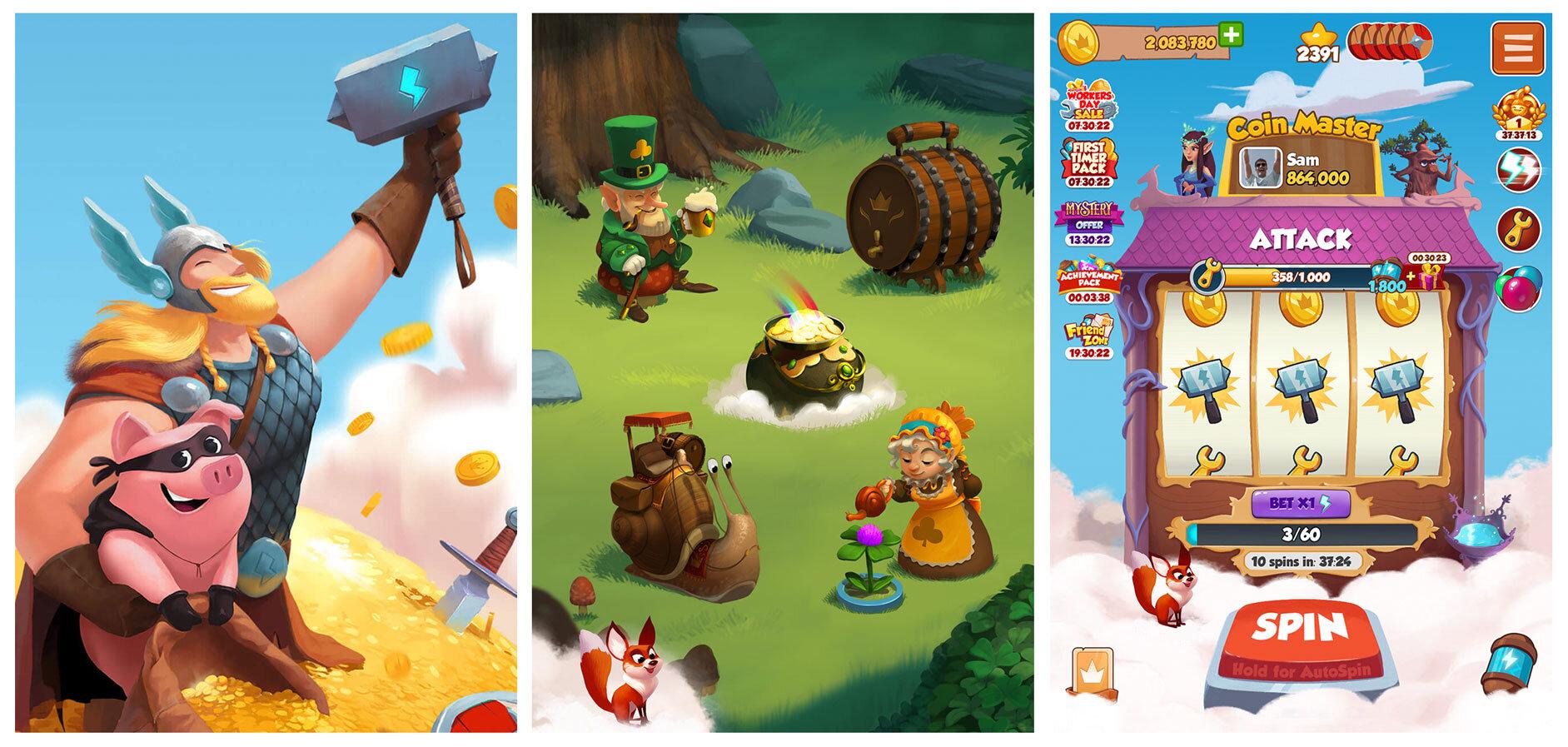
How Coin Master's Approachable Art Defined Casual Slot Genre
The success of Moon Active’s Coin Master is fundamentally linked to its approachable, storybook-inspired art style, which differentiates the title within the casual slot genre.
- Moon Active’s Coin Master utilizes an approachable, storybook-inspired art style to broaden its player funnel and increase retention within the casual slot genre.
- The game features a scalable theme system that allows for frequent visual refreshes of the game board, reel symbols, and village environments as players progress.
- Village assets are designed with a diagonal orientation to guide player focus toward the center of the screen, with each upgrade tier featuring distinct silhouette changes and unique destroyed states.
Game Discoverabilityland: Welcome to the Summer of Indie Direct
The landscape of video game discoverability in mid-2020 was defined by the industry’s rapid pivot to virtual showcases following the cancellation of E3 due to the COVID-19 pandemic.
- Aligning trailer reveals and marketing campaigns with concentrated digital event windows, such as Summer Game Fest, Guerrilla Collective, and Wholesome Direct, is a vital strategy for maximizing indie game visibility.
- Releasing game demos serves as a proven discovery tool, with SMG Studio data for Death Squared demonstrating a measurable increase in long-term sales performance.
- Strategic use of platform-specific discounts is essential for maintaining sales momentum and visibility within the crowded, decentralized digital marketplace.
Did WarriOrb's Use of Prologues Fail?
The use of free prologue versions to market full game releases remains a viable strategy despite recent concerns regarding the performance of the title WarriOrb.
- The developers of WarriOrb generated 16,000 wishlists but saw a low conversion rate of approximately 1.1%, resulting in 357 copies sold midway through their launch sale.
- First-time developers often struggle to achieve immediate success, as they lack the established reputation and audience base that experienced studios like HypeTrain Digital leverage to influence the Steam algorithm.
- The performance of WarriOrb was comparable to Levelhead, a platformer from a more experienced studio with a strong community, suggesting that the prologue strategy provided a baseline of visibility that might have been lower otherwise.

The LTV Metric Isn’t Dead. Here’s Why.
Lifetime Value (LTV) remains a critical and functional metric for mobile gaming marketers, provided it is utilized as a tool for strategic decision-making rather than an absolute truth.
- LTV remains a vital North Star for mobile gaming advertisers, as restricting acquisition to short-term payback ignores the vast majority of potential players; only 3.8% of mobile gamers ever become payers according to AppsFlyer.
- LTV models are inherently imperfect estimations, so teams should prioritize 'usefulness' and business decision-making over the pursuit of increasingly complex, yet still flawed, mathematical models.
- Defining LTV requires cross-departmental agreement on three core variables: the definition of value (including ad revenue or organic k-factors), the timing of the prediction, and the duration of the 'lifetime' horizon.

It’s Time to Retire the LTV Metric
The traditional Lifetime Value (LTV) metric is increasingly obsolete for modern mobile marketing, as it fails to account for the complexities of the current mobile ecosystem.
- The LTV (Lifetime Value) metric is an anachronism in the modern mobile economy because long-term projections are fragile, unreliable, and difficult to validate against frequently updated products.
- Mobile marketers should shift their focus from abstract, long-term LTV calculations to managing cash flow and optimizing for specific payback windows.
- Advertisers are better served by buying traffic against early-stage ROAS benchmarks and iteratively adjusting bids as more data is accumulated to prove later-stage performance.
PUBG Mobile: October Revenue Analysis
PUBG Mobile demonstrated significant financial momentum in October 2018, generating approximately $22 million in global revenue across the App Store and Google Play.
- In October 2018, PUBG Mobile generated approximately $22 million in revenue, marking its second-highest monthly revenue since in-game monetization began in April 2018.
- During the three-day Halloween period at the end of October, PUBG Mobile's daily revenue across the App Store and Google Play surpassed that of Fortnite by $100,000.
- Despite the Halloween surge, Fortnite’s total October iOS revenue of $55 million remained 2.5 times higher than PUBG Mobile’s combined revenue across both platforms.
Candy Crush Friends Saga Stacks Up 10 Million Downloads in Its First Week
The launch of Candy Crush Friends Saga marked a significant milestone for King, as the title achieved over 10 million global downloads within its first week of release in October 2018.
- Candy Crush Friends Saga generated 10 million downloads during its first week of global availability following a year-long soft launch.
- The title grossed approximately $780,000 in its first seven days, significantly lower than the $1.7 million and $3.7 million earned by predecessors Jelly Saga and Soda Saga during their respective launch weeks.
- First-week download volume for the new title reached roughly 77% of Jelly Saga’s 13 million installs and 71% of Soda Saga’s 14 million installs.

5 Tips for Managing Mobile Marketing Agencies
Mobile app developers often outsource user acquisition to agencies during early scaling phases to prioritize product development.
- Maintain internal control over marketing infrastructure, analytics, and reporting to ensure you retain ownership of your data and can effectively evaluate agency performance.
- Establish unambiguous, metrics-oriented performance benchmarks in your statement of work based on your own business goals rather than accepting standards proposed by the agency.
- Retain ownership of the measurement process by using your own attribution and cost aggregation accounts to prevent conflicts of interest and ensure audit oversight.