Key insights
6 slides
The problem
Video games frequently rely on reductive and harmful tropes when depicting mental illness.
The persistent archetype of the homicidal maniac is a notable example.
Key finding. 69% of characters in a study were depicted as violent, reinforcing the 'homicidal maniac' trope.
See it on page 469%
of characters in a study were depicted as violent.
1 / 6
- 01Researchers propose a three-dimensional model for analyzing mental illness in games, moving beyond binary 'good or bad' classifications to evaluate representations across a spectrum of depth.See it on page 5
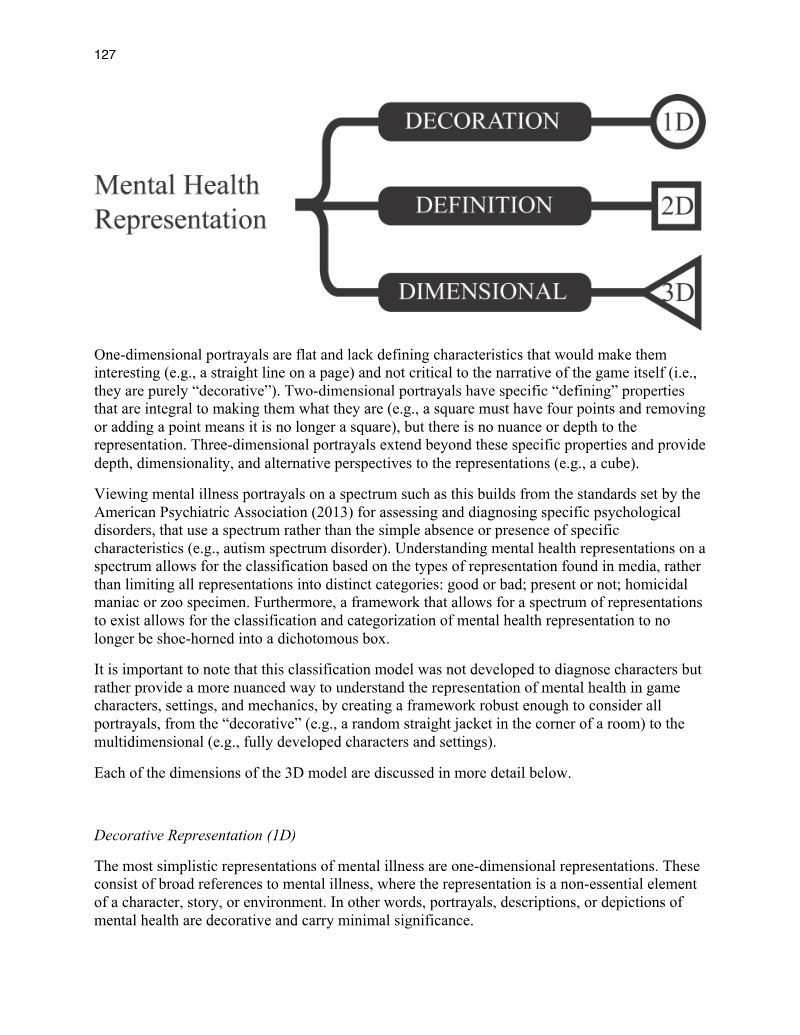
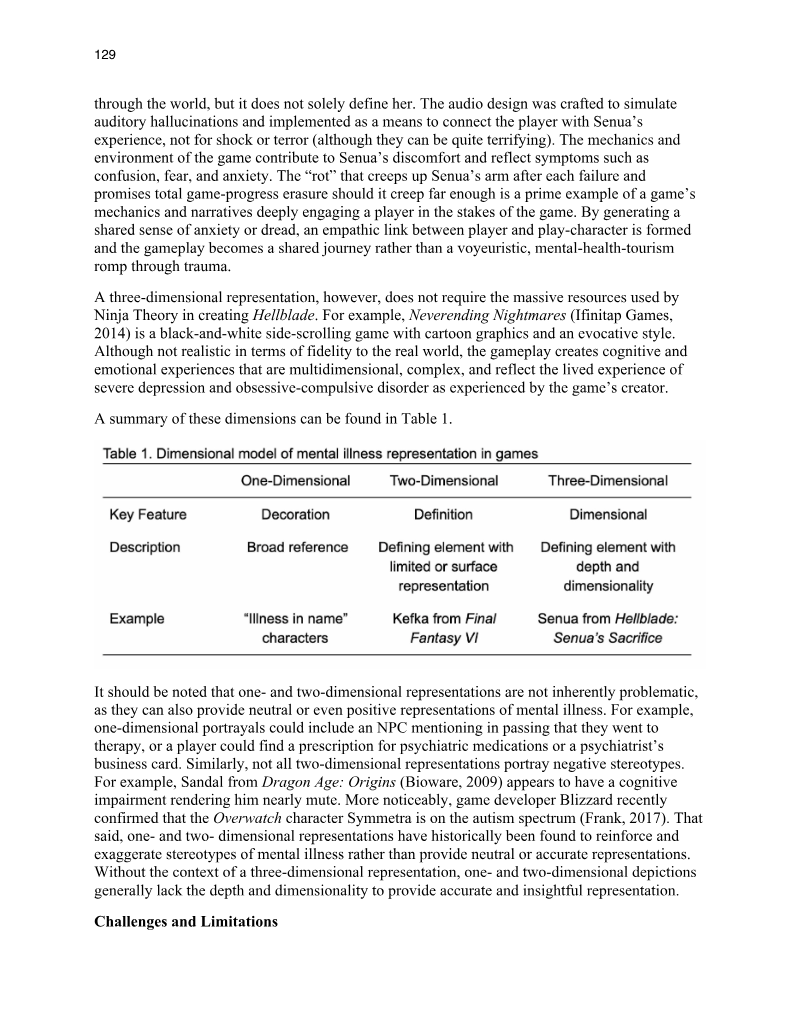
- 02One-dimensional (decorative) representations use mental illness as a non-essential background element, while two-dimensional portrayals use it as a defining character trait, and three-dimensional portrayals integrate it into the core narrative and mechanics.See it on page 6
- 03Previous research on mental illness in games, such as a study of 42 characters, found that 69% were depicted as violent, reinforcing the 'homicidal maniac' trope common in other media.See it on page 4
- 04Video games are a unique medium for mental health representation because they utilize specific affordances like in-game mechanics (e.g., sanity meters) and player-driven decision-making that differ from film or television.See it on page 1
- 05Hellblade: Senua's Sacrifice (Ninja Theory, 2017) serves as a primary example of a three-dimensional representation, where schizophrenia is integrated into the character's movement, narrative, and environmental design.See it on page 8
- 06Stereotypical media portrayals of mental illness contribute to real-world stigma, which research links to decreased tolerance, social discrimination in housing and employment, and public fear of those with mental health conditions.See it on page 2
Ask AI about this report
Summary
Video games frequently rely on reductive and harmful tropes, most notably the persistent archetype of the homicidal maniac, when depicting mental illness. Because traditional analytical frameworks derived from film and television studies fail to account for the unique interactive nature of gaming mechanics and player agency, a more specialized approach is required. The primary objective of this research is to establish a multidimensional model that evaluates how digital games represent mental health, moving beyond binary classifications to better reflect the complexities of lived experience.
The proposed three-dimensional spectrum categorizes representations into distinct tiers of depth. Decorative portrayals occupy the first dimension, serving as superficial references, while defining portrayals represent the second dimension by relying on surface-level stereotypes. The third dimension, termed dimensional representation, integrates mental health directly into the narrative and core gameplay mechanics. This framework provides developers and researchers with a sophisticated tool to assess how interactive media can move past stigmatizing shorthand to offer more nuanced, empathetic depictions of psychological conditions.
This analysis encompasses the global digital games industry, focusing on the intersection of media influence, social stigma, and the psychological impact of fictional portrayals. By shifting the focus from static observation to a play-centric lens, the model addresses the specific challenges posed by interactive media. Ultimately, the findings suggest that by embedding mental health into the mechanics of play rather than treating it as a narrative garnish, the industry can foster more responsible and accurate representations that challenge, rather than reinforce, societal prejudices.