Dice
CompanyUnited Kingdom
Documents about Dice

Playtika's $2 Billion Bet: Rolling the Dice on Inorganic Growth
This analysis examines the strategic implications of Playtika’s $2 billion acquisition of SuperPlay, positioned against a backdrop of broader mobile gaming trends and recent corporate performance.
- Playtika is acquiring SuperPlay for $2 billion, consisting of a $700 million upfront payment and up to $1.25 billion in potential earnouts.
- Playtika’s Q2 2024 financial performance shows a 2.5% year-over-year revenue decline to $627 million and a decrease in average daily paying users from 307,000 to 298,000.
- The acquisition strategy faces efficiency challenges, as SuperPlay’s user acquisition spending is estimated to be three times higher than Playtika’s current 18% of revenue.
Dice Dreams Boosted by Launch of Fellow Coin Looter Monopoly Go!
The mobile game Dice Dreams, developed by SuperPlay, has achieved a significant financial milestone by surpassing $400 million in cumulative gross revenue.
- SuperPlay's Dice Dreams has surpassed $400 million in total gross revenue, with $275 million of that total earned in the period following the 2023 launch of MONOPOLY GO!.
- In the three years prior to the release of MONOPOLY GO!, Dice Dreams generated $125 million in gross revenue.
- The launch of MONOPOLY GO! did not cannibalize the market share of Dice Dreams, suggesting that the former expanded the overall player base for the 'Coin Looter' genre.
Riven's Remake Tops a Slower "Steam Debuts" Week
Market performance for the final week of June 2024 reflects a significant slowdown in new releases as the industry deferred to the launch of the Steam Summer Sale.
- The Steam Summer Sale period caused a significant slowdown in new paid releases during the final week of June 2024, shifting market focus toward established hits and high-anticipation free-to-play titles.
- The First Descendant is positioned as a major upcoming contender in the looter-shooter segment, currently leading interest with over 215,000 Steam followers.
- The 3D remake of Riven performed as the week's top debut, reaching approximately 1,700 maximum concurrent users and selling between 25,000 and 30,000 units on Steam.
two & a half gamers session #39 - How to do a game review? Rush Royale full UA, GD, Admon analysis
Conducting a comprehensive game product review requires a multifaceted approach that integrates user acquisition, game design, and monetization strategies to evaluate a title’s market viability.
- Rush Royale generates approximately $1.7 million in monthly revenue from ads, accounting for roughly 30% of its total earnings.
- The game utilizes a localized ad network strategy, leveraging MyTarget for CIS markets and Pangle for Asian regions to maximize monetization.
- User acquisition for Rush Royale is driven by major networks including Unity, Facebook, and Google, utilizing gameplay-altered creatives to effectively capture target audiences.
Asmodee Rolls Dice on Divestiture
The divestiture of Asmodee from the Embracer Group marks a significant shift in the gaming landscape, positioning the board game giant as an independent entity on the Nasdaq Stockholm.
- Asmodee is spinning off from Embracer Group to become an independent entity on the Nasdaq Stockholm, carrying significant debt but reporting $1.42 billion in net sales for the fiscal year ending March 2024.
- The tabletop gaming industry is projected to grow from a $14.3 billion valuation in 2023 to $17.2 billion by 2028, maintaining a steady 5% annual growth rate post-pandemic.
- Asmodee currently holds a dominant market share in Europe, commanding 40% of the French market and 43% of the UK market.
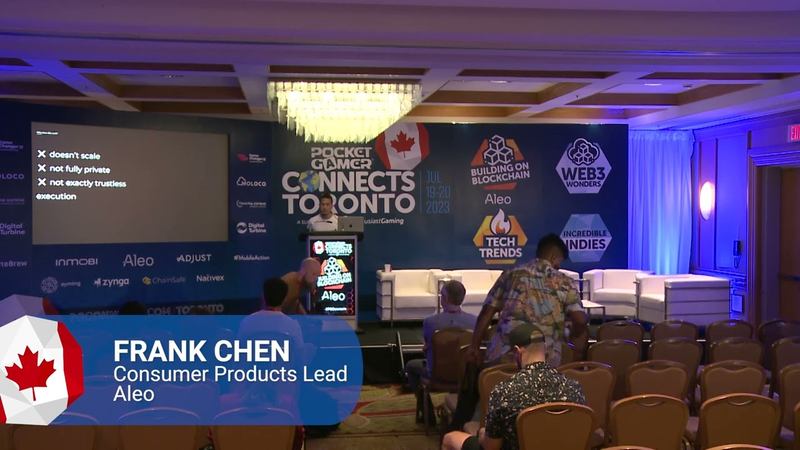
Your Game Will Suck Without Zero Knowledge Proofs - Frank Chen, Aleo
Decentralized gaming aims to eliminate the need for trusted third parties, protecting players from asset theft, data surveillance, and arbitrary service termination.
- Zero-knowledge (ZK) proofs are essential for decentralized gaming because they enable players to verify moves and game states without exposing private data or strategies.
- Public blockchain ledgers are currently unsuitable for genres like real-time strategy, shooters, and card games because they expose player inputs, which ruins games reliant on imperfect information.
- Existing privacy solutions are inadequate: trusted execution environments rely on vulnerable hardware, fully homomorphic encryption is too computationally intensive, and commit-and-reveal schemes lack long-term privacy.

Going Beyond User Acquisition: The Curious Case of Dice Dreams
The mobile gaming industry faces a persistent challenge in scaling titles beyond initial soft launches, where product improvements alone are often insufficient to achieve global success.
- SuperPlay achieved a 150% increase in Day 0 return on ad spend (ROAS) for Dice Dreams by leveraging data-driven marketing without increasing customer acquisition costs.
- The integration of Google’s Firebase platform and Audience Triggers allowed for precise identification and targeting of high-value players through measurable event generation.
- Long-term mobile game growth requires a dual focus on iterative product development and sophisticated, automated technical infrastructure.

Blockchain Tech at Dice 2022 | Games ReCAP
The 2022 DICE conference served as a primary industry forum for debating the integration of blockchain technology, non-fungible tokens (NFTs), and the metaverse into the gaming sector.
- The 2022 DICE conference revealed a sharp divide between executive and investor interest in blockchain financialization and the skepticism held by developers and players regarding its impact on game design.
- Proponents argue that decentralized server hosting could prevent game sunsetting by allowing multiplayer titles to persist after a studio ceases operations.
- Advocates proposed using token-based voting systems to grant players influence over game balance and development, a concept that faced significant pushback from professional designers.
U.S. Mobile Tabletop Game Spending: 2021
The mobile tabletop gaming sector in the United States experienced significant financial growth between August 2020 and July 2021, with total player spending rising by approximately 40 percent to reach $703.8 million.
- U.S. mobile tabletop game spending increased by 40% year-over-year to reach $703.8 million between August 2020 and July 2021.
- The Solitaire/Mahjong subgenre was the top revenue generator, contributing approximately $310 million in spending, a 44% increase over the previous year.
- Card games were the fastest-growing subgenre by revenue, with spending rising 83.6% year-over-year to $101.3 million.
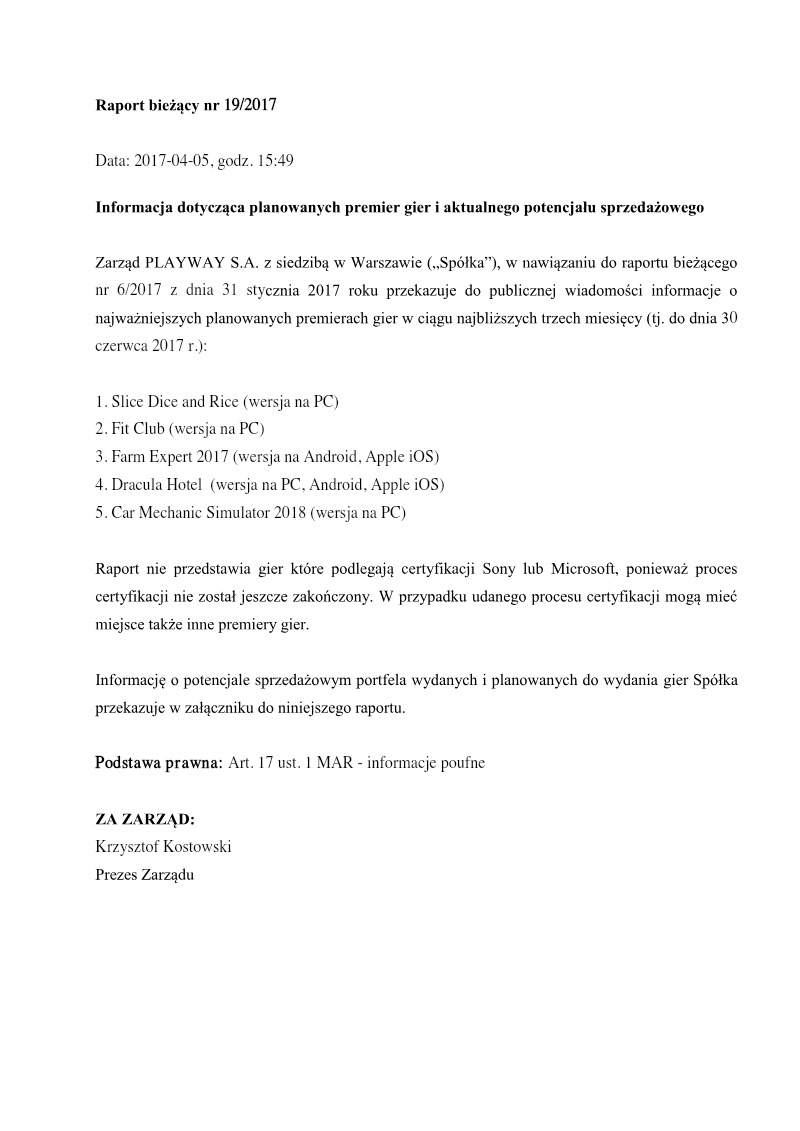
Raport Bieżący Nr 19/2017
PlayWay S.A. outlines its strategic release schedule and commercial outlook for the second quarter of 2017, focusing on a diverse portfolio of titles across multiple platforms.
- PlayWay S.A. is prioritizing the launch of its flagship title, Car Mechanic Simulator 2018, for PC during the second quarter of 2017.
- The company’s Q2 2017 release pipeline includes five confirmed titles: Slice Dice and Rice, Fit Club, the mobile version of Farm Expert 2017, and others.
- PlayWay S.A. is pursuing a multi-platform strategy targeting PC, Android, and iOS to maximize market reach.

Raport Bieżący Nr 15 /2017
PlayWay S.A. outlines its strategic release schedule and commercial outlook for the second quarter of 2017, focusing primarily on the PC and mobile gaming segments.
- PlayWay S.A. scheduled six specific titles for release by May 31, 2017, to maintain steady cash flow and mitigate market risk.
- The PC release slate includes Bad Dream Coma, Train Mechanic Simulator 2017, Slice Dice and Rice, and Fit Club.
- The company is expanding existing franchises with the Wheeler Dealers DLC for Car Mechanic Simulator 2015 and a mobile port of Farm Expert 2017 for Android and iOS.

FTUE: Disney Magical Dice
Disney Magical Dice, a mobile title developed by Netmarble, serves as a western-focused adaptation of the popular Korean board game Everyone’s Marble.
- Disney Magical Dice, developed by Netmarble, adapts the Korean board game Everyone’s Marble for Western audiences by blending Monopoly-style mechanics with collectible card game (CCG) progression.
- The game’s onboarding process suffers from significant friction, specifically due to mandatory push notification prompts and background data downloads that delay access to the core gameplay loop.
- While the tutorial effectively teaches basic movement and property acquisition, its restrictive nature fails to adequately prepare players for the game's more complex attribute management and card-fusion systems.