Casual
Documents
Rovio Sustainability Report 2025
The Rovio Sustainability Report 2025 outlines the company’s voluntary environmental, social, and governance performance for the fiscal period spanning April 1, 2025, to March 31, 2026. As a subsidiary of SEGA SAMMY Holdings, Rovio utilizes this disclosure to maintain transparency and accountability regarding its sustainability strategy, which is structured around three core pillars: Positive Play, Empowered People, and Protecting our Planet. The report aligns partially with European Sustainability Reporting Standards, though it remains a voluntary exercise for the organization.
Key findings highlight a total carbon footprint of 20,980 tons of CO2e, with Scope 3 emissions accounting for 98.6% of the total. For the first time, the company included downstream emissions from initial game downloads in its accounting, which significantly improved coverage but precluded direct year-over-year comparisons. Operationally, Rovio maintains six global locations with 508 employees, reporting a gender pay gap of 1.4% when adjusted for location, level, and role. The company continues to prioritize industry collaboration, maintaining active memberships in the Playing for the Planet Alliance and the Sustainable Games Alliance to drive collective climate action.
Strategic conclusions emphasize a pragmatic approach to sustainability, acknowledging challenges in formalizing long-term emission reduction plans due to supply chain limitations and evolving market realities. While the company successfully implemented new internal "Rovio Way" principles and improved data tracking for career progression, it faced capacity constraints that delayed the rollout of certain accessibility scorecards and carbon pricing models. Looking ahead, the organization intends to focus on integrating AI sustainability frameworks, enhancing inclusive game design, and embedding its new corporate principles into daily operations to ensure long-term, sustainable growth across its transmedia and mobile gaming portfolio.
- Rovio reported a total carbon footprint of 20,980 tons of CO2e for the fiscal period ending March 31, 2026, with Scope 3 emissions representing 98.6% of that total.
- The company expanded its carbon accounting to include downstream emissions from initial game downloads, a change that improved data coverage but prevented direct year-over-year comparisons.
- Rovio maintains a workforce of 508 employees across six global locations and reports an adjusted gender pay gap of 1.4%.
- The organization is prioritizing industry collaboration through active memberships in the Playing for the Planet Alliance and the Sustainable Games Alliance to address climate action.
- Capacity constraints caused delays in the implementation of planned accessibility scorecards and internal carbon pricing models.
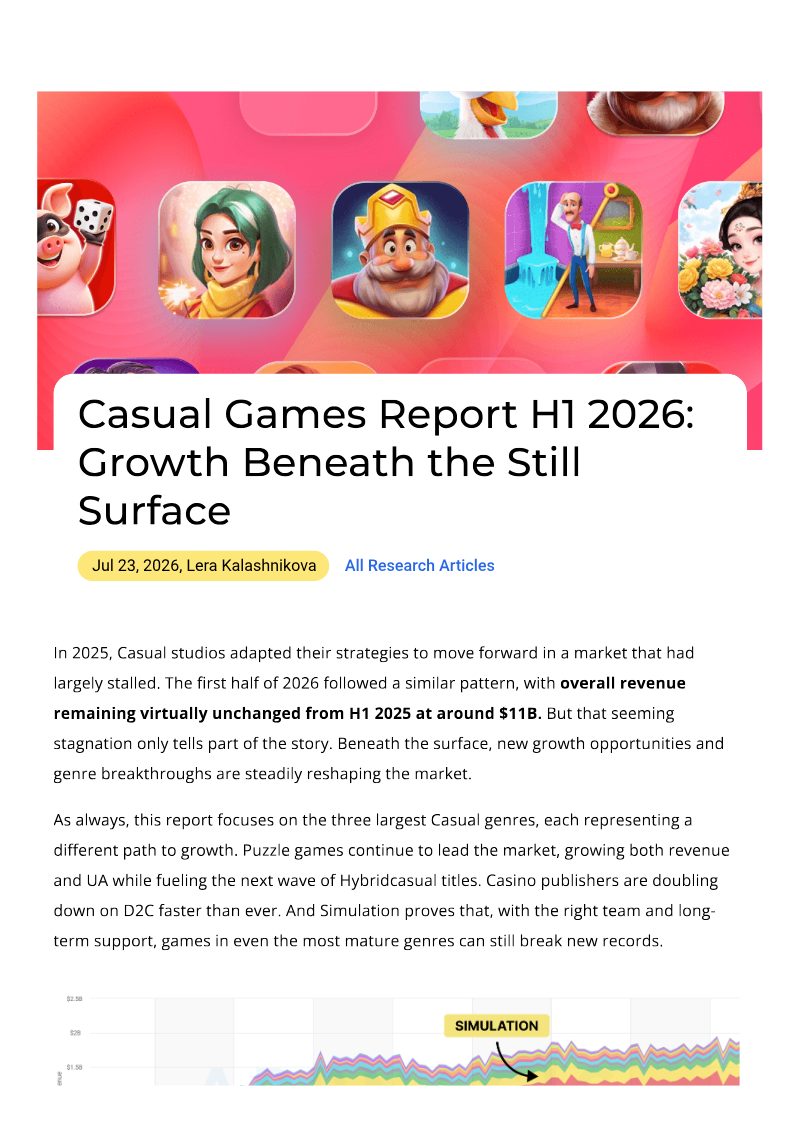
Mobile Gaming: Casual
The analysis demonstrates that casual mobile gaming has entered a phase of mature monetization and strategic diversification. Download volumes peaked at 17.3 billion in 2020, dipped to 15.5 billion by 2024, and are projected to rebound to 16.4 billion in 2025, while in‑app purchase (IAP) revenue has risen from $16.8 billion to an expected $22.9 billion by year‑end 2025, indicating a higher revenue per user. Leading titles now blend advertising, IAPs, and brand partnerships to create multiple income streams, with celebrity‑driven campaigns further amplifying user acquisition and lifetime value.
In early 2025, Royal Match topped the earnings list with $540 million in IAP revenue, followed by Monopoly Go! at $431 million and Candy Crush Saga at $421 million. These leaders illustrate divergent monetization models: Royal Match and Monopoly Go! rely exclusively on IAPs, whereas Candy Crush Saga incorporates ads. Playrix’s suite of games—Township, Gardenscapes, Homescapes, and Fishdom—collectively generated $554 million, underscoring the potency of hybrid strategies and the enduring value of established franchises.
Celebrity endorsements have proven effective at generating short‑term spikes. Royal Kingdom’s A‑list television campaign produced a 112 % download surge, while Supercell’s WWE‑inspired “Clashamania” yielded $2.15 million in single‑day IAP revenue for Clash of Clans. However, long‑term return on investment hinges on sustained engagement and lifetime value; Scopely’s “Friendship Pays” campaign achieved payback within 120 days, whereas Royal Kingdom’s lift suggests a longer monetization horizon. These findings highlight that high‑profile campaigns must be coupled with robust retention loops and rigorous LTV measurement to justify multi‑million dollar spend.
Overall, the casual mobile gaming sector is characterized by a shift toward higher monetization per download, diversified revenue models that combine ads and IAPs, and a strategic use of celebrity partnerships to accelerate growth. Success increasingly depends on balancing short‑term acquisition tactics with long‑term retention and monetization strategies across global markets, primarily in North America, Europe, and Asia-Pacific.
- Casual mobile gaming is shifting toward higher revenue per user, with IAP revenue projected to grow from $16.8 billion to $22.9 billion by the end of 2025 despite a fluctuating download volume.
- Market leaders demonstrate divergent monetization strategies: Royal Match ($540M) and Monopoly Go! ($431M) rely exclusively on IAPs, while Candy Crush Saga ($421M) successfully integrates advertising.
- Playrix’s portfolio approach, utilizing a suite of titles like Township and Gardenscapes, generated a combined $554 million, proving the effectiveness of hybrid monetization and established franchise management.
- Celebrity-driven marketing can trigger significant short-term growth, such as Royal Kingdom’s 112% download surge or Clash of Clans’ $2.15 million single-day IAP spike from the 'Clashamania' campaign.
- High-profile acquisition campaigns require rigorous LTV measurement and retention loops to be viable, as evidenced by Scopely’s 'Friendship Pays' campaign achieving payback within 120 days.
Game no Yakusoku Communication Book
The evolution of gaming from localized, offline experiences to global, interconnected online environments necessitates a modern approach to parental guidance and family communication. The primary purpose of this guide is to bridge the generational gap between parents and children by providing a framework for establishing mutually agreed-upon rules for safe and responsible gaming. It emphasizes that while the technology and accessibility of games have shifted from television-bound consoles to ubiquitous mobile and cross-platform devices, the fundamental need for trust and clear boundaries remains constant.
The analysis highlights significant shifts in the gaming landscape, noting that modern play is no longer restricted by age, geography, or hardware limitations. Because online environments allow for real-time interaction with diverse global participants, the risks and social dynamics have become more complex. To address this, the guide advocates for a collaborative rule-setting process that prioritizes the child’s developmental stage and specific gaming context. Effective agreements should be flexible, evolving alongside the child’s maturity, and should be rooted in open dialogue rather than rigid, top-down restrictions that may fail to account for the realities of online events or social gaming commitments.
Furthermore, the guide underscores the importance of digital literacy for parents, encouraging them to familiarize themselves with common gaming terminology and technical concepts such as in-app purchases, server stability, and online etiquette. By understanding these elements, parents can provide more informed advice regarding security, privacy, and behavior. Ultimately, the document concludes that gaming rules should function as a shared commitment to safety and mutual respect, ensuring that the gaming experience remains a positive and secure activity for children as they navigate increasingly sophisticated digital worlds.
- Modern gaming requires a shift from rigid, top-down restrictions to a collaborative rule-setting process that evolves alongside a child’s developmental maturity.
- The transition from localized, offline play to global, interconnected online environments has increased the complexity of social dynamics and safety risks for children.
- Effective family gaming agreements must be flexible enough to account for the realities of real-time online events and social gaming commitments.
- Parents should prioritize digital literacy by familiarizing themselves with technical concepts such as in-app purchases, server stability, and online etiquette to provide informed guidance.
- Establishing trust and clear boundaries remains the fundamental requirement for safe gaming, regardless of whether the platform is a console or a mobile device.
Q4 2025 Investor Presentation
The Q4 2025 investor presentation details a period of record financial performance for the company, characterized by significant revenue growth and successful strategic integration. The primary thesis centers on the company’s transformative year, highlighted by the successful consolidation of Plarium and a shift toward a midcore gaming focus. For the fourth quarter of 2025, the company achieved net sales of SEK 3,123 million, representing an 8% organic growth rate and a 108% increase in constant currency year-over-year. Adjusted EBITDA reached SEK 717 million, maintaining a 23% margin, while unlevered free cash flow totaled SEK 878 million with a 66% conversion rate.
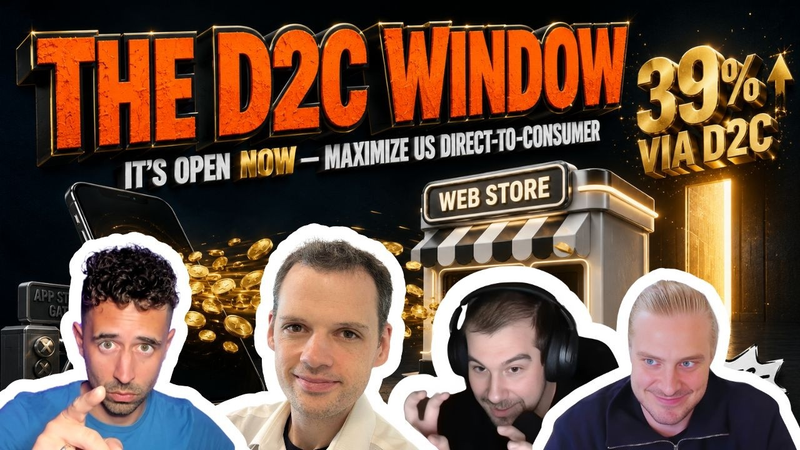
The scope of the report covers the global gaming operations of the company throughout the 2025 fiscal year, with specific emphasis on the fourth quarter. Key operational findings indicate that user acquisition (UA) spending rose to 38% of revenue in Q4, a 98% year-over-year increase in constant currency, largely driven by the integration of Plarium and the scaling of casual and racing franchises. Revenue streams showed a notable shift, with direct-to-consumer contributions rising 600 basis points to 32% of the total. Franchise performance was bolstered by strong results in the racing and word game segments, which saw year-over-year growth of 43% and 28%, respectively.
Methodologically, the financial data is presented on a reported basis, with constant currency adjustments applied to isolate organic growth trends. The report incorporates full-year 2025 figures and highlights the impact of the Plarium acquisition, which was integrated into the group starting in February 2025. Looking ahead, the company concludes the period with a stable leverage ratio and a new organizational structure, positioning itself for continued midcore expansion and the potential public offering of its PlaySimple division.
- The company achieved Q4 2025 net sales of SEK 3,123 million, marking 8% organic growth and a 108% year-over-year increase in constant currency.
- Adjusted EBITDA for Q4 2025 reached SEK 717 million with a 23% margin, supported by an unlevered free cash flow of SEK 878 million.
- User acquisition spending surged to 38% of revenue in Q4, representing a 98% year-over-year increase driven by the integration of Plarium and scaling of casual and racing franchises.
- Direct-to-consumer revenue contributions grew by 600 basis points to reach 32% of total Q4 revenue.
- Key franchise segments showed strong momentum, with racing games growing 43% and word games growing 28% year-over-year.
Mobile Market Landscape 2026
The mobile ecosystem is undergoing a fundamental structural transformation as the industry shifts from a volume-based growth model to one defined by monetization efficiency and technological integration. By 2026, the market has reached a state of saturation where total app releases have surged by 25% year-over-year, yet only 10% of new titles successfully secure meaningful user attention. A pivotal milestone occurred in late 2025 when non-gaming applications surpassed gaming in total revenue for the first time, largely propelled by the explosive 273% revenue growth in generative AI and the strategic expansion of utility-based tools.
Within the gaming sector, traditional genres such as Casino and RPG have faced stagnation, forcing publishers to adopt hybridization strategies that blend deeper monetization mechanics into previously hypercasual titles. This pivot has yielded significant results, with hypercasual revenue increasing by approximately 80% as developers move toward puzzle and simulation subgenres. Meanwhile, midcore gaming revenue has plateaued at $33–34 billion, prompting a reliance on intensified LiveOps and direct-to-consumer strategies. Across the broader app landscape, the integration of generative AI into creative assets has become standard, with over half of top-grossing games utilizing these tools to scale production, despite ongoing concerns regarding creative monotony.
Geographically, growth patterns are diverging as emerging markets like Indonesia continue to drive massive download volumes, while mature Western markets focus on maximizing revenue per user. The utility and social segments are similarly prioritizing premium subscription models to combat plateauing download numbers. While tools such as antivirus and cloud storage are seeing a resurgence in demand, the industry faces a broader challenge in maintaining long-term retention. Ultimately, the market is transitioning away from hypergrowth toward a sustainable, mature phase characterized by subscription-driven monetization and the strategic application of AI to optimize both user experience and operational efficiency.
- Non-gaming applications surpassed gaming in total revenue for the first time in late 2025, driven by a 273% revenue surge in generative AI and utility-based tools.
- The mobile market has reached saturation, with a 25% year-over-year increase in app releases while only 10% of new titles successfully capture meaningful user attention.
- Hypercasual gaming revenue grew by approximately 80% as developers pivoted toward hybridization, blending deeper monetization mechanics into puzzle and simulation subgenres.
- Midcore gaming revenue has plateaued at $33–34 billion, forcing publishers to rely on intensified LiveOps and direct-to-consumer strategies to maintain performance.
- Over 50% of top-grossing games now utilize generative AI to scale production of creative assets, despite industry concerns regarding potential creative monotony.
Global LiveOps Trends 2025
The global mobile gaming landscape in 2025 is characterized by a notable deceleration in overall market growth, with revenue increases stalling at 0.7% and download growth slowing to 4.1%. In response to this stagnation, developers are intensifying LiveOps strategies to sustain engagement and monetization. The average number of monthly events per game has risen to 89, shifting away from traditional holiday-centric scheduling toward persistent, competitive mechanics such as Win Streaks, Leaderboards, and various collection-based systems. This strategic pivot reflects a broader industry effort to maximize the lifetime value of existing player bases, particularly within the Midcore and Hybridcasual segments.
Genre performance is undergoing a significant realignment, as Puzzle and Strategy titles experience growth while RPG and Shooter categories face substantial declines. Midcore titles remain the primary drivers of revenue, relying on cooperative events and targeted monetization of high-spending players to maintain stability. Simultaneously, the Hybridcasual sector has emerged as a high-growth area, recording a 75% year-over-year revenue increase despite stagnant download figures. This success is largely attributed to the integration of Casual-style mechanics, such as Digging and Expedition events, which effectively boost session length and ad-based monetization.
The industry is currently defined by a move toward greater mechanical complexity and event density. By adopting diverse features like Stamp-based systems and Core Duplicates, developers are successfully diversifying their monetization strategies across different player archetypes. While Midcore games continue to prioritize whale-focused cooperative events, Hybridcasual titles are increasingly leveraging competitive, short-term engagement loops to drive performance. Ultimately, the 2025 market environment demonstrates that sustained success is no longer dependent on rapid user acquisition, but rather on the sophisticated, data-driven application of LiveOps to deepen engagement within established gaming ecosystems.
- The global mobile gaming market has stagnated, with revenue growth slowing to 0.7% and download growth to 4.1%, forcing a shift toward maximizing the lifetime value of existing players.
- Hybridcasual games have emerged as a high-growth sector, recording a 75% year-over-year revenue increase despite flat download numbers.
- LiveOps strategy has shifted toward high-frequency engagement, with the average number of monthly events per game rising to 89.
- Developers are moving away from holiday-centric calendars in favor of persistent, competitive mechanics like Win Streaks, Leaderboards, and collection-based systems.
- Genre performance is realigning, with Puzzle and Strategy titles showing growth while RPG and Shooter categories face substantial declines.
Top 10 Hybridcasual Games in Q1 2025: The Great Puzzle Takeover
The analysis highlights a rapid maturation of the hybrid‑casual segment in the mobile gaming market, showing that the top ten titles generated $87 million in net in‑app‑purchase (IAP) revenue in the first quarter of 2025—a 67 percent year‑over‑year increase from the same period in 2024. Puzzle games dominate the revenue mix, contributing 48 percent, while arcade titles account for 45 percent; together they represent more than 90 percent of total earnings. Within puzzles, block‑puzzle titles lead with 71 percent of puzzle revenue, followed by screw‑puzzle (20 percent) and sort‑puzzle (9 percent), the latter posting a 5.6‑times YoY growth. The report covers a global scope of 60 countries, focusing on the period from Q1 2023 through Q1 2025 and concentrating on the hybrid‑casual niche that blends hyper‑casual mechanics with deeper casual‑style monetisation and live‑ops.
Methodologically, the study isolates hybrid‑casual games by filtering the hyper‑casual tag for top‑grossing apps, then examines revenue, download, and release data for each title. Key case studies include Color Block Jam, which achieved $25 million in Q1 2025 after a modest Q4 2024 start, All in Hole, whose eat‑and‑grow model drove a nine‑fold YoY revenue surge and now accounts for 84 percent of its sub‑genre’s earnings, Mob Control, which posted 27 percent revenue growth and introduced “skip tickets” to balance ad and IAP streams, and Screwdom, whose shift to 3D puzzle design generated $3.6 million and set a new benchmark for screw‑puzzle games.
The findings suggest that successful hybrid‑casual titles combine a highly clickable core loop with layered progression, strategic live‑ops, and nuanced monetisation—often leveraging high‑budget user‑acquisition campaigns and viral social media exposure. This convergence of design and marketing is reshaping sub‑genres, lowering acquisition costs, and establishing hybrid‑casual as a dominant, profit‑rich trend in the mobile gaming ecosystem.
- The top ten hybrid-casual games generated $87 million in net IAP revenue in Q1 2025, marking a 67 percent year-over-year increase.
- Puzzle and arcade titles dominate the hybrid-casual market, collectively accounting for over 90 percent of total earnings with a 48 percent and 45 percent revenue share, respectively.
- Block-puzzle games lead the puzzle category with 71 percent of revenue, while sort-puzzle titles experienced the fastest growth, increasing 5.6 times year-over-year.
- Individual title performance highlights include Color Block Jam reaching $25 million in Q1 2025 and All in Hole achieving a nine-fold year-over-year revenue surge through its eat-and-grow model.
- Successful hybrid-casual titles are increasingly integrating deeper monetization strategies, such as Mob Control’s implementation of 'skip tickets' to balance ad and IAP revenue streams.
Mobile Casual Benchmarks Report 2025
The 2025 Mobile Casual Benchmarks Report provides a comprehensive analysis of the Android gaming market, focusing on performance metrics across various casual genres and subgenres. Based on data collected from over 10,000 mobile games and billions of installs between June 2024 and January 2025, the findings offer a strategic overview of the United States market. The analysis evaluates key performance indicators including download volume, user retention, session length, and ad monetization efficiency to identify growth opportunities for developers.
Findings indicate a significant shift in the mobile landscape, with a strong recommendation for developers to transition from pure hypercasual models to hybrid casual designs. While hypercasual and simulation games lead in total downloads, they suffer from low 30-day retention rates of approximately 3% and a modest ARPU of $0.79. In contrast, hybrid casual games—which integrate deeper progression systems and meta-elements—demonstrate superior sustainability. Subgenres such as Merge 3, Luck Battle, and Life Simulator emerge as highly profitable outliers, achieving ARPU figures between $11.08 and $14.83.
Engagement data reveals that Strategy and Tabletop genres command the highest user attention, while subgenres like Ludo and Merge 3 lead in session duration, with the latter averaging 656 seconds. Retention is strongest in Sports, Racing, and Tabletop categories, while specific subgenres like Coin Pusher and Management Sim maintain over 50% Day 1 retention. Regarding monetization, Puzzle and Match games are identified as the most effective vehicles for high-frequency ad impressions, whereas Strategy and Tabletop games are better suited for rewarded video formats. Ultimately, the data suggests that long-term profitability in 2025 depends on balancing accessible gameplay with the deeper engagement mechanics characteristic of the hybrid casual segment.
- Hybrid casual games are significantly more profitable than hypercasual models, with top subgenres like Merge 3, Luck Battle, and Life Simulator achieving ARPU figures between $11.08 and $14.83.
- Pure hypercasual and simulation games suffer from poor long-term sustainability, characterized by low 30-day retention rates of approximately 3% and an ARPU of only $0.79.
- Merge 3 games demonstrate high player engagement, leading all subgenres with an average session duration of 656 seconds.
- Coin Pusher and Management Sim subgenres are the most effective for player acquisition, maintaining over 50% Day 1 retention rates.
- Monetization strategy should be genre-specific, with Puzzle and Match games optimized for high-frequency ad impressions, while Strategy and Tabletop games perform best with rewarded video formats.
2024 Casual Gaming Apps Report
The global casual gaming market entered a period of recovery between April 2023 and April 2024, characterized by rebounding consumer spend despite a slowdown in total downloads. This shift is defined by a strategic migration from hyper-casual titles toward more complex hybrid-casual and 3D match models. User acquisition remains highly bifurcated by platform; iOS costs average $4.83 per install compared to just $0.65 on Android, though iOS continues to deliver a superior Day 7 return on ad spend. North America remains the most expensive and lucrative geographic region, while simulation games have emerged as the most cost-effective genre for acquisition.
Casual games function as a critical ecosystem driver, generating 91% of their own installs and significantly influencing mid-core titles. Puzzle subgenres, particularly Match3 and Mahjong Solitaire, now command 37% of casual installs, while the 3D Match category has seen explosive growth, increasing its US iOS market share fivefold in a single year. To sustain this growth, market leaders are increasingly relying on sophisticated LiveOps and social mechanics. Successful strategies include collaborative partner events, social win streaks, and "digging" minigames, all of which leverage group competition to drive engagement and baseline revenue.
Monetization strategies have evolved toward player choice and direct-to-consumer models. Progressive offers and "pick-one" bundles are now standard in 70% of top-performing US casual games, providing structured value through tiered rewards. Furthermore, developers are aggressively adopting engagement-linked offers and external web stores. By linking premium rewards to gameplay tasks and moving transactions to proprietary web platforms, developers are successfully bypassing traditional app store fees while fostering long-term player loyalty through exclusive digital storefronts and daily login incentives.
- The casual gaming market is shifting from hyper-casual titles toward hybrid-casual and 3D match models, with 3D Match category market share on US iOS increasing fivefold between April 2023 and April 2024.
- Developers are increasingly bypassing app store fees by adopting proprietary web stores and engagement-linked offers, a strategy now utilized by 70% of top-performing US casual games.
- User acquisition costs are highly bifurcated, with iOS installs averaging $4.83 compared to $0.65 on Android, though iOS maintains a superior Day 7 return on ad spend.
- Puzzle subgenres, specifically Match3 and Mahjong Solitaire, currently dominate the market by commanding 37% of all casual gaming installs.
- Simulation games have emerged as the most cost-effective genre for user acquisition, while casual games overall generate 91% of their own installs.
The State of Mobile Gaming in India: 2023
India’s mobile‑gaming ecosystem is experiencing rapid expansion, with a projected market value of $8.6 billion by 2027 and more than 600 million active users. Growth is fueled by affordable smartphones, low data costs, and a pandemic‑accelerated surge in casual, hyper‑casual, and real‑money titles. Install rates spiked up to 90 % during lockdowns, while in‑app purchase revenue is expected to reach $284 billion by 2026. To sustain this momentum, brands must deploy comprehensive customer‑engagement platforms that provide real‑time analytics, segmentation, and personalized push campaigns to enhance retention and monetization.
Push notifications and in‑app messaging prove critical for user engagement. Data shows a 3.34 % click‑through rate and up to 91 % delivery success for push alerts, while in‑app campaigns achieve 15–44 % conversion rates and a 38 % average on one million impressions. Segmentation techniques such as RFM, affinity profiling, and predictive AI models (e.g., Sherpa) enable targeted, omnichannel flows that reduce churn and lower acquisition costs—new customers cost five times more than retaining existing ones. App Store Optimization tools like AppTweak further amplify visibility; for instance, RummyCircle’s keyword strategy increased visibility by 14.2 % and drove a 200,000‑download spike after A/B testing.
Despite the market’s growth, brands face declining installs, stickiness, and revenue. The solution lies in data‑driven engagement: hyper‑personalized messaging powered by AI unlocks deeper customer insights, improves retention, and provides a competitive advantage. Platforms such as MoEngage, already trusted by Fortune 500 and internet‑first brands worldwide, offer the scalability required for publishers to thrive in India’s dynamic mobile‑gaming landscape.
- India’s mobile gaming market is projected to reach a value of $8.6 billion by 2027, supported by a user base of over 600 million active players.
- In-app purchase revenue in the Indian mobile gaming sector is forecasted to reach $284 billion by 2026.
- Retention is critical for profitability, as acquiring new customers is five times more expensive than retaining existing ones.
- Data-driven engagement tools are highly effective, with in-app campaigns achieving conversion rates between 15% and 44% and push notifications maintaining a 3.34% click-through rate.
- Advanced segmentation techniques, including RFM analysis and predictive AI models like Sherpa, are necessary to reduce churn and lower acquisition costs.
2023 Casual Gaming Apps Report
The casual gaming landscape in 2023 is defined by a strategic pivot from rapid user acquisition toward long-term profitability and sophisticated engagement models. While iOS acquisition costs significantly exceed those of Android at $2.23 compared to $0.63, both platforms achieve a comparable Day-7 return on ad spend of approximately 7.7%. North America remains the most expensive yet lucrative market, yielding an 8.1% return on ad spend despite a high $3.59 cost per install. Simulation games have emerged as a particularly efficient entry point for developers, maintaining the lowest acquisition costs at $0.59.
Casual titles serve as the primary engine for the broader mobile ecosystem, driving 74% of installs across all gaming categories and nearly 75% of mid-core installs. Hyper-casual and puzzle games remain the dominant traffic sources, but the industry is increasingly embracing hybridization. This trend involves layering complex meta-elements, such as narrative progression and competitive social features, over simple core mechanics. By blending ad-based and in-app purchase monetization models, developers are successfully targeting crossover audiences and extending the lifecycle of traditionally short-lived genres.
Engagement strategies now heavily rely on competitive mechanics and gameplay diversification. Approximately 90% of leading level-based titles utilize solo leaderboards, while over half incorporate team-based races, debunking the myth that casual players avoid competitive environments. Furthermore, nearly a quarter of top-grossing casual games integrate minigames, such as hidden object or board game mechanics, to refresh the user experience and lower acquisition barriers. These features collectively deepen player retention and monetization, signaling a shift toward more robust, feature-rich casual experiences that prioritize player depth over simple volume.
- Casual gaming now accounts for 74% of all mobile game installs and drives nearly 75% of mid-core game installations.
- Developers are shifting from volume-based user acquisition to hybrid models that blend ad-based revenue with in-app purchases to extend player lifecycles.
- North America remains the most expensive market with a $3.59 cost per install, yet it maintains a high 8.1% return on ad spend.
- While iOS acquisition costs ($2.23) are significantly higher than Android ($0.63), both platforms deliver a comparable Day-7 return on ad spend of approximately 7.7%.
- Simulation games currently offer the most efficient entry point for developers, maintaining the lowest acquisition costs at $0.59 per install.
The Highest-Grossing Mobile Games on iOS & Android: Q2 2022 Report & Infographics
This analysis examines the highest-grossing mobile games across iOS and Android platforms during the second quarter of 2022. Utilizing data from the Apptica platform across 37 countries, the study focuses on three primary industry segments: casual, casino, and mid-core games. The central thesis highlights the continued dominance of established franchises and the significant revenue-generating power of mid-core titles, which emerged as the highest-grossing genre during this period.
Key findings indicate that Rise of Kingdoms by Lilith Games was the top-earning individual title, generating over $179.5 million on iOS alone. On the Android platform, Candy Crush Saga led with revenues exceeding $122 million. When aggregating performance across multiple top-charting titles, King emerged as the highest-grossing publisher with over $264 million in revenue, followed closely by Lilith Games at $254.6 million and Playrix at $182.8 million. The data also reveals a high reliance on organic traffic for top-tier games; mid-core titles on iOS averaged 91% organic traffic, while casual games on Android maintained a lower average of 70%.
Geographically, the United States remains the primary hub for mobile game development, hosting 28.8% of the top-performing publishers' headquarters. Ireland and Israel follow as significant secondary hubs. In terms of market presence, Playrix and Playtika were the most frequent leaders in the charts, each accounting for 16.2% of the games appearing in the top-10 rankings. The analysis concludes that while the market is competitive, a small group of global publishers and established mid-core titles continue to capture the majority of mobile gaming revenue.
- Mid-core games emerged as the highest-grossing genre in Q2 2022, underscoring the sector's dominance in mobile revenue generation.
- King was the top-earning publisher for the quarter with over $264 million in aggregate revenue, followed by Lilith Games at $254.6 million and Playrix at $182.8 million.
- Rise of Kingdoms by Lilith Games led iOS revenue with over $179.5 million, while Candy Crush Saga topped Android charts with more than $122 million.
- Top-tier mobile games rely heavily on organic traffic, with mid-core titles on iOS averaging 91% organic acquisition compared to 70% for casual games on Android.
- The United States is the primary hub for mobile game development, housing 28.8% of the top-performing publishers' headquarters.