2015
Company
Documents about 2015

Fallout Shelter: Is Its Success Sustainable?
This analysis evaluates the long-term commercial viability of the mobile game Fallout Shelter following its rapid ascent to the top of the iOS US grossing charts in June 2015.
- Fallout Shelter has a Game Power Score of 81, which is above the average of 74 for the top 200 grossing games, but insufficient to reliably sustain a top 10 position.
- Only 8% of mobile games with a Game Power Score similar to Fallout Shelter have successfully maintained a position in the top 10 grossing charts.
- Sustaining a top 10 grossing position typically requires a Game Power Score of 90 or higher, as evidenced by benchmarks like Clash of Clans (94), Candy Crush Saga (91), and Game of War (90).

Mobile Games: A Flawed Industry
The mobile gaming industry faces a structural crisis characterized by extreme market saturation and unsustainable economics.
- The mobile gaming industry faces a structural profitability crisis, as average user acquisition costs reached $3 in 2015 while only 2% of users convert to paying customers.
- Successful developers must move beyond pure user acquisition strategies, as the high cost of paid installs often exceeds the lifetime value of a user, which typically ranges between $1 and $1.50 for average products.
- Retention is a critical failure point, with data indicating that only 10% of users remain active in an app after 10 weeks.

Ketchapp: A Case Study in Mobile Portfolio Management
Ketchapp, a Paris-based mobile publisher, serves as a primary case study for effective portfolio management within the mobile gaming industry.
- Ketchapp maintains a high-velocity publishing model, releasing simple, single-mechanic games at a rapid pace to capitalize on viral trends and maximize portfolio-wide cross-promotion.
- The company utilizes an aggressive cross-promotion strategy, using intrusive pop-up interstitials and native in-game integrations to propel new titles into the Top 10 downloaded positions on iOS.
- Ketchapp’s portfolio performance is highly calculated; of 16 releases in early 2015, only 5 reached the Top 10, suggesting the company throttles cross-promotion based on a game's immediate viral performance or click-through rates.
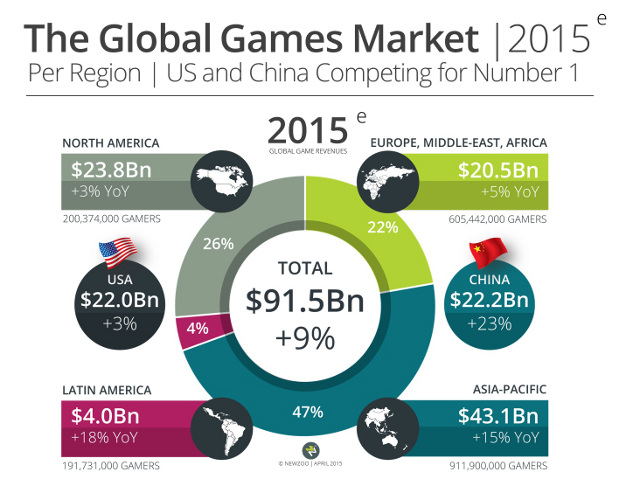
9.4% Growth for Global Games Market
The global games market is projected to experience significant expansion in 2015, with revenues expected to rise from €74.6 billion to €81.6 billion. This represents a year-on-year growth rate of 9.4%.
- The global games market is projected to grow by 9.4% in 2015, increasing from €74.6 billion to €81.6 billion.
- China is expected to surpass the United States in 2015 to become the world’s largest games market by revenue, reaching this milestone one year earlier than previously anticipated.
- PC and Mac remain the most popular gaming platforms, commanding a 37% share of the global market.
2015 CESA Consumer Survey Report
The 2015 CESA Consumer Survey Report provides a comprehensive analysis of gaming habits and lifestyle trends among the Japanese population.
- The total number of active game players in Japan across all platforms (home console, PC, mobile, and arcade) is estimated at 48.09 million.
- Smartphone and tablet gaming is the dominant platform, with 33.31 million active users compared to other hardware categories.
- The domestic market for home console gaming consists of 52.83 million owners, 31.38 million active users, and 15.41 million continuous players.
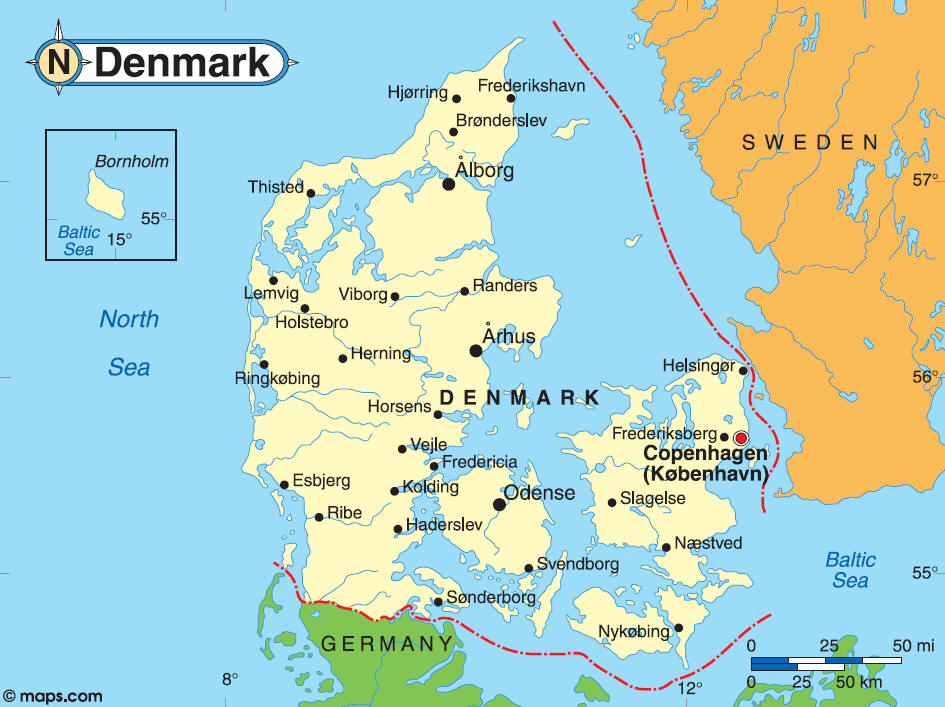
Facts and Figures about Games Industry in Denmark
The Danish games industry experienced significant growth between 2009 and 2013, establishing itself as the 27th largest market globally.
- Denmark is the 27th largest games industry in the world, with developer turnover growing 119% between 2009 and 2013.
- The country's video game export share increased by 80% during the 2009–2013 period, driving increased government investment in the sector.
- Interactive Denmark projects annual cultural support of €1.16 million and dedicated innovation funding of €2.67 million for the industry between 2015 and 2018.
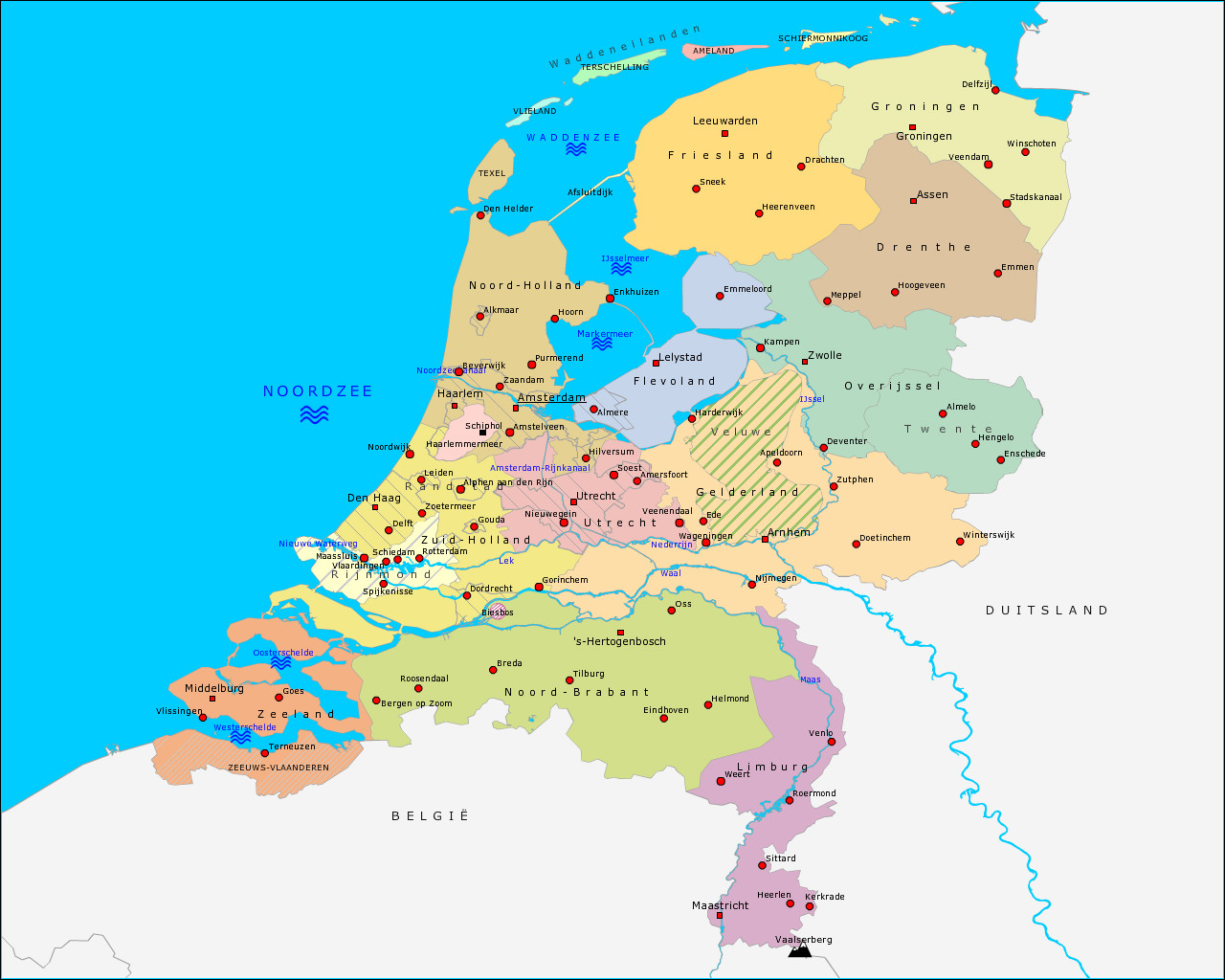
Facts and Figures About Games Industry in the Netherlands
The Dutch games industry represents a significant global market, ranking as the 16th largest in the world.
- The Dutch games industry is the 16th largest globally, generating $433.2 million (€394.27 million) in annual revenue as of 2015.
- The market is primarily driven by 'serious' games, which include training, educational, and simulation titles.
- Social gaming is the most frequent engagement method, with 43% of gamers playing these titles on a daily basis.

The Future of Match 3: What You Need to Know, Part II
This analysis examines the commercial landscape of casual, single-dimensional match 3 (SD3) mobile games as of April 2015.
- Top-grossing casual match-3 games frequently utilize more than three distinct 'destroyer' pieces, which are special items created by matching more than three basic pieces to increase player engagement and level complexity.
- Successful match-3 titles differentiate themselves by incorporating more than four unique level goals and more than four special 'block' board pieces to combat repetitiveness and provide varied tactical challenges.
- Integrating free samples of paid boosters directly into the game's tutorial familiarizes players with premium mechanics and increases the likelihood of future in-app purchases by lowering the first-purchase threshold.
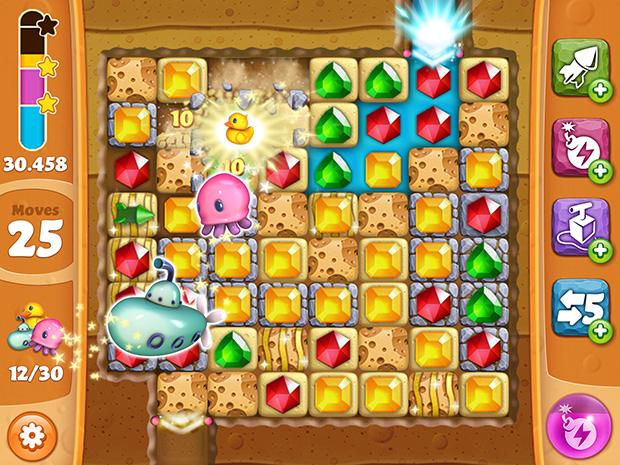
The Future of Match 3: What You Need to Know – Part I
The mobile Match 3 genre remains a dominant force in Western markets, characterized by two distinct archetypes: single-dimensional (SD3) and multi-dimensional (MD3) games.
- Match 3 games are categorized into Single-dimensional (SD3) titles, which focus on a single core layer of gameplay, and Multi-dimensional (MD3) titles, which integrate RPG or CCG elements like party management and character development.
- SD3 games, such as Candy Crush Saga and Candy Crush Soda Saga, rely on linear level progression and monetize primarily through consumable boosters, extra moves, and lives.
- MD3 games, such as Puzzle & Dragons and Marvel Puzzle Quest, utilize non-linear progression and monetize through collectibles and party progression in addition to standard consumable items.

Was the Clash of Clans Super Bowl Commercial About User Acquisition?
The Super Bowl commercial for Clash of Clans, which aired in early 2015, serves as a case study for the strategic shift of mobile game developers toward traditional, high-cost media.
- Supercell paid approximately $9 million for a 30-second Super Bowl XLIX ad spot, excluding production costs, based on NBC's rates of $4.4 to $4.5 million per spot.
- Assuming 28 million viewers saw the ad, the cost per viewer was $0.32, and a 1% conversion rate would result in a cost-per-install (CPI) of $32.08 for 281,000 new users.
- While the ad drove an increase in App Store rankings from 38th to 28th, the primary goal of such high-profile television advertising for mature games is likely brand legitimacy and re-engagement rather than pure user acquisition.

3 User Acquisition Megatrends for 2015
The mobile gaming industry faced a pivotal shift in 2015, characterized by increasing competition and the professionalization of marketing strategies.
- The provided source content contains no substantive data, analysis, or text regarding the '3 User Acquisition Megatrends for 2015' beyond the title and publication date.
- The document serves as a placeholder for a presentation delivered at PocketGamer Connects in London on January 13, 2015, but does not include the actual content of the slides.
- No specific metrics, growth rates, or strategic insights are available in the provided text to summarize.
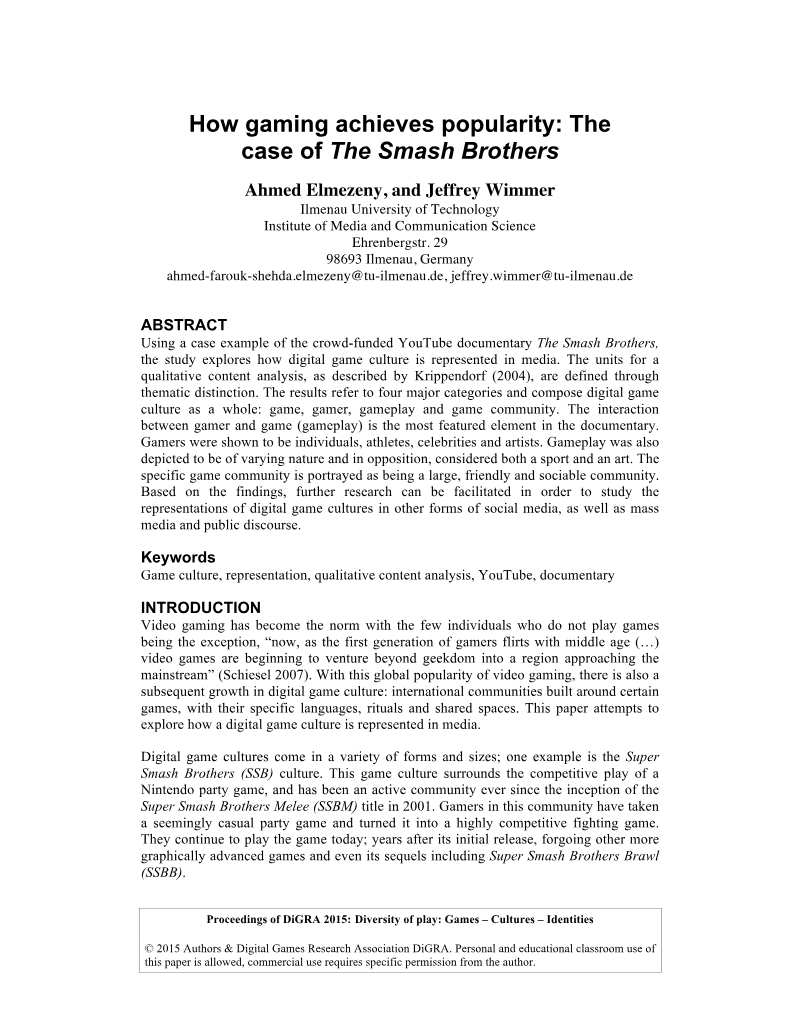
How Gaming Achieves Popularity: The Case of The Smash Brothers
A 2015 DiGRA study by Elmezeny and Wimmer examines how digital game culture is represented in mainstream and online media, using the crowd-funded YouTube documentary series The Smash Brothers as a case study.
- The study is a 2015 DiGRA paper by Elmezeny and Wimmer that uses the nine-episode, roughly 257-minute YouTube documentary series The Smash Brothers as a case study of how gaming is portrayed in media, focusing on the competitive Super Smash Bros. Melee (SSBM) community after its 2012 surge in visibility.
- A qualitative content analysis coded the documentary into four categories (gamer, game, gameplay, community), with gameplay (216 codes) and gamer (197 codes) dominating, and the portrayal of gamers was found to both challenge and reinforce stereotypes.
- The documentary underrepresents female gamers, who appear in only four instances, and the community it depicts is male-dominated and geographically split, especially between East and West Coast players.