Video Games Europe
Association39 documents
Documents
Article
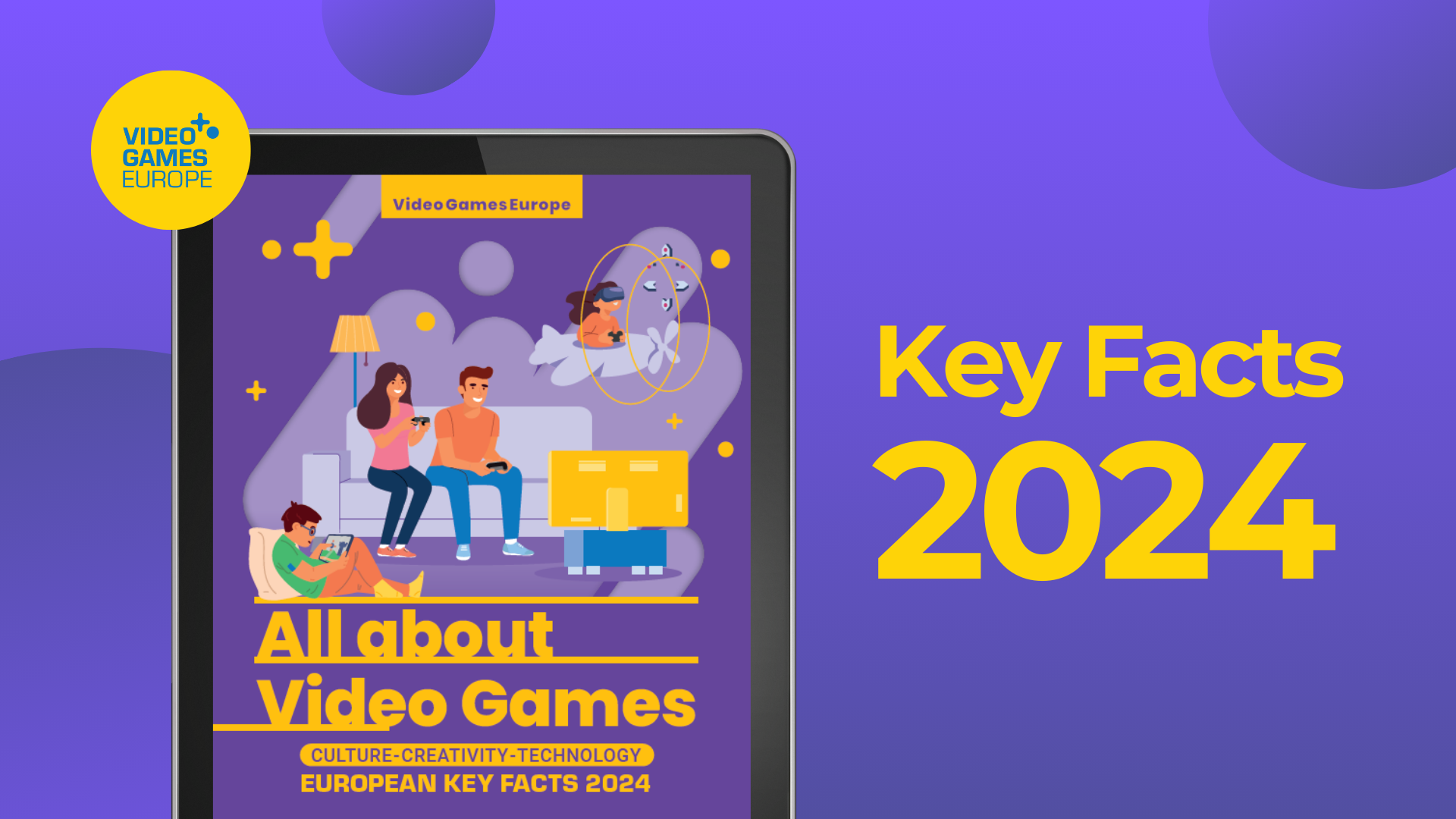
2024 All About Video Games: European Key Facts
The 2024 annual report on the European video games sector provides a comprehensive analysis of the industry’s economic performance, workforce composition, and player demographics. Produced by Video Games Europe in collaboration with the European Games Developer Federation, the report utilizes data from GameTrack Ipsos—covering France, Germany, Italy, Spain, and the UK—alongside GSD and internal member contributions to establish a definitive overview of the market.
Financially, the sector demonstrates steady growth, with revenue in key markets rising by 4% to reach 26.8 billion Euros. The industry is characterized by a strong shift toward digital distribution, which now accounts for 90% of total revenue, up from 85% in the previous year. Smartphone and tablet gaming remains the dominant revenue driver at 44%, followed by consoles at 38%, PC at 15%, and on-demand streaming at 4%.
Demographically, the European gaming landscape is broad and mature, with 54% of the population aged 6–64 engaging with video games. The average player age is 31, and 75% of the player base consists of adults. Gender representation remains balanced, with women comprising 45% of players. Engagement levels remain consistent, with an average weekly playtime of approximately nine hours.
The industry also shows positive momentum in employment, with the total European workforce increasing by 1.8% to 116,419 professionals. Women currently represent 24.9% of this workforce. These findings underscore a resilient and evolving sector that continues to integrate across multiple platforms, with 71% of players utilizing mobile devices, 59% using consoles, and 43% playing on PC.
- The European video games sector generated 26.8 billion Euros in 2024, representing a 4% year-over-year revenue growth across key markets.
- Digital distribution now accounts for 90% of total industry revenue, marking a 5% increase in market share compared to the previous year.
- Mobile gaming (smartphones and tablets) is the primary revenue driver at 44%, followed by consoles at 38%, PC at 15%, and on-demand streaming at 4%.
- The European gaming population is mature and broad, with 54% of individuals aged 6–64 playing games, an average player age of 31, and a gender split of 55% male to 45% female.
- The industry workforce grew by 1.8% in 2024 to a total of 116,419 professionals, with women accounting for 24.9% of these roles.
+1
Video Games EuropeAug 2025

Report33 pages
Power of Play: 2025 Global Video Games Report
Across more than twenty national markets, the majority of gamers report that playing video games reduces stress and enhances happiness, with 70‑90 % indicating lower stress levels and 57‑91 % feeling happier. Respondents also cite diminished anxiety and isolation, while parents observe a positive shift in relationships with their children, ranging from roughly one‑third in Sweden to nearly four‑fifths in Nigeria. Mobile devices dominate the landscape, accounting for 60‑96 % of play sessions, and online multiplayer emerges as the most prevalent social mode.
In the United Arab Emirates, United Kingdom and United States, surveys of roughly three thousand gamers reveal consistent benefits: about 70‑80 % experience reduced stress and increased well‑being, and roughly two‑thirds of parents note improved parent‑child interaction. Genre preferences diverge, with UAE players favoring teamwork, collaboration and creativity, whereas UK and US gamers gravitate toward problem‑solving, critical‑thinking and cognitive‑skill development. Approximately half to sixty percent of participants perceive gaming as supportive of career‑related or hobby pursuits, and a similar share report enhancements in professional competencies.
Research spanning multiple sectors demonstrates that video‑game‑based training yields measurable gains in cognition, decision‑making speed and technical performance. Gamers outperform non‑gamers in robotic‑surgery simulations, emergency‑response drills and retail‑seasonal‑sales scenarios, with meta‑analyses confirming statistically significant improvements in perception, attentional control and procedural accuracy. These outcomes translate into higher job performance, reduced error rates and stronger return on investment, prompting organizations such as NASA, the U.S. Air Force and elite sports teams to integrate game‑based platforms into their training pipelines.
- Video games provide measurable professional benefits, with gamers outperforming non-gamers in robotic surgery, emergency response, and retail simulations due to improved cognition, decision-making speed, and attentional control.
- Organizations including NASA, the U.S. Air Force, and elite sports teams have integrated game-based platforms into their training pipelines to reduce error rates and improve return on investment.
- Mobile devices are the primary gaming platform globally, accounting for 60–96% of all play sessions.
- A majority of gamers across more than twenty national markets report significant mental health benefits, with 70–90% experiencing reduced stress and 57–91% reporting increased happiness.
- Approximately 50–60% of gamers report that gaming supports their career or hobby pursuits and enhances professional competencies.
+1
Video Games EuropeJan 2025
Legal3 pages
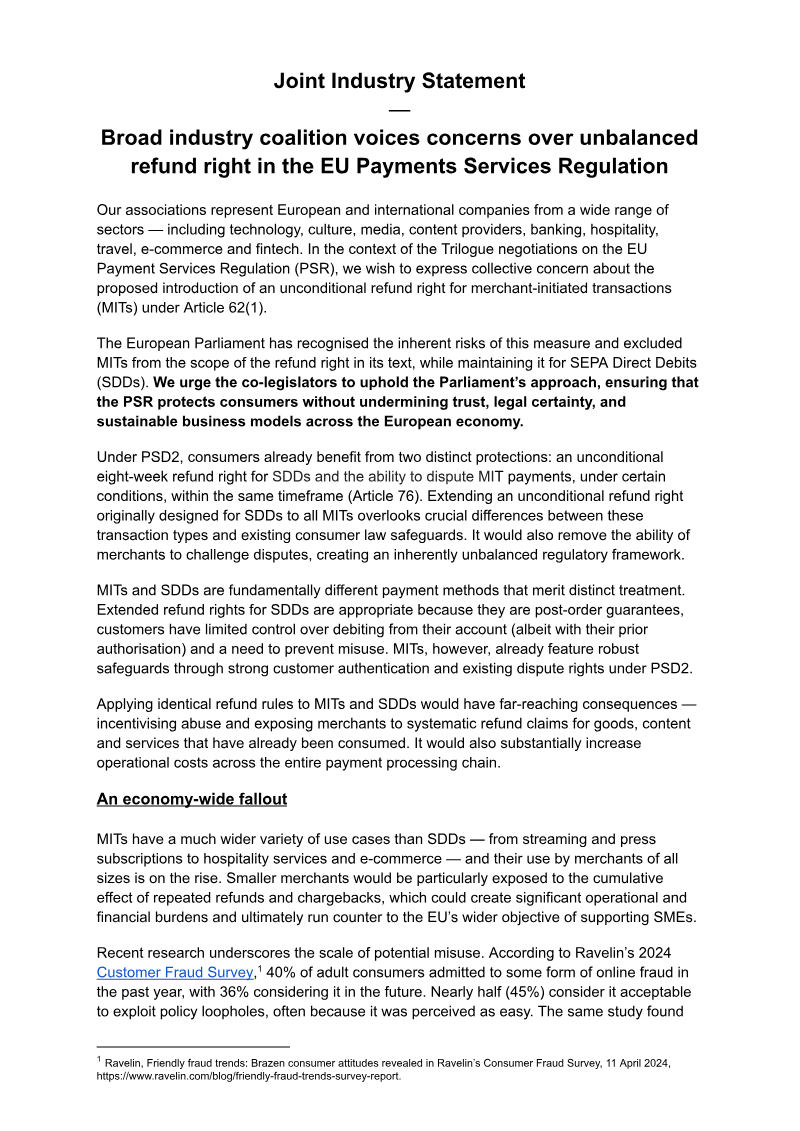
Joint Industry Statement
A coalition of European and international industry associations representing technology, media, banking, hospitality, travel, e‑commerce and fintech firms has voiced collective concern over the proposed unconditional refund right for merchant‑initiated transactions (MITs) in the EU Payment Services Regulation. The central argument is that extending the eight‑week unconditional refund provision, originally designed for SEPA Direct Debits (SDDs), to all MITs would create an unbalanced regulatory framework that undermines legal certainty, increases fraud risk and jeopardises the sustainability of many business models across the European economy.
The coalition points to existing consumer protections under PSD2, which already grant an unconditional eight‑week refund for SDDs and a conditional dispute right for MITs, as sufficient. It cites a 2024 consumer fraud survey indicating that 40 % of adults admitted to some form of online fraud in the past year, 45 % view exploiting policy loopholes as acceptable, and 26 % regularly use multiple accounts to obtain free digital content. Extending unconditional refunds to MITs would likely amplify these behaviours, exposing merchants to systematic refund claims for goods and services already consumed.
Sector‑specific analysis highlights heightened vulnerability for digital content providers, hospitality operators and subscription‑based e‑commerce services, where unconditional refunds could erode revenue predictability, increase operational costs and strain smaller merchants. The coalition warns that such outcomes run counter to EU objectives of supporting SMEs and maintaining a trustworthy payments ecosystem.
The position urges legislators to retain the refund right exclusively for SDDs, rely on the existing PSD2 dispute mechanisms, and await the forthcoming Digital Fairness Act before introducing additional consumer‑protection measures in payments law.
- A coalition of cross-industry associations is lobbying against a proposed EU regulation that would grant an unconditional eight-week refund right for all merchant-initiated transactions (MITs).
- The coalition argues that extending this refund right—currently limited to SEPA Direct Debits—would create significant fraud risks and threaten the financial sustainability of subscription-based, digital content, and hospitality business models.
- Data from a 2024 consumer fraud survey indicates that 40% of adults experienced online fraud in the past year, while 45% of consumers believe exploiting policy loopholes is acceptable.
- The survey further reveals that 26% of consumers regularly use multiple accounts to obtain free digital content, suggesting that unconditional refunds would likely incentivize systematic abuse.
- Industry stakeholders contend that existing consumer protections under PSD2, which provide conditional dispute rights for MITs, are already sufficient to protect users.
Video Games EuropeJan 2025
Article
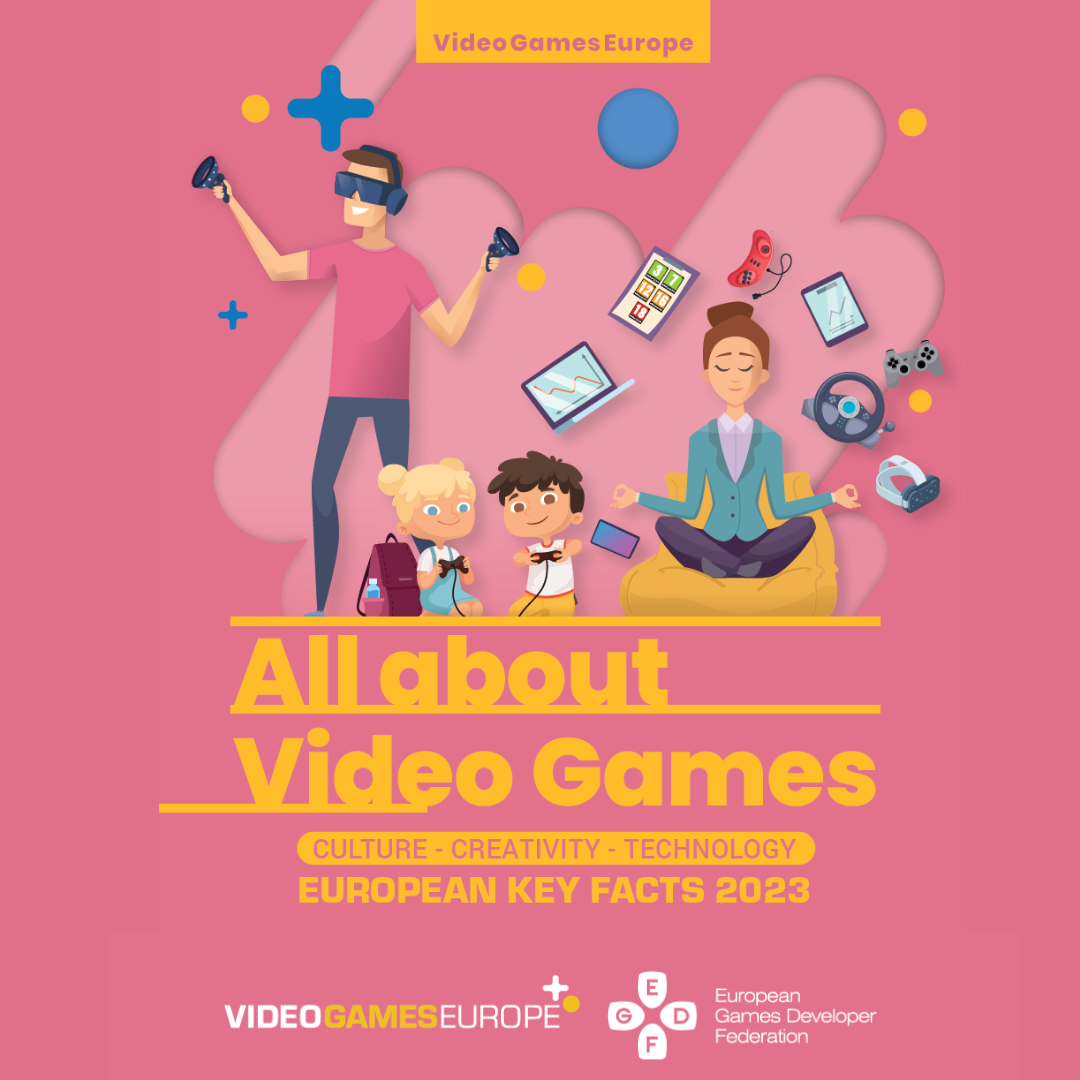
2023 All About Video Games: European Key Facts
The 2023 Key Facts report provides a comprehensive overview of the European video games sector, emphasizing its role as a significant driver of culture, creativity, and technological innovation. Produced by Video Games Europe in collaboration with the European Games Developer Federation, the analysis focuses on market performance, demographic trends, and the industry’s commitment to responsible gameplay across five major European markets.
The industry demonstrated robust economic health in 2023, generating €25.7 billion in revenue, which represents a 5% increase over the previous year. This growth is supported by a substantial workforce of 114,400 professionals engaged in diverse roles ranging from design and sound engineering to publishing and technology development. Notably, women account for 24.4% of this workforce. The consumer base remains broad and mature; 53% of the population aged 6–64 plays video games, with 124.4 million active players across the studied markets. The average age of a European player is 31, and 75% of the gaming population is aged 18 or older.
A central pillar of the industry’s operational framework is the promotion of safe and responsible gaming environments. The Pan-European Game Information (PEGI) rating system, which marked its 20th anniversary in 2023, remains a critical tool for consumer protection. Currently active in 40 countries with 2,600 member companies, the system has classified over 40,000 titles. Parental engagement with these standards is high, as 79% of parents are aware of PEGI labels, and 76% utilize them to guide purchasing decisions for their children. These findings underscore a mature, economically vital industry that balances commercial expansion with a structured approach to player safety and age-appropriate content.
- The European video games sector generated €25.7 billion in revenue in 2023, marking a 5% year-over-year increase.
- The industry employs 114,400 professionals across design, publishing, and technology, with women representing 24.4% of the workforce.
- Video games have reached a broad demographic, with 124.4 million active players across the five studied markets, representing 53% of the population aged 6–64.
- The European gaming audience is mature, with an average player age of 31 and 75% of the gaming population aged 18 or older.
- The PEGI rating system, which celebrated its 20th anniversary in 2023, has classified over 40,000 titles and is supported by 2,600 member companies.
+1
Video Games EuropeAug 2024
Report6 pages
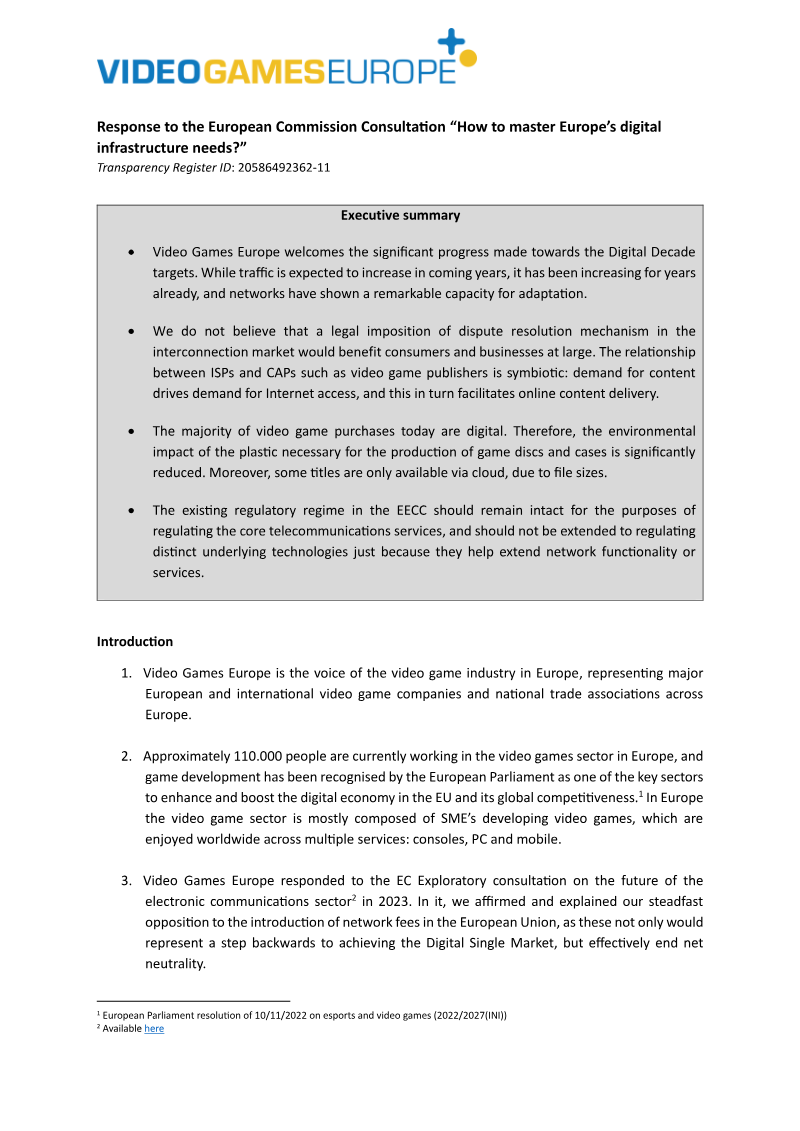
How to Master Europe’s Digital Infrastructure Needs?
Video Games Europe argues that Europe’s digital infrastructure policy should reinforce, rather than reshape, the existing market dynamics that underpin the continent’s thriving video‑game ecosystem. Representing roughly 110 000 employees and a €24.5 billion industry in which 53 percent of Europeans play, the association stresses that the sector’s growth is driven by digital distribution, which already reduces the environmental burden of physical media and, in many cases, relies on cloud delivery to limit data transfer. Typical online gameplay consumes between 60 and 80 megabytes per hour, with even the most data‑intensive titles rarely exceeding 250–300 megabytes, a fraction of the traffic generated by video streaming services.
The response highlights that network operators successfully managed the surge in traffic during the COVID‑19 lockdowns and that game publishers have collaborated with ISPs and content‑delivery networks to smooth peak loads through measures such as off‑peak download scheduling. It refutes claims that content providers “free‑ride” on ISP infrastructure, noting that publishers already pay for enhanced upload capacity and invest in their own CDN and data‑centre assets. Consequently, the relationship between content and application providers and ISPs is portrayed as symbiotic, fostering competition and consumer choice.
Against proposals to impose network fees or extend the European Electronic Communications Code to cloud services, the association warns that such pre‑emptive regulation could undermine net neutrality, increase consumer prices, and jeopardise Europe’s digital competitiveness. It calls for regulatory stability to protect investment security and urges that any infrastructure deployment be guided by concrete market demand rather than aspirational targets. The position draws on industry data, BEREC assessments of network resilience, and the sector’s own mitigation practices, concluding that preserving the current regulatory framework will best support sustainable growth and innovation across Europe’s digital economy.
- Video Games Europe opposes new network fees or expanded regulation of cloud services, arguing these measures would threaten net neutrality, increase consumer costs, and damage European digital competitiveness.
- The European video game industry generates €24.5 billion in annual revenue and employs approximately 110,000 people, with 53 percent of the European population participating in gaming.
- Gaming traffic is significantly lower than video streaming, with typical online gameplay consuming 60–80 megabytes per hour and high-intensity titles rarely exceeding 300 megabytes per hour.
- Game publishers refute 'free-riding' allegations by noting they already invest in their own data centers and content-delivery networks (CDNs) while paying for enhanced upload capacity.
- The industry maintains that existing market dynamics are sufficient, citing the successful management of COVID-19 traffic surges and ongoing collaboration with ISPs to schedule downloads during off-peak hours.
+3
Video Games EuropeJun 2024
Report14 pages
Children’s In-Game Spending 2024
Ipsos’ fifth edition of the In‑Game Spending by Children and Parent Supervision study tracks how European families manage micro‑transactions in video games, focusing on trends from 2018 through 2024. The research aims to gauge the prevalence of child‑initiated spending, the amount of money involved, and the supervisory mechanisms parents employ. The 2024 survey covered the United Kingdom, France, Germany, Spain and Italy, sampling 2,772 adults with children who play games and 10,998 gamers aged 11‑64, using quota‑based online panels weighted to national populations.
Three‑quarters of parents report that their children do not purchase in‑game extras, a proportion that has remained stable since 2020. Among the 26 % who do spend, average monthly outlays fell to €31, down €8 from the previous year, with 73 % of spenders allocating €1‑20 per month. Gameplay‑impacting items such as new weapons or powers attract the most expenditure (38 %), while decorative cosmetics account for 30 % and loot‑box‑type rewards remain the least popular at 21 %. Parental oversight is high: 95 % of spending households have an agreement with their child, and 63 % maintain explicit rules, either requiring permission (49 %) or setting limits (27 %). Permission‑based agreements and two‑factor authentication have risen year‑on‑year, while a minority (5 %) admit to monitoring nothing.
Among all gamers surveyed, only 11 % have ever bought real‑money in‑game currency and 4 % have purchased loot boxes, figures that have shown little change over
- The majority of children (74%) do not make in-game purchases, a stability trend maintained since 2020.
- Among the 26% of children who do spend money in-game, the average monthly expenditure dropped to €31, with 73% of these spenders limiting their costs to €20 or less per month.
- Gameplay-impacting items like weapons or powers are the primary drivers of spending (38%), followed by decorative cosmetics (30%) and loot-box rewards (21%).
- Parental oversight is robust, with 95% of spending households having established agreements and 63% enforcing explicit rules such as mandatory permission (49%) or spending caps (27%).
- Only 11% of all surveyed gamers have purchased real-money in-game currency, and only 4% have purchased loot boxes, with both figures remaining largely stagnant.
+1
Video Games EuropeJun 2024
Report4 pages
Transparent and Fair Purchases of In-Game Content
The initiative seeks to ensure that European players can make informed, transparent decisions when purchasing in‑game content, while safeguarding minors from unintended spending. It builds on the PEGI Age Rating System, now operating in forty countries, and introduces a three‑part policy framework: the PEGI Code of Conduct for purchasable content, additional safeguards focused on younger players, and coordinated information campaigns supported by trusted data.
Statistical evidence shows that 20.8 % of all games receiving a PEGI rating include in‑game purchase options, with 3 % offering paid random items such as loot boxes. An annual Ipsos survey commissioned by Video Games Europe from 2018 to 2024, covering the five largest European consumer‑spend markets, reveals that parental supervision remains high—95 % of Swedish parents monitor spending—and that 76 % of parents report their children do not make in‑game purchases, a figure stable since 2020. Average spend among permitted purchasers fell 21 % in the Netherlands since 2023, and only 11 % of players aged 11‑64 have bought in‑game currency across the surveyed regions.
The PEGI Code of Conduct obliges signatories to display a dedicated icon at the point of purchase, provide receipts, and clearly state the real‑world cost of any virtual currency. For paid random items, it mandates visible notices, confirms that such purchases are optional, and requires transparent probability disclosures in line with data‑protection laws. Additional safeguards include parental tools that default to zero spending for child accounts, separation of transaction interfaces from gameplay, and refund mechanisms for unauthorized purchases. Policies also prohibit the use of in‑game assets for illegal gambling or unauthorised trading, with enforcement powers vested in the PEGI Enforcement Committee.
Information campaigns, such as the Pan‑European “Seize the Controls” effort, aim to raise awareness of these tools and safeguards in national languages, leveraging partnerships with Safer Internet Centres and other stakeholders. The industry welcomes further support from EU institutions and member states to amplify outreach and reinforce responsible spending practices across the European gaming ecosystem.
- The PEGI Code of Conduct mandates that signatories display purchase icons, provide receipts, and disclose real-world costs for virtual currency, while requiring transparent probability disclosures for paid random items like loot boxes.
- Only 20.8% of PEGI-rated games include in-game purchase options, with just 3% of all rated games offering paid random items.
- Parental supervision remains robust, with 76% of parents reporting their children do not make in-game purchases, a figure that has remained stable since 2020.
- Industry safeguards now include parental tools that default child accounts to zero spending, the separation of transaction interfaces from gameplay, and established refund mechanisms for unauthorized purchases.
- Data from 2018–2024 indicates that only 11% of players aged 11–64 have purchased in-game currency across the five largest European markets.
+1
Video Games EuropeApr 2024
Legal6 pages
AI and Copyright
The paper advocates a balanced approach to artificial‑intelligence deployment in the European video‑games sector, emphasizing that AI should be nurtured as a driver of creativity and economic growth while preserving the core objectives of the existing copyright framework. It argues that the industry’s reliance on technological innovation and a robust copyright regime is essential for long‑term investment, and that any regulatory response must protect creators, respect trade secrets and avoid unnecessary burdens on developers and players.
AI has been embedded in games for more than a decade, from procedural terrain generation to advanced moderation tools, and generative models now promise to accelerate content creation, reduce production costs and enrich player experiences. The paper notes that most AI applications remain non‑generative, but where generative tools are used—whether for code, narrative or visual assets—they should be treated as ordinary creative aids: works that reflect a human author’s original choices retain copyright protection. It endorses the text‑and‑data‑mining exceptions of the EU’s DSM Copyright Directive as a suitable legal basis for training models, warning against additional EU legislation that could create uncertainty and distort competition.
Risk‑based regulation is recommended, with low‑risk uses such as internal foundation models for short dialogue exempt from mandatory transparency or labeling. Mandatory disclosure should be limited to cases where it does not jeopardize trade secrets or impose disproportionate costs, and labeling obligations are deemed unnecessary in contexts where players already expect AI‑assisted content. The paper also highlights the need for international cooperation to harmonize standards and protect creators globally.
The position reflects the perspective of a pan‑European industry body representing 19 game companies and 13 national trade associations, a sector valued at €24.5 billion with 53 % of Europeans identified as players. It calls on policymakers to engage continuously with stakeholders, to proceed cautiously with any legal changes, and to preserve the balance between innovation and creator rights that underpins the European video‑games ecosystem.
- The European video-games sector, valued at €24.5 billion with a player base comprising 53% of the population, advocates for a balanced regulatory approach that protects human creators while fostering AI-driven innovation.
- Generative AI tools should be classified as creative aids, meaning content remains eligible for copyright protection as long as it reflects the original choices of a human author.
- The industry supports the existing text-and-data-mining exceptions within the EU’s DSM Copyright Directive as the appropriate legal framework for training AI models, opposing any new legislation that could create market uncertainty.
- Regulatory frameworks should adopt a risk-based approach, exempting low-risk applications like internal foundation models for short dialogue from mandatory transparency or labeling requirements.
- Mandatory disclosure and labeling obligations should be limited to avoid compromising trade secrets, imposing disproportionate costs on developers, or addressing contexts where players already expect AI-assisted content.
Video Games EuropeApr 2024
Legal6 pages
Call for Contributions - Competition in ‘Virtual Worlds’ and Generative Artificial Intelligence
Video Games Europe submits a focused perspective on competition in virtual worlds and generative artificial intelligence, emphasizing that both technologies are central to the European video‑games sector’s ongoing innovation and consumer value. The contribution argues that regulatory interventions should be proportionate, evidence‑based, and designed to preserve the sector’s dynamism, warning that premature or overly prescriptive rules could impede the development of diverse business models and emerging services.
The analysis traces the evolution of virtual worlds from early networked games such as Mazewar (1974) through the rise of MMORPGs in the late 1990s and the recent popularity of platforms like Roblox, Fortnite and Animal Crossing, highlighting the sector’s historic reliance on immersive, persistent environments. Competition is described as vibrant, driven by talent, proprietary technologies, intellectual‑property access, data, AI advances, connectivity and net‑neutrality. Over 5,500 companies operated in the EU in 2021, with roughly 500 new developers entering the market that year, illustrating a high level of market entry and diversification. The response notes a shift toward open standards and interoperability, urging support for multilateral standard‑setting bodies while cautioning against mandatory interoperability mandates that could stifle innovation.
Regarding generative AI, the text observes that the technology is still nascent in game production but promises substantial productivity gains by enabling rapid creation of assets such as 3D models, dialogue and sound effects. It identifies key competitive factors—algorithms, data, training infrastructure, bias mitigation, skilled labour and regulatory guardrails—and stresses that existing frameworks for text‑and‑data mining and the forthcoming AI Act should remain the basis for policy, avoiding additional legislative changes without thorough impact assessment. Overall, the contribution underscores that the EU’s existing antitrust tools, including the DMA, are sufficient to address competition concerns in these fast‑moving domains, provided they are applied with continued stakeholder engagement.
- The EU video game sector remains highly competitive and dynamic, evidenced by over 5,500 active companies in 2021 and the entry of approximately 500 new developers in that year alone.
- Regulatory policy for virtual worlds and generative AI should rely on existing frameworks like the Digital Markets Act (DMA) and the AI Act, avoiding new, overly prescriptive legislation that could stifle innovation.
- While the industry is trending toward open standards and interoperability, mandatory interoperability requirements are discouraged as they risk impeding the development of diverse business models.
- Generative AI is currently in a nascent stage for game production but is expected to drive significant productivity gains by accelerating the creation of 3D assets, dialogue, and sound effects.
- Competitive advantages in the virtual worlds market are currently driven by a mix of proprietary technology, intellectual property access, data, and AI-driven advancements.
+1
Video Games EuropeMar 2024

Report4 pages
Manifesto 2024-2029: Più di un (video)gioco
The manifesto articulates a strategic vision for positioning Europe as a leading global hub for video‑game development, emphasizing the sector’s unique blend of technology and creativity. It calls for coordinated EU‑wide actions to strengthen the talent pipeline, ensure transparent content acquisition, and protect the distinctive nature of games while integrating them responsibly into broader cultural and educational contexts. Central to the argument is the need to maintain an open, competitive market; any imposed taxes, fees, or distribution constraints are portrayed as threats to investment, innovation, and the integrity of the single European market.
Key proposals include adapting the Creative Europe programme and extending the General Exemption Regulation to accommodate the specific requirements of video games, thereby aligning funding mechanisms with industry realities. The manifesto underscores the value of the PEGI rating system and co‑regulation, urging continued support for self‑regulatory frameworks that address consumer and business concerns swiftly. It advocates for comprehensive intellectual‑property safeguards, revised NACE codes to capture the sector’s economic contribution, and targeted funding through Horizon initiatives for mapping and skill‑gap analysis.
The scope spans the entire European Union and its member states, covering policy, education, and market regulation for the video‑game industry over the 2024‑2029 horizon. While no quantitative survey data are presented, the text references a network of national associations and industry bodies, indicating broad stakeholder consultation. The overarching aim is to foster diversity, equality, inclusion, climate responsibility, and child‑protection within a thriving European gaming ecosystem.
- The manifesto advocates for EU-wide policy alignment to establish Europe as a global video-game development hub by 2029, prioritizing the protection of an open, competitive market against new taxes or distribution constraints.
- Industry stakeholders are lobbying for the adaptation of the Creative Europe programme and the extension of the General Exemption Regulation to better align public funding mechanisms with the specific economic realities of game development.
- The proposal calls for the revision of NACE codes to accurately measure and report the sector's economic contribution to the European Union.
- The industry supports the continued use of the PEGI rating system and self-regulatory frameworks as the primary tools for addressing consumer protection and business concerns.
- Strategic initiatives for 2024–2029 include utilizing Horizon funding to conduct formal mapping and skill-gap analyses to strengthen the European talent pipeline.
Video Games EuropeMar 2024

Report40 pages
European Key Facts 2024: Video Games
The European video games industry represents a high-growth strategic sector that generated €26.8 billion in revenue in 2024, with digital channels accounting for 90% of all sales. This robust economic activity supports over 116,000 skilled professionals across 6,000 studios and serves a diverse player base comprising 54% of the European population. Mobile gaming remains the dominant platform, utilized by 71% of the region's 127 million players. To manage this vast ecosystem, the industry relies on the PEGI age-rating system across 40 countries, ensuring a standardized approach to consumer protection and responsible gameplay.
Central to the industry’s operational integrity is a rigorous regulatory framework focused on monetization transparency and online safety. Updated standards mandate the disclosure of loot box probabilities and strictly prohibit the exchange of virtual items for real-world currency. Safety protocols are reinforced by comprehensive parental controls, currently adopted by 67% of parents, alongside mandatory age-verification tools and reporting mechanisms for harmful content. Compliance is maintained through a tiered enforcement system, where severe violations of age-rating or safety standards can result in financial penalties of up to €500,000.
Beyond economic and regulatory concerns, the sector is increasingly defined by its commitment to social and environmental responsibility. Major regional initiatives across Spain, the United Kingdom, and Germany are driving diversity and inclusion through measurable policy changes and scholarships aimed at increasing female participation. Simultaneously, the industry is pursuing aggressive decarbonization through the Playing for the Planet Alliance and voluntary agreements that have already yielded significant energy savings in hardware manufacturing. These efforts are complemented by the integration of environmental themes into gameplay and the development of carbon calculators to assist studios in achieving long-term sustainability goals.
- The European video games industry generated €26.8 billion in 2024, with digital channels accounting for 90% of total sales.
- The sector supports 116,000 professionals across 6,000 studios and serves 127 million players, representing 54% of the European population.
- Mobile gaming is the primary platform in the region, utilized by 71% of the total player base.
- Regulatory frameworks now mandate the disclosure of loot box probabilities and prohibit the exchange of virtual items for real-world currency, with non-compliance penalties reaching up to €500,000.
- Consumer safety is supported by parental controls adopted by 67% of parents and the standardized PEGI age-rating system operating across 40 countries.
+1
Video Games EuropeMar 2024

Report19 pages
European Key Facts 2023: Video Games Industry
The European video games industry is a significant cultural and economic driver, characterized by steady growth and a commitment to responsible gameplay. In 2023, the European market reached €25.7 billion in revenue, a 5% year-on-year increase. The sector employs approximately 115,000 people across Europe, with 90,000 based in the EU. This growth is supported by a diverse player base; 53% of the European population aged 6-64 plays video games, with an average player age of 31.4 years. Notably, 75% of players are adults, and women make up 43.5% of the total gaming population.
The industry emphasizes a robust framework for minor protection and consumer transparency through the Pan European Game Information (PEGI) system. Celebrating its 20th anniversary, PEGI has issued nearly 40,000 age rating licenses across 40 countries. Awareness of these labels is high, with 79% of parents whose children play games recognizing the system. Furthermore, the industry actively promotes diversity and inclusion through various regional initiatives and addresses environmental sustainability via the Games Consoles Voluntary Agreement and the Playing for the Planet Alliance.
To maintain global competitiveness, the industry advocates for a strategic EU policy framework. Key priorities include recognizing video games as unique creative works distinct from the audiovisual sector, addressing the digital skills gap through education and STEAM programs, and maintaining a fair regulatory environment that supports small and medium-sized enterprises. The data for these findings is derived from GameTrack and Games Sales Data (GSD) surveys conducted by Ipsos, involving a sample of 60,000 individuals across major European markets to ensure national representation.
- The European video games industry generated €25.7 billion in revenue in 2023, representing a 5% year-on-year growth.
- The sector employs 115,000 people across Europe, with 90,000 of those roles based within the EU.
- Video games reach 53% of the European population aged 6–64, with an average player age of 31.4 years, 75% adult representation, and 43.5% female participation.
- The PEGI age-rating system has issued nearly 40,000 licenses over 20 years, with 79% of parents recognizing the labels.
- Industry advocacy focuses on securing a policy framework that classifies video games as unique creative works distinct from the audiovisual sector.
+1
Video Games EuropeMar 2024