Video Games Europe
Association39 documents
Documents
Report13 pages
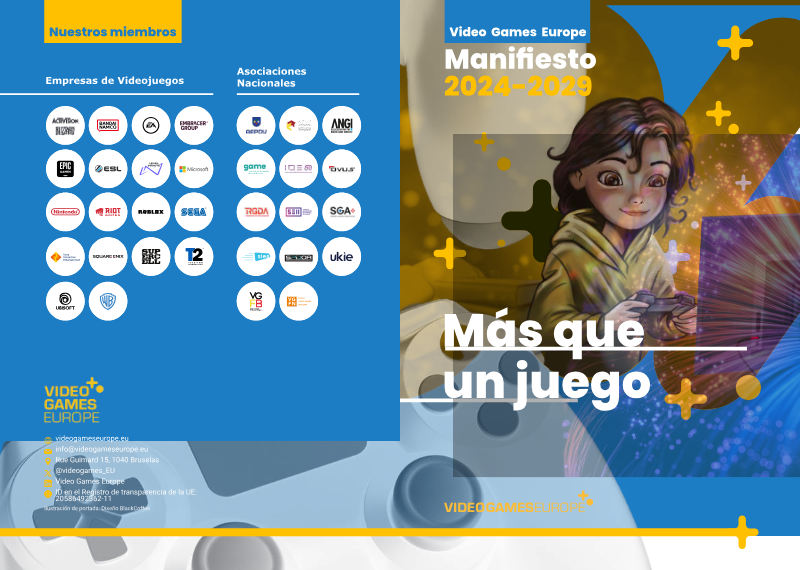
Video Games Europe Manifesto 2024-2029
Europe’s video‑game sector has expanded by 16 % between 2019 and 2024, now delivering €24 billion in revenue and employing roughly 110 000 highly‑skilled workers. More than half of the continent’s gamers are under 20 years old, and nearly half of parents rely on the PEGI age‑rating system to ensure safe play. The industry’s dual nature—combining advanced technology with creative content—underpins a call for EU‑level measures that preserve an open, tax‑free single market, extend the Creative Europe programme, apply the General Exemption Regulation to games, and reinforce intellectual‑property protection while investing in digital‑skill education, particularly STEM pathways for girls.
The PEGI framework, supported by co‑regulation, has already classified around 40 000 titles across 40 European countries, halving non‑compliance penalties and cutting energy‑consumption violations by roughly 20 %. Nevertheless, the sector faces a regulatory load of 850 new EU obligations (over 5 000 pages of rules) introduced between 2017 and 2022. A shift toward transparent self‑regulation is advocated, emphasizing clearer in‑game purchase disclosures, stronger parental‑control tools, and EU‑wide educational programmes to close digital‑skills gaps and attract diverse talent.
Safety‑by‑design requirements now obligate all publishers to integrate PEGI‑based age classification, parental‑control portals, chat moderation, purchase limits and time‑spending caps, reflecting the predominance of minors among players. The climate‑and‑inclusion agenda shows progress: women represent 23.7 % of the video‑game workforce, surpassing the 17 % share in the broader ICT sector, and industry members are adopting gender‑equality guidelines and green initiatives such as the Green Game Jam. Coordinated self‑regulation, targeted public funding, and unified online‑safety strategies are presented as essential to sustain economic contribution, foster innovation, and position Europe as the leading hub for socially responsible game development.
- The European video game sector grew by 16% between 2019 and 2024, reaching €24 billion in annual revenue and employing approximately 110,000 highly-skilled workers.
- Between 2017 and 2022, the industry faced a significant regulatory burden consisting of 850 new EU obligations spanning over 5,000 pages of rules.
- The PEGI age-rating system has successfully classified 40,000 titles across 40 countries, contributing to a 50% reduction in non-compliance penalties and a 20% decrease in energy-consumption violations.
- Women currently account for 23.7% of the European video game workforce, outperforming the 17% representation found in the broader ICT sector.
- Industry stakeholders are advocating for EU-level policies that include the application of the General Exemption Regulation to games, the preservation of a tax-free single market, and the expansion of the Creative Europe programme.
+1
Video Games EuropeJan 2024
Article
Power of Play: Global Report 2023
The Power of Play Global Report 2023 examines the multifaceted impact of video games on players, moving beyond the traditional perception of gaming as mere entertainment. The primary thesis posits that video games serve as essential tools for social connection, mental health support, and emotional well-being, supported by both player sentiment and academic research.
The findings are based on a comprehensive survey of nearly 13,000 players aged 16 and older across 12 countries, including Australia, Brazil, Canada, Japan, South Korea, the United States, and several European nations such as France, Germany, Italy, Poland, Spain, and the United Kingdom. The data indicates that while "having fun" remains the primary motivation for gaming, a significant majority of players utilize games to manage stress, find mental stimulation, and navigate difficult life periods. Furthermore, the report highlights the social utility of gaming, noting that over half of respondents engage in online multiplayer sessions, and nearly half report forming meaningful personal relationships, including friendships and romantic partnerships, through gaming platforms.
To validate these survey results, the analysis incorporates findings from approximately 15 recent peer-reviewed academic studies. This synthesis confirms that the social and emotional benefits provided by interactive gaming are distinct from other forms of media. By bridging the gap between industry-led consumer data and academic inquiry, the report concludes that video games function as a vital global gathering space that fosters creativity and positive mental health outcomes for the estimated 3 billion people who play them worldwide.
- Video games serve as a global platform for approximately 3 billion people, functioning as essential spaces for social connection, mental health support, and emotional well-being.
- A survey of nearly 13,000 players aged 16 and older across 12 countries confirms that while entertainment is the primary motivation, gaming is a critical tool for managing stress and navigating difficult life periods.
- Over 50% of surveyed players participate in online multiplayer sessions, demonstrating the medium's role as a primary social utility.
- Nearly 50% of respondents report forming meaningful personal relationships, including friendships and romantic partnerships, through gaming platforms.
- A synthesis of approximately 15 recent peer-reviewed academic studies confirms that the social and emotional benefits of interactive gaming are distinct from those provided by other forms of media.
+2
Video Games EuropeOct 2023

Article
2022 All About Video Games: European Key Facts
The 2022 European Key Facts report provides a comprehensive overview of the video game sector across Europe, emphasizing its cultural, creative, and technological significance. Produced by Video Games Europe in collaboration with the European Games Developer Federation, the publication serves as a primary resource for understanding the industry's economic footprint, demographic reach, and commitment to responsible gameplay standards.
The data reveals a robust and expanding market, with 53% of the European population aged 6 to 64 engaging with video games. The player base grew by 1.4% between 2021 and 2022, with an average player age of 32. Notably, the vast majority of these players—76%—are adults between the ages of 18 and 64. Economically, the industry remains a significant contributor to the European labor market, employing 110,000 professionals across diverse technical and creative roles, including programming, design, production, and audio. In 2022, the industry generated €24.5 billion in revenue across five key European markets.
Beyond economic metrics, the report highlights the industry’s focus on consumer safety and ethical standards. The Pan European Game Information (PEGI) rating system remains a cornerstone of this effort, having rated over 8,000 games in 2022. Awareness of these age labels is high, with 67% of parents and 73% of players recognizing the system. The findings underscore a broader industry commitment to fostering safe, responsible, and transparent gaming environments through established codes of conduct, parental control tools, and collaborative safety initiatives.
- The European video game industry generated €24.5 billion in revenue across its five primary markets in 2022.
- The sector employs 110,000 professionals in diverse roles including programming, design, production, and audio.
- 53% of the European population aged 6 to 64 plays video games, with the player base growing by 1.4% between 2021 and 2022.
- The average European gamer is 32 years old, and 76% of the total player base consists of adults aged 18 to 64.
- The PEGI rating system remains a primary safety standard, having rated over 8,000 games in 2022.
Video Games EuropeAug 2023
Legal6 pages
Video Games Europe: Position on the Right-to-Repair Directive Proposal
Video Games Europe endorses the European Commission’s draft Directive on common rules promoting the repair of goods, framing the initiative as essential to the EU’s green transition and to more sustainable consumption of electronic products. The organization argues that the gaming sector, which generated €23.3 billion in revenue in 2020, employs around 90 000 people and reaches roughly 250 million European players—over half of whom use consoles—has already established effective repair and refurbishment practices that should inform the legislation.
The core recommendation is that a replacement with a refurbished console be treated as equivalent to a repair, reflecting the voluntary agreement among major console makers (Sony, Microsoft, Nintendo) that provides authorised repair centres, a stock of refurbished units, and a typical repair turnaround of less than 14 working days. This approach is presented as both cost‑effective for consumers—repairs or refurbished replacements cost well below a new unit—and beneficial for the circular economy. The paper opposes the parliamentary proposal for mandatory loaned replacements during repairs, citing logistical complexity, fraud risk, and additional environmental burdens from extra shipping. It also welcomes the Commission’s decision to avoid fixed maximum repair times, preferring the “reasonable period of time” standard from Directive (EU) 2019/771, and supports retaining the current two‑year legal guarantee, noting that extending it would yield only 0.3 % CO₂ savings and negligible waste reduction over 15 years while imposing higher costs on firms.
A market‑based pricing regime for repairs is advocated, arguing that price controls would channel demand to manufacturers and marginalise independent repairers. The organization cautions against expanding the scope to include batteries or imposing direct producer liability, recommending that such matters be addressed within the existing Batteries Regulation and consumer‑protection framework to avoid legal uncertainty. Overall, the submission seeks to align the right‑to‑repair rules with proven industry practices, ensuring environmental objectives are met without compromising consumer convenience or market competition.
- Video Games Europe advocates that replacing a defective console with a refurbished unit should be legally recognized as equivalent to a repair, aligning with existing practices by Sony, Microsoft, and Nintendo.
- The industry currently maintains a repair turnaround time of under 14 working days through authorized centers, which they argue is more efficient than mandatory loaner programs.
- The organization opposes extending the current two-year legal guarantee, citing data that such an extension would yield only 0.3% in CO2 savings and negligible waste reduction over 15 years while increasing firm costs.
- Video Games Europe supports a market-based pricing model for repairs, warning that government price controls would likely marginalize independent repairers and distort competition.
- The gaming sector in Europe represents a significant economic force, generating €23.3 billion in 2020 and employing approximately 90,000 people to serve 250 million players.
Video Games EuropeAug 2023
Legal6 pages
Video Games Europe: Contribution on Ecodesign for Sustainable Products
The submission aims to shape the European Commission’s new ecodesign priorities by presenting the video‑games sector’s perspective on durability, repairability and the risks of imposing uniform horizontal requirements across ICT products. It argues that the industry already contributes to the EU green transition through initiatives such as the UNEP‑facilitated Playing for the Planet Alliance and the Games Console Voluntary Agreement, which embed resource‑efficiency, recyclability and out‑of‑warranty repair provisions for consoles. The sector stresses that any additional measures should build on these existing frameworks rather than create overlapping regulations.
Key observations highlight the diversity of ICT devices—consoles, PCs, laptops, tablets, smartphones, TVs and printers—and note that their functional and technical differences make a one‑size‑fits‑all approach impractical. Standardising components or limiting material counts, the response warns, could curb innovation, diminish spill‑over benefits to fields such as healthcare and AI, and restrict creative freedom for developers. It also stresses the need for safeguards protecting intellectual‑property rights and consumer safety when sharing repair information, given the reliance on proprietary diagnostic tools and trusted‑platform modules.
The commentary points out that durability, labelling and repair‑information requirements are already covered by the EU Sales of Goods Directive (2021) and the forthcoming Right‑to‑Repair proposal, and that new horizontal rules could generate legal uncertainty. The sector’s scope encompasses the European market, representing roughly 5,000 studios, over 98 000 employees and a 2021 turnover of €23.3 billion, serving more than 135 million players across 18 countries. The response, submitted in May 2023, draws on existing voluntary agreements and industry data rather than a formal survey.
- The European video game industry, comprising 5,000 studios and 98,000 employees, generated a €23.3 billion turnover in 2021 while serving over 135 million players.
- The industry argues against uniform horizontal ecodesign regulations, asserting that the functional and technical diversity of ICT devices like consoles, PCs, and smartphones makes a one-size-fits-all approach impractical.
- Existing frameworks, such as the Games Console Voluntary Agreement and the UNEP-facilitated Playing for the Planet Alliance, already address resource efficiency, recyclability, and out-of-warranty repair provisions.
- Mandatory standardization of components or material limits could stifle innovation, restrict creative freedom for developers, and negatively impact spill-over benefits in fields like AI and healthcare.
- The sector warns that new horizontal rules risk creating legal uncertainty, as durability, labeling, and repair requirements are already governed by the EU Sales of Goods Directive (2021) and the Right-to-Repair proposal.
Video Games EuropeMay 2023
Legal6 pages
The Future of the Electronic Communications Sector and Its Infrastructure – Video Games Europe Reply
Video Games Europe argues that imposing network fees on high‑bandwidth users would harm consumers, the broader Internet ecosystem and the European video‑games sector. The contribution to the European Commission’s exploratory consultation stresses that such fees are legally, technically and practically untenable, and directly conflict with the net‑neutrality principle enshrined in the Open Internet Regulation. It contends that content and application providers (CAPs) do not “free‑ride” on telecom infrastructure; instead, they generate demand that fuels competition and investment in connectivity, creating a mutually reinforcing virtuous cycle that benefits both ISPs and end‑users.
The position paper highlights several concrete concerns. First, mandatory contributions would add a financial burden to video‑game publishers already obliged under the Digital Content Directive to deliver frequent updates and security patches, potentially requiring costly deep‑packet inspection to differentiate fee‑eligible traffic. Second, the introduction of traffic‑based fees threatens the equal treatment of data flows, jeopardising net neutrality and prompting opposition from civil‑society groups and a large cohort of European Parliament members. Third, the sector points to evidence from BEREC and ETNO that data‑traffic growth has not translated into proportional energy consumption, thanks to efficiency gains and renewable‑energy adoption; cloud‑based delivery models further reduce carbon footprints by limiting unnecessary downloads and hardware upgrades.
Scope-wise, the analysis covers the European Union’s electronic‑communications market as of 2023, focusing on the video‑games industry, which comprises roughly 5,100 studios and publishers, generates an estimated €12 billion in annual turnover, employs over 90 000 people and recorded €23 billion in consumer spending in 2021. The contribution draws on industry membership data, BEREC sustainability reports and internal assessments rather than a formal survey, reflecting the collective view of 19 major publishers and national trade associations across 15 EU countries. The overarching conclusion is that network fees are unnecessary, would diminish Europe’s digital competitiveness, and could impede environmental progress, urging policymakers to preserve the current open‑Internet framework.
- Video Games Europe opposes mandatory network fees for high-bandwidth users, arguing they violate net-neutrality principles and would harm the European video-game sector.
- The European video-games industry comprises approximately 5,100 studios and publishers, generating €12 billion in annual turnover and €23 billion in consumer spending as of 2021.
- Imposing traffic-based fees would create significant financial and technical burdens for publishers, who are already required by the Digital Content Directive to provide frequent security patches and updates.
- Data-traffic growth has not resulted in proportional increases in energy consumption due to efficiency gains and the adoption of renewable energy, according to BEREC and ETNO data.
- The sector employs over 90,000 people across the EU and argues that content providers drive demand for connectivity, creating a mutually beneficial cycle for both ISPs and end-users.
+1
Video Games EuropeMay 2023
Legal7 pages
Initiative on Virtual Worlds: A Head Start Towards the Next Technological Transition
The response aims to shape EU policy on virtual worlds and the emerging metaverse by presenting the video games sector’s perspective, emphasizing that the concept remains fluid and should not be prematurely defined. It argues that existing EU digital legislation—covering consumer protection, competition, data protection, and cybersecurity—already applies to virtual environments, and that imposing legal interoperability at this early stage would hinder innovation. The submission stresses the strategic importance of digital‑skills education, urging a holistic pipeline from primary schools to higher education and the removal of immigration barriers to attract global talent.
Historical evidence shows that virtual worlds have long existed in games, from the 1974 MazeWar prototype to contemporary platforms such as Roblox, Fortnite and Animal Crossing, demonstrating their role in fostering social capital and community resilience, especially during the COVID‑19 pandemic. Empirical data underline the sector’s economic weight: European consumer spending reached €23 billion in 2021, the industry comprises over 5,100 studios, generates more than €12 billion in annual turnover and employs roughly 90 000 people. A forecast for Sweden predicts a shortfall of 25 000 game developers by 2031, highlighting a broader talent gap across the EU.
The text calls for expanded public‑funding mechanisms—Horizon Europe, Digital Europe, InvestEU—and the inclusion of video games in the General Block Exemption Regulation to enable SMEs to access support. It also advocates for greater awareness of existing R&I schemes, stronger public‑private partnerships, and the preservation of unlicensed spectrum for Wi‑Fi to sustain network capacity, noting that current fixed‑line and mobile traffic growth rates have stabilized below 20 % and 10 % respectively. Overall, the submission positions the video games industry as a catalyst for Europe’s digital transition while urging measured, standards‑based regulation that respects market dynamics.
- The European video game industry is a significant economic driver, generating over €12 billion in annual turnover, employing approximately 90,000 people, and reaching €23 billion in consumer spending in 2021.
- The sector faces a critical talent shortage, exemplified by a projected shortfall of 25,000 game developers in Sweden alone by 2031, necessitating improved digital-skills education and reduced immigration barriers for global talent.
- Existing EU digital legislation regarding consumer protection, competition, data protection, and cybersecurity is sufficient for virtual environments, and the industry warns that premature legal mandates for interoperability would stifle innovation.
- The industry advocates for expanding public-funding access through Horizon Europe, Digital Europe, and InvestEU, specifically requesting the inclusion of video games in the General Block Exemption Regulation to support SMEs.
- Virtual worlds are established platforms for social capital, with historical roots dating back to the 1974 MazeWar prototype and modern iterations including Roblox, Fortnite, and Animal Crossing.
+1
Video Games EuropeMay 2023
Legal5 pages
Video Games Europe & EGDF: Position on the Product Liability Directive Review
Video games and their developers argue that the European Commission’s proposal to revise the Product Liability Directive (PLD) would unjustly broaden liability by treating standalone software, including video games, as generic “products.” The core thesis is that video games are complex cultural works comprising software, music, narrative, graphics and user‑generated content, and therefore should not be subject to the strict, no‑fault liability regime designed for high‑risk physical goods. The position stresses that existing legal frameworks—such as the Computer Programs Directive, the 2001/21/EC Copyright Directive, the Digital Content Directive, the GDPR, and consumer‑rights legislation—already provide adequate protection, while the proposed PLD amendment would create legal uncertainty, overlap, and disproportionate exposure for developers.
Key findings highlight the sector’s long‑standing self‑regulation through the PEGI age‑rating system, now used in 38 European countries, and the deployment of parental‑control tools on consoles and other platforms for two decades. Survey data from the Commission’s impact assessment reveal low public support for compensating damages caused by intangible items that do not drive a device, with only 42 % agreeing to such liability for software apps and 48 % for the category that would include video games. The paper notes that the PLD’s definition of “defectiveness” relies on vague concepts such as “reasonably foreseeable misuse,” which could unfairly penalise iterative software development and frequent patching practices.
The scope of the argument covers the entire European Union, referencing 27 Member States and the broader digital market. Economic data underscore the sector’s significance: the European video‑games market generated approximately €23 billion in consumer spending in 2021, comprises over 5,100 studios with a combined turnover of €12 billion, and employs around 90 000 people. EGDF represents more than 2 500 developer studios and 45 000 employees across 22 countries. No primary survey was conducted; the analysis relies on existing EU impact‑assessment questionnaires and legal precedents from the Court of Justice of the EU.
Conclusions call for the exclusion of video games from the PLD’s definition of “product,” warning that the proposed liability regime could deter innovation, increase litigation risk, and undermine Europe’s digital and cultural future. The paper urges policymakers to retain the current, sector‑specific regulatory architecture and to avoid a one‑size‑fits‑all approach that fails to distinguish between high‑risk physical products and interactive digital entertainment.
- The European video game industry, comprising over 5,100 studios and 90,000 employees, opposes the European Commission’s proposal to classify standalone software as 'products' under the Product Liability Directive (PLD).
- Industry stakeholders argue that the proposed no-fault liability regime for physical goods is ill-suited for complex cultural works like video games, which are already governed by existing frameworks such as the Digital Content Directive and GDPR.
- Public support for extending liability to intangible items like software remains low, with only 48% of respondents in the Commission’s own impact assessment favoring such measures for video games.
- The sector warns that the PLD’s vague definition of 'defectiveness' and 'reasonably foreseeable misuse' could penalize iterative software development and frequent patching practices.
- The European video game market generated approximately €23 billion in consumer spending in 2021, and the industry maintains that current self-regulation, such as the PEGI age-rating system used in 38 countries, provides sufficient consumer protection.
+1
Video Games EuropeMar 2023

Legal15 pages
Position Paper: Public Consultation for the Fitness Check of EU Consumer Law on Digital Fairness
The analysis contends that the existing EU consumer‑protection framework is already adequate for ensuring digital fairness in the video‑game sector and should be fully deployed before any new legislation is considered. It calls for a coordinated, holistic approach that aligns the 2021 Guidance on digital services and the enforcement powers granted by the Omnibus Directive, and urges the European Commission to publish clear, ex‑ante guidelines on fair commercial practices. The industry’s self‑regulatory PEGI system, which enjoys roughly three‑quarters consumer awareness and provides age‑appropriate ratings, is presented as a cornerstone of this coordinated framework.
Evidence is offered that the current acquis effectively bans manipulative tactics such as bait‑and‑switch and false testimonials, with notable success in the gaming market. Coordinated actions by national consumer protection authorities on in‑app purchases during 2013‑14 and the Italian competition authority’s 2020 commitments on loot‑box transparency illustrate the system’s capacity to curb unfair practices. The analysis warns that forthcoming rules could duplicate or undermine these established mechanisms.
A specific argument is made regarding in‑game currencies, which are characterised as non‑convertible digital content lacking real‑world monetary value. Accordingly, they should be exempt from “monetary equivalence” regulations, provided that transparency is achieved by displaying the real‑currency price at the point of purchase and clearly informing players of the transaction details. The overall recommendation is to rely on the existing EU consumer‑protection instruments, reinforced by industry self‑regulation, to safeguard digital fairness across the European video‑game market.
- The existing EU consumer-protection framework is sufficient for ensuring digital fairness in the video-game sector, and no new legislation should be introduced until current powers are fully utilized.
- The industry’s self-regulatory PEGI system is a core component of the current framework, currently maintaining approximately 75% consumer awareness regarding age-appropriate ratings.
- Existing EU regulations already effectively prohibit manipulative commercial practices such as bait-and-switch tactics and false testimonials within the gaming market.
- Historical enforcement actions, including the 2013-14 coordinated efforts on in-app purchases and the 2020 Italian competition authority ruling on loot-box transparency, demonstrate that current mechanisms are capable of curbing unfair practices.
- In-game currencies should remain exempt from monetary equivalence regulations, provided that developers display real-currency pricing at the point of purchase and clearly disclose transaction details.
+1
Video Games EuropeFeb 2023
Legal7 pages
European Commission Proposal for a Regulation Laying Down Rules to Prevent and Combat Child Sexual Abuse
The position presented by Video Games Europe and the European Games Developer Federation seeks to shape the European Commission’s proposed regulation on child sexual abuse online by emphasizing that interactive video‑game environments already embody a robust, safety‑by‑design framework. It argues that the sector’s long‑standing tools, standards and cooperation mechanisms make online gaming one of the safest digital activities for children, and that regulatory measures should be calibrated to the low risk inherent in in‑game communications rather than applying a uniform, high‑risk model.
Across Europe more than half of the population engages in video‑game play, with children constituting a significant share. In‑game chat is typically short, text‑or voice‑based, pseudonymous, filtered, reportable and can be disabled, limiting opportunities for the exchange of illicit material. Empirical evidence shows a minimal incidence of abuse: a 2020 Ofcom/ICO survey of roughly 4,000 respondents found only 2 % of adults and 3 % of children reporting harms via gameplay, while an Interpol report noted no significant rise in cases of children targeted on game platforms. NCMEC’s 2021 Cybertipline data confirm that CSAM and grooming incidents on video‑game services are considerably lower than on platforms centred on photo or video sharing. An Ipsos poll further reveals that 60 % of parents restrict multiplayer access and, among the 40 % who allow it, 80 % supervise interactions.
The
- Video Games Europe and the European Games Developer Federation argue that gaming platforms should be exempt from uniform high-risk regulatory models because they already utilize safety-by-design frameworks.
- Data from the 2021 NCMEC Cybertipline indicates that incidents of child sexual abuse material (CSAM) and grooming are significantly lower on video game services compared to platforms focused on photo or video sharing.
- A 2020 Ofcom/ICO survey of 4,000 respondents found that only 2% of adults and 3% of children reported experiencing harms via video game play.
- Interpol reports indicate there has been no significant rise in cases of children being targeted on video game platforms.
- Parental oversight is high, with 60% of parents restricting multiplayer access and 80% of those who allow it actively supervising their children's interactions.
+1
Video Games EuropeFeb 2023

Report19 pages
European Key Facts 2023
This analysis provides a comprehensive overview of the European video game sector in 2023, detailing market health, player demographics, and regulatory priorities. The industry demonstrated resilience with annual revenues reaching €25.7 billion, representing a 5% year-on-year increase. Employment also saw significant growth, with the workforce expanding by nearly 7% to reach approximately 115,000 people across Europe.
The data reveals that video games are a mainstream cultural fixture, with 53% of the European population aged 6–64 identifying as players. Contrary to youth-centric stereotypes, the average player age is 31.4 years, and 75% of the gaming population are adults. Women represent 43.5% of the total player base, averaging 6.7 hours of play per week. While smartphones remain the most popular platform (68%), consoles (56%) and PCs (46%) maintain significant engagement. Despite the rise of digital media, average weekly playtime has remained stable for over a decade at approximately 8.9 hours.
A central thesis of the findings is the industry’s commitment to social responsibility and self-regulation. The Pan European Game Information (PEGI) system celebrated 20 years of operation, with 79% of parents aware of its ratings and 62% actively using parental tools to manage gameplay. Furthermore, the industry is increasingly focused on sustainability and diversity, noting that 44% of new hires in regions like Sweden are women and highlighting energy-saving agreements that have saved 54 TWh of electricity over the lifetime of major consoles.
The geographic scope covers the European Union and broader European markets, utilizing data from Ipsos, GameTrack, and Games Sales Data (GSD). Methodology includes online polling of 60,000 individuals across major markets, calibrated by nationally representative face-to-face surveys. Looking forward, the industry advocates for EU policy that recognizes video games as unique creative works, supports a robust talent pipeline through STEAM education, and maintains a fair regulatory framework that avoids distorting the single market.
- The European video game sector generated €25.7 billion in 2023, marking a 5% year-on-year revenue increase.
- Industry employment grew by nearly 7% in 2023, reaching a total workforce of approximately 115,000 people across Europe.
- Video games are a mainstream fixture with 53% of the population aged 6–64 identifying as players, maintaining a stable average of 8.9 hours of gameplay per week.
- The player base is mature and diverse, with an average age of 31.4 years, 75% adult representation, and 43.5% female participation.
- Smartphones are the leading platform at 68% usage, followed by consoles at 56% and PCs at 46%.
+1
Video Games EuropeJan 2023
Legal6 pages
Video Games Europe: Position on the Green Transition Consumer Directive
The text articulates Video Games Europe’s response to the European Commission’s proposal for a Directive that would empower consumers in the green transition, emphasizing the sector’s commitment to sustainability while seeking regulatory clarity. It welcomes the incorporation of the EU 2019/771 definition of “durability,” noting that reference to “normal use” safeguards producers from liability for piracy‑related damage and that the two‑year commercial guarantee benchmark offers a balanced baseline for both consumers and manufacturers.
The commentary raises concerns about the proposal’s vague treatment of “environmental or social impact,” urging the removal of “social impact” and the adoption of flexible, science‑based assessment methods rather than mandating a single methodology such as the PEF. It supports mandatory consumer information on software updates that affect digital features but warns against blanket bans on updates that reduce functionality, arguing that such restrictions could impede legitimate service termination, increase energy consumption, and expose producers to disproportionate liability.
Regarding the Consumer Rights Directive, the text objects to the requirement that durability‑guarantee information be displayed “directly before the consumer places his order,” suggesting a pre‑contract disclosure on the product details page to avoid distracting consumers from other essential rights.
The sectoral scope covers the EU video‑games ecosystem, including consoles, PC, mobile and tablet platforms, and reflects data from 2020: €23.3 billion in revenue, a 22 % growth rate, 90 000 employees, and roughly 250 million players (51 % of the European population, with 54 % regularly using consoles). The position paper, dated January 2023, draws on the industry‑led Playing for the Planet Alliance (2019) and aims to shape forthcoming EU legislation.
- The European video games sector, representing a €23.3 billion industry with 90,000 employees and 250 million players, is actively lobbying to shape the EU's Green Transition Consumer Directive.
- Video Games Europe supports the two-year commercial guarantee benchmark and the EU 2019/771 definition of 'durability,' which protects manufacturers from liability regarding piracy-related damage.
- The industry opposes a blanket ban on software updates that reduce functionality, arguing that such restrictions could hinder legitimate service termination and inadvertently increase energy consumption.
- The sector urges regulators to remove 'social impact' from the directive and rejects a mandatory Product Environmental Footprint (PEF) methodology in favor of flexible, science-based assessment tools.
- Industry representatives argue that durability-guarantee information should be disclosed on product detail pages rather than immediately before checkout to prevent consumer distraction from other essential rights.
Video Games EuropeJan 2023