
DiGRA
The Digital Games Research Association: the international association of academics and professionals who study digital games. Its Digital Library holds the proceedings of the DiGRA conferences since 2002.
Documents
Challenges and Opportunities for Collective Action in Local Games Industries
This paper examines the prospects and obstacles for collective organising among gameworkers, using the Australian games industry as a case study for regions outside the large studio systems of North America and Western Europe.
- The central argument is that decentralised, project-based, and socially entangled local games work creates distinct barriers to traditional unionisation, so organising strategies must not assume a large-studio model.
- The Australian games sector, used as the case study, is dominated by small firms: the average studio employs only nine people, and many workers are on fixed-term contracts or work as solo developers.
- In a GDC 2019 State of the Industry survey of roughly 4,000 gameworkers, 47 percent said they wanted to unionise and a further 26 percent said maybe.

Fostering Ethics and Morality in Adult Learning through Gameplay
This design-based research study, conducted by Rafael Leonardo da Silva at the University of Georgia, investigates whether a narrative digital game built around situations adult learners may face in real workplaces can improve moral reasoning, empathy, and the transfer of concepts into professional practice.
- The study is a design-based research project by Rafael Leonardo da Silva at the University of Georgia, testing whether a narrative game built around real workplace situations can improve adult learners' moral reasoning, empathy, and transfer of concepts into professional practice.
- It targets a gap in prior work, which relied on commercial off-the-shelf games whose scenarios bore little resemblance to learners' own professional contexts.
- The prototype was an interactive narrative game for an adult professional development course on internal controls in local governments, tested iteratively with only four participants of differing gameplay experience.
Evolution of PC Bangs: Traditions and Trends in South Korea
PC bangs in South Korea have evolved from dedicated gaming venues into multipurpose entertainment and leisure spaces, according to this study of contemporary PC bang culture.
- PC bangs in South Korea have shifted from dedicated gaming venues into multipurpose third places where gaming blends with everyday leisure, according to research based on three months of 2018 fieldwork in Seoul.
- Weekly visitation is rising: 43.5% of South Korean teen gamers visited a PC bang more than once a week in 2018, up from 26.7% three years earlier, per Korea Creative Content Agency survey data.
- Venues have expanded into general entertainment offerings including movie viewing, music, VR experiences, live-streaming studios, esports screens, and dining.
Who Is a Videogame Developer? The Politics of Videogame Maker Identities
This paper by Brendan Keogh examines who counts as a videogame developer and argues that the term is contested and politically loaded.
- The term "developer" carries technological and software-industry connotations inherited from the medium's origins, and this framing shapes how industry, policymakers, and scholars imagine and count game makers, marginalising hobbyist, artistic, and noncommercial practices.
- Using Bourdieu's concept of the field, the paper argues the label "developer" helps sustain a videogame field centred on commercial production.
- Interviews with game makers in Australia, Canada, and the Netherlands show wide variation in whether people identify as developers and whether they see themselves as part of a videogame industry, with some identifying as developers without seeing an industry affiliation and others reversing this pattern.
A Ludo Mix Perspective on Dynamic Game Characters
This paper examines how dynamic game characters create tension within media mixes and ludo mixes, the commercial strategies that spread content across multiple platforms with a character at the center.
- Games are increasingly anchoring media mixes, yet they tend to receive peripheral treatment in transmedia storytelling, which has historically prioritized anime and manga over digital games.
- Dynamic game characters, whose identities branch according to player choices, intensify friction in media mixes because multiple player-influenced identities are hard to reconcile with the canonization processes used to maintain a character's continuous identity.
- The paper argues that players' sense of creative agency is often an illusion, since the dominant character identity is ultimately presented through non-ludic media such as manga and anime.
How Musical Leitmotifs Enhance Narration and Evoke Emotion
This paper argues that musical leitmotifs, which have received little sustained attention in English-language game studies, deserve a contemporary definition suited to digital games and accessible to non-musicians.
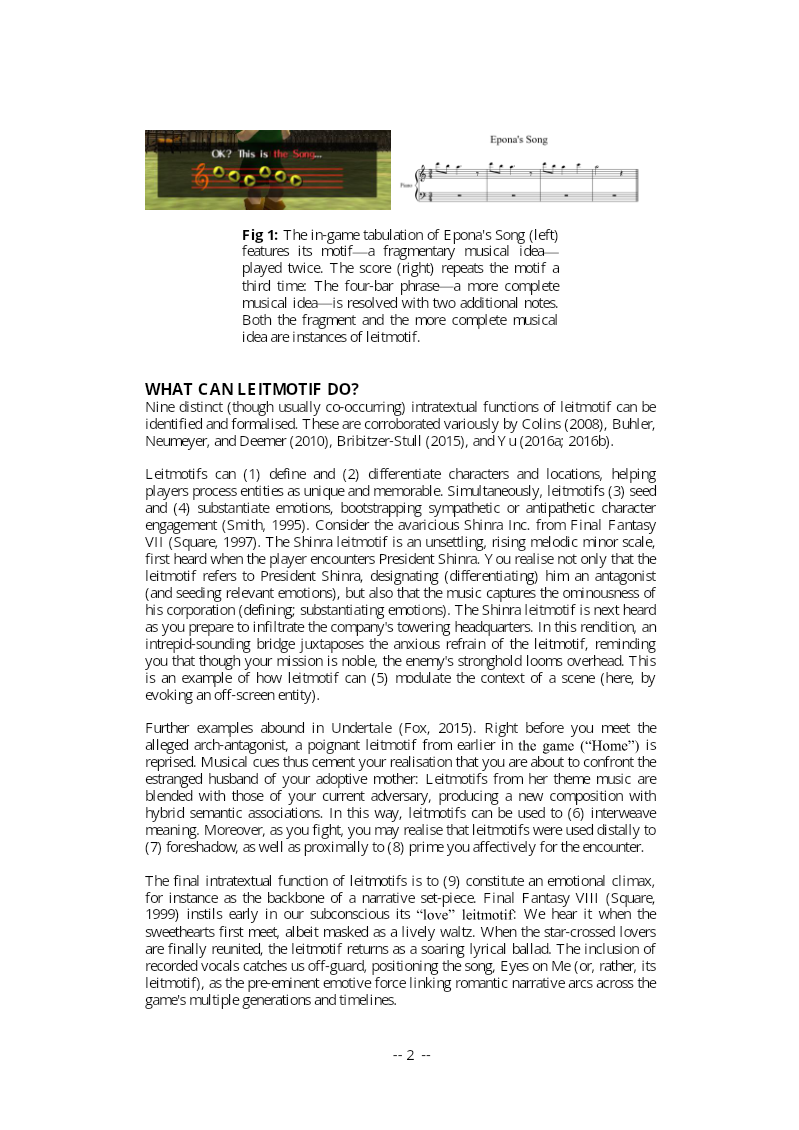
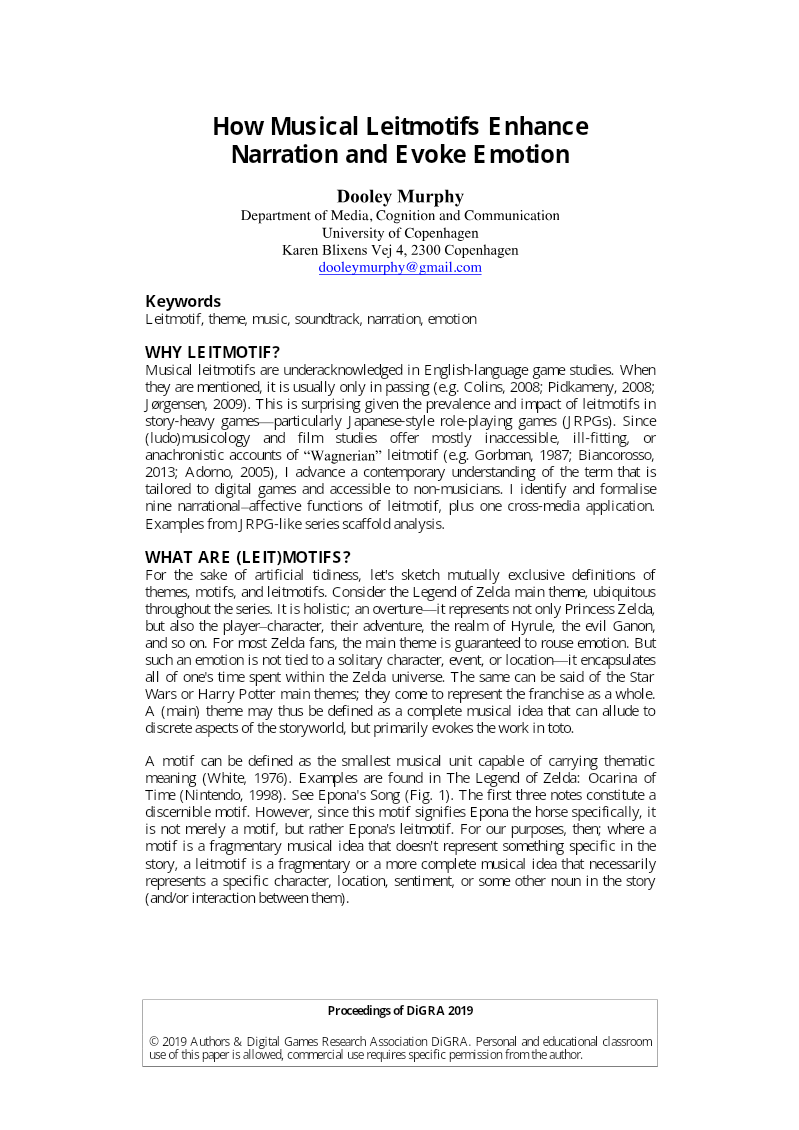
- Leitmotifs are musical ideas tied to a specific character, location, sentiment, or story element, and the paper argues they deserve a contemporary definition suited to digital games and accessible to non-musicians.
- The paper distinguishes leitmotifs from broader thematic material (which evokes a work as a whole) and from motifs (which lack specific representational reference).
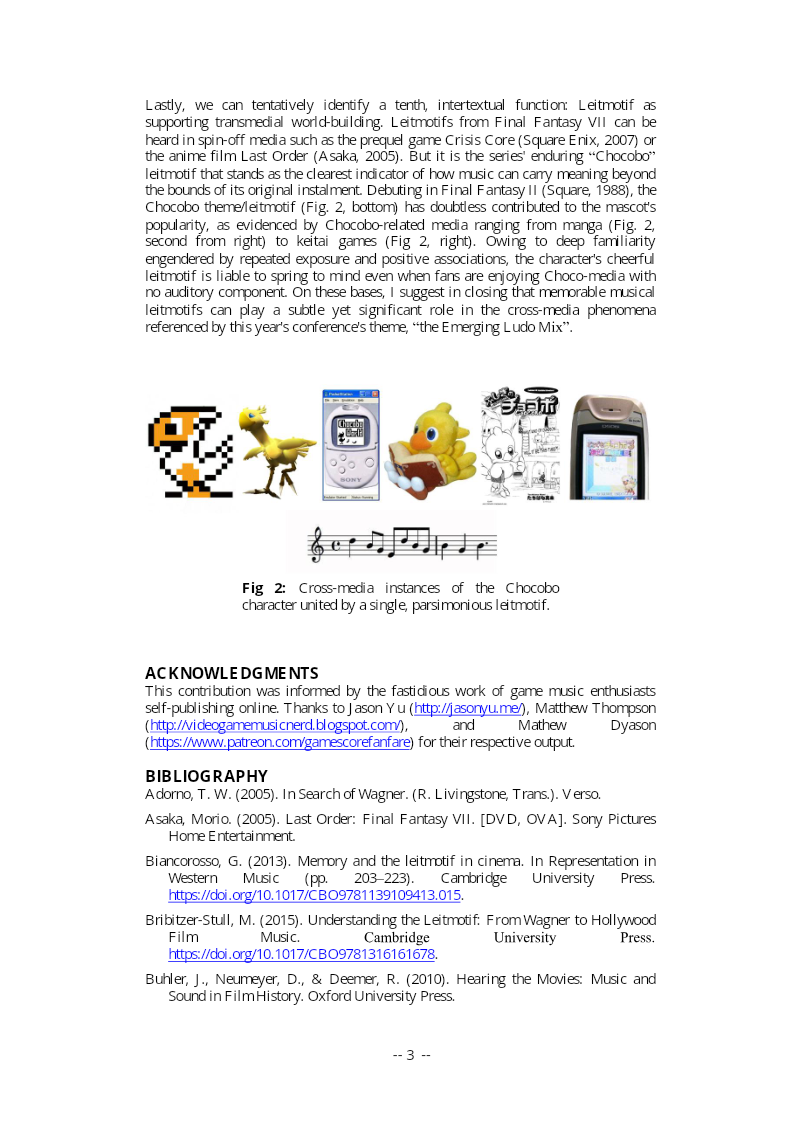
- The paper identifies nine intratextual functions of leitmotifs, including defining characters and locations, seeding and substantiating emotion, foreshadowing, and constituting an emotional climax.

Ludo Mix as an Aesthetic Experience: Designing Games for Franchises
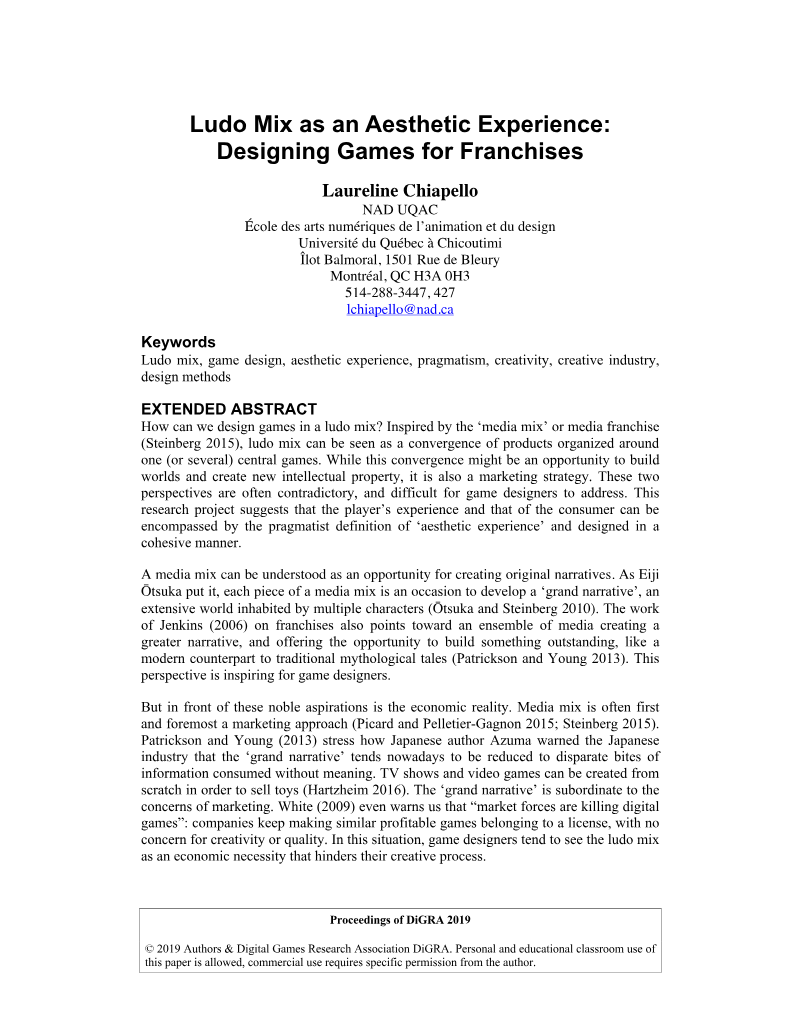
This paper argues that game designers working within "ludo mixes," the convergence of products organized around one or several central games, can resolve the tension between creative world-building and marketing imperatives by adopting John Dewey's pragmatist concept of aesthetic experience.
- The paper proposes that designers of 'ludo mixes' (franchises organized around one or more central games) can resolve the tension between creative world-building and marketing demands by adopting John Dewey's pragmatist concept of aesthetic experience.
- The central idea is that player and consumer experiences should be unified under Dewey's notion of an experience that is 'whole' and 'complete,' where each component meaningfully fits the larger whole rather than fragmenting the intellectual property.
- The ludo mix is framed as a descendant of Japanese media mix and franchise models described by Ōtsuka, Jenkins, and Steinberg, in which each product should contribute to a 'grand narrative.'
Schoolyard Riot: League of Legends and High School Esports
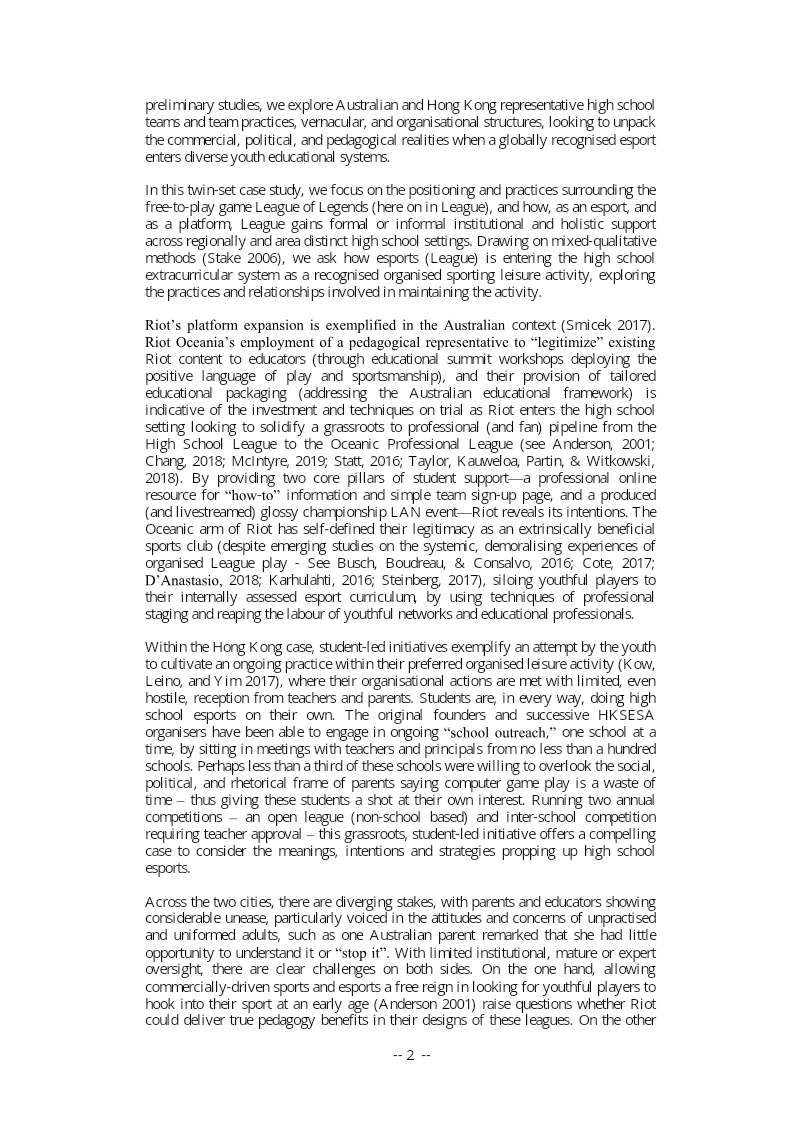
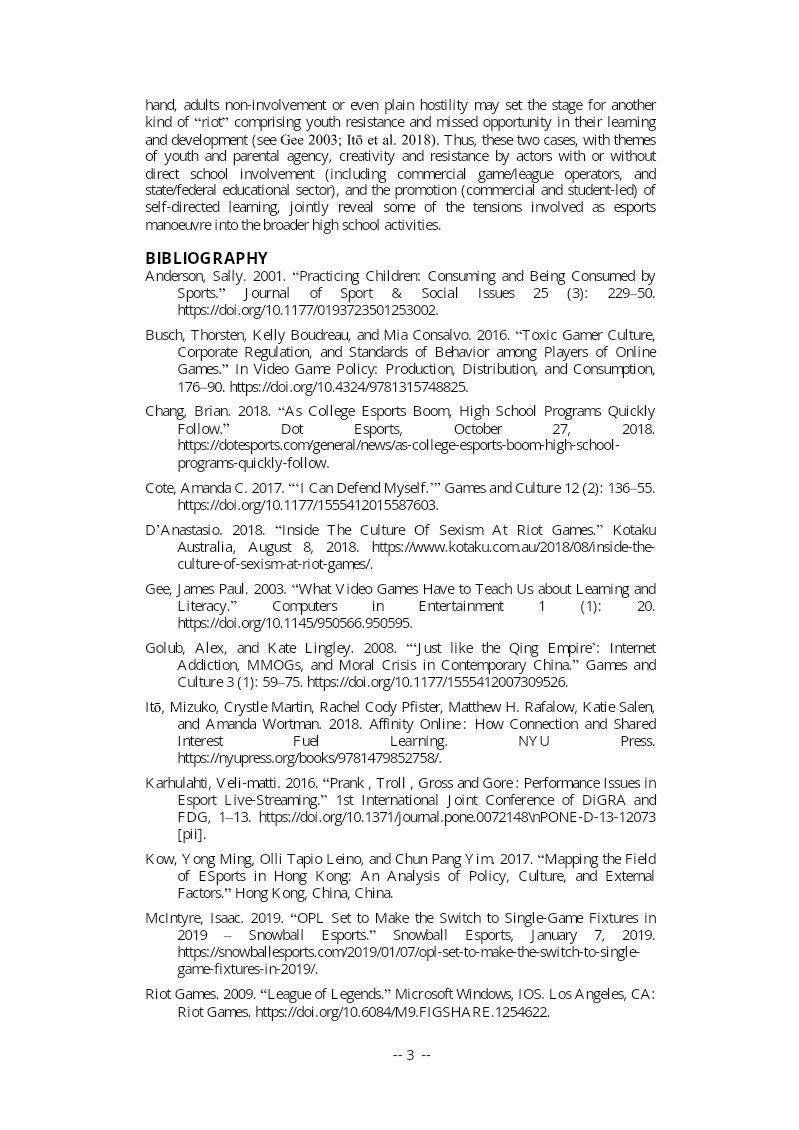
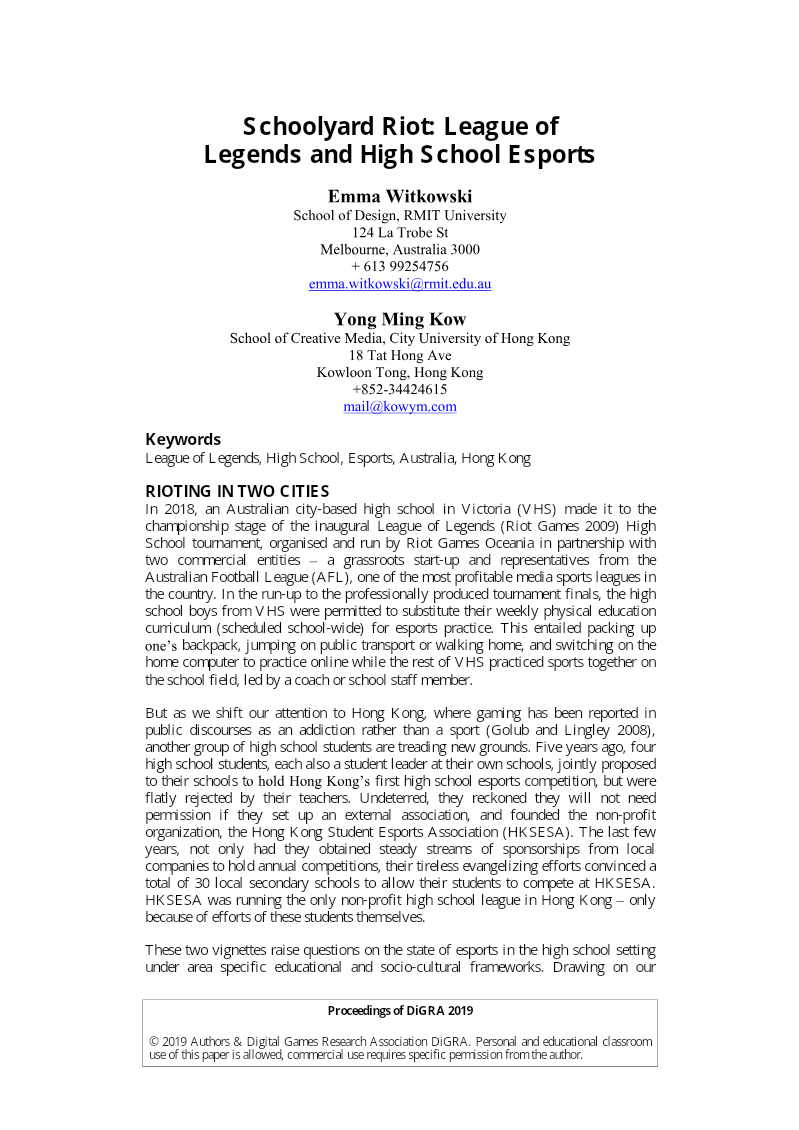
This paper is a comparative case study examining how League of Legends, the free-to-play esport developed by Riot Games, is entering high school extracurricular systems in Australia and Hong Kong.
- The paper is a comparative case study of League of Legends (developed by Riot Games) entering high school extracurricular systems in Australia and Hong Kong, arguing that high school esports is shaped by competing commercial, pedagogical, and socio-cultural forces.
- In Australia, a Victorian high school's boys' team reached the championship stage of Riot's inaugural High School tournament in 2018, a competition built with commercial partners including an Australian football league representative.
- The authors interpret Riot Oceania's educator workshops, tailored curriculum packaging, and professional-grade livestreamed finals as deliberate efforts to build a grassroots-to-professional pipeline, with team members allowed to replace school PE with online practice.
Designing a Digital Roleplaying Game to Foster Awareness of Hidden Disabilities
The document presents the design case for On Fighting Shadows (OFS), a two-dimensional digital roleplaying game built to raise awareness of hidden disabilities, with hydrocephalus as the focal condition in the prototype.
- The project is On Fighting Shadows, a 2D digital roleplaying game built in RPG Maker MV to raise awareness of hidden disabilities, using hydrocephalus as the focal condition in its prototype.
- The protagonist, Marvin, experiences anxiety, depression, and hydrocephalus, and the game targets both the medical realities of these conditions and the social misunderstandings surrounding brain and mental illness.
- The designer chose a 2D format and limited player actions to directional movement, dialogue, and object interaction to reduce cognitive load for players unfamiliar with roleplaying games.
Video Games Production Networks in the Periphery: The Chilean Case
This paper examines whether Chile's emerging video games sector risks reproducing older patterns of economic dependency, framing the question through dependency theory, cognitive capitalism, and the Global Production Networks literature.
- Chile's video games sector in 2016 comprised around 33 medium and small companies generating roughly 13 million dollars in revenue, within a national economy historically dependent on copper exports.
- The study frames Chile's games industry through dependency theory, cognitive capitalism, and Global Production Networks, asking whether it risks reproducing older patterns of economic dependency on the Global North.
- Dependence on development tools such as SDKs and engines, largely controlled by publishers and console manufacturers in the Global North, is a central concern, with console certification requirements imposing strict technical and stylistic standards on developers.
Multimodal Analysis of Using Video Game Minecraft to Study BA-Construction in Chinese
This study examines whether the video game Minecraft can be used to teach the Ba-construction, a grammatically complex and frequently used structure in Chinese as a second language instruction.
- The study proposes using Minecraft to teach the Chinese Ba-construction, arguing that classroom methods that pair Ba-constructions with SVO counterparts lead learners to treat them as interchangeable or to overgeneralize the structure.
- Analysis of six participants in three collaborative pairs found that all target Ba-construction structures emerged during authentic communicative and problem-solving exchanges in Minecraft, whereas such authentic interaction was absent from classroom settings.
- Transcripts were analyzed in ELAN using a multimodal framework that included gestures, facial expressions, body language, and situational context, not just spoken language.
The Business Model Network of eSports: The Case of Overwatch
This paper, presented at DiGRA 2019 and authored by researchers at the University of Siegen, examines how the eSports industry operates as an interconnected network of stakeholders rather than as a traditional competitive market.
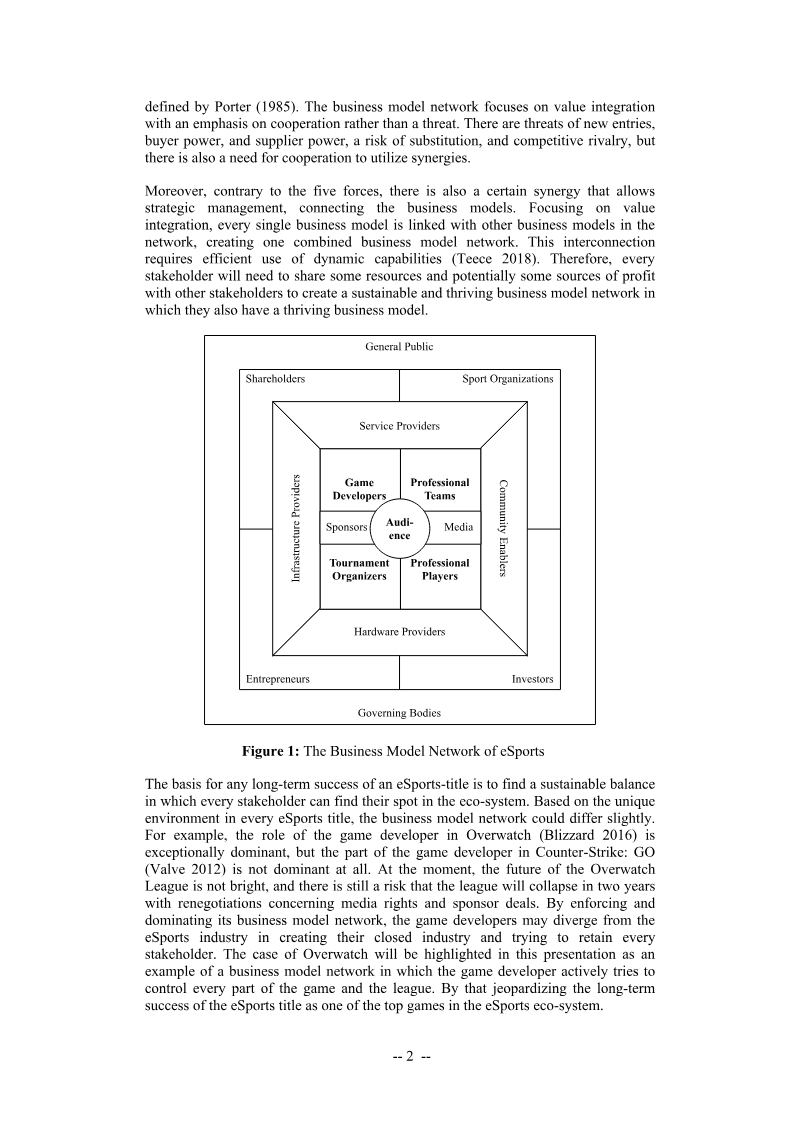
- The paper frames the eSports sector as a 'business model network' of interdependent stakeholders (entrepreneurs, media, sports organizations, investors, developers, sponsors, tournament organizers, and players), extending Porter's five forces model toward value integration and synergy over pure rivalry.
- The central claim is that long-term viability depends on each stakeholder finding a sustainable place in the ecosystem, and that this network structure varies by game title.
- Using Overwatch as the primary case, the authors argue that developer Blizzard plays an unusually dominant role by seeking to control both the game and its competitive league, whereas Counter-Strike: Global Offensive shows a far less dominant developer role.