1 free read left. Create a free account for unlimited reading + AI research.
Create free accountWhitepaper DiGRA
1 free read left. Create a free account for unlimited reading + AI research.
Create free accountWhitepaperDiGRA
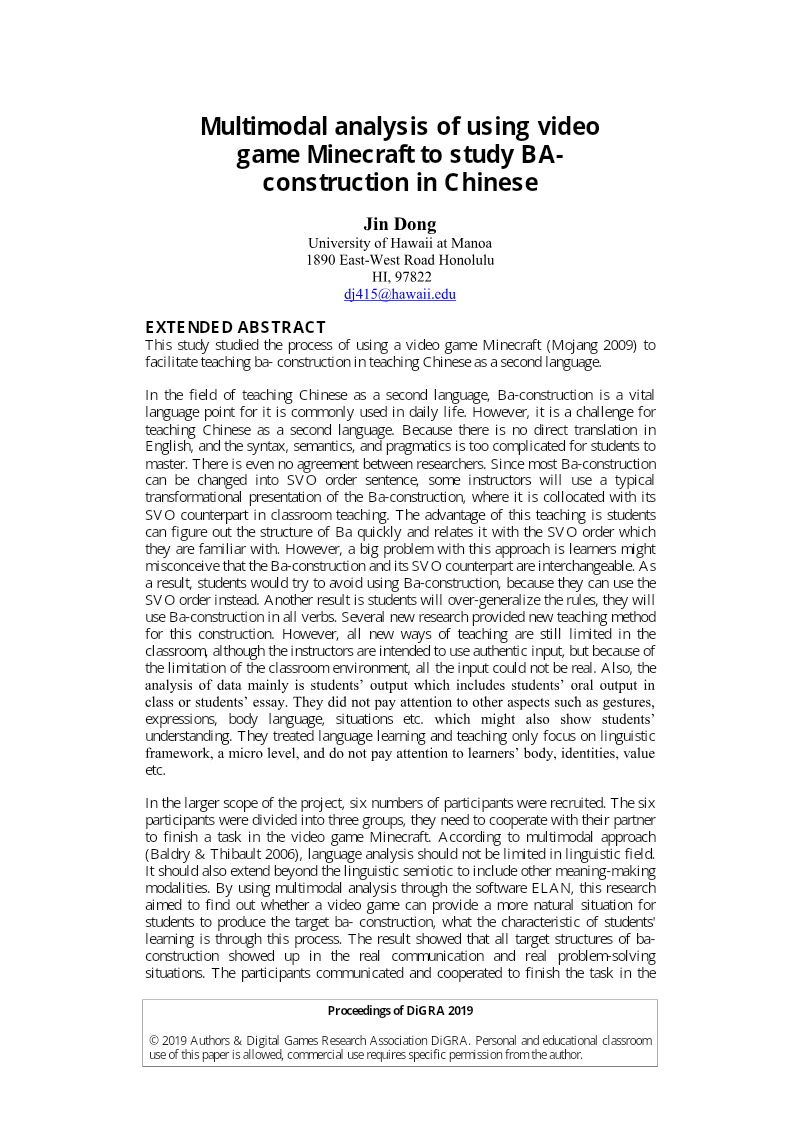
Conventional classroom approaches pair Ba-constructions with their SVO counterparts. The author argues this often leads learners to treat the two forms as interchangeable or to overgeneralize the construction.
This study examines whether the video game Minecraft can be used to teach the Ba-construction, a grammatically complex and frequently used structure in Chinese as a second language instruction. The author argues that conventional classroom approaches, which pair Ba-constructions with their SVO counterparts, often lead learners to treat the two forms as interchangeable or to overgeneralize the construction, and that existing innovations remain constrained by the artificial input and linguistic-only data analysis typical of classrooms. Grounded in a multimodal analytical framework, the research proposes that a game environment can generate more authentic communicative demands than the classroom.
The study involved six participants divided into three pairs who collaborated to complete a task within Minecraft. Their interactions were transcribed and analyzed with the ELAN software, extending the analysis beyond spoken language to include gestures, expressions, body language, and situational context. The findings indicate that all target Ba-construction structures emerged in genuine communicative and problem-solving exchanges during gameplay, whereas such authentic interaction was absent from classroom settings. The construction arose most often in instructional and explanatory speech, particularly when learners answered "how" questions.
Beyond these linguistic outcomes, the research reports that participants were motivated by the experience, as shown by their self-reports and the strong quality of their later final projects. The author also finds that task design is critical, as an overly difficult game environment hindered rather than supported language production. The study concludes that video games can provide a macro-level, experiential learning context that complements micro-level linguistic instruction, and it argues that such quality-driven experiences should be preserved within educational settings.
Each row is a game or company this document names, each column a document, oldest first. A mark means that document names it. Select a row to see those documents.

DiGRA · 2026

DiGRA · 2026



DiGRA · 2026



DiGRA · 2026



DiGRA · 2026



DiGRA · 2026



DiGRA · 2026



DiGRA · 2026

DiGRA · 2026



DiGRA · 2026



DiGRA · 2026

DiGRA · 2026
Mobilegamer.biz · 2026