
DiGRA
The Digital Games Research Association: the international association of academics and professionals who study digital games. Its Digital Library holds the proceedings of the DiGRA conferences since 2002.
Documents
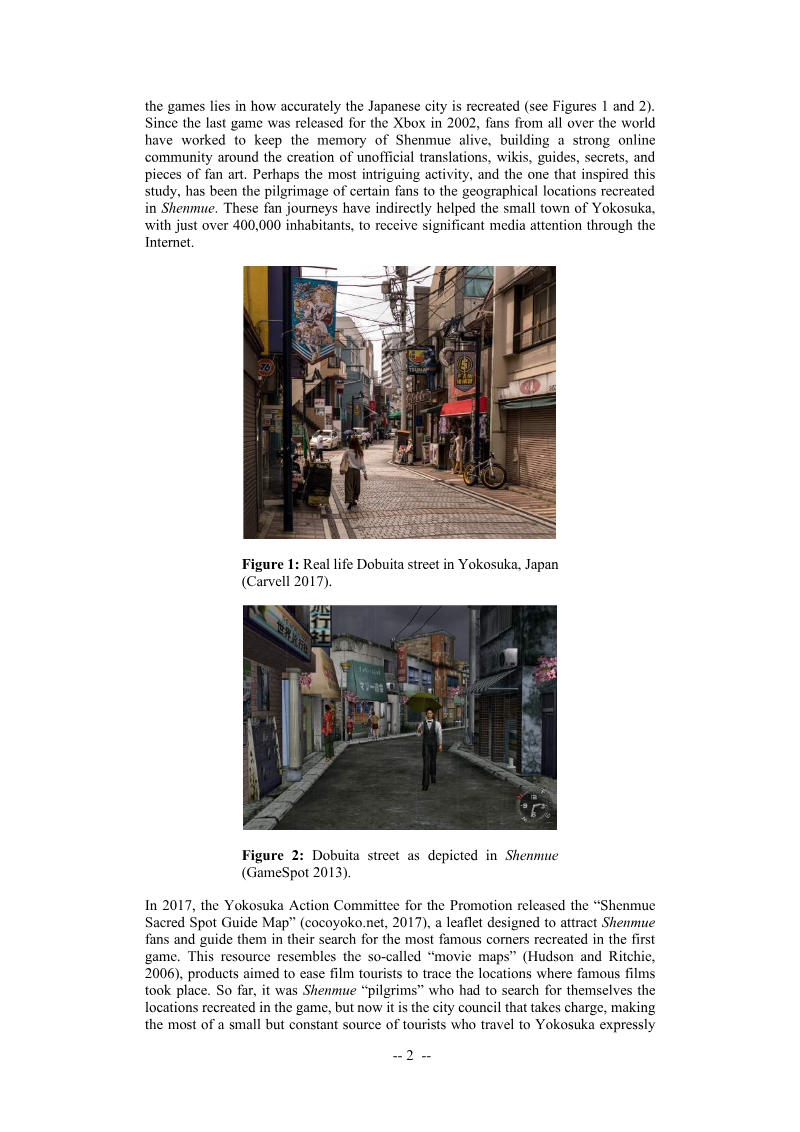
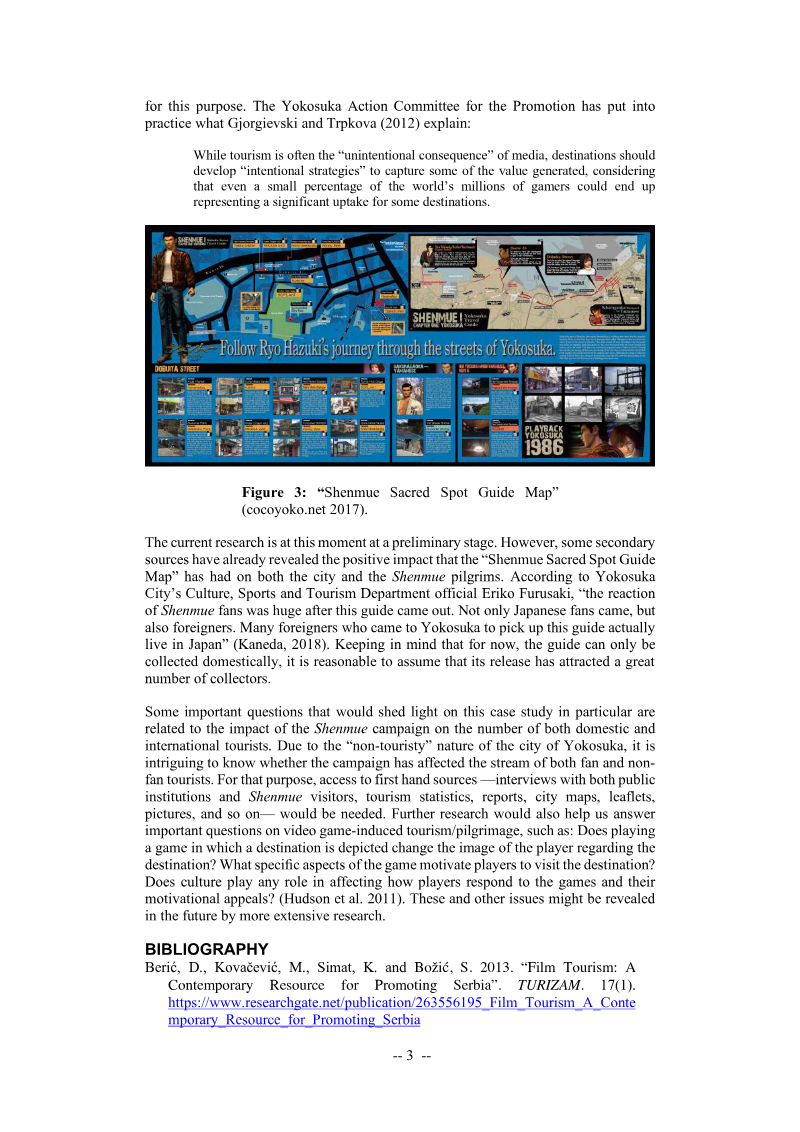
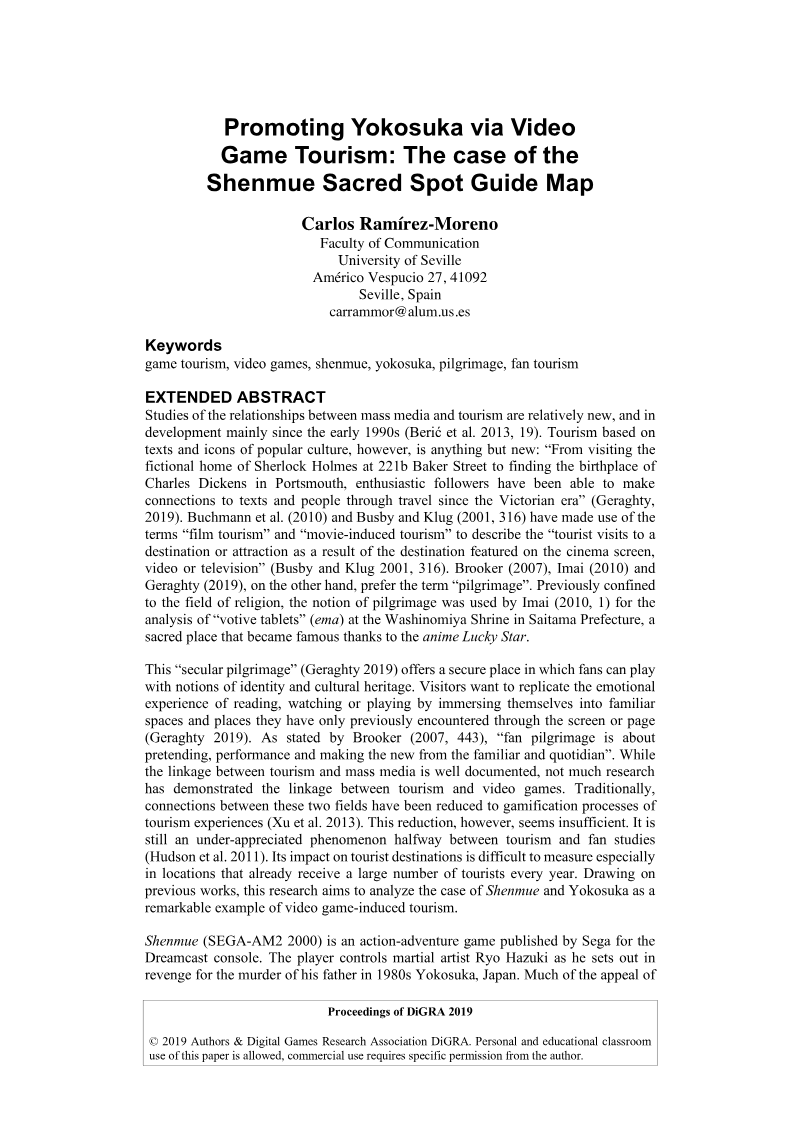
Promoting Yokosuka via Video Game Tourism: The Case of the Shenmue Sacred Spot Guide Map
This paper examines how the video game Shenmue (SEGA-AM2, 2000) has generated tourism to Yokosuka, Japan, and how the city's Yokosuka Action Committee for the Promotion responded by releasing the "Shenmue Sacred Spot Guide Map" in 2017.
- Yokosuka, a city of roughly 400,000 people in Japan, has drawn tourism driven by fan pilgrimages to locations recreated in SEGA-AM2's 2000 game Shenmue, a phenomenon the author calls "video game-induced tourism" or "secular pilgrimage."
- In 2017 the Yokosuka Action Committee for the Promotion released the "Shenmue Sacred Spot Guide Map," shifting the municipality from passively benefiting from fan travel to deliberately capturing its economic value through a promotional leaflet modeled on film "movie maps."
- Per an interview with a Yokosuka City tourism official, demand for the guide is strong among both Japanese and foreign fans, many of whom were residents of Japan, and the guide is currently available only domestically.

New Media Ecosystems: Amazon and the Advancing Game Economy
Eric Freedman's paper examines Amazon's expanding presence in game-based technologies and the broader implications of that presence for digital economies.
- Amazon's 2015 acquisition of the CryEngine codebase (rebranded as Lumberyard) and its 2016 purchase of the Twitch streaming platform, combined with Amazon Web Services, form an integrated ecosystem linking game developers and players.
- The paper positions Amazon as a media company whose influence spans e-commerce, middleware, and consumer hardware, and argues that game engines are becoming foundational to commerce, artificial intelligence, and everyday interfaces.
- Amazon reportedly uses game spaces as testing grounds for new interaction models, linking its Alexa voice service and connected devices to engine-driven infrastructure and crowdsourcing research through its developer and streaming communities.
Fired in a Blog Post: The End of Heroes of the Storm Esports
Blizzard Entertainment's decision in December 2018 to end the professional competitive league for Heroes of the Storm (HotS), announced with little warning, forms the starting point for this DiGRA 2019 paper by Patrick Prax.
- Blizzard Entertainment ended the professional competitive league for Heroes of the Storm (HotS) in December 2018, announcing the decision with little warning.
- The study is based on seven qualitative open-structure interviews (90 to 180 minutes each) with former and prospective professional players, team managers, casters, and board members of European and North American amateur HotS leagues, analysed via thematic analysis.
- Preliminary findings suggest Blizzard's professional league was both a rallying point and aspirational model for players, yet it also constrained the organic growth of HotS esports.
Designing Global Empowerment? Activist Self-Narratives in Culturally Mixed Settings
This paper examines how the Denmark-based Game Girl Workshop, which teaches girls to design games using a Scandinavian-style participatory model, frames empowerment, and whether that framing holds up in culturally mixed settings.
- The Denmark-based Game Girl Workshop frames empowerment around three assumptions: self-expression, teamwork built on flat hierarchies and agile participatory design, and tangible achievement as the route to lasting engagement.
- The central thesis is that these individualist-leaning assumptions can conflict with collectivist cultural contexts, producing consequences beyond a simple mismatch.
- Completing a game and the pride it produced was the most meaningful dimension of empowerment for participants, often more so than the quality of the finished product.
Adapting the Empty Orchestra: The Performance of Play in Karaoke
Bryan and Tanenbaum's paper, presented at DiGRA 2019, argues that karaoke should be understood as an adaptable social game of performance play rather than a simple entertainment activity.
- Karaoke is framed as an adaptable social game of performance play, grounded in more than 600 hours of participant observation across United States venues, and presented at DiGRA 2019.
- Karaoke's adaptability stems from five factors: its ubiquity, minimal explicit rules, flexible implicit social norms, varied personal player goals, and multiple modes of play.
- In most venues, explicit rules are limited to sign-up procedures and start and end times, while implicit social norms do most of the shaping, accepting loud public singing and showing off but discouraging booing.
In Situ: Researching Corporate Diversity Initiatives with Game Developers
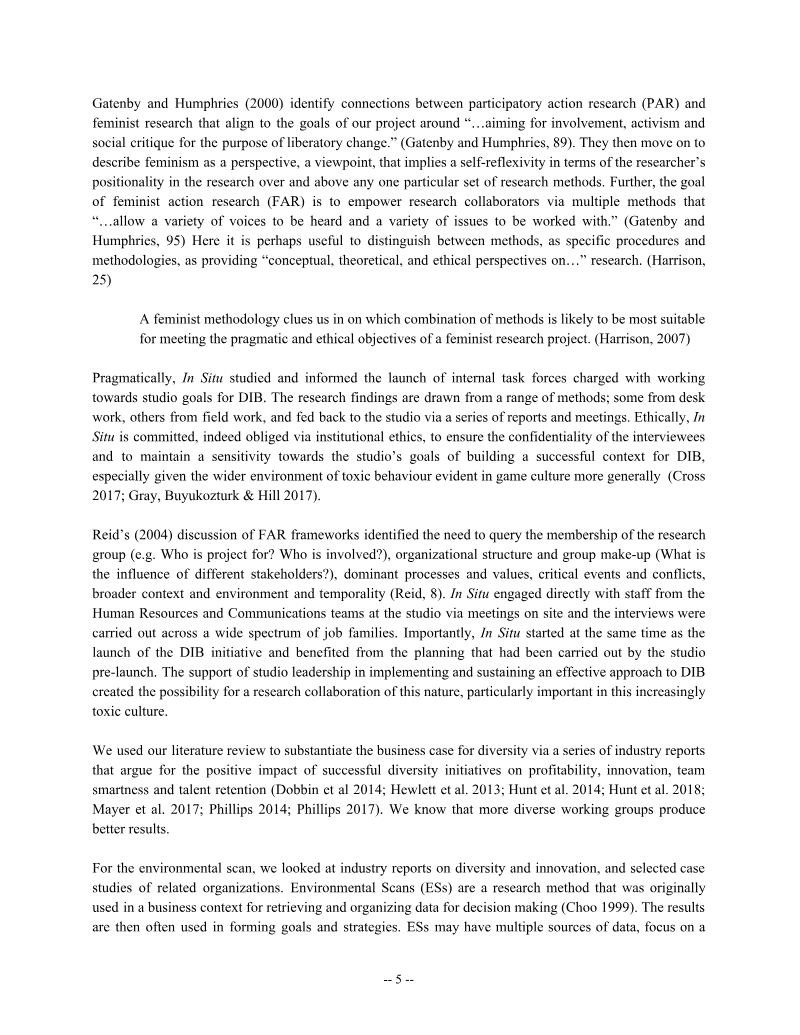
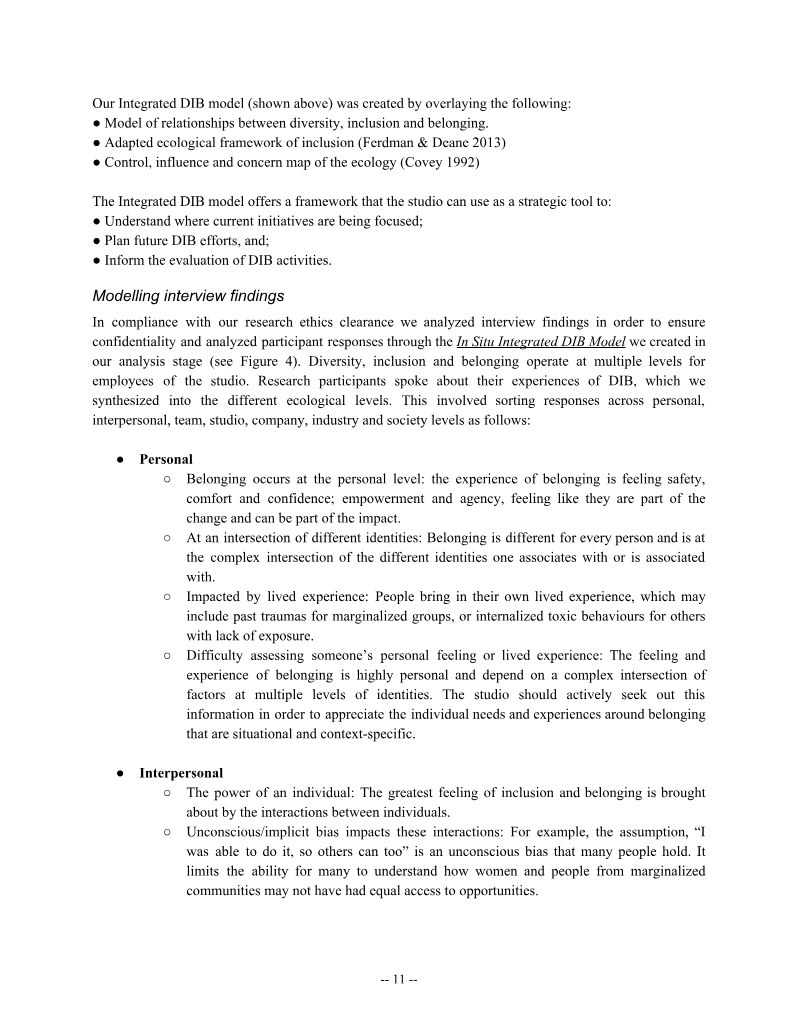
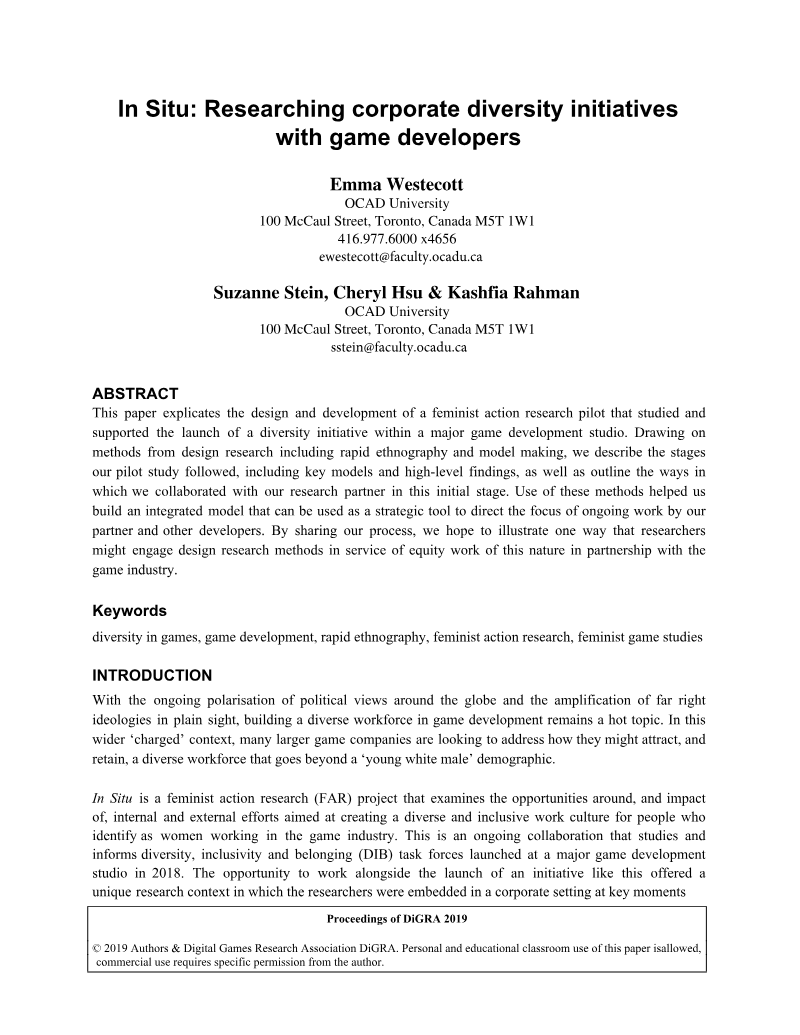
"In Situ" presents an eight-month feminist action research pilot conducted in 2018 within a major Canadian game studio, examining diversity, inclusion, and belonging (DIB) task forces aimed at women game developers.
- The study was an eight-month feminist action research pilot conducted in 2018 within a major Canadian game studio, examining diversity, inclusion, and belonging (DIB) task forces aimed at women game developers.
- Its findings rest on rapid interviews with five senior leaders and twelve DIB-invested employees, plus environmental scans of companies including Riot Games, Microsoft Xbox, and Intel.
- The authors conclude that inclusive practices are the mechanism linking diversity to belonging, because diversity alone may produce assimilation or differentiation rather than genuine inclusion.
Describing the Game Studies Canon: A Game Citation Analysis
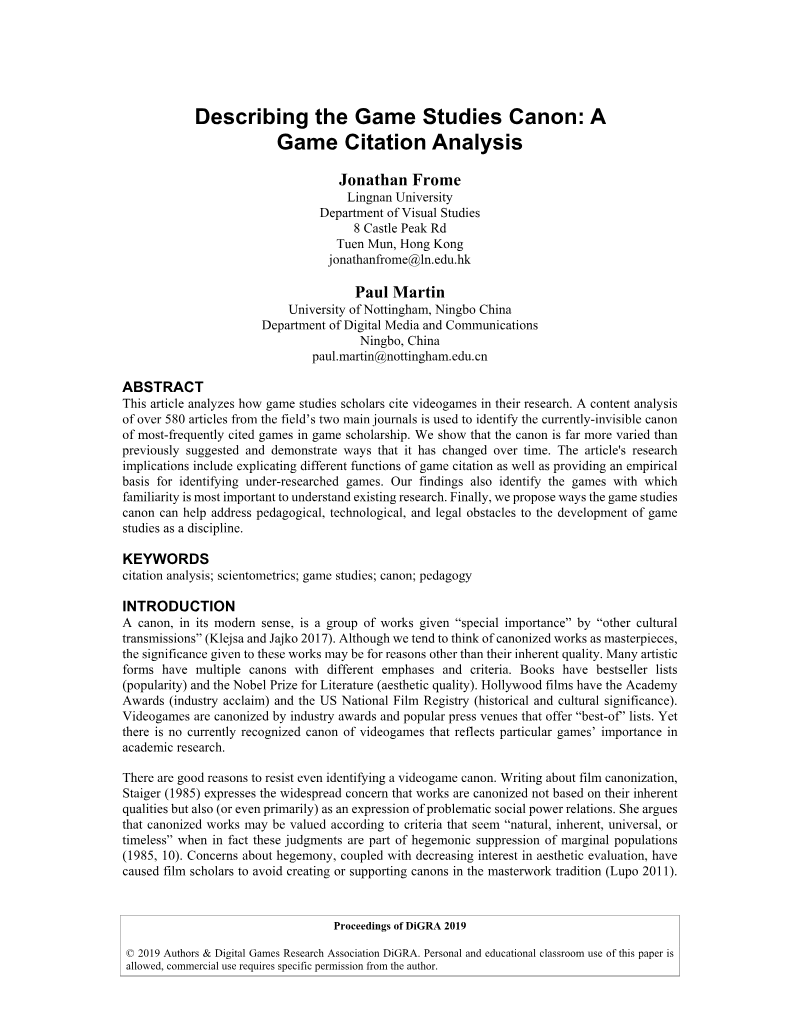
Frome and Martin's study examines how game studies scholars cite videogames across the field's two principal journals, Game Studies and Games and Culture, from their inception through September 2018.
- Roughly 90 percent of the 582 articles published in Game Studies and Games and Culture between 2001 and 2018 cite at least one videogame, contradicting an earlier claim that nearly 40 percent do not.
- World of Warcraft leads all citations with 159, followed by Grand Theft Auto and Chess, while about 96 percent of cited games appear in fewer than ten articles, revealing a pronounced long tail.
- The authors argue the field lacks a recognized canon and propose a descriptive canon built from the titles scholars most often cite, rather than a prescriptive list of significant games.
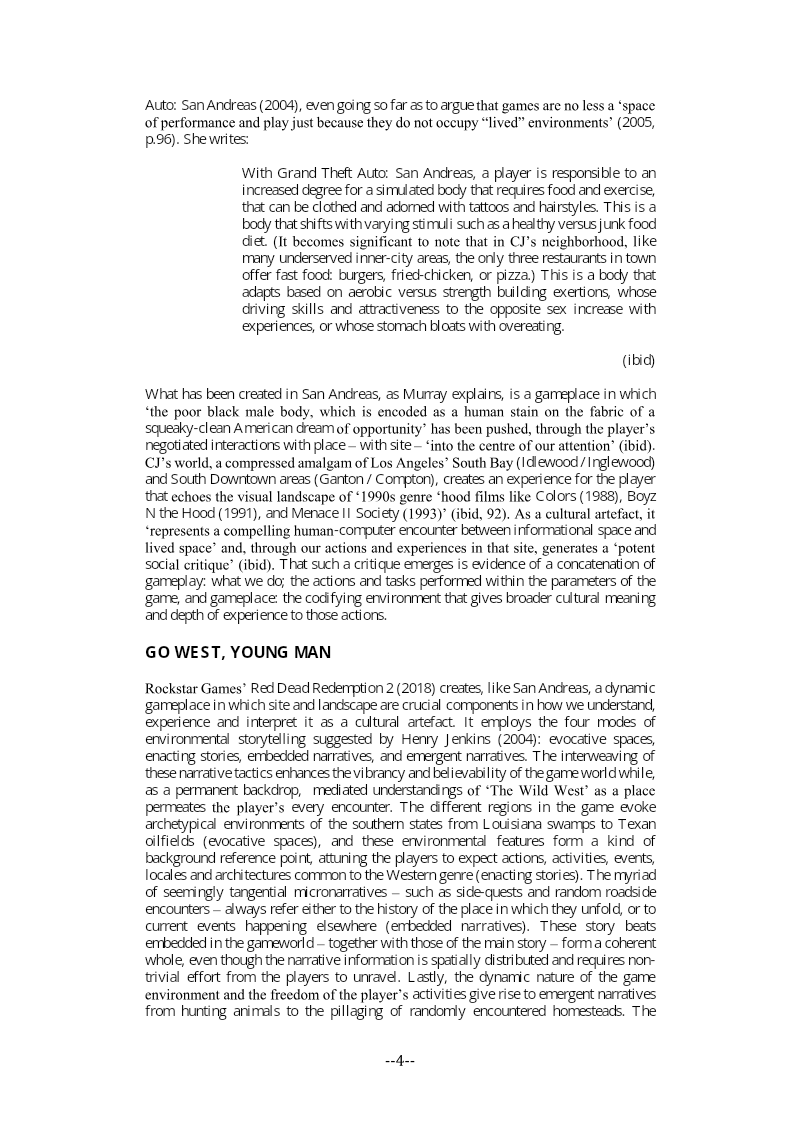
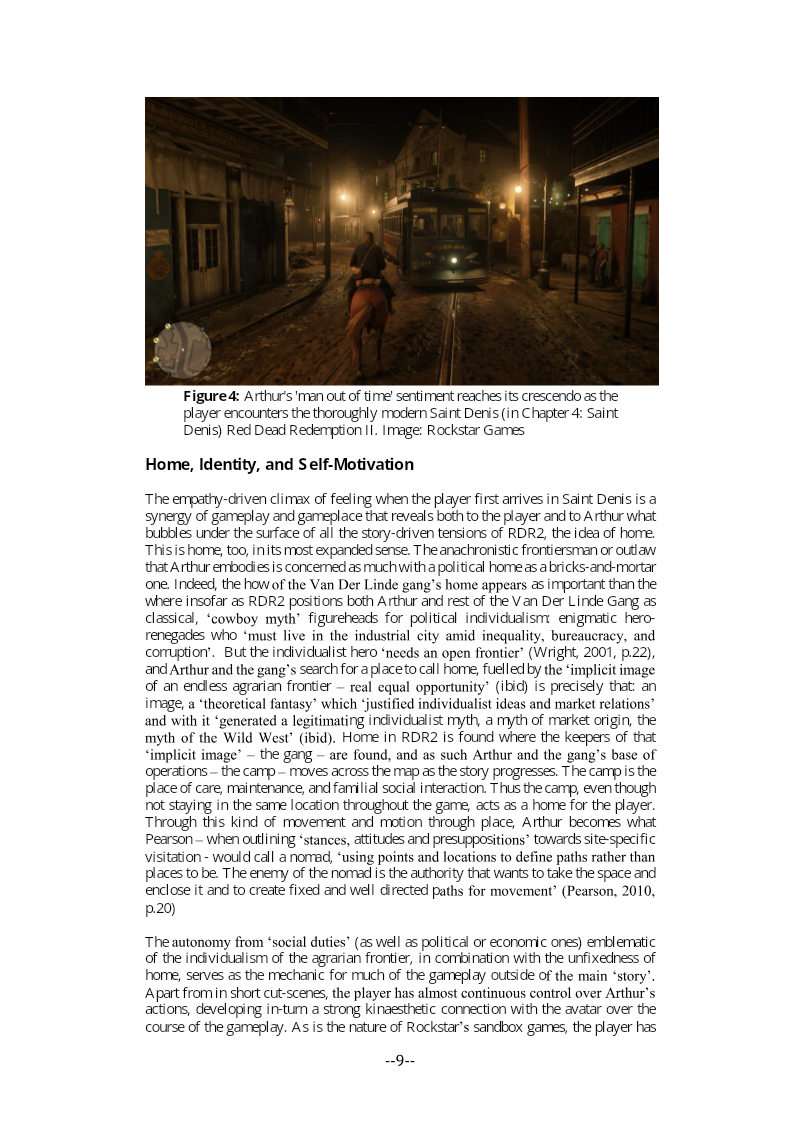
Sites of Play: Locating Gameplace in Red Dead Redemption 2
The paper examines how Red Dead Redemption 2 builds a sense of place, drawing on placeness theory and site-specific performance to argue that places in games emerge from the interplay of space, human connection, and player activity.
- The paper argues that places in games emerge from the interplay of space, human connection, and player activity, drawing on placeness theory and site-specific performance, based on more than thirty hours of close gameplay analysis of Red Dead Redemption 2.
- The authors identify four modes of environmental storytelling through which RDR2 constructs its world: evocative spaces, enacting stories, embedded narratives, and emergent narratives.
- Place functions as both storyteller and structural device, dramatizing Arthur Morgan's movement from frontier myth toward modernity via the progression from snowy mountains to Valentine to the industrial city of Saint Denis.
Categorizing Morality Systems Through the Lens of Fallout
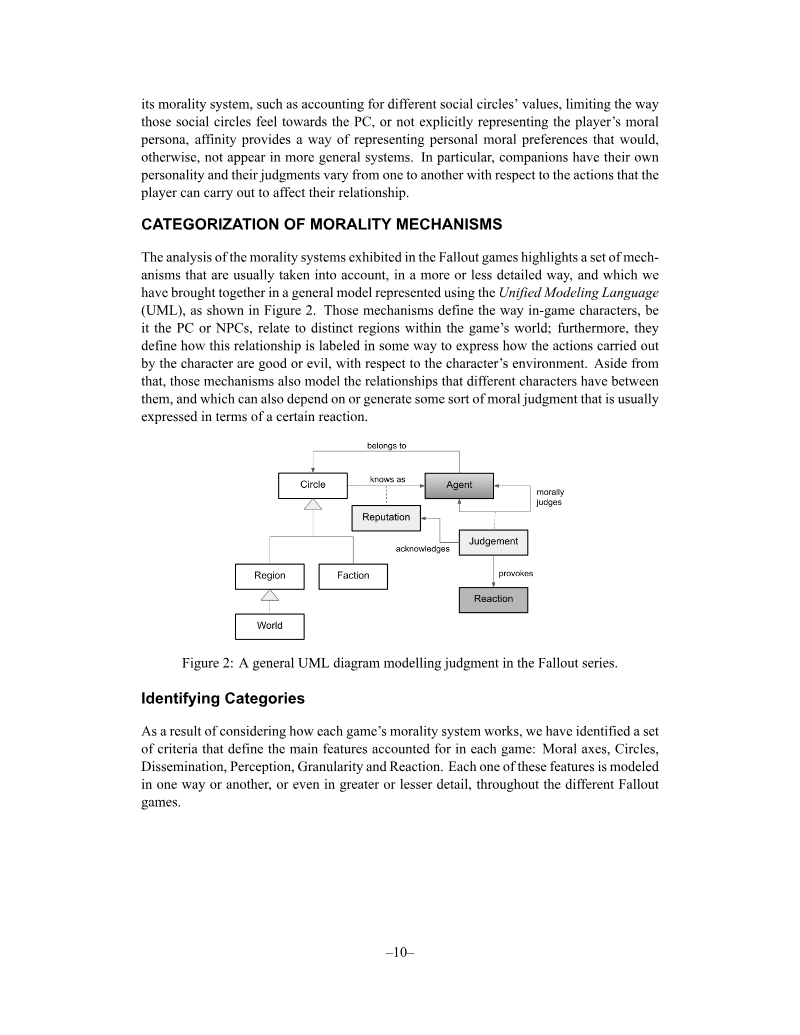
The paper examines how morality systems in the canonical Fallout CRPG series track a player character's moral persona, focusing on how in-game actions shift moral alignment and how non-player characters respond to that alignment.
- The paper analyzes how the five canonical Fallout CRPGs (1997, 1998, 2005, 2010, 2015) model moral weight, excluding spin-offs and Fallout 76 because it lacks NPCs, shifting focus from prior player-experience scholarship to the games' own mechanics.
- The authors argue that Fallout: New Vegas has the most comprehensive morality system in the series because it tracks good and evil on separate axes, so deeds do not cancel each other out.
- New Vegas tracks Fame and Infamy per faction and town, reflecting that different social circles hold different values, a design that the authors identify as the most nuanced in the series.
The Path That Lies Ahead: Intimacy Through Overwhelmedness in The Legend of Zelda: Breath of the Wild
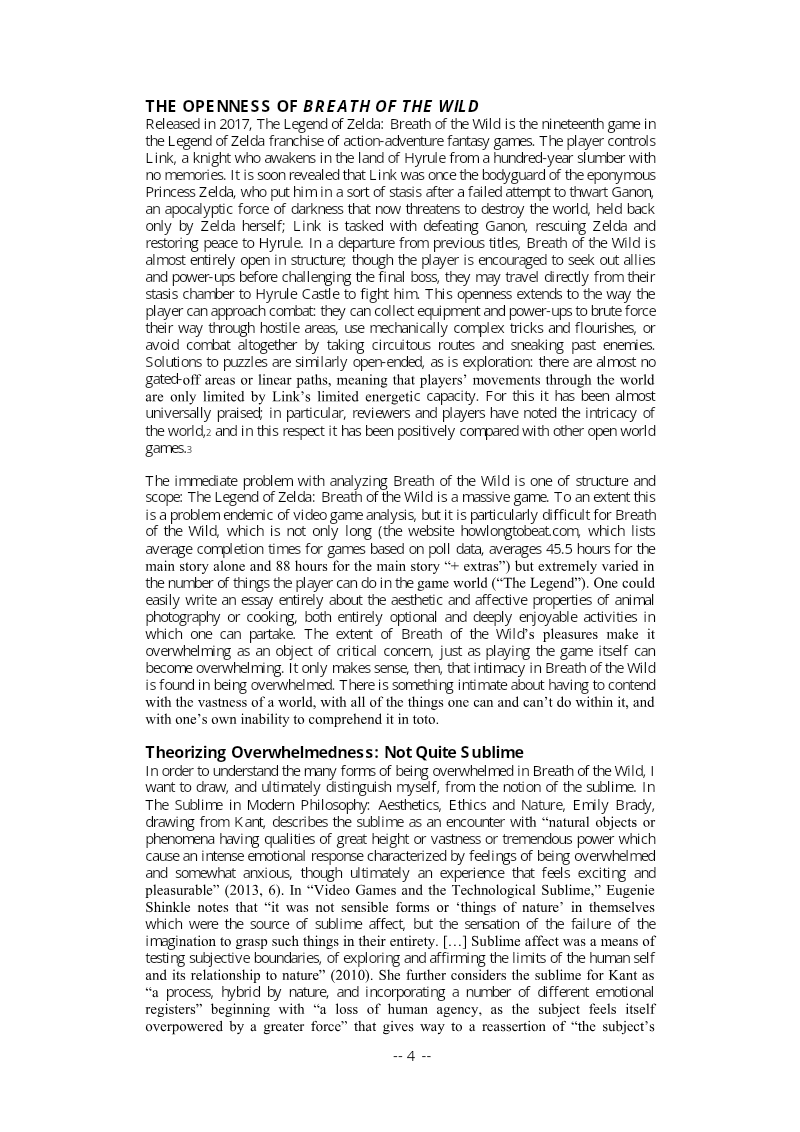
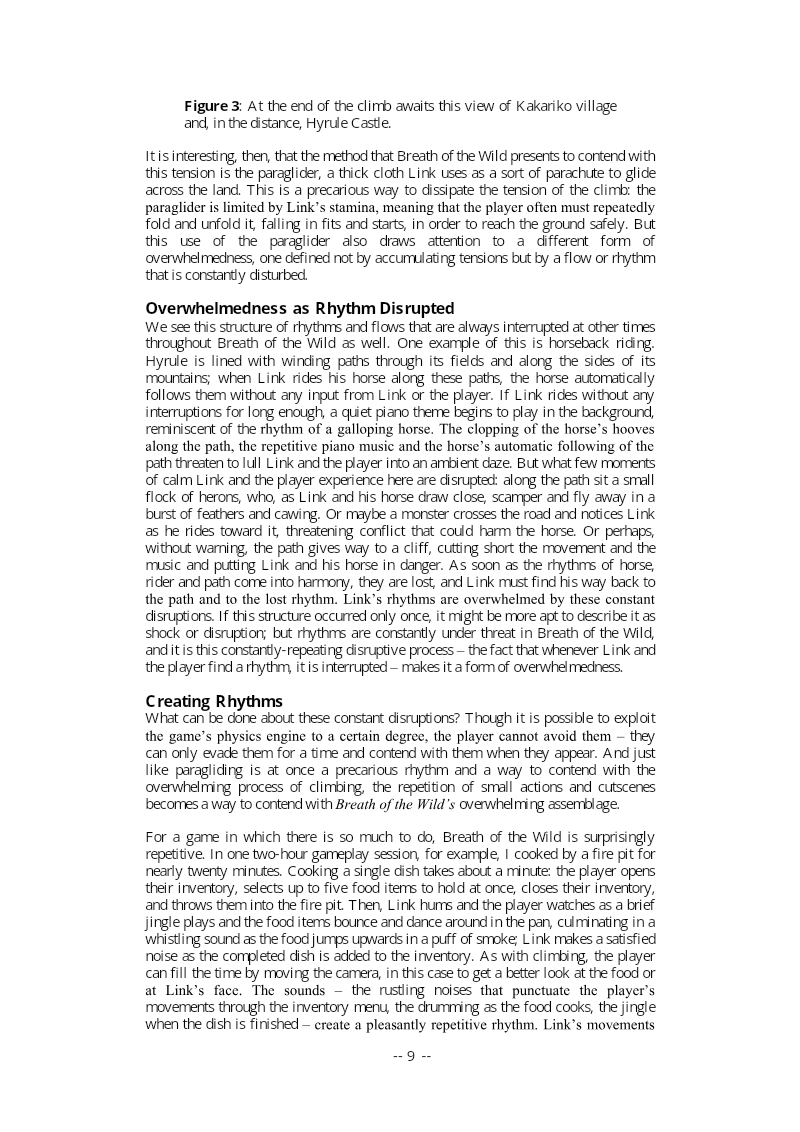
In "The Path That Lies Ahead," Kaelan Doyle-Myerscough argues that intimacy in The Legend of Zelda: Breath of the Wild is best understood as an affect rather than an interpersonal bond, and that the game generates this intimacy through overwhelmedness.
- The essay argues that intimacy in The Legend of Zelda: Breath of the Wild is an affect generated through overwhelmedness, meaning vulnerability, loss of control, and precarity, rather than an interpersonal bond.
- Overwhelmedness is distinguished from the Kantian sublime: where the sublime culminates in awe that resolves into reason and self-elevation, the game's overwhelm accumulates from many small encounters and is never fully resolved.
- The author situates these feelings within contemporary neoliberal conditions of uncertainty, drawing on Deleuzian affect theory, Lauren Berlant, and Nasser Yousef.
Port or Conversion? An Ontological Framework for Classifying Game Versions
"Port or Conversion?" argues that the term "game port" is conceptually vague and historically inconsistent, yet indispensable for game analysis and preservation.
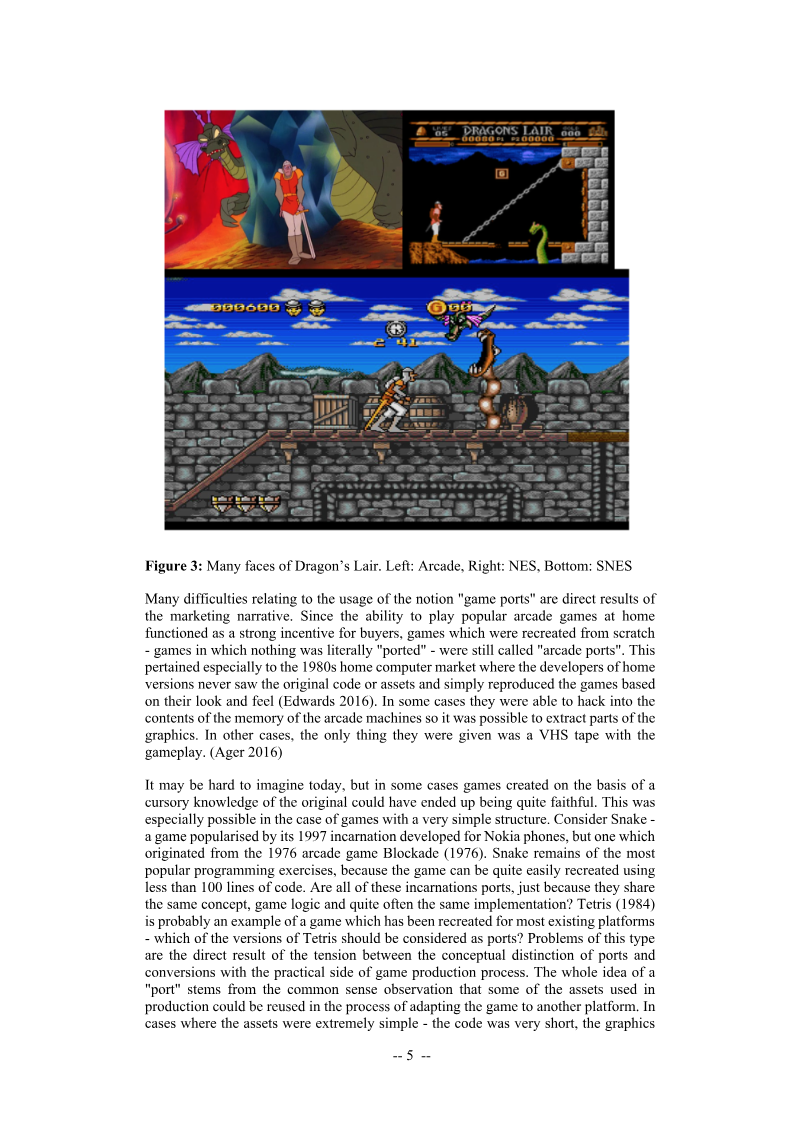
- The paper argues that 'game port' is a conceptually vague and historically inconsistent term, yet indispensable for game analysis and preservation, and that existing definitions based on names, platforms, marketing, legality, or literal code transfer fail to yield a stable academic category.
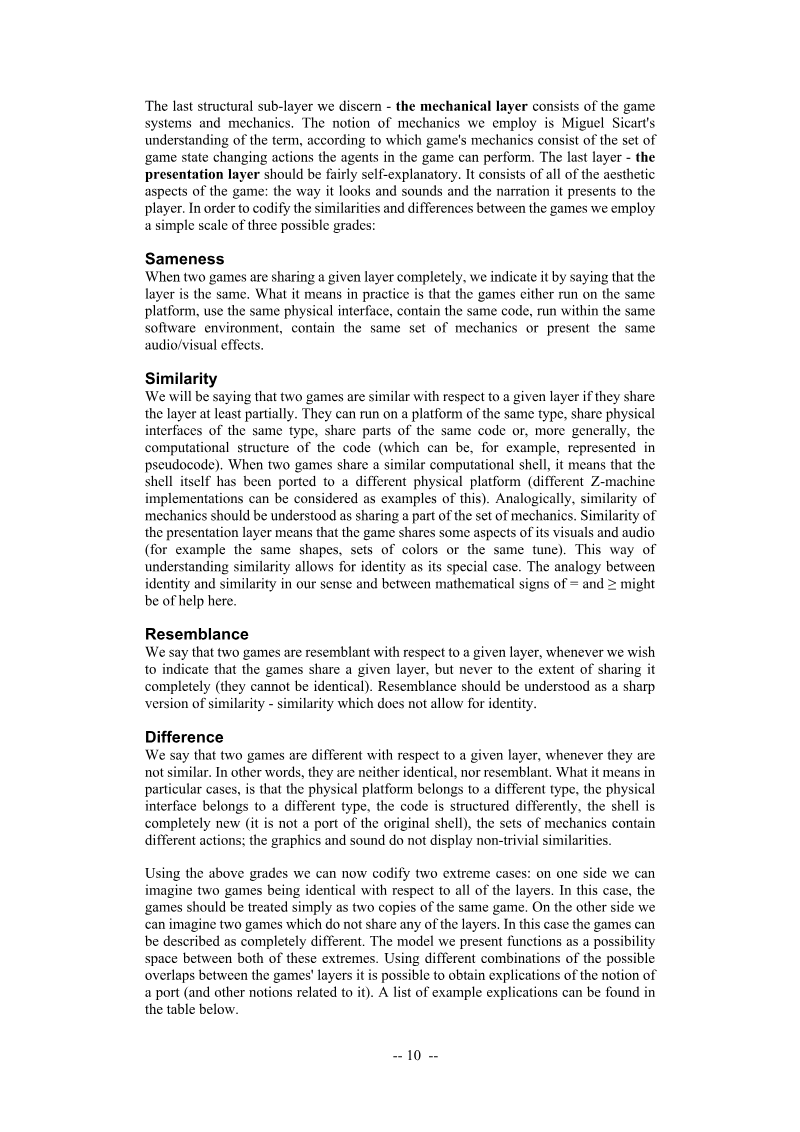
- To fix this, it proposes a Carnapian explication built on a three-layer ontology (physical, structural, and presentation layers) paired with a graded scale of sameness, similarity, resemblance, and difference for classifying game versions by fidelity.
- Case studies such as multiple Pac-Man versions, Thunder Blade's Atari ST and Amiga releases, and Marvel vs. Capcom on PlayStation 1 show the same title can differ dramatically across platforms, with fidelity expectations focused far more on mechanics than on audiovisual presentation.
Effects of Game Design Features on Player-Avatar Relationships and Motivation for Buying Decorative Virtual Items
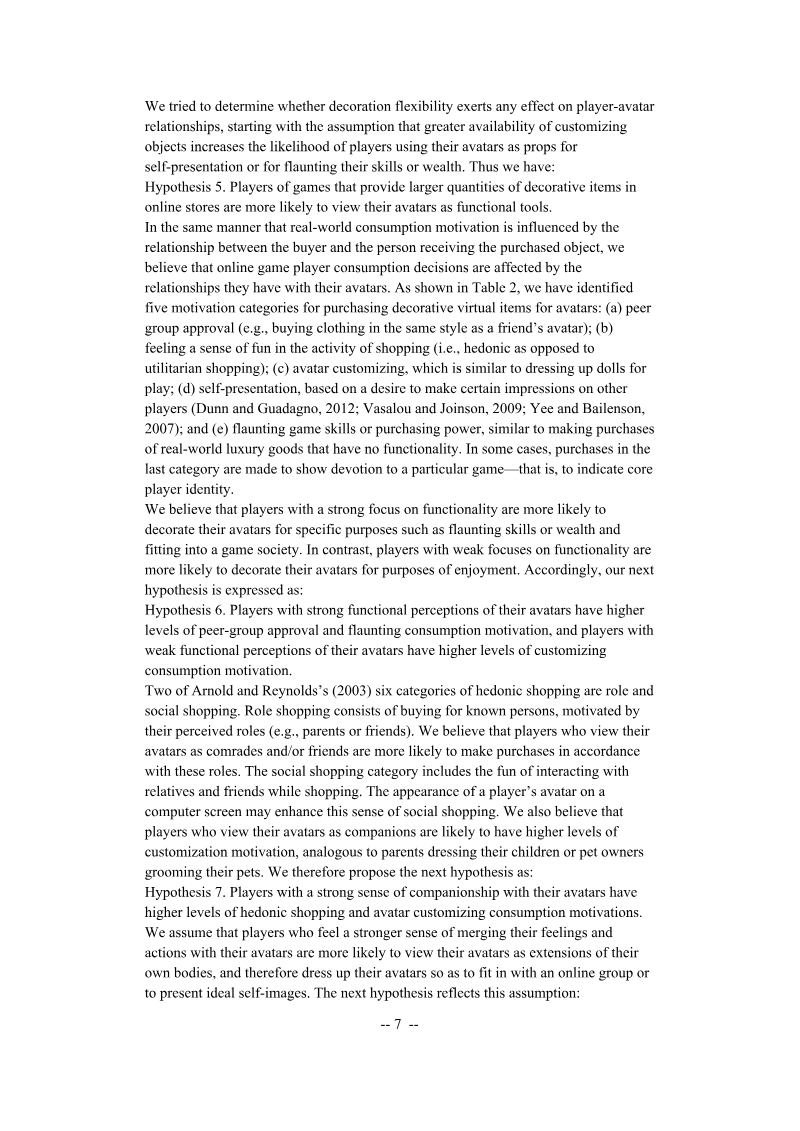
A 2019 DiGRA study examines how game design features shape players' relationships with their avatars and, in turn, their motivation to purchase decorative virtual items.
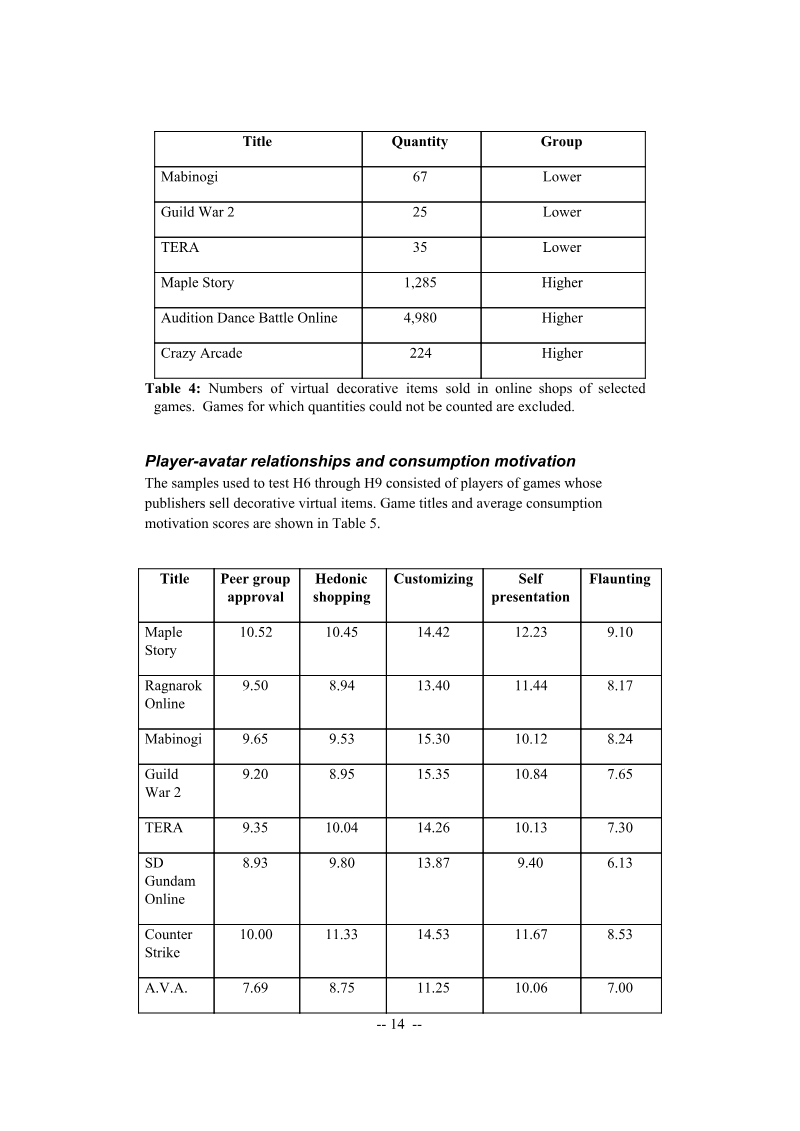
- Player-avatar relationship orientation is central to decorative item purchasing: players who see their avatar as a functional tool show stronger motivation to buy decorative items for flaunting and peer approval, while those who see avatars as companions or role-play characters show higher hedonic and customization motivation.
- Design choices shape how players relate to their avatars: more frequent avatar deaths reduced players' sense of shared feelings with their avatar (p = .042), and harsher death penalties increased the perception of the avatar as a tool (p = .012).
- Pet ownership was associated with lower tool perception of the avatar (p = .03), indicating that pet systems may shift players away from treating their avatar as merely functional.