1 free read left. Create a free account for unlimited reading + AI research.
Create free accountReport DiGRA
1 free read left. Create a free account for unlimited reading + AI research.
Create free accountReportDiGRA
The paper examines how Riot Games' free-to-play esport is entering high school extracurricular systems in Australia and Hong Kong.
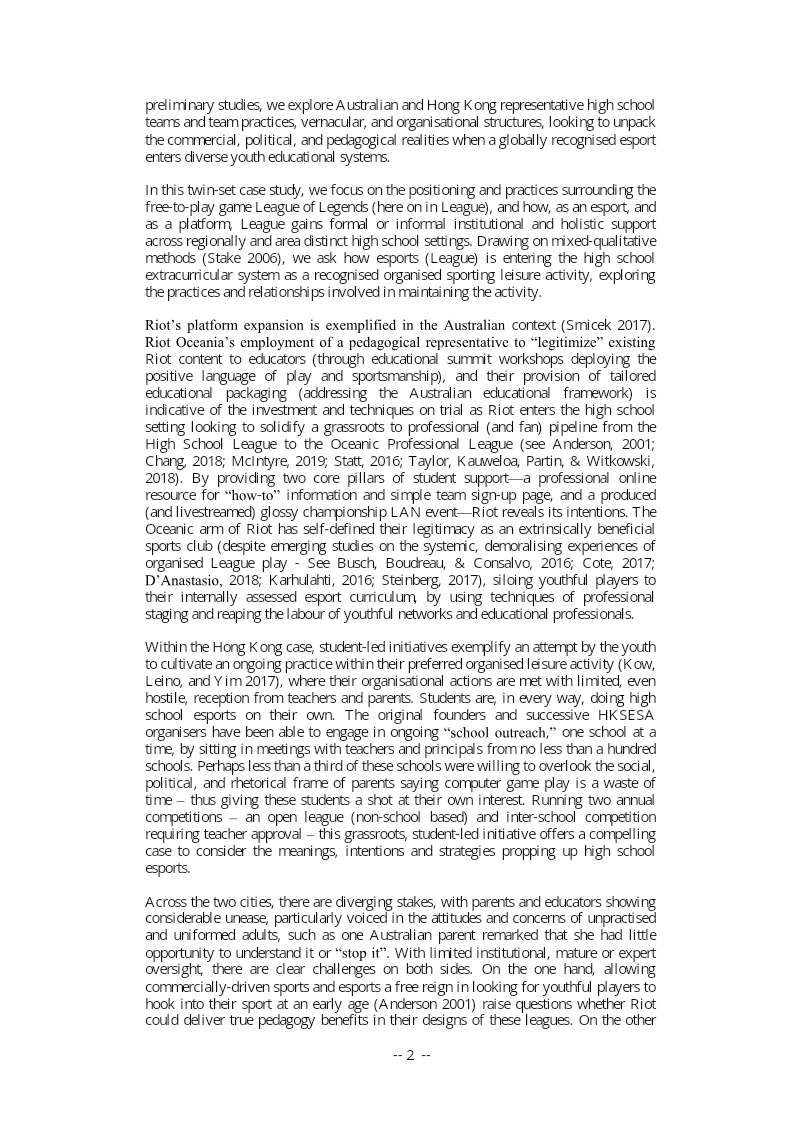
This paper is a comparative case study examining how League of Legends, the free-to-play esport developed by Riot Games, is entering high school extracurricular systems in Australia and Hong Kong. Its central argument is that high school esports is shaped by competing commercial, pedagogical, and socio-cultural forces, and that the two cases reveal the tensions that arise when a globally recognised esport moves into diverse youth educational settings. The study draws on preliminary fieldwork and mixed-qualitative methods, focusing on team practices, vernacular, and organisational structures.
In Australia, the study describes a Victorian high school whose boys' team reached the championship stage of the inaugural Riot-run High School tournament in 2018, a competition developed with commercial partners including an Australian football league representative. Team members were permitted to replace scheduled school physical education with individual online practice, and the authors interpret Riot Oceania's educator-facing workshops, tailored curriculum packaging, and professional-grade livestreamed finals as deliberate efforts to build a grassroots-to-professional pipeline. The paper argues that this approach extrinsically frames competitive gaming as a beneficial sport while drawing on young players' labour, despite emerging research on toxic and demoralising experiences within organised League play.
In Hong Kong, by contrast, the paper documents a student-led initiative in which four students founded the non-profit Hong Kong Student Esports Association after their schools rejected a proposed competition. The association now runs an open league and an inter-school competition, has secured local sponsorships, and has enlisted around thirty secondary schools, though its outreach met considerable resistance from teachers and parents who view gaming as a waste of time. The authors conclude that the two cases expose divergent stakes, with adult unease on one side, unchecked commercial influence and questionable pedagogical benefit on the other, and youth resistance and missed learning opportunities where adult involvement is absent.
Each row is a game or company this document names, each column a document, oldest first. A mark means that document names it. Select a row to see those documents.

DiGRA · 2026

DiGRA · 2026



DiGRA · 2026



DiGRA · 2026



DiGRA · 2026



DiGRA · 2026



DiGRA · 2026



DiGRA · 2026

DiGRA · 2026



DiGRA · 2026



DiGRA · 2026

DiGRA · 2026
DiGRA · 2016