
DiGRA
The Digital Games Research Association: the international association of academics and professionals who study digital games. Its Digital Library holds the proceedings of the DiGRA conferences since 2002.
Documents
God Is a Game Designer: Accelerating 'Existential Ludology'
This paper argues that existentialist frameworks, which emphasize thrownness, formlessness, and the denial of god as a source of meaning, are fundamentally at odds with computer games, which are well-formed artifacts designed by skilled individuals and entered into voluntarily by players.
- The paper argues that existentialist frameworks stressing thrownness and formlessness clash with games, which are designed artifacts entered voluntarily, and proposes an accelerationist extension of 'existential ludology' to resolve this tension.
- It draws on occasionalism, the theological view that God is the original cause operating within moments of causation, and imagines the game designer as a Malebranchian watchmaker whose agency appears within cause-and-effect relations.
- The core question is whether one can attend to a game's material existence and emergent 'worldness' while still recognizing the designer as an arbiter of meaning.
The Theme Park Experience: Kingdom Hearts and the Franchise
This paper, a DiGRA 2019 conference contribution by Anh-Thu Nguyen of the University of Cologne, argues that the Kingdom Hearts series, a collaboration between Disney and Japanese developer Square Enix, is best understood as a transmedia video game franchise built around its player character Sora.
- The paper argues Kingdom Hearts, a Disney and Square Enix collaboration, is best understood as a transmedia video game franchise centred on its player character Sora rather than as a simple licensed tie-in.
- Using Daniel Vella's framework for game characters, the author positions Sora as a tourist who moves through Disney worlds with the tourist gaze described by John Urry and Jonas Larsen, turning the game into a recreation of the theme park experience.
- Sora's costume changes within Disney worlds are read as cosplay, and reproductions of iconic film scenes have him either participating in or observing the action.
Failure in Videogames: Similarities and Differences to Textile Craft
This paper applies Jesper Juul's account of failure in videogames to hand knitting, arguing that videogame play and textile craft share a paradox: both are frustrating yet pleasurable, and both draw practitioners toward repeated trial and error in pursuit of mastery.
- Both videogame play and hand knitting share a paradox: they are frustrating yet pleasurable, drawing practitioners into repeated trial and error in pursuit of mastery.
- In knitting, errors appear as physical flaws (incorrect stitches or dropped loops) corrected by "frogging," unravelling back to the mistake, while knitters mitigate excessive unravelling by inserting lifelines, stable positions to return to.
- The paper argues that knitting's recoverable, incremental failure parallels the game Unravel (2016) and its sequel Unravel Two (2018), where the yarn-based protagonist's unravelling and the game's rules make catastrophic failure unlikely.
Who Creates Microtransactions: The Production Context of Video Game Monetization
This paper examines the production context of video game monetization, asking who actually designs and implements microtransactions, loot boxes, and other in-game purchase systems.
- Monetization responsibilities are usually absorbed into existing roles such as game designers and product managers rather than handled by a dedicated function, though emerging positions like economy designers, live operations producers, and data analysts increasingly carry these duties.
- Interviewees reported that monetization design is sometimes outsourced to external monetization specialists.
- The study uses a mixed-methods design combining nine exploratory interviews with German game professionals, analysis of 91 English and German job vacancy notices mentioning "monetization," and a review of credits from 68 titles released in 2018.

People@Meeple: It's a Community Thing
This study examines why hobbyist boardgamers attend a public convention, Meeplecon, a small annual event in Melbourne, Australia, that draws around 400 attendees, most of them returning participants.
- Hobbyist boardgamers attend Meeplecon, a small annual Melbourne convention of around 400 mostly returning attendees, despite it offering little of the environmental control they value at home, because community participation can outweigh these practical drawbacks.
- Qualitative research combining field observation with 22 attendee interviews (11 men, 11 women, aged 28 to 64) yielded eight themes, with playing games central for all participants.
- Attendees valued setting aside dedicated time away from everyday obligations such as housework and childcare, and many came specifically to meet people.
Using Physiological Response Data to Examine Horror Video Game Enjoyment
This study examines how physiological and eye-movement data can reveal the experience of enjoying horror video games, an entertainment genre that deliberately induces fear and other negative emotions.
- Heart rate combined with pupil constriction proved an accurate measure of immersion and enjoyment in the horror game "The House," with physiological and eye-movement data captured alongside mouse actions across horror event stages.
- As immersed players progressed through the game, fixation frequency rose while average fixation duration fell, a pattern that runs counter to previously reported immersion patterns in non-horror genres.
- Immersed players attended closely to narrative clues during high-suspense moments while staying alert to possible shocks, whereas less immersed players focused on event triggers that might prompt them to stop playing.
The Interaction of Discourse and Acts: Spectating Grassroot Livestreamers in China
This paper examines the streaming behavior of grassroot game live-streamers in China and the spectating behavior of their viewers, focusing on how discourse and interactive acts shape audience relationships on platforms such as Douyu.com.
- Grassroot game livestreaming in China has become a viable full-time career for over ten thousand gameplayers, and the livestreaming audience exceeded four hundred million by June 2018, with game content the most preferred category.
- The paper's central thesis is that a streamer's self-image, verbal and playful interactions with viewers, and recurring communication rituals together create symbolic boundaries that separate one streamer from competitors and cultivate a distinctive fan culture able to sustain a livelihood.
- Self-image is built through distinctive visual markers, displays of daily life, and fixed streaming schedules and spaces, which help define a streamer's identity to viewers.
How Theme Park Rides Adapted the Shooting Gallery
This paper traces how the interactive shooting dark ride emerged from a long lineage of target-shooting amusements, arguing that the modern theme park attraction borrowed its logic from videogames but was in fact rooted in fairground and arcade traditions.
- The paper argues that the interactive shooting dark ride, exemplified by Disney's Buzz Lightyear Space Ranger Spin (1998), emerged from a gradual convergence of fairground, arcade, and videogame traditions rather than a sudden innovation.
- The author uses a media archaeology approach, tracing lineages from early twentieth-century cinematic shooting galleries and electromechanical games through the light-gun tradition that began with William Gent's Electric Rifle in 1920.
- Sega's Ghost Hunters at Joypolis Yokohama (1994) is cited as an early dark-ride shooter, while Disneyland's Main Street Shooting Gallery opened in 1955 and the Dick Tracy's Crime-Stoppers concept, from around 1990, was never built.
Only a Game? Player Misery Across Game Boundaries
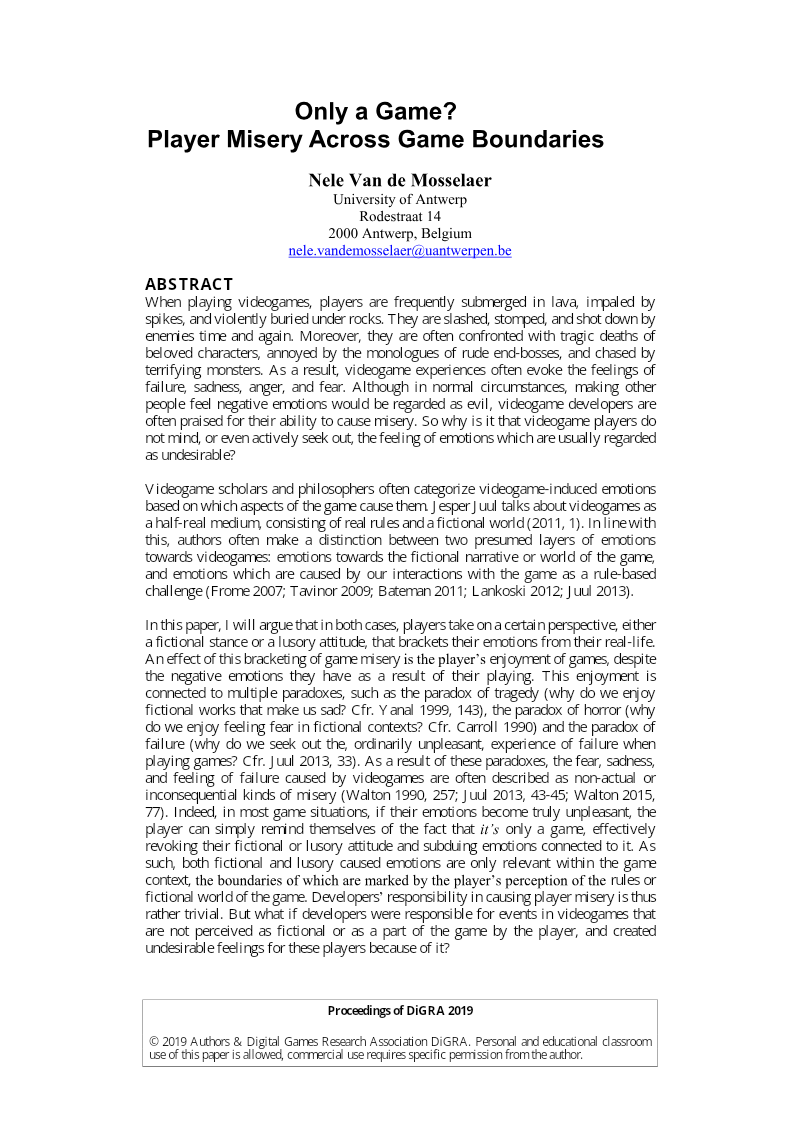
This philosophical paper by Nele Van de Mosselaer examines why players enjoy videogames that cause negative emotions such as sadness, fear, anger, and frustration.
- The paper argues that players enjoy games causing negative emotions because they adopt a fictional stance or lusory attitude that brackets those feelings from real life, resolving paradoxes such as tragedy, horror, and failure.
- Because such negative feelings can be dismissed with "it's only a game," the conventional view holds that developers bear relatively trivial responsibility for player misery.
- The author's main contribution is a third category of player misery, arising when developers create elements players do not perceive as part of the game, so the bracketing effect fails.
Games and Gestures: Remarks on Emotes in Digital Online Games
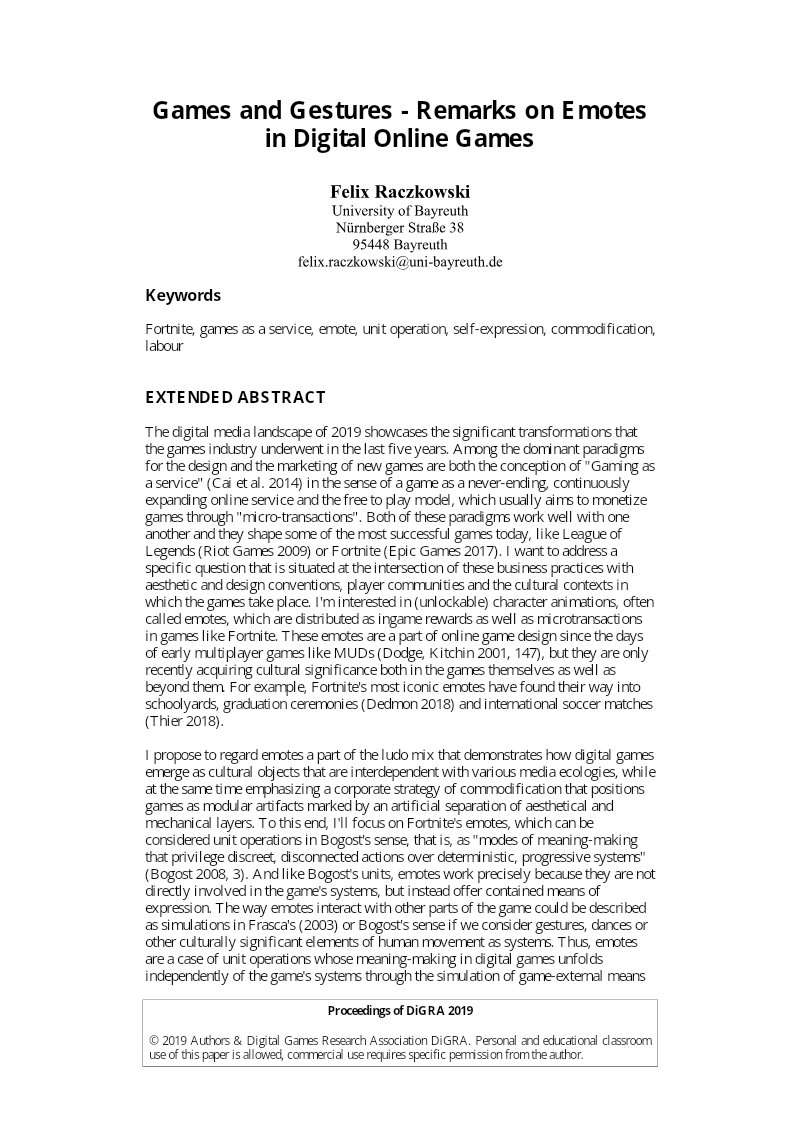
This paper by Felix Raczkowski examines emotes, the unlockable character animations and gestures sold or awarded in free-to-play online games, with a focus on Epic Games' Fortnite.
- Emotes are unlockable character animations and gestures sold or awarded in free-to-play online games, with Epic Games' Fortnite as the primary case study.
- Drawing on Ian Bogost's concept of "unit operations," the paper argues emotes create meaning independently of a game's underlying mechanical systems, yet remain central to player self-expression.
- The author contends that the industry's claim that visual modifications are "just cosmetic" is artificial, since these hedonic attributes drive purchasing decisions.
CryptoKitties and the New Ludic Economy: How Blockchain Introduces Value, Ownership, and Scarcity in the Digital World
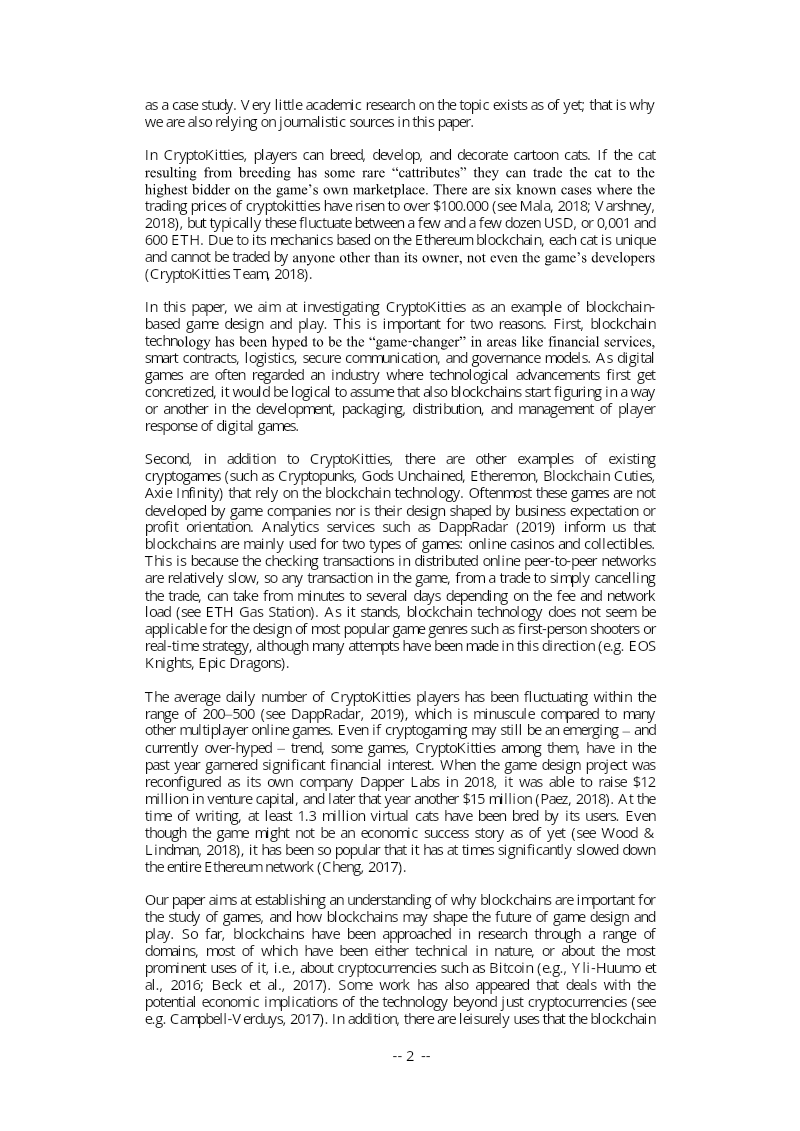
This paper examines CryptoKitties, a blockchain-based multiplayer game launched in 2017 in which players breed, collect, buy, and sell virtual cats built on the Ethereum network.
- The paper's central argument is that blockchain enables artificial digital scarcity through verifiable, tamper-resistant ownership records, and that this scarcity underpins the value of in-game assets.
- Rare CryptoKitties have occasionally traded for more than $100,000, though most typically sell for a few to a few dozen USD.
- CryptoKitties averaged roughly 200 to 500 daily players, a modest figure relative to mainstream multiplayer titles, even though more than 1.3 million virtual cats had been bred at the time of writing.

The Experience of Procedurality: Effects and Appreciation of Persuasive Gameplay Rhetoric
This paper, by Ruud Jacobs of the University of Twente, examines whether procedural rhetoric, the embedding of a persuasive message in gameplay systems so players reach their own conclusions through actions and consequences, is a viable mechanism in persuasive games.
- Procedural rhetoric, which conveys a persuasive message through gameplay systems so players reach conclusions via actions and consequences, was tested as a viable mechanism for persuasive games in two experiments by Ruud Jacobs of the University of Twente.
- In a study of 262 participants aged 15 and older, two persuasive games on teen dating violence (one narrative-driven, one procedural) both changed attitudes toward accepting angry behaviors and boosted self-efficacy in preventing abuse, with no measurable difference between their effects.
- In a study of 241 participants, weakening the reflective power of the picking mechanic in the forced-labor game My Cotton Picking Life roughly halved attitude change, showing the game depended heavily on its procedural rhetoric.