Uk
Documents
Interim Results: H1 FY26
Frontier Developments plc reported unaudited interim results for the six months to 30 November 2025, showing a 26 % increase in revenue to £59.6 million and a 76 % rise in adjusted operating profit to £9.7 million compared with the same period in 2024. The growth was driven primarily by the launch of Jurassic World Evolution 3, which contributed 90 % of total revenue in H1 FY26 and earned nominations at the Game Awards 2025 and BAFTA Games Awards 2026. Other titles such as Planet Zoo, Planet Coaster 2 and Elite Dangerous also performed strongly, with Planet Zoo becoming the Group’s highest‑grossing individual game.
Cash profitability improved markedly; adjusted operating profit, which excludes non‑cash development capitalisation and includes tax and R&D credits, grew to £9.7 million from £5.5 million year‑on‑year. IFRS operating profit rose 73 % to £7.8 million. Gross margin fell to 64 % from 70 %, reflecting higher royalty‑bearing IP revenue. The Group’s cash balance increased to £40.1 million, up 47 % from the prior year, after a £10 million share buy‑back that raised earnings per share to 21.4 p.
The Board upgraded FY26 guidance, now targeting revenue of approximately £100 million and adjusted operating profit of around £11 million, citing strong seasonal sales momentum. CEO Jonny Watts stepped down on 1 January 2026, succeeded by Jo Cooke, with Watts remaining as Executive Director until 31 May 2026 to ensure a smooth transition. The Group remains debt‑free, with no significant liabilities beyond lease obligations, and maintains a robust pipeline of CMS titles slated for release in FY27–FY28.
- Frontier Developments reported a 26% revenue increase to £59.6 million and a 76% rise in adjusted operating profit to £9.7 million for H1 FY26, driven primarily by the launch of Jurassic World Evolution 3.
- Jurassic World Evolution 3 accounted for 90% of total revenue in H1 FY26, while Planet Zoo became the company's highest-grossing individual title.
- The Board upgraded full-year FY26 guidance to approximately £100 million in revenue and £11 million in adjusted operating profit, supported by strong seasonal sales momentum.
- Cash reserves grew 47% year-on-year to £40.1 million, even after executing a £10 million share buy-back that increased earnings per share to 21.4p.
- Gross margin declined from 70% to 64% due to a higher proportion of revenue generated from royalty-bearing intellectual property.
Current Report No. 40/2021: Investment Agreement with Square Enix Limited
The report announces that PCF Group S.A. entered into an investment agreement with Square Enix Limited on 29 August 2021, formalizing the issuance of subscription warrants and related capital‑raising activities. The agreement stipulates that PCF will offer up to 1,555,922 warrants, each convertible into one Series C ordinary share, in up to six tranches linked to revenue milestones from contracts with Square Enix. Each tranche is released once cumulative contract revenue reaches a 45‑million‑PLN threshold, with the final tranche capped by 30 September 2024. The number of warrants per tranche is calculated as the ratio of 4.5 million PLN to the final share price offered in the public offering, ensuring a proportional allocation relative to revenue performance.
Square Enix may exercise its conversion rights after the fourth tranche and subsequently with each additional tranche, subject to a 31 December 2025 expiry. The agreement allows for accelerated tranching or conversion in events such as a change of control or delisting from the Warsaw Stock Exchange. Square Enix also retains an opt‑out clause, enabling it to relinquish conversion rights in exchange for compensation if the parties decide against further investment.
As of the report date, PCF’s revenue from Square Enix contracts exceeded 90 million PLN, triggering the obligation to offer two warrant tranches. The potential conversion of these warrants would represent roughly 1.8 % of PCF’s share capital, indicating a modest dilution impact. The agreement concludes prior negotiations that began with an initial memorandum of understanding on 31 July 2020, thereby formalizing the terms outlined in PCF’s prospectus.
- PCF Group S.A. entered an investment agreement with Square Enix Limited on 29 August 2021, establishing a mechanism for issuing up to 1,555,922 subscription warrants convertible into Series C ordinary shares.
- Warrant issuance is tied to revenue milestones from contracts with Square Enix, with each tranche triggered by cumulative revenue increments of 45 million PLN.
- As of the report date, PCF had already exceeded 90 million PLN in contract revenue, triggering an immediate obligation to offer two warrant tranches.
- The potential conversion of all 1,555,922 warrants represents a modest dilution of approximately 1.8% of PCF’s total share capital.
- Square Enix may exercise conversion rights starting after the fourth tranche, with all rights subject to a final expiry date of 31 December 2025.
Raport Bieżący Nr 44/2025: Zawarcie Warunkowego Porozumienia ze Spółką Square Enix Limited
PCF Group S.A. has entered into a conditional agreement with Square Enix Limited to finalize the financial settlement of the Gemini project and formally terminate existing development and publishing partnerships. This agreement marks the conclusion of two long-standing collaborations, specifically the 2020 production-publishing contract for the Gemini project and the 2016 agreement concerning the Madness project. As part of this settlement, both parties have agreed to waive all potential claims arising from their previous professional relationship.
The effectiveness of this agreement is subject to a specific condition precedent involving the transfer of technical assets. PCF Group is required to deliver a comprehensive closing kit containing all development materials related to the Gemini project within 30 days of the agreement date. Square Enix Limited then has a subsequent 30-day window to verify and accept these materials. Should the publisher fail to respond or formally reject the contents of the closing kit, the agreement will expire, and the stipulated legal consequences, including the termination of the contracts and the waiver of claims, will not take effect.
This development represents a strategic shift in the operational relationship between the Warsaw-based developer and the London-based publisher. By resolving these outstanding project obligations, the parties aim to clear the path for future independence or alternative partnerships. The company intends to provide further updates as the verification process for the closing kit progresses and the final status of the agreement is confirmed.
- PCF Group S.A. and Square Enix Limited have signed a conditional agreement to formally terminate their 2020 Gemini project contract and 2016 Madness project agreement.
- The settlement includes a mutual waiver of all potential claims arising from the previous professional relationship between the two companies.
- The agreement is contingent upon PCF Group delivering a comprehensive closing kit of all Gemini project development materials within 30 days of the agreement date.
- Square Enix Limited has a 30-day window following the delivery of the closing kit to verify and accept the materials.
- If Square Enix fails to accept the closing kit or does not respond within the 30-day verification period, the agreement will expire and the contract terminations and claim waivers will not take effect.
Reconnecting with Gen Z Mobile Gamers: UK
Mobile gamers aged 18 to 24 represent a critical demographic for the UK gaming industry, characterized by high engagement levels but increasing volatility. While 79% of this cohort plays mobile games at least several times a week, their overall time investment is declining, dropping to an average of 4.4 hours per week. This shift is driven by intense competition from other digital entertainment channels, with 57% of Gen Z players reporting that social media, streaming, and short-form video content are actively displacing their mobile gaming time.
The research, based on an online survey of 1,605 UK residents, reveals that Gen Z exhibits significantly lower title loyalty than the general population. Approximately 57% of these players frequently rotate between games, constantly seeking new experiences. This churn is exacerbated by dissatisfaction with current industry practices; 71% of Gen Z players cite intrusive monetization and advertising as primary deterrents, while 62% feel there is a lack of fresh, appealing content in the current market.
To recapture this audience, developers must pivot toward discovery strategies rooted in social proof and authentic gameplay. Gen Z discovery is increasingly spontaneous, relying on creator content and peer recommendations rather than traditional marketing assets. Successful engagement strategies require front-loading immediate rewards, designing for shareable social moments, and implementing fair, non-intrusive monetization models. By prioritizing short-form satisfaction and consistent content updates, developers can better align with the fragmented attention spans and high expectations of this demographic, ultimately fostering more sustainable long-term retention.
- 71% of UK Gen Z mobile gamers cite intrusive monetization and advertising as the primary reason for abandoning games.
- Gen Z mobile gaming time is declining to an average of 4.4 hours per week as 57% of players shift their attention to social media, streaming, and short-form video.
- Title loyalty is low among this demographic, with 57% of players frequently rotating between games in search of new experiences.
- 62% of Gen Z players report a lack of fresh, appealing content in the current mobile gaming market.
- While 79% of 18- to 24-year-olds play mobile games at least several times a week, engagement is increasingly volatile and reliant on spontaneous discovery through creator content and peer recommendations.
The Value of Esports in the UK
The study demonstrates that the United Kingdom’s esports industry has experienced robust growth, expanding at an average annual rate of 8.5 % between 2016 and 2019. In 2019 alone, the sector generated approximately £60 million in revenue—about eight per cent of global esports earnings—and contributed £111.5 million to the national Gross Value Added, supporting more than 1,200 full‑time equivalent jobs. These figures underscore the sector’s role as a significant driver of the UK digital creative economy.
Key drivers identified include the proliferation of professional teams, high‑profile tournaments hosted by organisations such as ESL, Gfinity and Epic.LAN, and the rise of streaming platforms that have broadened audience reach. Dedicated venues like Belong Gaming Arenas further stimulate grassroots participation and local economic activity. Modelling of direct, indirect and induced effects reveals a total impact of roughly 216 FTEs and £19.5 million in GVA, while spill‑over benefits from event tourism—estimated at £234 k per 1,000 visitors and nearly five FTEs—highlight additional value for host communities.
The analysis projects that hosting a major global esports event could add 238 full‑time equivalents and £12 million in GVA to the UK economy, signalling substantial upside potential. The findings point to opportunities for further investment, clearer regulatory frameworks and strategic positioning to attract international events, thereby consolidating esports as a pivotal growth sector within the United Kingdom’s broader digital economy.
- In 2019, the UK esports industry generated £60 million in revenue and contributed £111.5 million to the national Gross Value Added (GVA), supporting over 1,200 full-time equivalent (FTE) jobs.
- The sector experienced robust growth between 2016 and 2019, expanding at an average annual rate of 8.5%.
- Hosting a single major global esports event is projected to add £12 million in GVA and 238 FTE jobs to the UK economy.
- Event tourism provides significant spill-over benefits, estimated at £234,000 in economic value and nearly five FTEs per 1,000 visitors.
- Key industry drivers include professional tournament organizers such as ESL, Gfinity, and Epic.LAN, alongside the expansion of streaming platforms and physical infrastructure like Belong Gaming Arenas.
Esports 2023: Challenges and Opportunities in the UK
The report argues that the United Kingdom’s esports sector has evolved from a fragmented niche into a rapidly professionalised ecosystem, yet it still requires coordinated investment and policy to sustain growth. Key findings show an audience of roughly 55 million adults, with 82.7 % aged 18‑34 and a male dominance of 83 %. While shooters such as Call of Duty, CS:GO and Fortnite command the largest viewership, only 3.8 % of gamers follow competitive play, revealing a small “iceberg” of engaged fans. This gap highlights opportunities for talent development and global brand expansion, especially as the UK lags behind U.S. and Asian markets in producing top‑tier professionals.
Economic data underscore the sector’s momentum: gross value added reaches £111 million and sponsorship revenue exceeds $1.38 billion, with UK events and teams capturing a $1.5 billion share of the global market. Major brands—Intel, Red Bull, Saudi PIF—and tournament operators such as ESL, FACEIT and Gfinity are driving investment, while infrastructure projects by XLHQ, Royal Ravens and Cloud9 create dedicated studios and community hubs. Educational initiatives, including a BTEC programme with Pearson and university leagues like NUEL, demonstrate that esports can boost computing engagement and skill development among 10 000 pupils.
Despite these gains, challenges persist. Mainstream media coverage remains limited, and government support is uneven, constraining broader recognition of esports as a legitimate sport. Diversity and inclusion remain under‑addressed, with female participation at 17 % and a need for stronger links between education, industry and policy to create sustainable career pathways. Emerging monetisation models—Web3, NFTs, metaverse experiences—offer new revenue streams but require regulatory clarity and infrastructure investment. Coordinated action across stakeholders is essential to unlock the UK’s full economic and cultural potential in esports.
- The UK esports sector generates £111 million in gross value added, with UK-based teams and events capturing a $1.5 billion share of the global market.
- While the UK has a potential audience of 55 million adults, only 3.8% of gamers follow competitive play, indicating a significant opportunity for fan base expansion.
- The demographic profile of the UK esports audience is highly concentrated, with 82.7% aged 18–34 and 83% male, highlighting a need for improved diversity and inclusion efforts.
- Major investment is being driven by global brands like Intel, Red Bull, and the Saudi PIF, alongside infrastructure developments from organizations such as XLHQ, Royal Ravens, and Cloud9.
- Educational initiatives, including a Pearson BTEC programme and the NUEL university league, are currently engaging 10,000 pupils in computing and skill development.
Annual Review: 2025
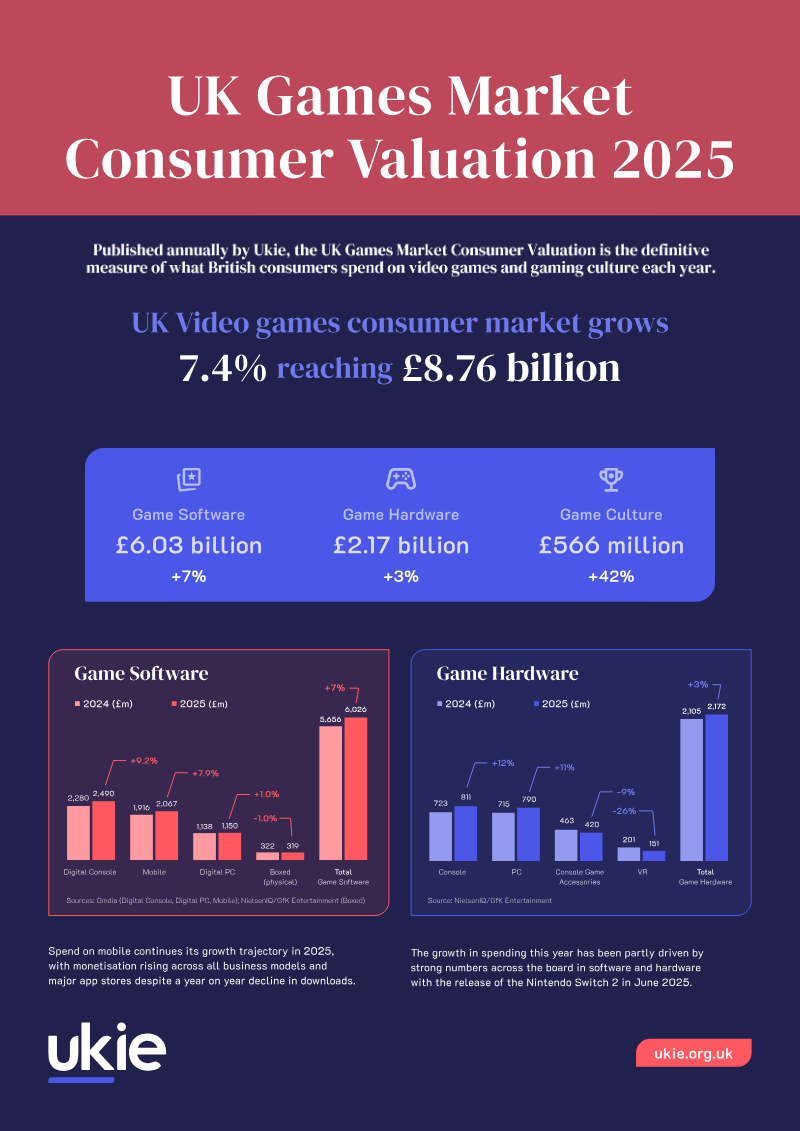
The document outlines Ukie’s first year of its five‑year “Supercharged” strategy, aimed at accelerating the UK video games and interactive entertainment sector. The thesis is that a coordinated policy, industry‑wide campaigns, talent development and trade support can secure the UK’s position as a global leader in games. Key findings show that consumer spending reached £7.6 billion in 2024, a record high, and that Ukie’s advocacy generated three major policy wins: recognition of games as a growth sector, a tailored growth package and £30 million for the UK Games Fund. The organisation also secured £75 million in business wins through global trade activity at GDC and Gamescom, and delivered 19 consultations to government bodies. In talent development, Ukie supported 30 companies via its Growth Programme and ran the largest student game jam with over 200 participants, while Digital Schoolhouse won a national BETT award for best opportunities and experience. The scope covers the UK, with outreach to Scotland, Wales, Northern Ireland and international partners such as Tencent. Methodology includes evidence‑based lobbying, a national pulse survey network, and partnership with academic institutions for skills research. The report concludes that the next year will focus on deepening policy influence, expanding trade missions, and fostering emerging mobile, UGC and external‑engine opportunities to sustain industry growth.
- UK consumer spending on video games and interactive entertainment reached a record high of £7.6 billion in 2024.
- Ukie’s advocacy efforts secured £30 million in funding for the UK Games Fund and official recognition of the sector as a key driver of economic growth.
- Global trade activities at GDC and Gamescom generated £75 million in business wins for the UK games industry.
- The organization delivered 19 formal consultations to government bodies to influence policy and secure a tailored growth package for the sector.
- Talent development initiatives included supporting 30 companies through the Growth Programme and hosting a student game jam with over 200 participants.
Business Case for an Enhanced Video Games Expenditure Credit: UK
The analysis argues that a targeted increase in the Video Games Expenditure Credit (VGEC) would markedly strengthen the United Kingdom’s competitive position within the global video‑games sector. By raising the nominal rate to 53 % for projects up to £10 million and to 39 % for larger productions, the model predicts an additional £530 million in gross value added (GVA) and roughly 6,000 new full‑time jobs over five years. The return on investment is projected at £2.12 of GVA and tax revenue for every £1 spent, positioning the UK as one of the most attractive jurisdictions for game development.
Key findings highlight a worldwide contraction in employment, with 30 000 layoffs expected between 2023 and 2024, prompting a shift toward freelance and subcontracted talent. Venture‑capital funding has fallen sharply from $9 billion in 2020 to just over $3 billion by early 2024, while indie sales on platforms such as Steam now account for nearly 70 % of full‑game revenue. These trends underscore the need for flexible, cost‑efficient production models and a supportive fiscal environment.
Comparative analysis shows that the current UK VGEC effective rate of 14 % is lower than those in France (20.2 %) and Canada’s Quebec (18.2 %). The proposed tiered scheme would raise the UK rate to 20.6 %, matching or surpassing many international competitors and potentially adding an extra 5,000 full‑time equivalents over five years. Across all scenarios, the cost‑benefit profile remains favorable, with GVA returns of £1.3–£1.4 per £1 invested and tax returns of £0.4–£0.5 per £1.
In sum, the enhanced VGEC package delivers a superior economic return by stimulating export‑driven intellectual property creation and supporting both small studios and multinational operations. The model demonstrates that a carefully calibrated incentive structure can offset macro‑economic pressures, sustain employment growth, and secure the UK’s position as a global leader in video‑game development.
- Increasing the Video Games Expenditure Credit (VGEC) to a tiered rate of 53% for projects under £10 million and 39% for larger productions is projected to generate £530 million in additional gross value added (GVA) and 6,000 new full-time jobs over five years.
- The proposed fiscal enhancement would raise the UK’s effective VGEC rate to 20.6%, surpassing current rates in France (20.2%) and Quebec (18.2%) to improve international competitiveness.
- Every £1 of government investment in the enhanced VGEC is projected to yield a return of £2.12 in combined GVA and tax revenue.
- The global video game industry faces significant contraction, with 30,000 layoffs expected between 2023 and 2024 and venture capital funding dropping from $9 billion in 2020 to roughly $3 billion by early 2024.
- Indie game sales on platforms like Steam now represent nearly 70% of total full-game revenue, highlighting a market shift toward smaller, cost-efficient production models.
Annual Report 2025
Annual Report 2025 details a landmark financial year for Games Workshop, characterized by record-breaking growth and the company’s promotion to the FTSE 100. For the 2024/25 period, total revenue rose to £617.5 million, with profit before taxation reaching £262.8 million. This performance was driven by a 14.2% increase in core sales—particularly within the trade channel and North American markets—and a near-doubling of licensing operating profit to £49.5 million, bolstered by the exceptional success of the Space Marine 2 video game.
The company continues to leverage a vertically integrated model, expanding its global footprint to 570 retail stores across 24 countries and an independent retailer network spanning 71 nations. To support this growth, significant capital investments are underway, including the construction of a fourth manufacturing facility by 2026 and a comprehensive IT systems overhaul slated for completion by 2029. While navigating macroeconomic challenges such as projected tariff impacts and supply chain disruptions, the Group maintained a robust liquidity position with £132.6 million in cash and distributed a record £20 million in profit-sharing to its workforce.
Strategic priorities have shifted toward long-term value alignment, evidenced by a new remuneration policy that introduces share-based compensation for executives and a "Triennial Share Award" linked to revenue and profit targets. Sustainability remains a core focus; despite a rise in total emissions driven by global freight, the company surpassed its 2032 reduction targets for Scope 1 and 2 emissions through facility electrification. Looking forward, the Group is prioritizing internal talent development, digital engagement through Warhammer+, and a potential media partnership with Amazon to further scale the brand's global reach.
- Games Workshop achieved record financial results for 2024/25 with £617.5 million in revenue and £262.8 million in profit before taxation, leading to its promotion to the FTSE 100.
- Licensing operating profit nearly doubled to £49.5 million, largely driven by the commercial success of the Space Marine 2 video game.
- Core sales grew by 14.2%, fueled by strong performance in the trade channel and North American markets.
- The company is scaling infrastructure with a fourth manufacturing facility scheduled for 2026 and a major IT systems overhaul targeted for 2029.
- Management has implemented a new executive remuneration policy featuring share-based compensation and a Triennial Share Award tied to specific revenue and profit targets.
Press Start on Growth: Unlocking the Full Potential of the UK Video Games Industry
The analysis argues that the United Kingdom’s video‑games sector is a high‑growth pillar of the creative economy, already delivering roughly £6 billion in gross value added (GVA) and supporting more than 73 000 jobs, and that strategic policy action could lift its contribution to about £7.6 billion in 2024 and generate an additional £5.7 billion GVA and up to 5.4 million jobs over the next five years. The assessment covers the full UK market from 2022 through 2024, spanning software, hardware, live events, esports, ancillary merchandise and related media, and benchmarks performance against Western‑European averages.
Key findings show a continued erosion of physical boxed software, which fell 34 % year‑on‑year and now accounts for only 4 % of total spend, while mobile games grew 8 %—still below the 13 % regional average. Full‑game digital purchases slipped due to a thin slate of blockbuster releases, yet overall game volume remained stable. Live‑event spending contracted 15 % after pandemic‑related cancellations, whereas esports surged 44 % YoY, driven by a rise in UK‑based tournaments. Subscription revenue rose modestly as price hikes offset a near‑saturation of console subscriber bases. Hardware sales weakened for PS5 disc and Xbox consoles and for the Nintendo Switch, while the PS5 digital edition posted record software sales at a lower price point. Game‑culture engagement declined 13 % across PC and console categories, and related toy and merchandise sales fell 8.5 %.
The conclusions stress that without targeted reforms—particularly in financing, skills development, and talent support—the sector risks losing its global leadership. Conversely, coordinated policy could unlock further growth, broaden international reach, and reinforce the UK’s position as a leading hub for video‑games innovation and cultural influence. Data are drawn from industry sources such as Omdia, Ukie, NielsenIQ/GfK Entertainment, BFI, Comscore and the Official Charts Company, reflecting a comprehensive market‑valuation approach across multiple
- The UK video games industry currently contributes £6 billion in gross value added (GVA) and supports over 73,000 jobs, with the potential to add £5.7 billion in GVA and 5.4 million jobs over the next five years through strategic policy intervention.
- Physical boxed software sales have collapsed, falling 34% year-on-year to represent only 4% of total market spend.
- Esports experienced a significant surge of 44% year-on-year, driven by an increase in UK-based tournaments, contrasting with a 15% contraction in live-event spending.
- Mobile gaming in the UK grew by 8%, though this remains below the 13% regional Western-European average.
- Hardware sales for major consoles, including the PS5 disc edition, Xbox, and Nintendo Switch, weakened, while the PS5 digital edition achieved record software sales at a lower price point.
Is the Past the Future of Gaming?
Remakes and remasters have become a cornerstone of the video‑game market, now generating roughly two hundred releases each year and projected to reach about thirty titles in 2025. Their commercial performance consistently exceeds that of the original versions, exemplified by the Resident Evil 4 remake, which sold ten million copies within two years of launch, and the continued success of other high‑profile updates such as the Crash series. This growth reflects a broader industry shift toward leveraging established intellectual property to secure reliable revenue streams.
A survey of 1,500 gamers identifies nostalgia as the dominant motivator for purchasing these updated titles, with more than eighty percent seeking the emotional comfort of revisiting familiar experiences. Seventy‑one percent view remakes as a means to introduce classic games to younger players, while between sixty‑seven and eighty‑five percent appreciate the opportunity to discover titles they missed originally. Players also demand contemporary enhancements, ranking higher‑resolution textures, smoother animation, improved lighting, remappable controls, and bug fixes as essential. Nevertheless, the audience is split: roughly thirty‑five percent each prefer strict fidelity to the original or the freedom to alter narrative and gameplay, highlighting a tension between preservationist and innovation‑leaning attitudes.
Pricing expectations reveal a nuanced market perspective. Nearly half of respondents anticipate remakes to be priced slightly below new releases, while a quarter are comfortable with parity, twenty percent expect a more substantial discount, and a small segment seeks free or bundled options. These preferences shape release strategies, with developers balancing cost, value perception, and the timing of launches to maximize appeal.
While nostalgia‑driven updates can boost sales, an overreliance on remakes risks dampening creative innovation. Gamers express a clear desire for a blend of faithful revisions and fresh original IP, suggesting that sustainable growth will depend on integrating modern improvements with new, inventive experiences across the global gaming landscape.
- Remakes and remasters have become a major industry pillar, with roughly 200 releases annually and projections indicating 30 high-profile titles for 2025.
- Commercial performance for remakes frequently outperforms original releases, evidenced by the Resident Evil 4 remake achieving 10 million sales within two years.
- Nostalgia is the primary consumer driver, with over 80% of 1,500 surveyed gamers citing the desire for emotional comfort as their main motivation for purchasing updated titles.
- Consumer demand for remakes is split between preservation and innovation, with roughly 35% of players favoring strict fidelity to the original and 35% preferring narrative or gameplay changes.
- Players prioritize technical modernization in remakes, specifically requesting higher-resolution textures, smoother animation, improved lighting, remappable controls, and bug fixes.
UKIE Annual Review 2024
Ukie’s 2024 annual review presents a comprehensive account of the UK video‑games sector’s performance, strategic direction and advocacy work over the past twelve months. The central thesis is that the industry, now a £6 billion economic engine supporting 76 000 jobs, must be “supercharged” through coordinated efforts to energise businesses, empower talent and elevate games as cultural and educational assets. The review outlines the new five‑year “Supercharged” strategy, which frames Ukie’s campaigning and support programmes for the next decade.
Key findings highlight robust economic contributions: consumer spending on games rose 4 % to £7.82 billion, while a joint analysis with FTI Consulting estimated video‑game technology spill‑overs added up to £760 million to UK GDP and created nearly 10 000 jobs in 2021. International trade activities at Gamescom and GDC generated over £70 million in business wins and attracted more than £150 million of foreign direct investment for 180 UK companies. Policy influence is demonstrated by over 100 engagements with MPs, successful submissions to Ofcom on online safety, and a manifesto that secured inclusion of the sector in major party election platforms. Education initiatives reached 299 470 learners through the Digital Schoolhouse programme, and IP protection actions removed 1.5 million infringing links and prevented £100 million of illicit digital sales.
The review’s scope covers the UK video‑games ecosystem from indie studios to multinational publishers, spanning 2023‑24 and encompassing economic, cultural and regulatory dimensions. Methodologically, the analysis combines internal data on events, memberships and media coverage with external research collaborations, consultation responses and round‑table workshops to produce evidence‑based recommendations. The narrative underscores a commitment to diversity, with a newly approved five‑year EDI strategy and over 20 inclusion‑focused events, positioning the sector for sustained growth and global competitiveness.
- The UK video games sector is a £6 billion economic engine supporting 76,000 jobs, with consumer spending rising 4% to £7.82 billion in the 2023-24 period.
- Video game technology spill-overs contributed £760 million to UK GDP and created nearly 10,000 jobs as of 2021.
- International trade activities at events like Gamescom and GDC generated over £70 million in business wins and attracted more than £150 million in foreign direct investment for 180 UK companies.
- Ukie’s IP protection efforts successfully removed 1.5 million infringing links, preventing an estimated £100 million in illicit digital sales.
- The Digital Schoolhouse education programme reached 299,470 learners, supporting the industry's focus on talent development.