Updated Jun 1, 2026 by Ukie
Report · December 16, 2025
Published by Ukie, Olsberg SPI, Nordicity
ukie OLSBERG SPI Nordicity Why esports represents such a big opportunity for the UK 24 How big is esports and how fast is it growing? 31 The value to local economies Key Impacts and the Potential of a Major UK event 34 How can the UK esports sector grow further? Ukie’s Recommendations for Growth In 1980 Atari ran the Space Invaders Tournament. It attracted over 10,000 participants and was won by Rebecca Heineman.
October 2020 * * HDET EDIENTIA The value of esports in the UK A study for Ukie by Olsberg • SPI with Nordicity MATA ukie OLSBERG SPI Nordicity
Contents 03 Foreword and introduction The global esports phenomenon 10 What is esports? Why esports represents such a big opportunity for the UK 24 How big is esports and how fast is it growing? Revenue and Economic Impact 31 The value to local economies Key Impacts and the Potential of a Major UK event 34 How can the UK esports sector grow further? Ukie’s Recommendations for Growth 37 Appendix Economic Impact Methodology
Foreword Dr Jo Twist OBE, Ukie CEO In 1980 Atari ran the Space Invaders Tournament. It attracted over 10,000 participants and was won by Rebecca Heineman. It would have been hard DIGITAI to predict that playing and watching organised and competitive video SCHOO games – esports – would be the world's fastest growing entertainment sector 40 years on. BY But that is what has happened. A global sector at the intersection of technology, creativity, broadcast and entertainment – all areas of real national strength for the UK. This report shows us that the UK has a strong and growing esports industry, but that there is more to do to capture the full potential of this exciting, high-growth sector. Ukie, in its capacity as the trade body for esports, looks forward to continuing to work with industry and Government to make the UK a global hub for esports. lobal hub for esports.
~~About ~~ Ukie Ukie is the trade body for the UK games and interactive entertainment industry. With over 480 members, we represent games business of all sizes, from small start-ups to large multinational developers, publishers, service companies, charities and academic institutions, working across PC, console, mobile, online, esports and immersive technologies. As well as supporting our members by connecting them with one another and promoting their innovative games and services, we keep policy makers informed, ensuring essential support measures are provided by government for games companies and players alike. 4 | Foreword and Introduction
About ~~this study~~ Against the backdrop of opportunity and growth in UK esports, Ukie commissioned Olsberg•SPI with Nordicity to evaluate the scale of the sector in this study. The study assesses the economic impact of UK esports, and also provides an overview of the sector and its impact on regional economies. It also examines the breadth of businesses active in the sector, and includes a set of recommendations for the future growth of esports. Olsberg•SPI with Nordicity previously assessed the impact of esports to the UK’s economy and its role in the UK’s games industry in the 2018 study Screen Business, published by the British Film Institute. Since 2016, the base year for Screen Business, esports has continued to see strong growth in the UK and beyond – as shown by the results of this Study. 5 | Foreword and Introduction
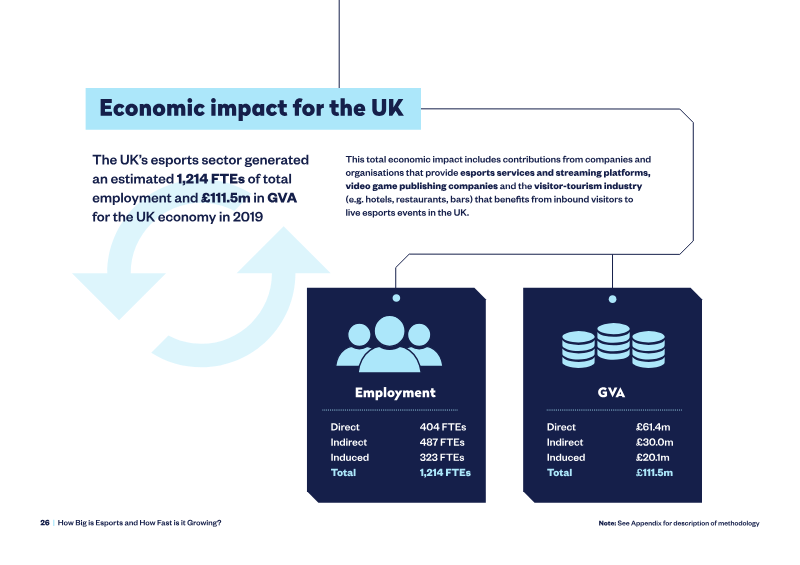
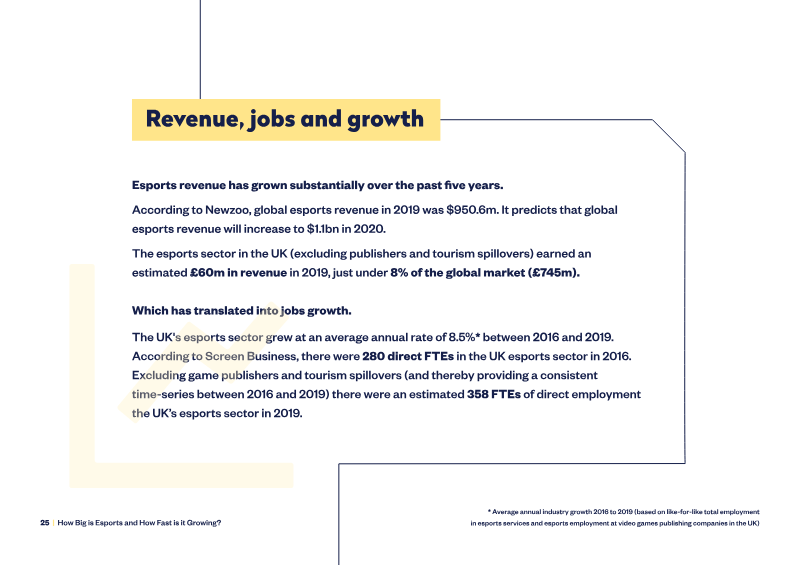
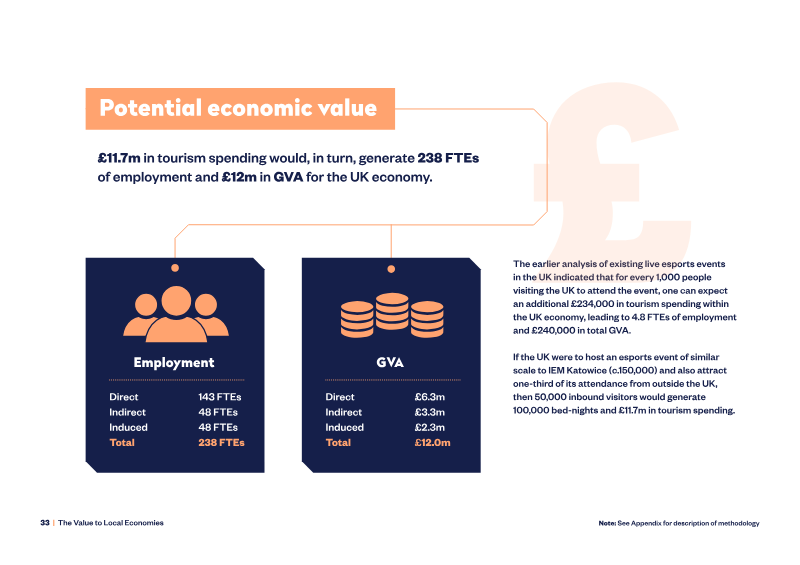
Headline findings The esports sector has grown at an annual average rate of 8.5% between 2016 and 2019. The sector supported over 1,200 jobs in 2019. The UK esports sector represents just under 8% of the global market. The UK esports sector supported £111.5 million in Gross Value Added (GVA) in 2019. A major global esports event could generate 238 full-time equivalents (FTEs) of employment and £12 million in GVA for the UK economy. 6 | Foreword and Introduction
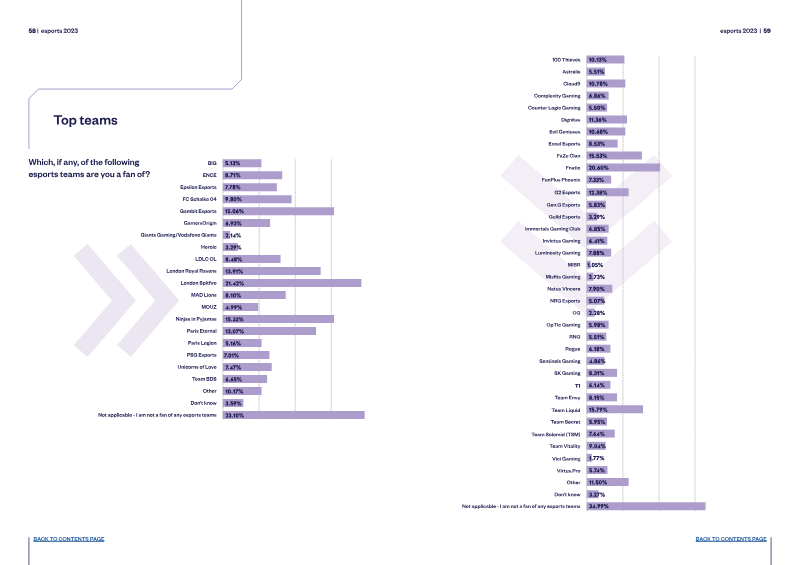
Image courtesy of British Esports / Jonas Kontautas ~~<u>BACK TO CONTENTS PAGE</u>~~ 2 | esports 2023 esports 2023 | 3 04 Chapter 22 46 Chapter 2 72 Chapter 3 04 Chapter 1 22 46 Chapter 2 72 Chapter 3 ~~<u>Foreword by Ukie</u>~~ ...
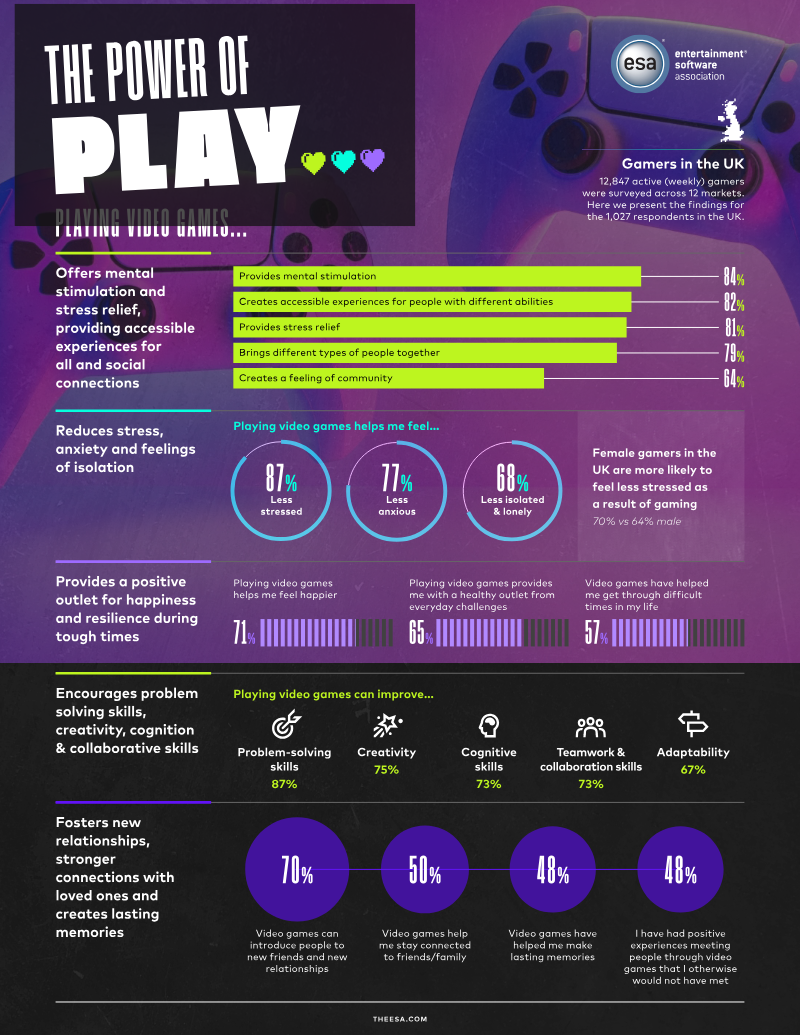
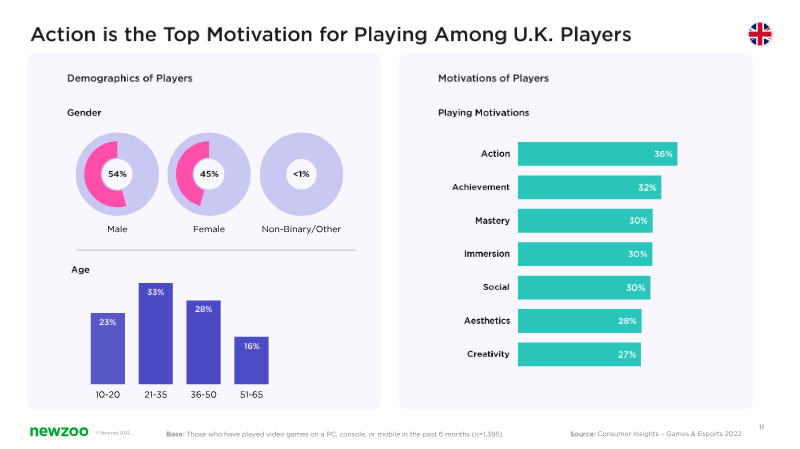
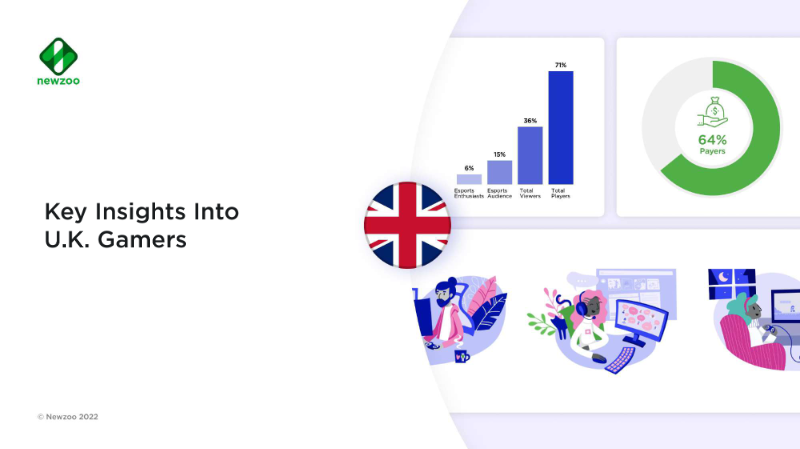
The United Kingdom represents a major global gaming hub, ranking as the sixth-largest market by revenue and tenth by player population as of late 2022. Research conducted among the online population aged 10 to 65 indicates that gaming is a primary entertainment pillar in the region, with 71% of the population identifying as game enthusiasts. This engagement is split between active play and content viewership, with 36% of the population exclusively playing games and another 35% both playing and viewing gaming video content. The demographic profile of UK gamers is nearly balanced by gender, consisting of 52% male and 47% female players. While gaming spans all age groups, the 21-35 bracket is the most active. Motivation for play is driven primarily by the desire to unwind and relax, followed by the pursuit of achievement and social interaction. When categorized by persona, Time Fillers—those who play casually to pass the time—represent the largest segment, followed by Mainstream Gamers who engage deeply with both play and viewership. Platform preferences show that mobile gaming has the highest reach at 46%, followed by console at 41% and PC at 29%. However, PC and console players demonstrate higher average weekly time commitments compared to mobile users. Financial engagement is also significant, with 63% of players identified as payers. The primary driver for spending is the availability of sales or special offers, though social motivations, such as spending to play with friends or family, also influence purchasing behavior. The findings are based on a 2022 survey of 2,010 respondents in the United Kingdom, part of a broader global study covering 36 markets. The methodology utilizes a representative sample of the online population to track dozens of key performance indicators, including audience profiles, platform behavior, and monetization trends.
The report establishes that Africa’s video‑game industry has entered a phase of rapid maturation, driven largely by mobile play in urban centres such as South Africa, Nigeria and Kenya. Mobile accounts for roughly 90 % of the $1.8 billion market in 2024, with a 10 % year‑over‑year rise in players to 349 million. PC and console remain niche but critical for studio visibility, with Steam dominating distribution (≈70 % of PC use) and local platforms like Gara and Jiwe capturing the remainder. Funding for studios is overwhelmingly sourced from international incubators and grants—Pro Helvetia, the French Agence Française de Développement, the British Council’s Ignite Culture and Digital Lab Africa—yet local infrastructure gaps (low internet penetration, limited payment systems, unreliable electricity) continue to constrain broader market development. Key findings show that the fastest‑growing economies—Eritrea, Niger, Egypt, Ethiopia, Nigeria and South Africa—host studios such as Maliyo Games, Kayfc and Legends of Orisha that are producing mobile‑first IP while experimenting with higher‑production PC/console titles. Female representation and gender inclusivity are addressed through programmes like Pro Helvetia’s “She Got Game”, yet overall skill development remains uneven, with many studios still operating at the indie level and lacking robust business training. The esports sector mirrors this mobile dominance, with titles like PUBG Mobile and Free Fire generating substantial prize pools and viewership across hubs such as Morocco, Egypt and Kenya. However, talent development is concentrated in a handful of urban centres, leaving Francophone and non‑English speaking regions underrepresented. The analysis concludes that sustainable growth hinges on three pillars: deeper, studio‑level talent development; reliable data infrastructure for market intelligence; and evolved payment systems that reduce friction. Strengthening African‑European partnerships, expanding local incubation pathways, and ensuring annual data updates are essential to unlock the continent’s commercial potential while preserving African leadership in game creation.
IN VIETNAM: A NEW TOURWAMENT WHY ESPORTS NOW ? HOW CAN BRANDS 1 A culture of competition 8 BRIDGE THE GAP? 2 A global rising star 10 3 Vietnam’s new favorite pastime 13 1 Ads 44 2 KOL Engagement 54 WHO ARE VIETNAM’S 3 Sponsorship 65 4 Unexplored Alleys 74 ESPORTS FANS? ...