Serious Games reports and market data
Documents

Business Management Simulations: A Detailed Industry Analysis and Recommendations
Business management simulations serve as a critical bridge between theoretical instruction and practical application, functioning as a formative yet fragmented industry.
- The post-simulation debriefing process is the most critical factor for achieving educational outcomes, outweighing the simulation's internal game mechanics.
- Successful simulations must integrate robust instructor support, assessment mechanisms, and collaborative features like team-based play and immersive storylines.
- The market is currently dominated by North American providers, with significant untapped growth opportunities in Europe, Asia, and Australia.

Kinesthetic Elementary Mathematics: Creating Flow with Gesture Modality
Kinesthetic interaction serves as a powerful pedagogical tool for elementary mathematics, specifically designed to foster a state of flow and sustained cognitive engagement among children aged six to eight.
- Integrating gesture-based technology like the Microsoft Kinect into elementary mathematics education significantly improves student immersion, retention, and academic performance.
- Empirical testing with sixty-seven participants demonstrates that physical interaction with digital content facilitates deep work and sustained cognitive engagement.
- Kinesthetic learning is particularly effective for students with diverse needs, such as those with ADHD, as gross motor activity helps stabilize concentration during complex tasks.

Game Based Cyber Security Training: Are Serious Games Suitable for Cyber Security Training?
This analysis evaluates the efficacy of serious games as training tools for cyber security, a field increasingly vital due to the high economic and social costs of digital crime.
- Serious games for cyber security are currently in an immature state, with most existing tools limited to basic public awareness topics like phishing rather than advanced professional training.
- There is a critical lack of specialized training resources tailored for IT professionals and management decision-makers.
- Current interventions predominantly rely on short-term, single-session formats, which contradicts established behavioral science indicating that effective training requires long-term, sustained engagement.


Augmented Reality Cubes for Cognitive Gaming: Preliminary Usability and Game Experience Testing
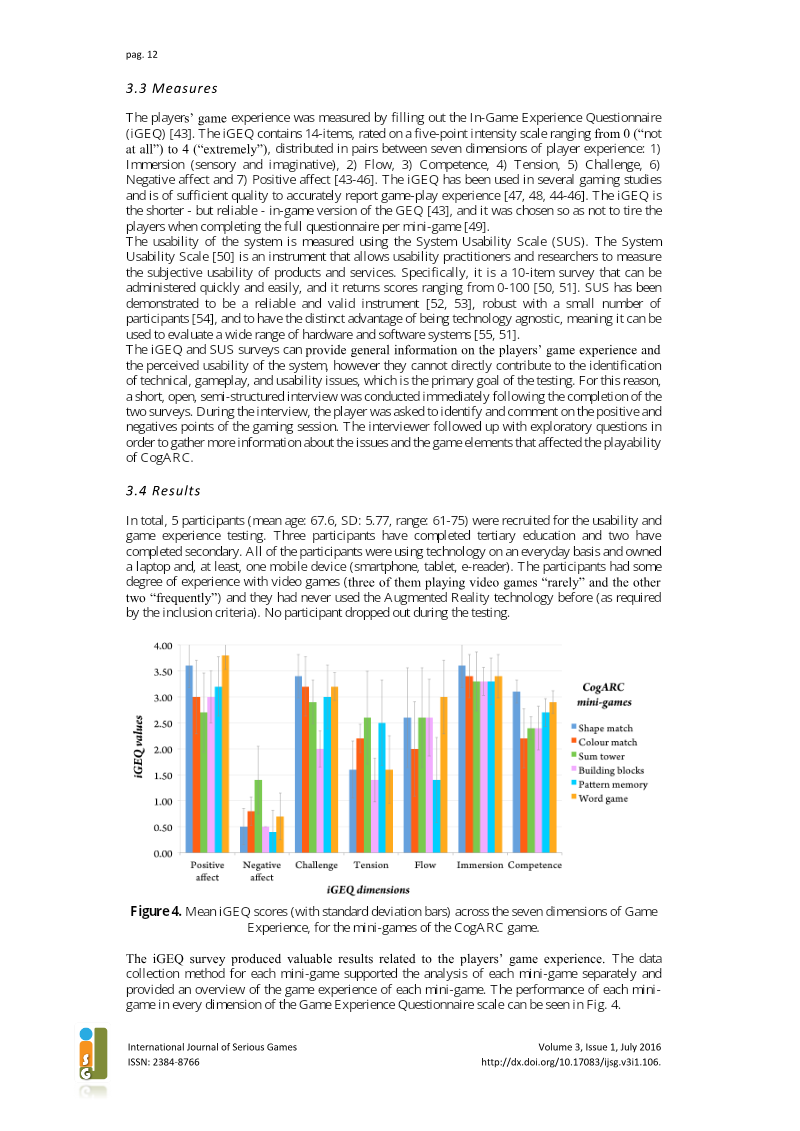
The Cognitive Augmented Reality Cubes (CogARC) system serves as a novel serious gaming platform designed to facilitate cognitive screening and training for elderly populations.
- The CogARC system uses physical cubes and tablet-based augmented reality to provide cognitive screening and training for elderly populations, focusing on memory, attention, and executive processing.
- Preliminary usability testing with elderly participants resulted in a System Usability Scale score of 70.5, indicating a generally positive reception.
- Technical development has migrated to the Unity platform and implemented multi-marker tracking to address persistent issues with latency and marker occlusion.
Accurate Complex Systems Design: Integrating Serious Games with Petri Nets
The integration of Petri Nets with serious game development provides a robust framework for the design and validation of complex systems.
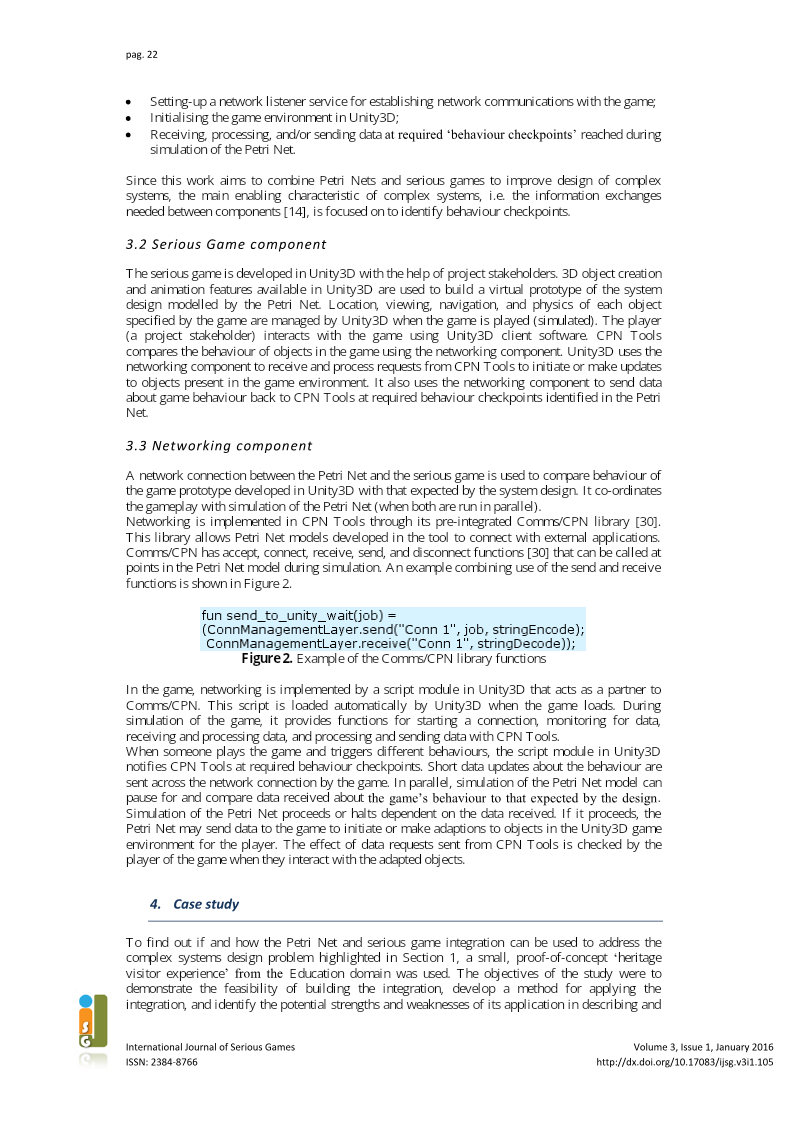
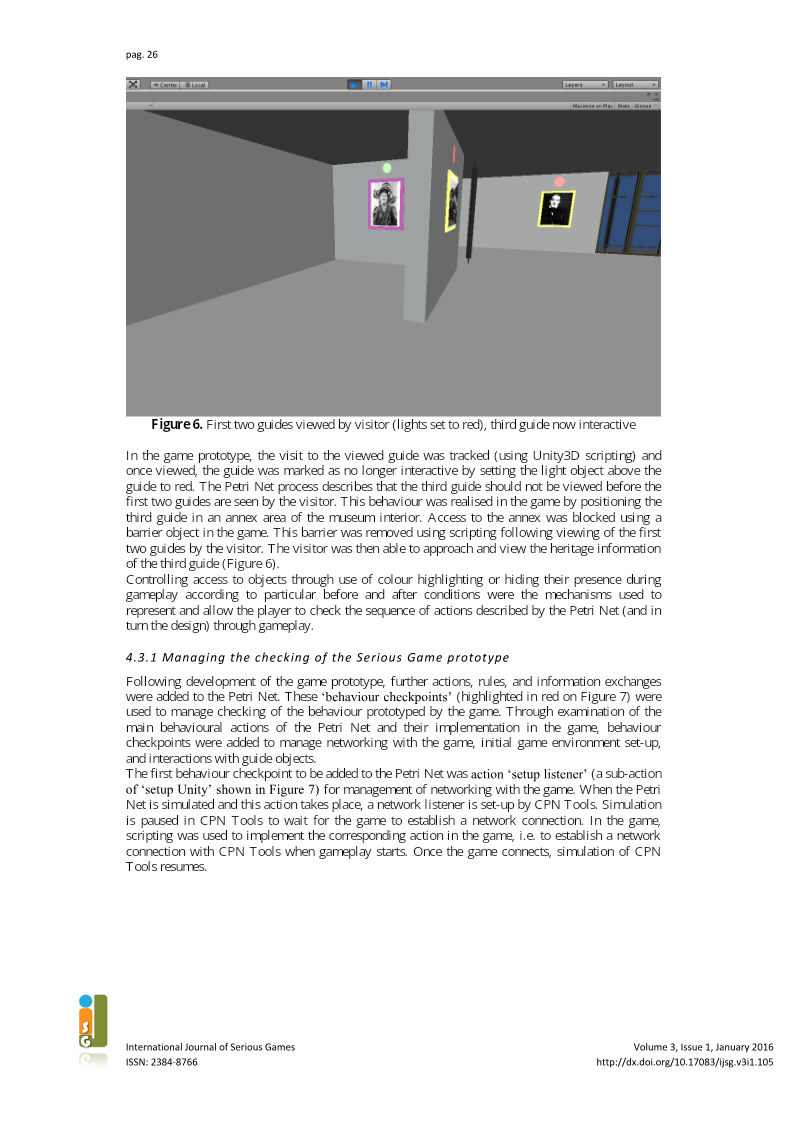
- Integrating Petri Nets with Unity3D creates a hybrid framework that combines rigorous mathematical modeling with immersive prototyping to validate complex system logic.
- Synchronizing Petri Net simulations with game-based environments via behavioral checkpoints allows for the real-time detection of sequencing errors, logic flaws, and missing information.
- This methodology bridges the communication gap between technical developers and non-technical stakeholders by transforming abstract specifications into an interactive, accessible experience.

Enhancing Surgical Team Performance with Game-Based Training
Medical errors in surgical environments are frequently linked to breakdowns in team communication and hierarchical power imbalances.
- The Safe Surgery Trainer (SST) game significantly improved both declarative knowledge and the transfer of communication skills in a study of 141 participants compared to a control group.
- Participants who played the SST game demonstrated a superior ability to apply communication strategies to novel clinical scenarios, indicating the development of accurate mental models for team interaction.
- The study utilized a randomized controlled design to evaluate the game's efficacy in addressing surgical errors caused by communication breakdowns and hierarchical power imbalances.

Framing Serious Games Development as a Matter of Business
Serious games development is fundamentally shaped by the interplay between product design and business strategy.
- Serious games development is inseparable from business strategy, as the need for consistent cash flow and market reach directly dictates a game's design, narrative, and functional maturity.
- Developers operate on a 'pendulum' model, oscillating between creating highly specific, client-tailored versions and generic, scalable frameworks to balance customization with market growth.
- Consultancy-based firms prioritize bespoke, high-touch solutions that ensure quality control but face inherent limitations in scalability.

Playing with History's Otherness: A Framework for Exploring Historical Games
This paper by Manuel Alejandro Cruz Martínez offers a provisional framework for analysing historical video games through the lens of identity and alterity, drawing on the anthropological work of Gerd Baumann and Andre Gingrich.
- The paper offers a provisional framework for analysing historical video games through identity and alterity, drawing on anthropologists Gerd Baumann and Andre Gingrich, and argues that deconstructing history this way is a necessary step to understand how games represent the past.
- The same critical approach can guide the design of subversive historical games that challenge dominant narratives and open space for marginalised or subaltern histories.
- The medium's interactivity and capacity to foster empathy may complicate conventional ideas about who makes history.



Public History, Game Communities and Historical Knowledge
Nick Webber's paper argues that scholarly attention to historical games has focused too narrowly on the historical content encoded within game design, and that the more significant site of historical thinking lies in the communities that form around games, particularly persistent massively multiplayer online games.
- Nick Webber argues that scholarly focus on historical games has been too narrow, concentrating on historical content in game design when the more significant site of historical thinking is the communities that form around games, especially persistent MMOGs.
- The paper frames a tension between historians, who prioritise "what we know" through disciplined analysis of evidence, and publics, who often prioritise "why" the past matters in the present, and proposes public history as a way to reconcile the two.
- The central case study is EVE Online, a science-fiction MMOG with more than 300,000 players on a single server and thirteen years of history at the time of writing, whose sandbox design lets player alliances of thousands produce a persistent, politically complex past.
A History of Voice Interaction in Games
This paper traces the history of voice interaction in digital games, arguing that the modality has long been promised as a natural form of play while remaining marginal in practice.
- Voice interaction in games has long been promised as a natural form of play yet has remained marginal in practice, a tension the paper examines through platform studies and the constraints platforms place on voice input.
- The earliest identified voice-controlled game is Voice-Chess, built on the Hearsay-I speech understanding system in 1973, and 1960s computer science research used simple games as test cases because a limited, standardised vocabulary made recognition tractable.
- Ambitious early-1980s speech add-ons such as the Halcyon console and the Atari Voice Commander never reached mass production after the 1983 North American video game crash, while Japan's Famicom microphone, largely unused and omitted from the international NES, found a modest niche in titles like The Legend of Zelda and Kid Icarus.

Towards Normative Validity in the Evaluation of Game-Based Learning
This paper argues that evidence-based research on digital game-based learning (DGBL), while methodologically rigorous, is insufficient on its own for guiding educational decisions, and that researchers must also attend to normative validity, asking whether they are measuring what is actually valued in education.
- Evidence-based DGBL research, though methodologically rigorous, is insufficient on its own to guide educational decisions; researchers must also assess normative validity, i.e., whether they measure what education actually values.
- Media comparison studies struggle to select representative games, define appropriate control conditions, and control for the many contextual variables present in classrooms.
- Value-added studies isolate specific game mechanics but often rely on self-developed games of lower quality than commercial titles, ignore interactions among design elements, and are slow relative to fast-changing technology.

BioGraphr: Science Games on a Biotic Computer
BioGraphr is a tabletop biotic computing platform that uses roughly one million phototactic Euglena cells in a 3 mm micro-aquarium to generate bioconvection patterns in response to projected light.
- BioGraphr is a tabletop biotic computing platform in which roughly one million phototactic Euglena cells in a 3 mm micro-aquarium generate bioconvection patterns in response to projected light, with a tablet camera closing the loop between players and living organisms.
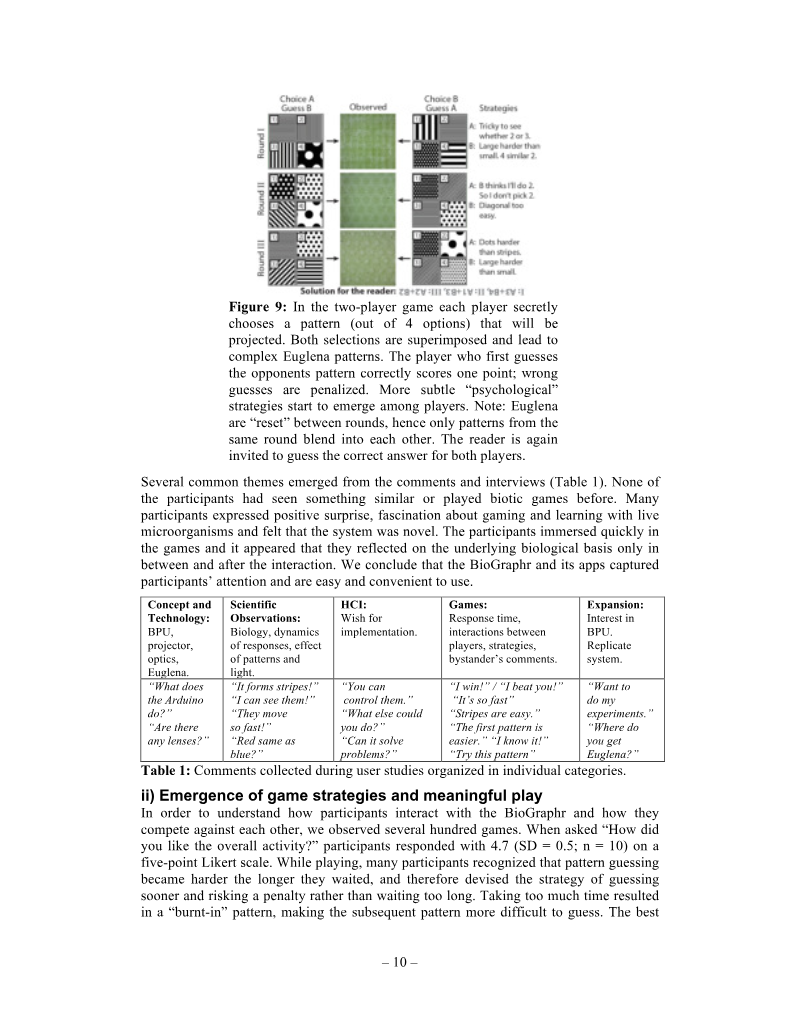
- Across 43 participants, two prototype games (a one-player pattern-guessing game and a two-player game) were rated 4.7/5 (n=10), and players developed strategies such as rapid guessing to avoid burnt-in patterns and choosing hard-to-recognize patterns for opponents.
- Players measurably improved with repeated play: completion time fell from 38.8 s to 30.3 s and errors dropped from 9 to 2 (p < 0.001).