1 free read left. Create a free account for unlimited reading + AI research.
Create free accountWhitepaper DiGRA
1 free read left. Create a free account for unlimited reading + AI research.
Create free accountWhitepaperDiGRA
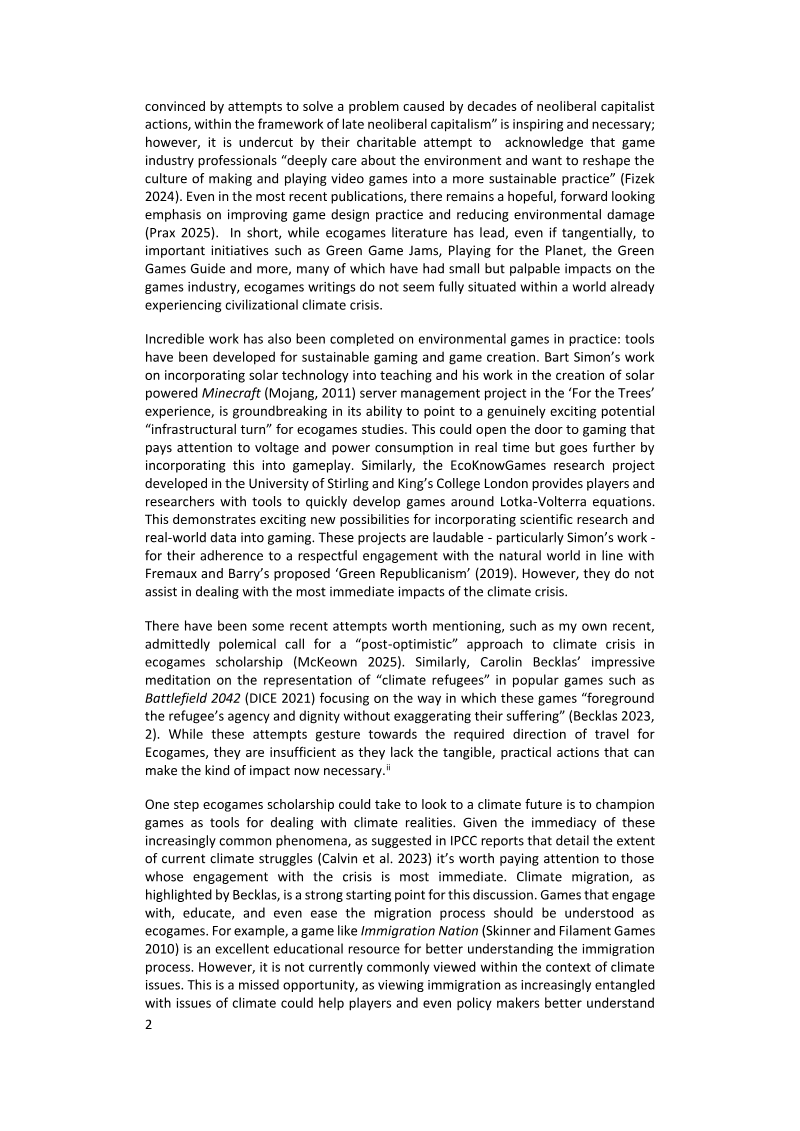
The paper traces voice interaction in digital games and argues the modality has been promised as natural while remaining marginal in practice.
This paper traces the history of voice interaction in digital games, arguing that the modality has long been promised as a natural form of play while remaining marginal in practice. Adopting a platform studies approach, the authors examine how game platforms have enabled and constrained voice input, and how these constraints have shaped design patterns over time. The historical account is organised into six overlapping phases, beginning with 1960s computer science research, in which simple games served as test cases for speech recognition because they could be controlled with a limited, standardised vocabulary. The earliest example identified is Voice-Chess, built on the Hearsay-I speech understanding system in 1973.
The paper traces a commercial attempt in the early 1980s, when speech recognition add-ons were developed for several home computers and consoles. Ambitious projects such as the Halcyon console and the Atari Voice Commander failed to reach mass production after the 1983 North American video game crash. A more modest version of voice input found success in Japan through the Famicom, whose controller microphone was largely unused and omitted from the international Nintendo Entertainment System, though it featured in titles such as The Legend of Zelda and Kid Icarus. The authors identify a stylistic divergence in subsequent decades: Japanese developers favoured two-way conversational interaction with characters, while North American developers mainly used one-way voice commands. Karaoke is highlighted as the genre that achieved the broadest success, valued for its social role.
The paper credits the Microsoft Kinect with bringing voice interaction close to ubiquity, largely because built-in speech support removed the need for developers to build their own recognition software. The most recent phase is marked by independent developers producing voice-enabled games and mods for computers and mobile phones, which the authors find to engage more deeply with the design challenges specific to voice in games.
DiGRA · 2026
DiGRA · 2003