Retention reports and market data
Documents

LiveOps Secrets Revealed: How Top Game Developers Drive Success
Effective LiveOps strategies in mobile gaming rely on three core pillars: the ability to deploy content updates without client-side changes, sophisticated player segmentation, and a robust, data-driven analytics infrastructure.
- Successful LiveOps requires the technical capability to deploy content, events, and shop offers instantly without requiring client updates or server maintenance.
- Player segmentation is essential for personalization; developers should offer targeted discounts or rewards based on individual player history, such as rewarding lapsed spenders or celebrating specific gameplay milestones.
- LiveOps strategy involves balancing revenue-focused offers with retention-focused rewards, using multivariate testing to find the optimal ratio between game difficulty and reward value for different player segments.

Why Every Game Needs A Creator Program
Modern live-service games increasingly rely on creator programs as foundational pillars for long-term growth, shifting the focus from traditional influencer marketing toward sustainable, performance-based ecosystems.
- Creator programs are shifting from ad-hoc influencer marketing to performance-based ecosystems that drive player retention, reactivation, and conversion of free users into high-value customers.
- Revenue-sharing models using integrated creator codes allow even creators with modest audiences to generate significant revenue, serving as a vital link between community engagement and direct-to-consumer web shops.
- Scaling these programs requires moving away from manual processes toward automated infrastructures to handle the administrative complexities of global payouts, tax compliance, and performance tracking.
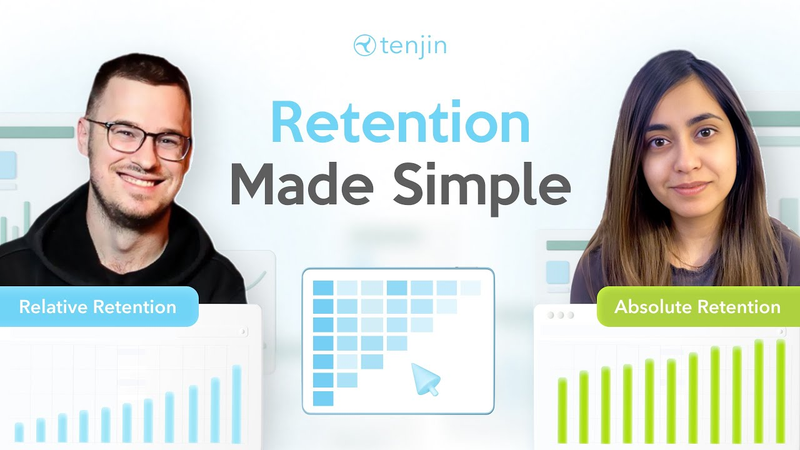
Mobile App Retention: The Critical Difference Developers Miss
Mobile app retention analysis relies on two distinct cohort methodologies—absolute and relative—which significantly impact how publishers interpret user behavior and evaluate campaign performance.
- Absolute retention tracks users by calendar day, while relative retention measures activity based on a strict 24-hour window following the exact moment of installation.
- Absolute retention typically yields higher figures than relative retention because it counts any return visit on a subsequent calendar day, whereas relative retention requires a full 24-hour cycle.
- Relative retention is the preferred metric for user acquisition analysis as it eliminates time-zone-based noise to provide a more accurate signal of engagement.

How do Playtika and Wooga nail their Live Ops strategies?
Successful Live Ops strategies in the modern casual gaming market rely on a layered framework that integrates social interaction, engagement mechanics, and data-driven monetization.
- Top-performing casual games now utilize collectible frameworks, such as albums and multi-stage missions, in 75 percent of titles to unify progression and reduce player cognitive overload.
- Successful Live Ops strategies are shifting from large-scale clan structures to intimate, one-on-one partnerships that leverage social accountability and psychological triggers like the prisoner’s dilemma.
- Monetization models have evolved from static purchasing to gamified, effort-based bundles that are dynamically tailored to a player’s specific progression stage.
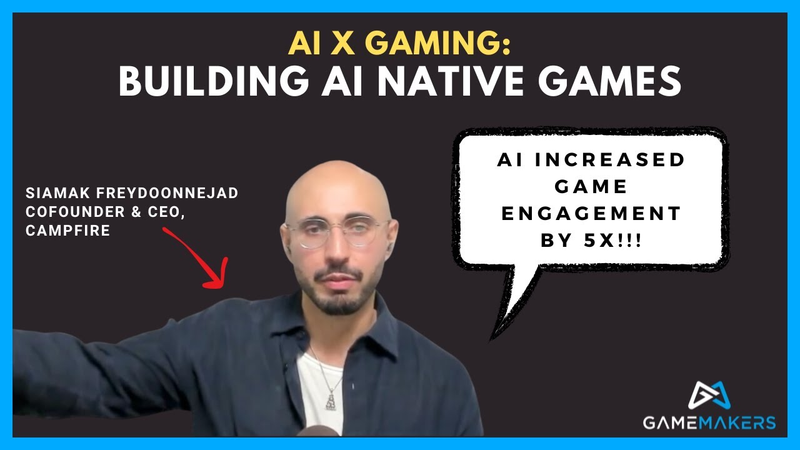
How AI Increased Game Engagement By 500%
The gaming industry is undergoing a fundamental shift toward AI-native development, where generative technology serves as the primary driver of player engagement rather than a peripheral feature.
- Campfire discovered that players spent five times longer interacting with AI companions than engaging with traditional game mechanics, a finding that shifted the company's focus toward AI-native gaming.
- The company developed Sprites.AI as a toolset to simplify AI agent creation, allowing developers to manage personality traits, memory, and conversational flows without needing deep expertise in complex AI building blocks like RAG or Chain of Thought.
- To address the stochastic nature of AI outputs, Campfire implemented a monitoring framework that qualitatively analyzes agent performance to ensure interactions remain engaging and fun for users.
How To Design A Loyalty Program That Players Love
The mobile gaming industry is increasingly defined by the need for sophisticated, experiential loyalty programs that transcend simple transactional rewards.
- IP and brand collaborations are critical for growth, as 20% of players cite them as a factor for installation and retention, while over 50% of those who engage with these events make related in-app purchases.
- Loyalty programs must transition from simple transactional models, like punch cards, to experiential frameworks that prioritize player status, exclusivity, and community building.
- Developers should treat all users as valuable contributors, recognizing that players who provide time, social interaction, and ad engagement are essential to the ecosystem and deserve rewards.
Mobile Gamers Have More Choice Than Ever—Here’s How to Keep Them Loyal, Playing, and Paying
The mobile gaming landscape is currently defined by extreme market saturation, necessitating a strategic shift from aggressive user acquisition toward long-term retention and monetization optimization.
- To maximize monetization, studios must align ad creative and in-app messaging with specific player personas and behavioral motivations rather than relying on generic acquisition strategies.
- Approximately 75% of mobile gamers conduct research, such as checking community feedback and reviews, before deciding to download a new game, making social proof a critical component of user acquisition.
- Direct-to-consumer web shops are a growing revenue channel, with 26% of players open to visiting them for exclusive deals and 8% of spenders having already completed a purchase through these platforms.
Exploring Path of Exile2: Pay for Convenience & Comfort
Path of Exile 2 has entered Early Access with substantial momentum, reaching a peak of over 578,000 concurrent players on Steam.
- Path of Exile 2 launched into Early Access with significant market impact, achieving a peak of over 578,000 concurrent players on Steam.
- The game utilizes a free-to-play monetization model that avoids pay-to-win mechanics, focusing instead on cosmetic microtransactions and utility-based purchases like specialized stash tabs.
- Developers have implemented a 10% reduction in mechanical density compared to the original title to improve accessibility while maintaining the franchise's hardcore design philosophy.
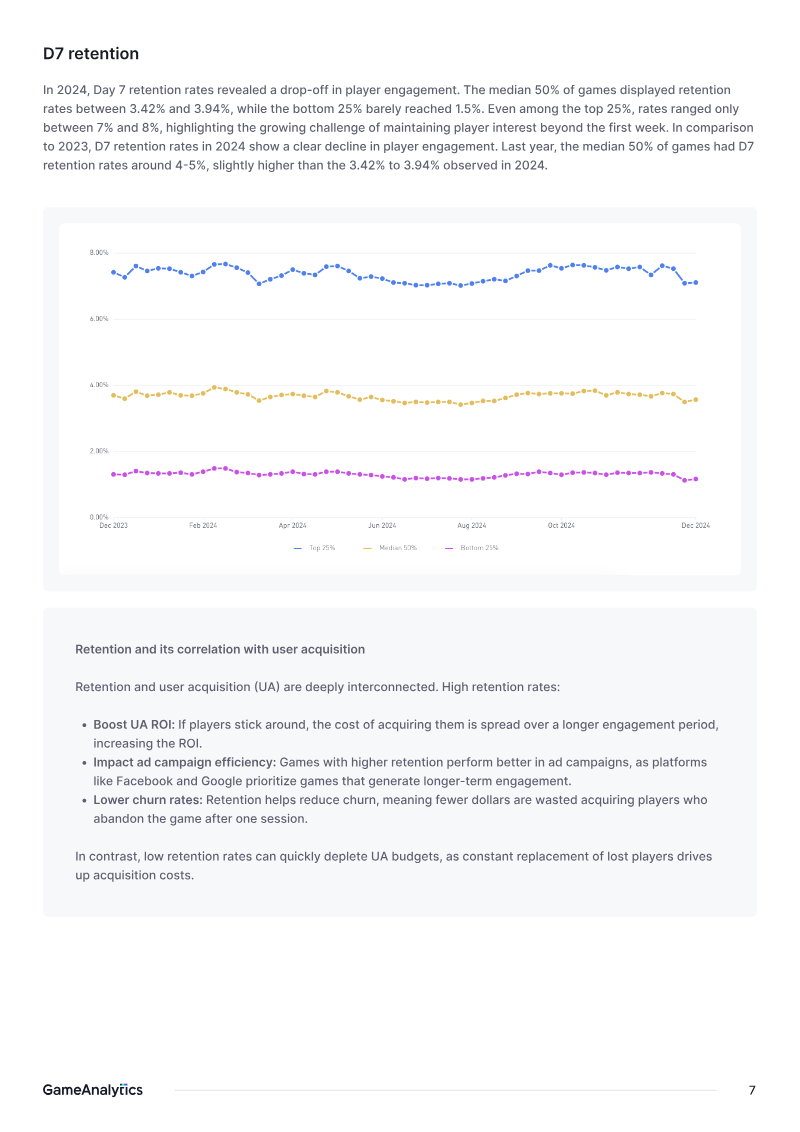

Mobile Gaming Benchmarks 2025
Mobile Gaming Benchmarks 2025 delivers a comprehensive, data-driven reference for developers seeking to refine acquisition, monetization and content strategies across the global mobile market.
- Retention is the primary driver of long-term engagement, revenue, and user acquisition ROI across the 11,600 titles analyzed.
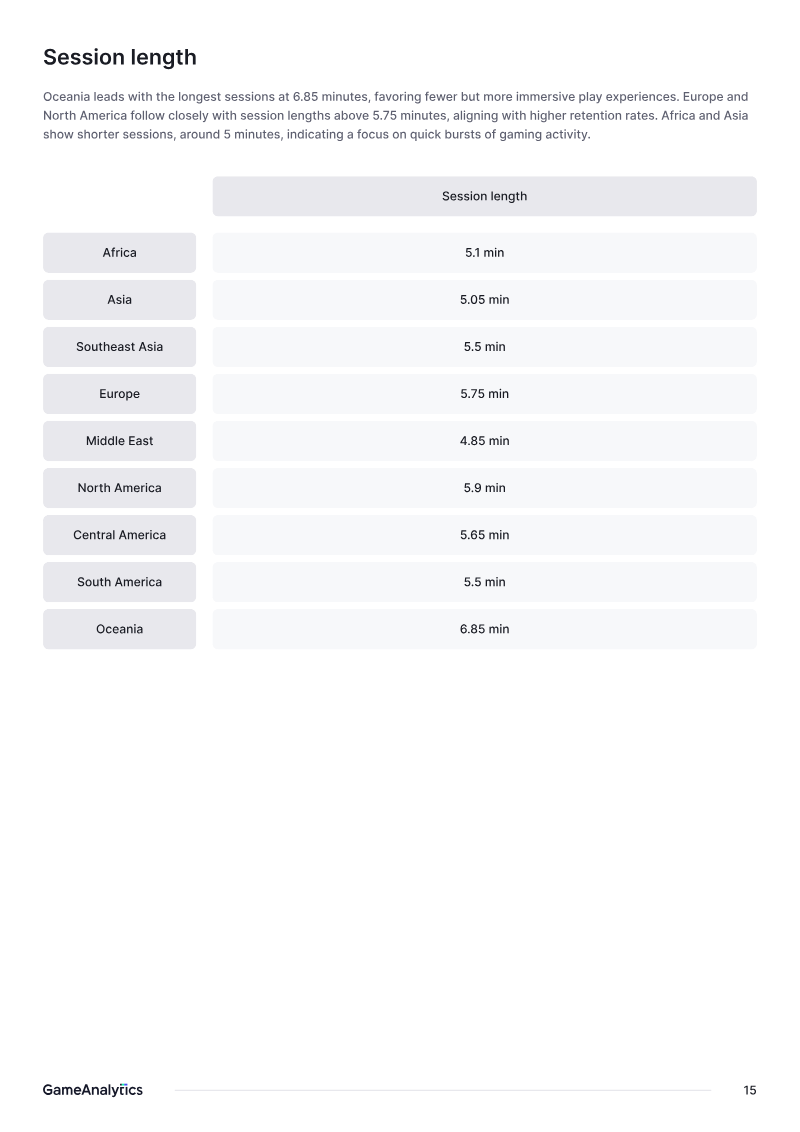
- Average session lengths have decreased, with top-tier games averaging 8–9 minutes and median-tier games averaging 5–6 minutes.
- Midcore titles lead in engagement frequency, generating six to seven sessions per day.
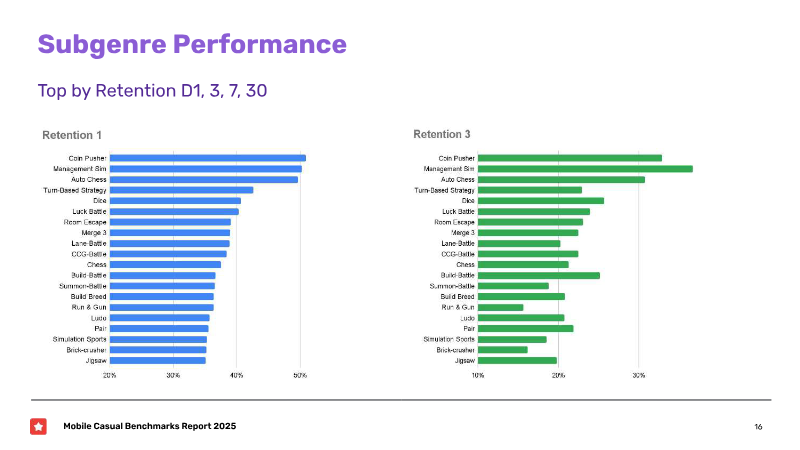

Mobile Casual Benchmarks Report 2025
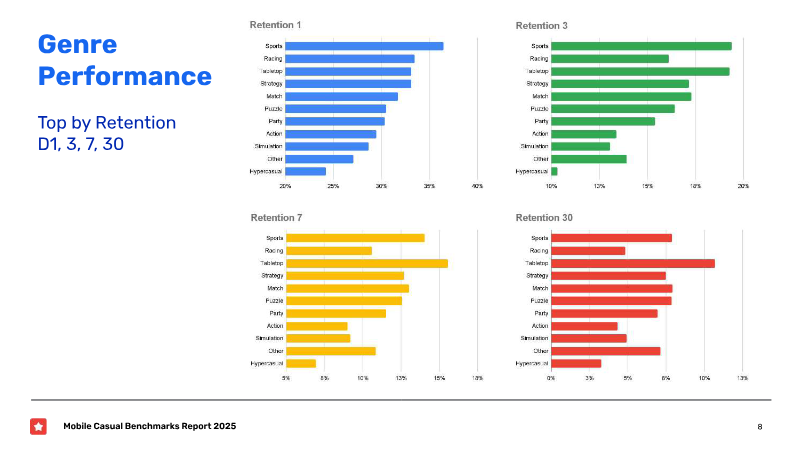
The 2025 Mobile Casual Benchmarks Report provides a comprehensive analysis of the Android gaming market, focusing on performance metrics across various casual genres and subgenres.
- Hybrid casual games are significantly more profitable than hypercasual models, with top subgenres like Merge 3, Luck Battle, and Life Simulator achieving ARPU figures between $11.08 and $14.83.
- Pure hypercasual and simulation games suffer from poor long-term sustainability, characterized by low 30-day retention rates of approximately 3% and an ARPU of only $0.79.
- Merge 3 games demonstrate high player engagement, leading all subgenres with an average session duration of 656 seconds.
Retention Radar
The global mobile ecosystem is entering a period of maturation characterized by a 2.3% decline in installs, necessitating a strategic pivot from aggressive user acquisition toward sophisticated retention models.
- A 10% improvement in user retention can drive profit increases of up to 90%, making retention a more critical financial lever than aggressive user acquisition in a market seeing a 2.3% decline in installs.
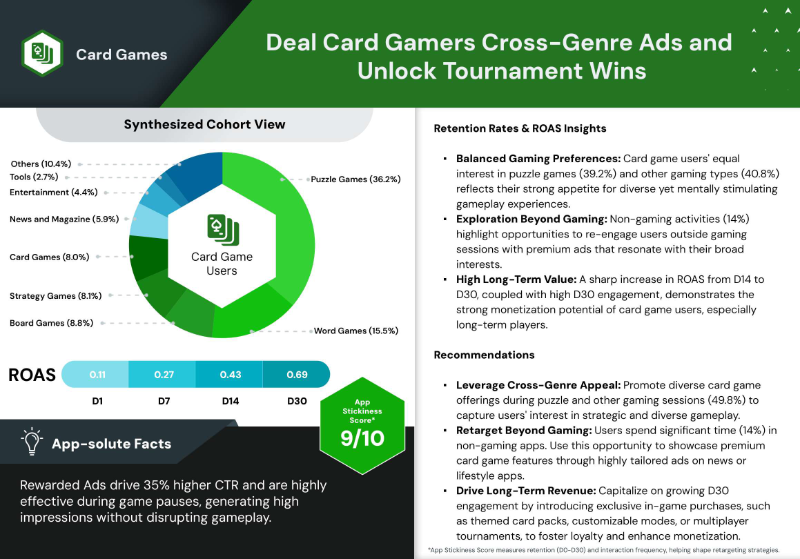
- Simulation games demonstrate the value of long-term engagement by achieving a threefold increase in Return on Ad Spend (ROAS) by the thirtieth day of player activity.
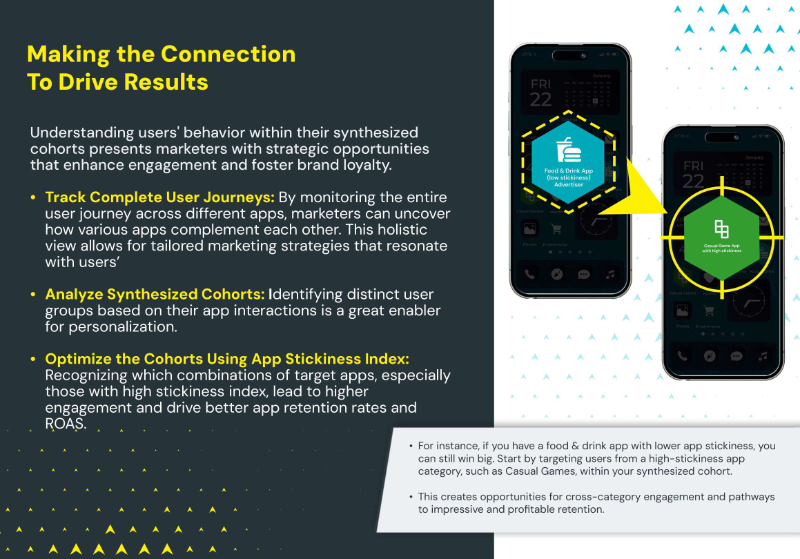
- Targeting 'synthesized cohorts'—clusters of interconnected apps based on shared user habits—is more effective than siloed marketing, especially given that RPG players show a 40.2% engagement rate with non-gaming applications.
2025 State of Mobile Gaming: In-App Purchase Trends of Leading Apps
The 2025 State of Mobile Gaming report analyzes the transition of the mobile gaming industry into a new growth phase characterized by refined monetization and sophisticated user acquisition.
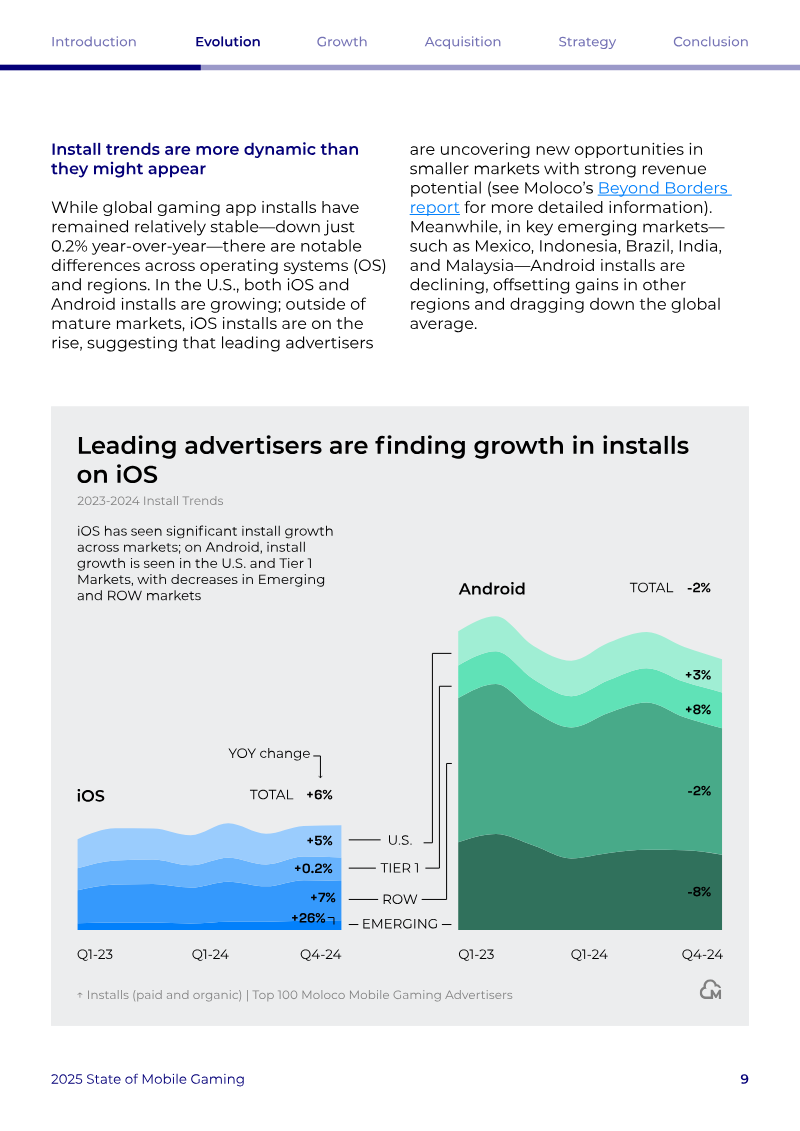
- Global IAP revenue grew by 4% in 2024 despite flat install volume, driven by a 6% increase in both install-to-payer conversion rates and Day 90 ARPPU.
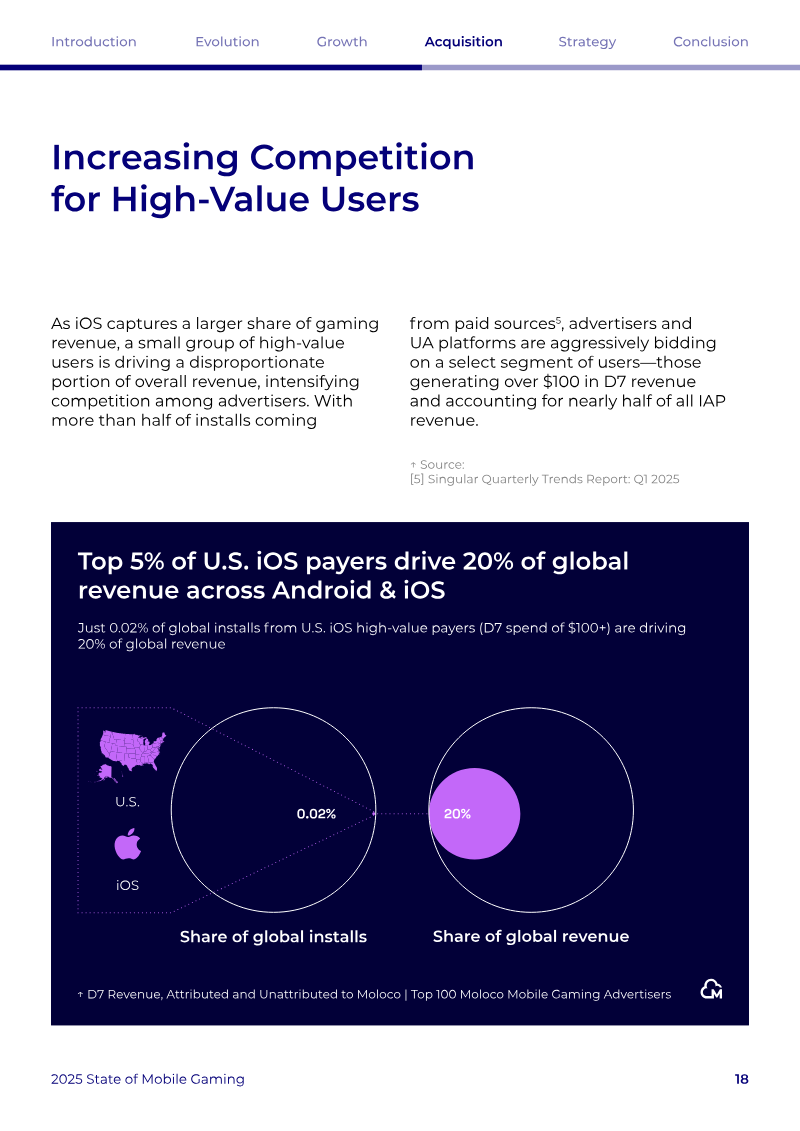
- The top 5% of players generate 48% of total revenue, with a hyper-niche segment of U.S. iOS users (0.02% of global installs) accounting for 20% of all global gaming revenue.
- Competition for high-value spenders has intensified, causing bid prices for the top 1% of iOS users to surge by 140% year-over-year.